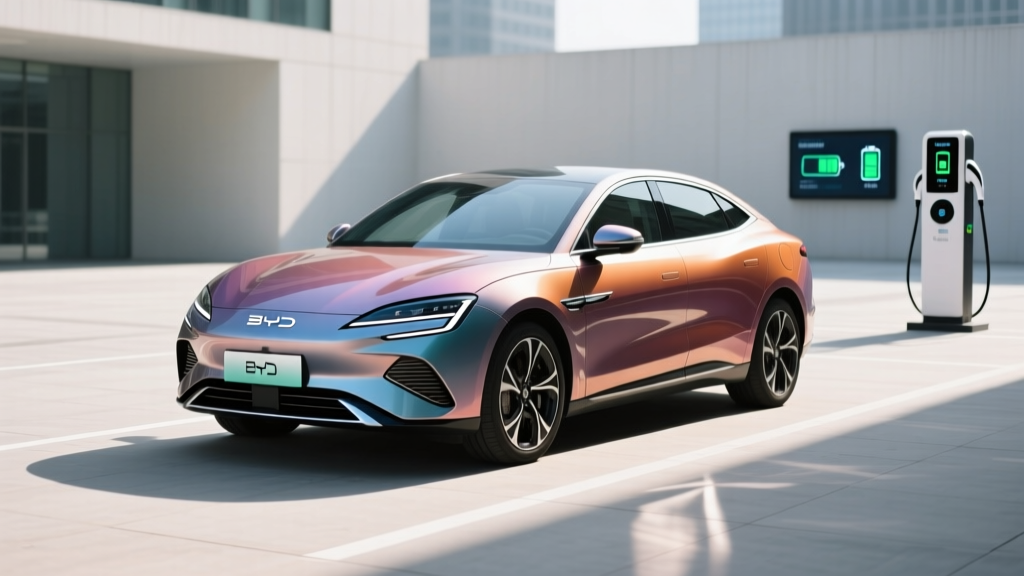
BYD's expansion into Europe has been one of the most aggressive EV rollouts of the decade. Models like the Atto 3, Seal, and Dolphin have undercut legacy European automakers on price while delivering competitive range and build quality. But a growing chorus of European buyers and reviewers has flagged a specific set of software omissions: the EU-spec BYD lineup is missing features like Sentry Mode-style surveillance, true remote parking, and the full version of BYD's DiPilot advanced driver-assistance suite that Chinese-market buyers take for granted.
If you've searched for answers on BYD EU version missing features Sentry Mode remote parking DiPilot and come up short, you're not alone. This review breaks down exactly what's absent from European BYD models, why those gaps exist, and whether the hardware underneath still makes these cars worth buying in 2026.
BYD Atto 3 (EU Spec): Core Specifications at a Glance
Before we dissect the software gaps, let's establish the baseline hardware. The 2026 BYD Atto 3 (known as the Yuan Plus in China) remains BYD's volume seller in Europe. Here are the numbers that matter:
| Specification | BYD Atto 3 (EU, 2026) |
|---|---|
| EPA-Equivalent Range (WLTP) | 261 mi (420 km) |
| Real-World Highway Range | ~210–230 mi |
| Real-World Cold-Weather Range | ~175–195 mi (below freezing) |
| Battery Capacity | 60.48 kWh usable |
| Battery Chemistry | LFP (Lithium Iron Phosphate) — BYD Blade |
| Max DC Fast Charge | 88 kW peak |
| 10–80% DC Charge Time | ~29 minutes |
| Level 2 AC Charge Rate | 11 kW (~37 mi/hr) |
| Motor Output | 201 hp (150 kW), FWD |
| 0–62 mph (0–100 km/h) | 7.3 seconds |
| Efficiency (WLTP) | 160 Wh/km (~26 kWh/100 mi) |
| Cargo Volume | 15.6 cu ft (rear seats up) / 46.1 cu ft (folded) |
| Rear Legroom | 35.8 inches |
| Battery Warranty | 8 years / 100,000 mi (70% capacity retention) |
| Vehicle Warranty | 6 years / 93,000 mi |
| Base MSRP (EU) | €37,990 (~$41,200 USD) |
The Missing Features: What EU BYD Owners Don't Get
Here's the core of the frustration. Chinese-market BYD vehicles ship with a significantly more feature-rich software stack than their European counterparts. The three most-cited omissions are:
1. No Sentry Mode (Parked Surveillance Recording)
Tesla's Sentry Mode — which uses the car's cameras to record surroundings when parked and alerts the owner to impacts or suspicious activity — has become a benchmark feature that EV buyers expect. The Chinese-market Atto 3 and Seal include a 360-degree camera system with dashcam recording capabilities that can function similarly when parked.
The EU-spec BYD models retain the 360-degree camera hardware for low-speed maneuvering, but the parked surveillance and motion-detection recording functionality is disabled. BYD has not publicly detailed why, but the likely explanation is a combination of EU GDPR (General Data Protection Regulation) restrictions on continuous public-space recording and the cost of certifying a surveillance feature under European type-approval regulations. Without a dedicated "Sentry" mode, owners must rely on aftermarket dashcams with parking-mode functionality for equivalent protection.
2. Remote Parking Is Limited or Absent
In China, BYD's higher-trim models (especially the Seal and Han) offer remote-controlled parking via the BYD app — the car can pull itself into or out of a tight space while the driver stands outside using a smartphone as a controller. This is a Level 2 automation feature that competitors like BMW (Remote Parking), Hyundai (Remote Smart Parking Assist), and Tesla (Smart Summon) offer in various markets.
EU-spec BYD models do not currently offer app-based remote parking. The vehicles include front and rear parking sensors and a 360-degree camera view, but the driver must be inside the car and behind the wheel for all parking maneuvers. BYD Europe has acknowledged the gap in press briefings but has not committed to a timeline for an over-the-air (OTA) update to enable it. Regulatory hurdles around remote-controlled vehicle movement on public roads in the EU are the primary barrier.
3. DiPilot ADAS Is Significantly De-Contented
DiPilot is BYD's branded suite of driver-assistance features. In China, DiPilot on the Atto 3 and Seal includes:
- Adaptive cruise control with stop-and-go
- Lane centering assist (Level 2)
- Traffic jam assist
- Automatic emergency braking with pedestrian/cyclist detection
- Blind-spot monitoring with rear cross-traffic alert
- Navigation-piloted driving (highway lane changes and on/off-ramp assist on select models)
- Automatic parking assist (in-car, button-initiated)
The EU-spec DiPilot retains adaptive cruise, lane centering, AEB, and blind-spot monitoring. However, navigation-piloted highway driving, automatic parking assist, and certain traffic-jam-assist behaviors are either absent or significantly restricted. The lane-centering system in EU cars is also tuned more conservatively — it disengages more readily and applies less assertive steering torque than the Chinese version, which European reviewers have noted feels less confident on curved motorways.
Why the Feature Gap Exists
The missing features aren't a case of BYD cutting corners to save cost. Three structural factors explain the divergence:
Regulatory fragmentation: The EU's type-approval framework (UN R157 for automated lane-keeping, GDPR for data collection) imposes certification requirements that don't exist — or are less restrictive — in China. Enabling remote parking or camera-based surveillance in Europe requires separate software validation, data-handling compliance, and in some cases hardware modifications.
Localization cost vs. timeline: BYD prioritized getting vehicles into European showrooms quickly to capture market share during the 2023–2026 expansion window. Fully localizing every software feature for EU regulations would have delayed launches by 12–18 months per model. BYD chose to ship with a compliant-but-reduced feature set and add capabilities via OTA updates as certifications clear.
Liability and insurance landscape: European insurers and regulators are still defining liability frameworks for remote-controlled and semi-autonomous parking features. Until those frameworks solidify, automakers — not just BYD — are cautious about enabling them.
Charging Performance: The 88 kW Bottleneck
Charging speed is where the Atto 3's LFP Blade battery reveals its most significant real-world limitation. Here's how it compares to the segment:
| Charging Level | BYD Atto 3 (EU) | Segment Benchmark (Hyundai Ioniq 5) |
|---|---|---|
| Level 1 (120V / 2.3 kW) | ~8 mi/hr | ~8 mi/hr |
| Level 2 (240V / 11 kW) | ~37 mi/hr | ~37 mi/hr |
| DC Fast Charge (Peak kW) | 88 kW | 240 kW (800V architecture) |
| 10–80% DC Charge Time | ~29 minutes | ~18 minutes |
| Sustained Charge Rate (20–60%) | ~70–80 kW | ~180–220 kW |
The Atto 3 peaks at 88 kW on DC fast chargers and sustains roughly 70–80 kW through the 20–60% state-of-charge window before tapering. A 10–80% session takes about 29 minutes at a capable 150+ kW charger. That's adequate for planned stops but noticeably slower than 800-volt competitors like the Hyundai Ioniq 5, Kia EV6, or Porsche Taycan, which can recover 200+ miles in under 20 minutes.
The LFP Blade battery's thermal characteristics contribute to this. LFP cells have higher internal resistance than NMC at high charge rates, which limits peak kW acceptance. BYD has not implemented the aggressive battery preconditioning routines that Tesla and Hyundai use to warm the pack before a fast-charge session, further limiting real-world charge speeds in cold weather.
Pricing, Tax Credits, and Value Proposition
For US readers evaluating BYD as a potential future import (BYD does not currently sell passenger vehicles in the United States), or for European buyers comparing against the competition, here's the pricing context:
| Model / Trim | EU MSRP | Approx. USD |
|---|---|---|
| Atto 3 Comfort (base) | €37,990 | ~$41,200 |
| Atto 3 Design (top) | €40,490 | ~$43,900 |
| Seal (RWD) | €44,990 | ~$48,800 |
| Seal (AWD Excellence) | €49,990 | ~$54,200 |
| Dolphin (Comfort) | €31,490 | ~$34,200 |
US Federal Tax Credit (§30D): Because BYD does not sell passenger vehicles in the US market as of 2026, these models are not eligible for the IRS §30D federal EV tax credit. Even if BYD entered the US market, eligibility would depend on meeting MSRP caps ($55,000 for sedans, $80,000 for SUVs/vans), buyer income limits ($150,000 single / $300,000 joint AGI), and critical-mineral/battery-component sourcing requirements under current IRS rules. BYD's vertically integrated Chinese supply chain — including CATL and BYD's own battery production — would face significant hurdles meeting the North American sourcing thresholds that §30D requires.
For European buyers, national and local incentives vary widely by country. Germany's Umweltbonus ended in late 2023, while France's bonus écologique has been restructured to favor vehicles with lower carbon footprints across the full lifecycle — a framework that has at times disadvantaged Chinese-manufactured EVs. Check your national transport ministry for current incentive availability.
Pros, Cons, and the Verdict
Pros
- Competitive pricing — undercuts VW ID.4 and Tesla Model Y in Europe
- LFP Blade battery offers excellent cycle life and thermal stability
- Strong build quality and materials for the price point
- Generous 8-year / 100,000-mi battery warranty
- Standard heat pump across EU trims
- Spacious rear seat (35.8" legroom) for the compact crossover segment
Cons
- No Sentry Mode or parked surveillance recording
- No remote/app-controlled parking
- DiPilot ADAS de-contented vs. Chinese market
- 88 kW peak DC charging is slow for the segment
- WLTP range (261 mi) trails competitors; real-world highway is ~210–230 mi
- Infotainment UI translation and responsiveness lag behind rivals
- Not available in the US market
Who Should Buy a BYD in Europe — And Who Shouldn't
Buy if: You're a European urban commuter who values price-per-mile efficiency, wants a well-built compact crossover, and doesn't rely on the latest ADAS features. The Atto 3 and Dolphin are strong value plays for city and suburban driving where the LFP battery's longevity and lower cost shine. If you charge at home overnight and rarely take trips exceeding 180 miles without a planned stop, the range and charging speed are perfectly manageable.
Pass if: You prioritize cutting-edge driver-assistance features, need fast DC charging for regular long-distance motorway travel, or want Tesla-level software polish (Sentry Mode, app-based remote features, OTA-delivered novelty functions). Buyers who frequently drive 300+ mile routes in winter will find the Atto 3's 175–195 mile cold-weather range limiting, and the 29-minute 10–80% charge time adds noticeable downtime compared to 800V competitors.
Frequently Asked Questions
Will BYD add Sentry Mode or remote parking to EU models via OTA?
BYD Europe has not confirmed a timeline for enabling either feature. Remote parking faces regulatory barriers in many EU member states, and Sentry Mode-style recording must comply with GDPR data-handling requirements. Some features may arrive in future model years with updated hardware and software certifications, but current owners should not count on retroactive enablement.
Is the EU-spec DiPilot safe to use?
Yes — what's included (adaptive cruise, lane centering, AEB) meets Euro NCAP requirements and functions reliably within its design limits. However, it is an SAE Level 2 system requiring constant driver supervision. The reduced assertiveness of lane centering compared to the Chinese spec means you'll need to intervene more frequently on curves and in construction zones.
How does BYD's LFP Blade battery compare to NMC competitors?
LFP (lithium iron phosphate) offers superior cycle life (3,000+ full cycles before significant degradation vs. ~1,500–2,000 for NMC) and better thermal stability — it's far less prone to thermal runaway. The trade-off is lower energy density, which is why the Atto 3's 60.48 kWh pack delivers less range than competitors with similarly sized NMC packs. LFP also handles regular 100% charging better than NMC, which simplifies daily charging habits.
Can I buy a BYD in the United States?
Not as of 2026. BYD has not announced US passenger vehicle sales, and current US tariffs on Chinese-manufactured EVs (100% under Section 301 as of 2024, maintained through 2026) make a near-term US launch economically unviable. BYD does sell electric buses and commercial vehicles in the US, but consumer models like the Atto 3, Seal, and Dolphin remain unavailable.
What's the real-world range of the BYD Atto 3 on the highway?
Expect approximately 210–230 miles at motorway speeds (70–80 mph) in moderate temperatures. In winter conditions below 32°F (0°C), range drops to 175–195 miles. These figures account for the heat pump's efficiency but reflect the reality that LFP packs lose more usable capacity in cold weather than NMC alternatives. For detailed efficiency data, consult EV Database's independent testing.
Is the BYD Atto 3 worth buying vs. the VW ID.4 or Tesla Model Y?
On pure value, the Atto 3 undercuts both by €5,000–€10,000 in most European markets. However, the VW ID.4 offers faster DC charging (135–175 kW depending on trim), longer real-world range, and a more mature ADAS suite. The Tesla Model Y provides superior software features (Sentry Mode, app ecosystem, Supercharger access) and faster charging. If software features and charging speed are priorities, the Atto 3's price advantage narrows considerably in total ownership experience.
Sources: BYD Europe official specifications, EV Database, IRS §30D Clean Vehicle Credit, Euro NCAP safety assessments.