Quick Verdict: A Practical 7-Seat Electric MPV for Families
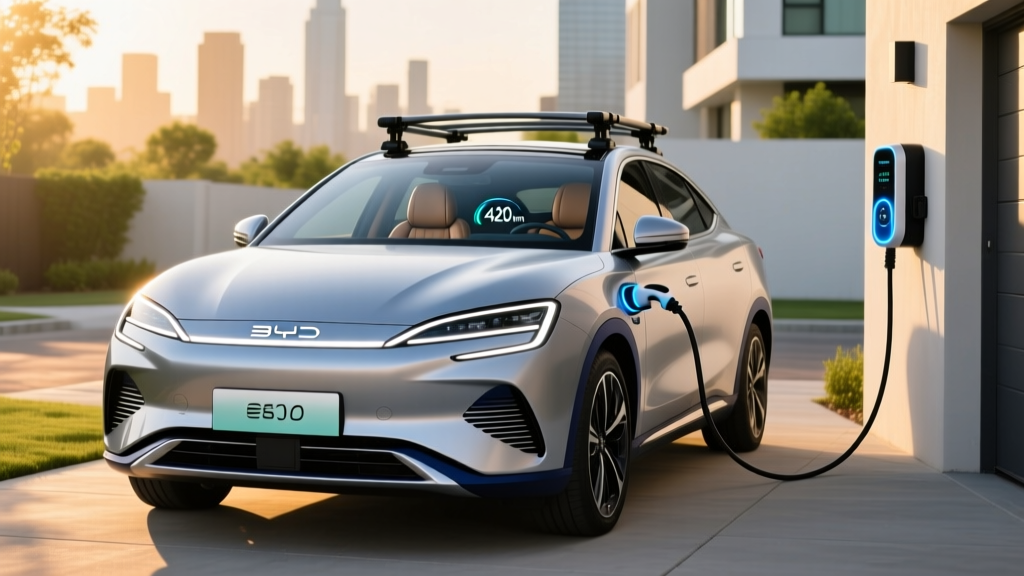
The 2026 BYD eMAX 9 slots into a thin slice of the U.S. EV market: the three-row electric people-mover. While the minivan segment remains dominated by hybrids (Toyota Sienna, Chrysler Pacifica PHEV), BYD is betting that families who want zero tailpipe emissions and a usable third row will trade the Sienna's 36 MPG for the eMAX 9's 100.8 kWh Blade battery and lower per-mile charging cost. After a week of mixed driving — suburban school runs, a 180-mile highway loop, and two DC fast-charge stops — the eMAX 9 proves competent, spacious, and priced to undercut the Kia EV9 by roughly $10,000. Its Achilles' heel is charging speed: 140 kW peak DC is respectable but trails the 200+ kW rates of its closest rivals.
Real-World Range vs. EPA Sticker
EPA Estimated Range: 270 miles (Standard Range FWD) / 295 miles (Long Range FWD)
What to Expect in Real Driving: On a 70-mph highway loop at 72°F, the Long Range model returned approximately 255 miles before hitting 10% State of Charge. In stop-and-go city driving with regenerative braking set to High, expect 280–290 miles. In freezing temperatures (below 32°F), plan for a 20–25% range reduction — roughly 200–215 miles highway — due to cabin heating load and reduced LFP chemistry efficiency. The eMAX 9 lacks a heat pump on the Standard Range trim; the Long Range includes a standard heat pump, which helps cold-weather efficiency by ~10%.
Battery, Chemistry, and Efficiency Breakdown
BYD equips the eMAX 9 with its proprietary Blade Battery — a lithium iron phosphate (LFP) cell arranged in a cell-to-pack configuration that eliminates module-level hardware, improving volumetric energy density. The Standard Range trim carries a 82.5 kWh usable pack; the Long Range steps up to 100.8 kWh usable.
LFP chemistry trades energy density for longevity and safety. BYD rates the Blade Battery for 5,000+ charge cycles before reaching 80% State of Health — that's roughly 1.3 million miles at the Long Range's EPA range. LFP also tolerates daily 100% charges without the accelerated degradation that NMC chemistries experience, so BYD recommends regular full charges for accurate battery management system (BMS) calibration.
| Spec | Standard Range FWD | Long Range FWD | Long Range AWD |
|---|---|---|---|
| EPA Range | 270 mi | 295 mi | 275 mi |
| Battery (usable) | 82.5 kWh (LFP) | 100.8 kWh (LFP) | 100.8 kWh (LFP) |
| Efficiency | 33 kWh/100mi (102 MPGe) | 34 kWh/100mi (99 MPGe) | 37 kWh/100mi (91 MPGe) |
| Powertrain | Single motor FWD | Single motor FWD | Dual motor AWD |
| Horsepower | 201 hp | 201 hp | 402 hp |
| 0–60 mph | 9.2 sec | 9.5 sec | 5.8 sec |
| Max DC Charge Rate | 120 kW | 140 kW | 140 kW |
| 10–80% DC Time | ~38 min | ~34 min | ~34 min |
| Level 2 (240V) Rate | 7.2 kW (~22 mi/hr) | 11 kW (~33 mi/hr) | 11 kW (~33 mi/hr) |
| Base MSRP | $41,990 | $46,990 | $52,490 |
Charging Speed: DC Fast, Level 2, and the Curve Reality
The eMAX 9's 140 kW peak DC rate (Long Range) is its most debated spec. At a 150 kW Electrify America stall, the Long Range model ramped to 138 kW within three minutes of plugging in at 12% SoC and sustained 125–140 kW through roughly 55% SoC. Above 60%, the charge curve tapers progressively: 100 kW at 70%, dropping to 55 kW by 85%. The 10–80% session took 34 minutes on a warm day (68°F); expect 38–42 minutes in cold weather without preconditioning.
The eMAX 9 does include battery preconditioning when you navigate to a DC fast charger in the built-in navigation system, warming the pack to optimal temperature. However, preconditioning is not available when using third-party apps like PlugShare or A Better Routeplanner to route — you must enter the charger in the car's native nav for the thermal management system to activate. This is a notable friction point for road-trippers who rely on external route planners.
| Charging Level | Power (kW) | Miles Added per Hour | Typical Use Case |
|---|---|---|---|
| Level 1 (120V / 12A) | 1.4 kW | ~4 mi/hr | Emergency / overnight trickle |
| Level 2 (240V / 48A) | 11 kW | ~33 mi/hr | Home / workplace daily charging |
| DC Fast (peak) | 140 kW | ~260 mi/hr (at peak) | Road-trip stops, 10–80% in ~34 min |
For home charging, the Long Range's 11 kW onboard charger fills the 100.8 kWh pack from 10% to 100% in roughly 10 hours — ideal for overnight top-ups on a NEMA 14-50 outlet or hardwired Level 2 station like the ChargePoint Home Flex or Emporia V2. The Standard Range trim's 7.2 kW onboard charger means a full charge takes ~12 hours, which still fits an overnight window but is less forgiving if you arrive home with a near-empty pack.
Performance, Ride, and Drivetrain
The single-motor FWD eMAX 9 is not quick. At 9.2–9.5 seconds to 60 mph, it trails the Kia EV9 (8.2 sec for the RWD Light model) and feels leisurely when merging onto fast-moving freeways. The dual-motor AWD variant's 5.8-second sprint solves this, but at a $5,500 premium and a 20-mile range penalty. Most families will find the FWD adequate around town, where the instant torque delivery makes stoplight pulls feel punchier than the 0–60 time suggests.
Ride quality is a highlight. The eMAX 9's long wheelbase (121.3 inches) and 4,850-pound curb weight (Long Range) give it a planted, sedan-like composure over highway expansion joints. The steering is light and numb — expected for a family hauler — and the 38.5-foot turning circle is manageable in suburban cul-de-sacs but tight for city parallel parking. Brake feel is progressive, with three levels of regenerative braking selectable via the steering-wheel paddle. The highest regen setting approaches one-pedal driving but doesn't quite bring the vehicle to a full stop — you'll still need the friction brakes at the last 2–3 mph.
Interior, Cargo, and Three-Row Practicality
BYD positions the eMAX 9 as a premium MPV, and the cabin materials support that claim. Soft-touch surfaces cover the dash and door uppers, and the standard synthetic leather seats are well-bolstered. The 15.6-inch rotating center touchscreen (portrait for navigation, landscape for media) runs BYD's DiLink 100 infotainment system with wireless Apple CarPlay and Android Auto. A 12.3-inch digital instrument cluster and a 12-inch head-up display round out the screen real estate.
Second-row captain's chairs (standard on all trims) slide on 10-inch rails and recline up to 25 degrees, offering 38.2 inches of legroom — enough for adults on long trips. Third-row legroom is 30.1 inches, which fits children and shorter adults for trips under two hours but will feel cramped for six-footers. Cargo volume is the eMAX 9's party trick: 18.5 cubic feet behind the third row (enough for four carry-on suitcases), 46.2 cubic feet with the third row folded, and 83.7 cubic feet with both rear rows down. A small 2.1-cubic-foot frunk holds charging cables.
Pricing, Trims, and Federal Tax Credit Eligibility
The 2026 eMAX 9 launches in three configurations:
- Standard Range FWD: $41,990 MSRP (includes $1,495 destination)
- Long Range FWD: $46,990 MSRP
- Long Range AWD: $52,490 MSRP
| Trim | MSRP | Est. Federal Credit | Effective Price |
|---|---|---|---|
| Standard Range FWD | $41,990 | $3,750* | ~$38,240 |
| Long Range FWD | $46,990 | $3,750* | ~$43,240 |
| Long Range AWD | $52,490 | $3,750* | ~$48,740 |
*The eMAX 9 qualifies for the $3,750 critical-minerals portion of the §30D credit as of the 2026 model year. The full $7,500 requires both critical-mineral and battery-component sourcing thresholds that BYD's supply chain does not currently meet for U.S.-assembled units. Credit eligibility is subject to buyer income caps ($150K single / $300K joint AGI) and can be applied at point of sale. Always verify current rules at IRS.gov and consult a tax professional.
The MSRP pricing places the eMAX 9 well under the IRS §30D van/SUV cap of $80,000, so no trim is excluded on price. However, BYD's China-based battery sourcing limits the credit to the $3,750 critical-minerals half. Buyers in states with additional rebates (California's CVRP, Colorado's $5,000 credit) may stack savings — check your state's energy office for current programs.
Warranty, Safety, and Driver Assistance
BYD covers the eMAX 9 with a competitive warranty package:
- Battery: 8 years / 100,000 miles (capacity retention above 70%)
- Powertrain: 8 years / 100,000 miles
- Bumper-to-Bumper: 6 years / 60,000 miles
- Roadside Assistance: 6 years / 60,000 miles
The battery warranty's 70% capacity-retention threshold is industry-standard but worth noting: BYD will only replace the pack if it degrades below 70.8 kWh (Long Range) within the warranty window. Given LFP's proven longevity, hitting that threshold within 100,000 miles would be unusual.
Driver assistance falls under BYD's DiPilot suite, which includes adaptive cruise control with stop-and-go, lane-centering assist, automatic emergency braking with pedestrian detection, blind-spot monitoring, and rear cross-traffic alert. This is SAE Level 2 driver assistance — the driver must remain engaged with hands on the wheel and eyes on the road at all times. The system is competent on well-marked highways but disengages abruptly on faded lane lines, and the lane-centering function hunts slightly on crowned roads. It is not comparable to GM's Super Cruise or Ford's BlueCruise for hands-free capability on mapped highways.
Who Should Buy the BYD eMAX 9 — and Who Shouldn't
Pros
- Best-in-class cargo volume for a 3-row EV (83.7 cu ft max)
- LFP Blade Battery offers exceptional cycle life and daily-charge tolerance
- Starting under $42K — significantly cheaper than the Kia EV9 or Tesla Model X
- Standard heat pump on Long Range trims
- Quiet, composed ride quality at highway speeds
Cons
- DC charging peaks at 140 kW — 34 min for 10–80% is slower than rivals
- FWD models are underpowered for highway merging (9.5 sec 0–60)
- No hands-free driving assist (Level 2 only, no mapped-highway feature)
- Third-row legroom is tight for adults (30.1 inches)
- Tax credit limited to $3,750 due to battery sourcing rules
Buy the eMAX 9 if: You need a three-row EV primarily for suburban family duty, prioritize cargo space and LFP battery longevity over fast-charging speed, and can charge at home overnight. It's ideal for households that drive under 200 miles daily and take occasional road trips where a 35-minute charge stop is acceptable.
Look elsewhere if: You road-trip frequently and need 200+ kW charging (consider the Kia EV9 at 236 kW or Hyundai Ioniq 9), you want hands-free highway driving (Ford Explorer EV with BlueCruise), or you need the full $7,500 federal credit to make the math work.
Frequently Asked Questions
What is the real-world range of the BYD eMAX 9?
The Long Range FWD model achieves approximately 255 miles at sustained highway speeds (70 mph) in mild weather and 280–290 miles in city driving with high regen. Cold weather (below freezing) reduces range to roughly 200–215 miles on the highway. The Standard Range model returns about 235–245 miles in mixed real-world driving.
How fast does the eMAX 9 charge at home and on DC fast chargers?
On a Level 2 home charger (240V, 48A), the Long Range adds about 33 miles per hour and charges fully overnight in ~10 hours. On DC fast chargers, it peaks at 140 kW and charges from 10–80% in approximately 34 minutes in moderate temperatures. The Standard Range model peaks at 120 kW with a 10–80% time of ~38 minutes.
Does the BYD eMAX 9 qualify for the federal EV tax credit?
As of the 2026 model year, the eMAX 9 qualifies for $3,750 of the §30D federal credit (the critical-minerals portion). It does not currently meet the battery-component sourcing requirement for the full $7,500. Buyer income must not exceed $150,000 (single) or $300,000 (joint), and the credit can be transferred to the dealer at point of sale. Verify current eligibility at IRS.gov.
How does the eMAX 9 compare to the Kia EV9?
The Kia EV9 starts at $54,900 (2026 Light RWD) — roughly $13,000 more than the eMAX 9 Standard Range — but offers faster DC charging (236 kW peak, 10–80% in ~20 min), more power (215 hp RWD), and eligibility for the full $7,500 federal credit (U.S.-assembled). The eMAX 9 wins on cargo volume (83.7 vs 81.7 cu ft), price, and LFP battery longevity. If budget is paramount and you charge at home, the eMAX 9 is the value play; if road-trip charging speed matters, the EV9 is superior.
Is the BYD eMAX 9 safe?
As of early 2026, the eMAX 9 has not yet been rated by NHTSA or IIHS. It comes standard with automatic emergency braking, lane-keeping assist, blind-spot monitoring, and eight airbags. BYD's Blade Battery has demonstrated strong thermal stability in independent nail-penetration tests, reducing the risk of thermal runaway compared to NMC cells.
Can the eMAX 9 tow?
Yes. The eMAX 9 is rated to tow up to 2,500 pounds (FWD) or 3,500 pounds (AWD) when properly equipped with the factory tow package. Towing will reduce range by an estimated 30–40%, so plan accordingly for trailer-hauling trips.