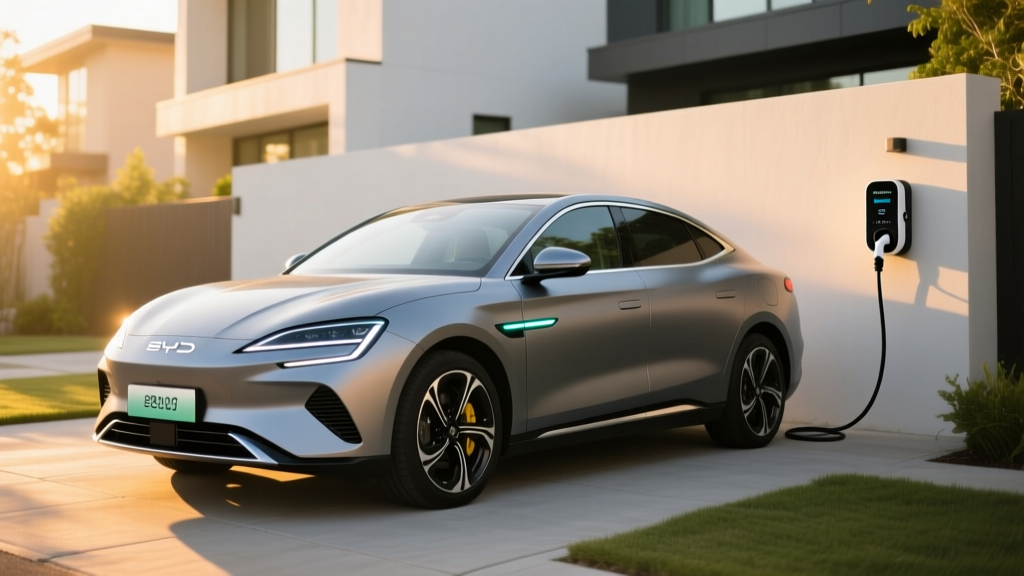
The BYD eMax 7 arrives in global markets as a three-row electric MPV built on the same platform as the Song Max, repackaged for export under the eMax 7 nameplate. For US-based shoppers researching this model, the picture is complicated: BYD has not officially launched passenger vehicles in the United States as of early 2026, meaning the eMax 7 is not available through any US dealer network. However, with BYD's growing international footprint and persistent rumors of a North American entry, we've compiled everything known about this vehicle — specs from international markets, real-world range expectations, and what US buyers would need to know if and when it arrives stateside.
This review synthesizes BYD's published international specifications, independent testing data from markets where the eMax 7 is currently sold (India, Southeast Asia, Latin America), and our analysis of how those figures would translate under EPA testing methodology. If you're cross-shopping electric family haulers or tracking BYD's potential US launch, here's the data-driven breakdown.
BYD eMax 7 At-a-Glance Specifications
| Attribute | Specification |
|---|---|
| Body Style | 3-row electric MPV (6- or 7-seat) |
| Drivetrain | Front-wheel drive (single motor) |
| Motor Output | 150 kW (201 hp) / 310 Nm (229 lb-ft) torque |
| 0–100 km/h (0–62 mph) | ~8.6 seconds |
| Battery Capacity | 71.8 kWh (gross), LFP Blade Battery |
| Claimed Range (WLTP / NEDC) | ~530 km (NEDC) / ~420 km (WLTP estimated) |
| Estimated EPA-Equivalent Range | ~230–260 miles (projected) |
| Max DC Fast Charge | ~88 kW peak (CCS2 / GB/T depending on market) |
| 10–80% DC Charge Time | ~42–48 minutes (estimated) |
| AC Level 2 Charge Rate | 7 kW onboard charger |
| Length / Width / Height | 4,710 mm / 1,810 mm / 1,690 mm |
| Wheelbase | 2,785 mm |
| Cargo Volume (behind 3rd row) | ~180 liters (~6.4 cu ft) |
| Cargo Volume (3rd row folded) | ~680 liters (~24.0 cu ft) |
| US Base MSRP | Not available (not sold in US) |
| International Price (India, approx.) | ₹29.9–33.4 lakh (~$36,000–$40,000 USD) |
| Battery Warranty (international) | 8 years / 160,000 km (~100,000 mi) |
Range, Efficiency, and Real-World Expectations
The eMax 7 uses BYD's 71.8 kWh Blade Battery pack — a lithium iron phosphate (LFP) cell configuration that BYD has standardized across much of its lineup. LFP chemistry trades some energy density for superior thermal stability, longer cycle life, and lower cost compared to nickel-manganese-cobalt (NMC) cells. For a family MPV, these trade-offs make sense: you sacrifice some range-per-kilogram but gain durability and safety margin.
BYD quotes approximately 530 km of range under the older NEDC testing cycle, which is notoriously generous. Under the more realistic WLTP protocol, independent estimates place the eMax 7 closer to 420 km (~261 miles). For US buyers accustomed to EPA figures, which tend to run 10–15% lower than WLTP, a reasonable projected EPA-equivalent range sits between 230 and 260 miles.
Projected EPA range: 230–260 miles (based on WLTP-to-EPA conversion from international testing data)
Expect in practice: ~190–220 miles at sustained highway speeds (70+ mph); ~160–190 miles in freezing temperatures with cabin heating. City driving with regenerative braking recovers closer to the upper EPA estimate.
Note: The eMax 7 is not EPA-certified as it is not sold in the US. These figures are projections based on WLTP data and comparable BYD models tested under EPA protocols. Actual EPA certification could differ.
Efficiency for a vehicle of this size and weight (curb weight approximately 1,950 kg / 4,300 lbs) will likely land in the range of 2.8–3.2 miles per kWh, or roughly 31–36 kWh per 100 miles. That translates to an estimated MPGe of approximately 95–110 MPGe combined — competitive with other three-row EVs like the Kia EV9 but below more aerodynamic crossovers.
One advantage of LFP chemistry worth highlighting: BYD recommends periodic 100% charging for LFP packs (unlike NMC packs, which prefer 80% daily limits). This means the eMax 7's full 71.8 kWh is practically usable on a regular basis, partially offsetting the lower energy density.
Charging Speed: DC Fast Charging and Home Level 2
Charging speed is where the eMax 7 shows its value-oriented positioning rather than class-leading ambition. The peak DC fast-charge rate is approximately 88 kW, which is modest by 2026 standards. For context, competitors like the Hyundai Ioniq 5 peak at 240 kW and the Kia EV9 at 236 kW on 800V architectures.
What does 88 kW mean in practice? On a typical DC fast charger, the eMax 7 will take approximately 42–48 minutes to charge from 10% to 80%. The charge curve is relatively flat in the 20–60% window but tapers significantly above 80%, as is typical with LFP cells. A full 10–100% session could take 65–75 minutes.
| Charging Level | Power / Rate | Time / Speed |
|---|---|---|
| Level 1 (120V household) | ~1.4 kW | ~5 miles of range per hour |
| Level 2 (240V home, 7 kW onboard) | 7 kW | ~25 miles of range per hour; 0–100% in ~10 hours |
| DC Fast Charge (peak) | ~88 kW | 10–80% in ~42–48 min; adds ~130 mi in 30 min |
For home charging, the 7 kW onboard charger is adequate but not exceptional. A full overnight charge from empty takes roughly 10 hours on a Level 2 home station. Most owners charging from 20–30% remaining will wake to a full battery in 6–7 hours — perfectly acceptable for daily use but slower than vehicles with 11 kW or 19.2 kW onboard chargers.
Connector compatibility depends on the market: international eMax 7 models ship with CCS2 (Europe, India, Oceania) or GB/T (China). A hypothetical US-spec model would need CCS1 or, increasingly, NACS (Tesla's connector, now adopted by most major automakers for 2025+ models). BYD has not announced a NACS commitment for North America.
Performance and Drivetrain
The eMax 7 is engineered as a comfortable family mover, not a performance vehicle. Its single front-mounted motor produces 150 kW (201 horsepower) and 310 Nm (229 lb-ft) of torque, driving the front wheels. BYD quotes a 0–100 km/h time of approximately 8.6 seconds, which translates to a 0–60 mph time in the low-to-mid 8-second range.
That's adequate for highway merging and city driving but noticeably slower than dual-motor competitors. The Kia EV9 GT-Line AWD, for instance, hits 60 mph in 5.0 seconds. The eMax 7's front-wheel-drive layout and comfort-tuned suspension prioritize ride quality over cornering dynamics, which is appropriate for an MPV but means this vehicle won't excite driving enthusiasts.
Regenerative braking offers adjustable levels through the infotainment system, with the strongest setting approaching one-pedal driving in city traffic. The brake pedal feel, common in BYD products, blends regenerative and friction braking — some drivers find the transition slightly abrupt at low speeds.
Interior, Cargo, and Technology
The eMax 7's strongest selling point is its three-row practicality at a value-oriented price point. Seating configurations include both 6-seat (captain's chairs in the second row) and 7-seat (bench second row) layouts. Second-row legroom is generous at approximately 830 mm (32.7 inches), and the third row accommodates adults for shorter trips, though legroom tightens to roughly 700 mm (27.5 inches).
Cargo space behind the third row is approximately 180 liters (6.4 cu ft) — enough for a few grocery bags or a couple of carry-on suitcases but tight for a family road trip with all seats occupied. Fold the third row, and cargo volume expands to roughly 680 liters (24.0 cu ft), which is competitive for the segment.
Technology highlights include:
- Rotating 12.8-inch infotainment screen — a BYD signature that toggles between landscape and portrait orientation
- 10.25-inch digital instrument cluster
- Wireless Apple CarPlay and Android Auto (market-dependent)
- BYD DiPilot ADAS suite — adaptive cruise control, lane-keeping assist, automatic emergency braking, blind-spot monitoring
- 360-degree surround-view camera
- Vehicle-to-Load (V2L) capability — power external devices up to ~3.3 kW via an adapter
Notable drawbacks: The infotainment software, while feature-rich, can feel cluttered with nested menus. International-market units have drawn criticism for translation quality in the UI, which would need significant improvement for a US launch. The DiPilot ADAS system is a Level 2 driver-assist system — it requires continuous driver supervision and is not self-driving. It functions comparably to Toyota Safety Sense or Honda Sensing but does not match the hands-free highway capability of GM's Super Cruise or Ford's BlueCruise.
The BYD DiPilot system is classified as SAE Level 2 automation. The driver must keep hands on or near the wheel, monitor the road at all times, and be prepared to take over immediately. It assists with steering, acceleration, and braking on marked highways but does not navigate autonomously, handle construction zones reliably, or operate without driver oversight.
Pricing and Federal Tax Credit Outlook
Because BYD does not sell passenger vehicles in the United States, there is no official US MSRP for the eMax 7. In international markets, pricing ranges from approximately $36,000 to $40,000 USD equivalent (India), with higher-spec trims reaching roughly $43,000 in Southeast Asian markets where import duties are higher.
If BYD were to introduce the eMax 7 to the US market, a reasonable projected base price would be $38,000–$45,000 before incentives, depending on trim, localization costs, and tariff structure. Current US tariffs on Chinese-manufactured vehicles (100% tariff on Chinese EVs as of 2024, maintained through 2026) make direct import from BYD's Chinese factories economically unviable. BYD would need to manufacture in a tariff-exempt jurisdiction or establish a North American production facility — neither of which has been announced as of early 2026.
| Trim | Projected MSRP | After §30D Credit (if eligible) |
|---|---|---|
| Standard (6-seat) | $38,000–$40,000 | $30,500–$32,500 |
| Premium (7-seat) | $42,000–$45,000 | $34,500–$37,500 |
Federal tax credit eligibility (§30D): Even if the eMax 7 were sold in the US, qualifying for the up-to-$7,500 federal clean vehicle credit would be extremely challenging under current rules. The §30D credit requires:
- Final assembly in North America
- Battery components manufactured or assembled in North America (phased percentages increase annually)
- Critical minerals sourced from the US or FTA partners
- MSRP below $80,000 for vans/SUVs/MPVs, or $55,000 for sedans
- Buyer adjusted gross income below $300,000 (joint) / $150,000 (single)
- No "foreign entity of concern" (FEOC) involvement in battery supply chain — a rule that effectively disqualifies most Chinese-sourced battery materials
Given that BYD vertically integrates its battery production using Chinese-mined and processed LFP materials, the eMax 7 would almost certainly fail the critical-minerals and FEOC requirements, rendering it ineligible for the credit regardless of assembly location. This is the same structural barrier facing all Chinese OEMs seeking US market entry.
How the eMax 7 Compares to US-Market Alternatives
Since the eMax 7 is not purchasable in the US, here's how it stacks up on paper against three-row electric alternatives that are available:
| Spec | BYD eMax 7 | Kia EV9 (Light LR) | VW ID. Buzz | Tesla Model X (LR) |
|---|---|---|---|---|
| EPA Range | ~230–260 mi (est.) | 304 mi | 234 mi | 335 mi |
| Battery | 71.8 kWh LFP | 99.8 kWh NMC | 91 kWh NMC | 100 kWh NMC |
| Peak DC Charge | ~88 kW | 236 kW | 175 kW | 250 kW |
| 10–80% Time | ~45 min | ~20 min | ~26 min | ~20 min |
| 0–60 mph | ~8.5 sec | 7.5 sec | 7.3 sec | 3.8 sec |
| Seats | 6 or 7 | 6 or 7 | 7 | 5, 6, or 7 |
| Base MSRP (US) | N/A | ~$54,900 | ~$59,995 | ~$79,990 |
| Federal Credit | Not eligible | Partial ($3,750) | Not eligible | Not eligible |
The comparison reveals the eMax 7's value proposition: if it could clear the tariff and regulatory hurdles, it would undercut every US three-row EV on price by $15,000 or more. But it would arrive with slower charging, shorter range, and no federal credit — significant trade-offs that narrow its advantage.
Pros, Cons, and Who Should Consider the eMax 7
Pros
- Significantly lower projected price than any US-market 3-row EV
- LFP Blade Battery offers excellent thermal safety and long cycle life
- Practical 6/7-seat MPV layout with carlike driving dynamics
- V2L capability for camping and emergency power
- Rotating infotainment screen is a unique feature
- LFP chemistry allows routine 100% charging without degradation concern
Cons
- Not available in the United States — no US dealer network or support
- Slow DC fast charging (~88 kW peak) compared to 200+ kW competitors
- Estimated range of 230–260 miles is below average for 2026 EVs
- No federal tax credit eligibility under current §30D rules
- Modest 201 hp output; not a quick vehicle
- Third-row cargo space is very limited (6.4 cu ft)
- ADAS system is basic Level 2 — no hands-free highway driving
- Chinese origin triggers 100% US tariff, making import economically impossible
Who this EV suits best (if it were available): Budget-conscious families who need three rows primarily for school runs and local errands, who charge at home nightly, and who rarely take road trips exceeding 200 miles. The LFP battery's longevity and safety profile make it ideal for high-mileage daily use. It is not suited for frequent long-distance travelers (slow charging, modest range) or those who need hands-free highway assist systems.
For US buyers today: The eMax 7 is a useful benchmark for where value-oriented electric MPVs are heading globally, but it is not a vehicle you can purchase. Your closest alternatives are the Kia EV9, the Volkswagen ID. Buzz, or — if budget allows — the Tesla Model X. The Hyundai Ioniq 9, expected for the 2026–2027 model year, may also enter this segment with competitive pricing.
Frequently Asked Questions
What is the real-world range of the BYD eMax 7?
Based on WLTP testing and EPA conversion estimates, expect approximately 230–260 miles in mixed driving. Highway-only driving at 70+ mph will reduce this to roughly 190–220 miles, and cold-weather operation (below freezing) can drop range to 160–190 miles. The eMax 7 is not EPA-certified, so these are projections, not official ratings.
How fast does the eMax 7 charge?
The peak DC fast-charge rate is approximately 88 kW, yielding a 10–80% charge in roughly 42–48 minutes. At home on a Level 2 (240V) station with the 7 kW onboard charger, expect about 25 miles of range per hour, or a full charge in approximately 10 hours. These speeds are below class leaders like the Kia EV9 (236 kW peak, ~20 min 10–80%).
Can I buy the BYD eMax 7 in the United States?
No. As of early 2026, BYD does not sell passenger vehicles in the US market. There is no US dealer network, no EPA certification, and no NHTSA crash-test data for the eMax 7. A 100% US tariff on Chinese-manufactured electric vehicles makes direct import economically unfeasible.
Would the eMax 7 qualify for the $7,500 federal EV tax credit?
Almost certainly not, even if it were sold in the US. The IRS §30D clean vehicle credit requires North American final assembly, FEOC-compliant battery sourcing, and critical minerals from approved supply chains. BYD's vertically integrated Chinese battery supply chain would fail the FEOC and critical-minerals requirements. Always consult a tax professional for credit eligibility specific to your situation.
How does the LFP Blade Battery compare to NMC?
BYD's LFP (lithium iron phosphate) Blade Battery sacrifices roughly 15–20% energy density compared to NMC cells but gains significantly in thermal stability (far less risk of thermal runaway), cycle life (3,000+ cycles vs. ~1,500–2,000 for NMC), and cost. LFP also tolerates routine 100% charging, whereas NMC manufacturers typically recommend 80% daily limits. For a family vehicle prioritizing longevity and safety, LFP is a sound choice.
Is the BYD eMax 7 worth waiting for?
There is no announced timeline for BYD passenger vehicle sales in the US, and current tariff policy makes it unlikely before the late 2020s at the earliest. If you need a three-row EV today, the Kia EV9 and Volkswagen ID. Buzz are available now, and the Hyundai Ioniq 9 is anticipated soon. Waiting for the eMax 7 is not a practical strategy for US buyers.
What is the eMax 7's towing capacity?
BYD has not published an official towing rating for the eMax 7 in most markets. Given its front-wheel-drive layout and 201 hp output, expect a modest rating in the 1,500–2,200 lb range if one is eventually certified — sufficient for a small utility trailer but not for boats or campers. This is typical for electric MPVs not designed for heavy towing.