BYD Electric Trucks: The 2026 US Market Reality
If you've been searching for BYD electric trucks available for purchase in the United States, the short answer is nuanced. BYD — the Chinese automaker that surpassed Tesla in global BEV sales in late 2023 — has a substantial commercial electric truck portfolio internationally, but its presence in the US light-duty consumer truck market remains nonexistent as of 2026. What BYD does offer stateside is a lineup of commercial-grade battery-electric trucks aimed at fleet operators, delivery companies, and port authorities. For the individual consumer looking for an electric pickup truck to park in their driveway, BYD is not yet an option.
This profile breaks down BYD's electric truck offerings that are relevant to the US market — primarily its Class 6 and Class 8 commercial vehicles — and explains why consumer-facing BYD pickups remain absent, what the specs look like, and which competitors fill the gap for buyers who want an electric truck today.
BYD's Commercial Electric Truck Lineup: What's Actually Available
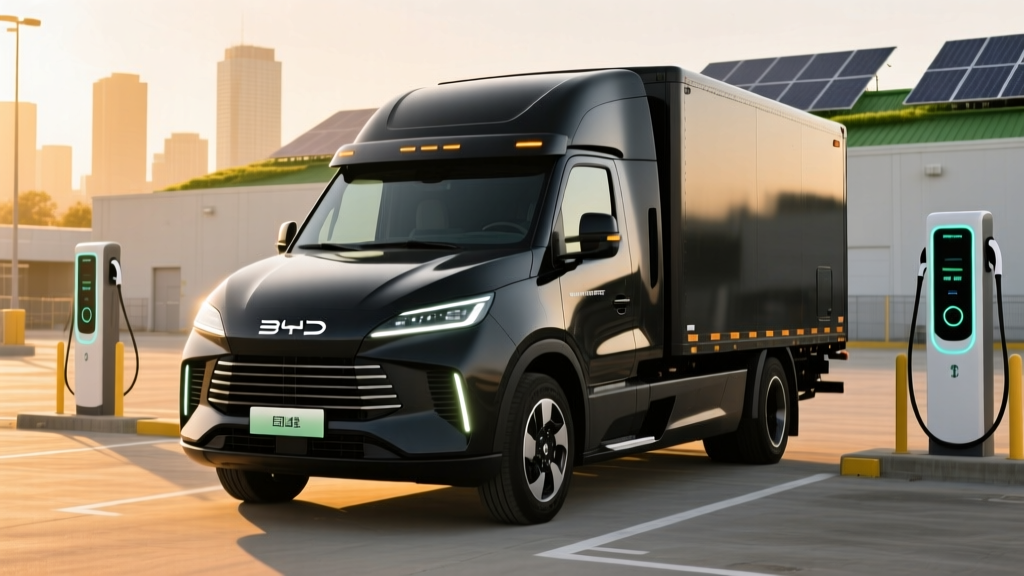
BYD's US truck operations run through its Lancaster, California facility, where the company has assembled commercial vehicles since 2017. The core models available to US fleet buyers in 2026 include:
| Specification | BYD 8F (Class 8 Semi) | BYD 6F (Class 6 Box Truck) | BYD 8TT (Class 8 Terminal Tractor) |
|---|---|---|---|
| Vehicle Class | Class 8 (Day Cab) | Class 6 | Class 8 (Yard/Port) |
| Battery Capacity | ~440 kWh (LFP) | ~220 kWh (LFP) | ~280 kWh (LFP) |
| EPA-Est. Range | ~200 miles (laden) | ~180 miles (laden) | ~150 miles (shift-based) |
| Max DC Fast Charge | ~150 kW (CCS1) | ~120 kW (CCS1) | ~120 kW (CCS1) |
| 10–80% Charge Time | ~120 minutes | ~90 minutes | ~100 minutes |
| Motor Output | ~490 hp (360 kW) | ~280 hp (210 kW) | ~350 hp (260 kW) |
| Drivetrain | Dual-motor RWD | Single-motor RWD | Single-motor RWD |
| GVWR | 80,000 lbs (combined) | 26,000 lbs | 80,000 lbs (combined) |
| Base MSRP (Fleet) | ~$350,000+ | ~$220,000+ | ~$280,000+ |
| Battery Warranty | 8 years / 500,000 mi | 8 years / 300,000 mi | 8 years / 500,000 mi |
These figures are compiled from BYD's US fleet documentation and industry reporting. Because these are commercial vehicles, they do not carry EPA consumer window stickers in the same way a Ford F-150 Lightning or Rivian R1T does. Range estimates are based on typical laden duty cycles and vary significantly with payload, terrain, and ambient temperature.
Battery Chemistry and Why BYD Uses LFP Exclusively
Every BYD electric truck uses the company's proprietary Blade Battery, a lithium iron phosphate (LFP) cell in a cell-to-pack configuration. This is a deliberate engineering and economic choice:
| Attribute | LFP (BYD Blade) | NMC (Competitors) |
|---|---|---|
| Energy Density | Lower (~150 Wh/kg cell-level) | Higher (~220–260 Wh/kg) |
| Cycle Life | 3,000–5,000+ cycles | 1,000–2,000 cycles |
| Thermal Stability | Excellent (resistant to thermal runaway) | Good (requires more active cooling) |
| Cold-Weather Performance | Moderate (greater capacity loss below 32°F) | Better (less capacity fade in cold) |
| Cost per kWh | Lower (~$80–100/kWh pack-level) | Higher (~$120–150/kWh) |
| Cobalt/Nickel Content | None | Significant |
For commercial trucks that charge at a depot nightly and accumulate high mileage over a decade, LFP's superior cycle life and lower cost are compelling advantages. The trade-off — heavier packs for the same energy and worse cold-weather range — matters less when vehicle weight is already measured in tens of thousands of pounds and routes are predictable. For a consumer pickup truck, however, the energy-density penalty would be harder to accept, which is partly why US-market consumer EVs from Ford, GM, and Rivian have favored NMC (though LFP adoption is growing in consumer models too).
Charging Infrastructure: Fleet Depots vs. Public Networks
BYD's commercial trucks charge primarily via CCS1 connectors at fleet depot chargers, not at public Electrify America or EVgo stations. Here's what the charging picture looks like:
| Level | Power (kW) | Typical Use Case | Miles Added Per Hour |
|---|---|---|---|
| Level 2 (AC Depot) | 19–40 kW | Overnight / scheduled downtime | ~15–35 mi/hr |
| DC Fast Charge | 120–150 kW peak | Mid-shift top-up, opportunity charging | ~80–110 mi/hr (at peak) |
Charging a 440 kWh Class 8 battery from 10–80% at 150 kW takes approximately two hours — far longer than a consumer EV with a smaller battery. This is why fleet operators typically rely on overnight Level 2 depot charging (10–12 hours for a full charge) and use DC fast charging only for mid-route opportunity top-ups. The charging curve on BYD's LFP packs is relatively flat compared to NMC, meaning the truck sustains close to peak charge rate for a longer portion of the session before tapering above 80% State of Charge.
For context, this infrastructure model is fundamentally different from consumer EV ownership. There's no plugging into a home Level 2 charger in your garage. Fleet depot installations typically cost $50,000–$150,000+ per site including utility upgrades, switchgear, and multiple dispenser units — a capital investment that only makes sense at commercial scale.
Why There's No BYD Consumer Electric Pickup in the US
BYD has not announced a consumer electric pickup truck for the US market as of 2026. Several structural barriers explain this:
- Tariffs and trade policy: Chinese-manufactured vehicles face a 100% tariff under Section 301 as of 2024, effectively doubling any import price. BYD would need to manufacture in the US, Mexico (subject to USMCA rules-of-origin scrutiny), or a trade-friendly nation to compete on price.
- Dealer and service network: BYD has no consumer dealer network in the US. Selling a consumer pickup requires sales, service, parts distribution, and warranty infrastructure that takes years to build.
- Regulatory homologation: US-market vehicles must meet FMVSS safety standards, EPA emissions (or EV-equivalent) certification, and NHTSA crash-testing requirements — a multi-year, multi-million-dollar process per model.
- Brand perception: Consumer trust in Chinese auto brands remains low in the US, particularly for a high-value purchase like a pickup truck where resale value and long-term serviceability matter.
- Political climate: Bipartisan concern over Chinese EV imports has made any market-entry strategy politically fraught for BYD.
BYD's US subsidiary has stated publicly that it focuses on commercial vehicles — buses, trucks, and forklifts — where fleet buyers make procurement decisions based on total cost of ownership rather than brand loyalty. This is a pragmatic strategy, but it means consumers searching for "BYD electric trucks" will not find a showroom-ready pickup.
US Consumer Electric Trucks You Can Actually Buy in 2026
If you're a US buyer who wants an electric pickup truck today, here are the competitors that fill the space BYD doesn't occupy:
| Model | EPA Range | Battery (kWh) | Max DC kW | 0–60 mph | Base MSRP |
|---|---|---|---|---|---|
| Ford F-150 Lightning (Std Range) | 240 mi | 98 (NMC) | 120 kW | ~5.0 sec | ~$54,995 |
| Ford F-150 Lightning (Ext Range) | 320 mi | 131 (NMC) | 150 kW | ~4.5 sec | ~$69,995 |
| Rivian R1T (Dual-Motor) | 270–420 mi | 92–149 (NMC) | 200+ kW | ~4.5 sec | ~$69,900 |
| Chevrolet Silverado EV (4WT) | 280 mi | ~100 (NMC) | ~150 kW | ~5.5 sec | ~$55,000 |
| GMC Sierra EV (Denali) | 340–440 mi | ~200 (NMC) | ~350 kW | ~4.5 sec | ~$87,000 |
| Tesla Cybertruck (AWD) | 340 mi | ~123 (NMC) | ~250 kW | ~4.1 sec | ~$79,990 |
These are the trucks competing for the US consumer electric pickup market. All use NMC chemistry (except where noted), support CCS1 or NACS charging, and are available through established dealer or direct-sale networks with full service infrastructure. For fleet buyers who were considering BYD's commercial trucks, the Ford F-150 Lightning commercial variants and the Chevrolet Silverado EV Work Truck offer a bridge between consumer and fleet use cases with EPA-certified specs and fueleconomy.gov data.
Tax Credits, Pricing, and Fleet Incentives
Federal EV tax credit rules under IRS §30D apply to consumer light-duty vehicles — meaning BYD's Class 6 and Class 8 commercial trucks do not qualify for the consumer $7,500 credit. However, fleet buyers may be eligible for:
- Commercial Clean Vehicle Credit (§45W): Up to $7,500 for vehicles under 14,000 lbs GVWR and up to $40,000 for heavier commercial EVs. BYD's Class 8 trucks can qualify for the $40,000 credit per vehicle, subject to business tax liability and sourcing requirements.
- State and local incentives: Programs like California's Hybrid and Zero-Emission Truck and Bus Voucher Incentive Project (HVIP) provide substantial point-of-sale vouchers for fleet electrification. These vary by jurisdiction — consult your state's air-quality or energy agency for current amounts.
- Utility demand-charge management: Many utilities offer commercial EV charging rates and make-ready infrastructure rebates that significantly reduce depot-charging installation costs.
Who BYD Electric Trucks Actually Serve
BYD's electric trucks in the US are purpose-built for a narrow but important set of buyers:
- Regional delivery fleets running predictable daily routes under 200 miles with depot return for overnight charging.
- Port and terminal operators needing yard tractors that run continuous shifts with opportunity charging during breaks.
- Municipal and government fleets with sustainability mandates and access to grant funding for zero-emission vehicle procurement.
- Drayage operators serving ports like Los Angeles/Long Beach, where California's Advanced Clean Fleets rule mandates zero-emission drayage trucks by 2035.
For these buyers, BYD's LFP battery durability, vertically integrated manufacturing (BYD builds its own cells, motors, and semiconductors), and fleet-oriented pricing can be compelling. For everyone else — the homeowner who wants an electric truck for towing, commuting, and weekend adventures — BYD is simply not in the conversation in 2026.
Pros
- LFP Blade Battery offers exceptional cycle life (3,000–5,000+ cycles)
- Vertically integrated supply chain reduces component costs
- Strong fleet support and depot-charging expertise
- No cobalt or nickel — fewer supply-chain ethical concerns
- Proven in thousands of commercial vehicles globally
Cons
- No consumer pickup truck available in the US
- LFP cold-weather range loss is significant (25–35%)
- Slower DC charging than consumer EVs (2-hour 10–80%)
- No consumer dealer or service network
- §45W credit eligibility uncertain due to battery-sourcing rules
- Brand perception and political headwinds in US market
Frequently Asked Questions
Can I buy a BYD electric pickup truck in the US?
No. As of 2026, BYD does not sell consumer electric pickup trucks in the United States. Their US truck lineup consists exclusively of Class 6 and Class 8 commercial vehicles sold to fleet operators. BYD has not announced plans for a consumer pickup for the US market.
What is the range of BYD's commercial electric trucks?
BYD's Class 8 semi (8F) delivers approximately 200 miles of range under typical laden conditions, while the Class 6 box truck (6F) achieves around 180 miles. Real-world range varies 15–35% depending on payload, route topography, and ambient temperature. Cold weather has a particularly pronounced effect on LFP cells.
How fast do BYD electric trucks charge?
BYD's Class 8 truck charges at up to 150 kW DC, achieving a 10–80% charge in approximately 120 minutes. Class 6 models peak at around 120 kW with a 10–80% time of roughly 90 minutes. Most fleet operators rely on overnight Level 2 depot charging (19–40 kW) for full charges over 8–12 hours.
Do BYD trucks qualify for the federal EV tax credit?
BYD's commercial trucks do not qualify for the consumer §30D credit (which caps at $7,500 for light-duty vehicles). They may qualify for the §45W Commercial Clean Vehicle Credit, which offers up to $40,000 for heavy-duty vehicles, but eligibility depends on battery-component and critical-mineral sourcing rules that may disadvantage Chinese-manufactured cells. Always verify with a tax professional and current IRS guidance.
How do BYD electric trucks compare to the Tesla Semi?
The Tesla Semi (in limited production for PepsiCo and other fleet customers) claims approximately 500 miles of range with a ~900 kWh battery pack and charges via MCS (Megawatt Charging System) at up to 1,200 kW — dramatically faster than BYD's 150 kW CCS1 charging. However, the Tesla Semi's price is estimated at $250,000–$290,000, and production volumes remain very low. BYD's trucks are available in higher volumes today with proven LFP durability, though at shorter range and slower charging speeds.
Will BYD ever sell a consumer electric truck in the US?
There is no confirmed timeline or announcement. BYD would need to overcome 100% Section 301 tariffs (requiring non-China manufacturing), build a US dealer and service network, complete FMVSS homologation, and navigate a politically hostile environment for Chinese auto brands. Industry analysts consider a BYD consumer truck in the US unlikely before 2028 at the earliest, and possibly not at all.