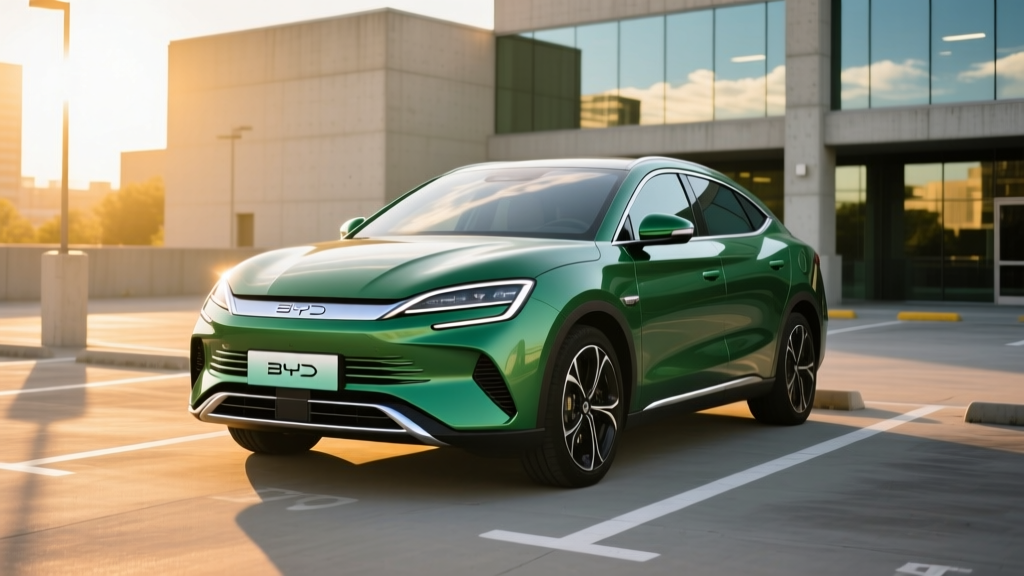
If you've been following EV news, you already know BYD has become the world's largest producer of plug-in electric vehicles, surpassing Tesla in total plug-in deliveries and rivaling it in pure battery-electric volume. With models priced aggressively in Europe, Australia, Southeast Asia, and Latin America, American shoppers are asking a logical question: how much is a BYD electric car, and can I actually buy one in the United States?
The short answer for US buyers in 2026 is complicated. BYD does not currently sell passenger vehicles in the United States, and a combination of 100% tariffs on Chinese-made EVs, battery-sourcing restrictions under the Inflation Reduction Act, and BYD's own strategic focus on other export markets means there is no official US price sheet. But that doesn't mean the pricing question is irrelevant. Understanding what BYD charges globally — and what those prices would translate to stateside — is essential context if you're cross-shopping EVs, watching the market for future entry, or considering import-adjacent options in neighboring markets.
Below, we break down the real pricing for BYD's most popular global EVs, explain the tariff and regulatory barriers keeping them out of the US, and translate those international figures into what American buyers would likely pay if BYD ever entered the market.
BYD's Global EV Lineup: What Models Exist and What They Cost
BYD's passenger EV portfolio spans from sub-$20,000 city cars to premium sedans competing with the Tesla Model S. The brand uses its proprietary Blade Battery — a lithium iron phosphate (LFP) cell in a cell-to-pack configuration — across nearly all models, which gives BYD a structural cost advantage over competitors using nickel-manganese-cobalt (NMC) chemistry from third-party suppliers.
Here's what the core lineup looks like in 2026, with pricing converted to USD from primary markets (Australia, UK, Thailand, Brazil, and Europe):
| Model | Segment | Battery (kWh) | Chemistry | WLTP Range | 0-62 mph | Approx. USD Price |
|---|---|---|---|---|---|---|
| Dolphin | Subcompact hatch | 60.4 | LFP Blade | 265 mi | 7.0s | $22,000–$27,000 |
| Atto 3 (Yuan Plus) | Compact SUV | 60.5 | LFP Blade | 260 mi | 7.3s | $28,000–$35,000 |
| Seal | Midsize sedan | 82.5 | LFP Blade | 323 mi | 3.8s (AWD) | $38,000–$48,000 |
| Seal U | Midsize SUV | 87.0 | LFP Blade | 310 mi | 5.9s (AWD) | $40,000–$50,000 |
| Han EV | Full-size sedan | 85.4 | LFP Blade | 320 mi | 3.9s (AWD) | $45,000–$58,000 |
| Tang EV | 3-row SUV | 108.8 | LFP Blade | 280 mi | 4.6s (AWD) | $55,000–$68,000 |
Note: WLTP range figures are generally 10–15% higher than US EPA equivalents. Prices vary significantly by market due to local taxes, shipping, and dealer structures. Converted at approximate 2026 exchange rates.
What Would a BYD Cost in the US? Tariff and Pricing Reality
The prices above look attractive next to comparable American-market EVs. A BYD Dolphin at ~$22,000 undercuts the Chevrolet Equinox EV; the Seal at ~$38,000 competes directly with the Tesla Model 3 and Hyundai Ioniq 6. But those are ex-factory or lightly marked-up export prices, not what US consumers would see.
Three major cost layers would inflate any BYD sold stateside:
- Section 301 tariffs: As of 2026, Chinese-manufactured EVs face a 100% tariff under US trade policy. A $28,000 Atto 3 would carry a $28,000 import duty before it reached a dealership.
- Homologation and compliance: BYD vehicles are not currently certified to US FMVSS (Federal Motor Vehicle Safety Standards) or EPA emissions/efficiency testing protocols. Retooling for US crash structures, lighting standards, and OBD requirements adds significant per-unit cost.
- Dealer network and logistics: Building a US dealer and service network from scratch — or relying on a direct-to-consumer model — requires billions in upfront investment.
BYD Seal Deep Dive: The Model Most Likely to Compete in the US
If BYD ever enters the US passenger market, the Seal is the most plausible candidate. It's a midsize sport sedan that directly benchmarks the Tesla Model 3, with competitive range, strong performance, and premium interior materials. Here's what we know from global-market specifications and independent testing.
| Specification | Value |
|---|---|
| Battery capacity | 82.5 kWh (usable), LFP Blade cell-to-pack |
| WLTP range | 323 mi (RWD) / 289 mi (AWD Excellence) |
| Estimated EPA range | ~275–290 mi (RWD) / ~250–265 mi (AWD) |
| Motor output (AWD) | 523 hp / 497 lb-ft torque |
| Motor output (RWD) | 308 hp / 266 lb-ft torque |
| 0-62 mph (AWD) | 3.8 seconds |
| 0-62 mph (RWD) | 5.9 seconds |
| Drivetrain | RWD single-motor or AWD dual-motor |
| Max DC fast charge | 150 kW peak |
| 10–80% DC charge time | ~26 minutes (estimated) |
| Level 2 AC charge rate | 11 kW (3-phase, where available); 7 kW single-phase |
| Length / Wheelbase | 189.0 in / 111.4 in |
| Cargo volume | 14.1 cu ft (trunk) + 1.8 cu ft (frunk) |
| Curb weight (AWD) | ~4,800 lbs |
Charging Speed and Infrastructure
The Seal's 150 kW peak DC fast-charging rate is adequate but not class-leading. For comparison, the Hyundai Ioniq 6 peaks at ~235 kW on an 800V architecture, and the Tesla Model 3 Highland can sustain ~250 kW on V3 Superchargers. BYD's charge curve is relatively flat through the mid-range (holding near peak from ~20–60% SoC), but tapers significantly above 80%, as is typical for LFP cells.
For home charging, the Seal supports up to 11 kW on 3-phase AC power (common in Europe and Australia). In the US, where most homes have single-phase 240V service, expect ~7–7.4 kW on a Level 2 home charger, adding roughly 25–30 miles of range per hour of charging. A full 0–100% home charge would take approximately 11–12 hours.
Federal Tax Credit: Would a BYD Qualify Under §30D?
This is where BYD's US prospects hit a second wall beyond tariffs. The IRS §30D Clean Vehicle Credit has strict requirements that would almost certainly disqualify any BYD sold in America, even if tariffs were reduced:
- Battery sourcing: A percentage of critical minerals must be sourced from the US or a free-trade-agreement partner. BYD's supply chain is heavily China-domestic.
- Foreign Entity of Concern (FEOC) restriction: Vehicles with battery components manufactured or assembled by a FEOC (which includes most Chinese battery manufacturers, including BYD itself) are ineligible for the credit entirely as of 2024 onward.
- MSRP caps: Sedans must be under $55,000; SUVs/pickups under $80,000. Some BYD models would clear this, but the sourcing rules make it moot.
- Income caps: Buyer AGI must not exceed $150,000 (single) / $300,000 (joint). This applies to all qualifying EVs regardless of brand.
BYD vs. US-Market Competitors: How Do the Numbers Stack Up?
Since you can't buy a BYD in the US today, here's how the Seal's global specs compare to the American-market EVs it would compete against — giving you a sense of the value gap BYD is trying to close globally and the benchmarks it would need to meet stateside.
| Spec | BYD Seal (AWD) | Tesla Model 3 LR AWD | Hyundai Ioniq 6 Limited AWD | BMW i4 xDrive40 |
|---|---|---|---|---|
| Est. US Price | ~$52,000* | $47,740 | $52,600 | $59,095 |
| EPA Range | ~250–265 mi (est.) | 341 mi | 270 mi | 282 mi |
| Battery | 82.5 kWh LFP | 79 kWh NMC | 77.4 kWh NMC | 83.9 kWh NMC |
| 0–60 mph | 3.6s | 4.2s | 5.1s | 4.7s |
| Peak DC Charge | 150 kW | 250 kW | 235 kW | 205 kW |
| 10–80% DC Time | ~26 min | ~18 min | ~18 min | ~28 min |
| Tax Credit (§30D) | Not eligible (FEOC) | Eligible (partial/full varies) | Not eligible (Korea-built) | Not eligible (Germany-built) |
*Estimated US price includes hypothetical tariff mitigation via non-China manufacturing. Actual pricing would depend on production location and trade agreements.
The comparison reveals BYD's challenge: even with aggressive pricing, the Seal trails the Model 3 in range and charging speed, and the Tesla's access to the Supercharger network (now with NACS as the de facto US standard) adds a significant infrastructure advantage. BYD's LFP battery offers superior cycle life and safety characteristics, but US buyers tend to prioritize range and charging speed in purchase decisions.
Where BYD Is Actually Available in 2026
BYD's export strategy has focused on markets where Chinese-manufactured EVs face lower tariff barriers and where the brand can establish dealer partnerships quickly:
- Europe: Available in Germany, UK, France, Netherlands, Sweden, Norway, and others. The Atto 3 and Seal are the primary models, with Euro NCAP 5-star safety ratings.
- Australia & New Zealand: Strong market presence with the Atto 3, Dolphin, and Seal. Australia was one of BYD's first right-hand-drive markets.
- Southeast Asia: Thailand is BYD's largest ASEAN market, with a local factory (opened 2024) producing the Atto 3 for regional export.
- Latin America: Brazil and Mexico have seen rapid BYD expansion. BYD opened a factory in Camacari, Brazil, in 2025, producing the Dolphin and Song Plus for the South American market.
- Middle East & Africa: Growing presence in UAE, Saudi Arabia, and South Africa.
Notably absent: the United States and Canada. BYD has stated it is "monitoring" the North American market but has announced no concrete plans for passenger vehicle entry. The company does sell electric buses and commercial vehicles in the US (through a Lancaster, California facility), but these are fleet products, not consumer cars.
Who Would a BYD Suit — And Who Should Look Elsewhere?
If you're reading this from outside the US, or if BYD's US plans change in the future, here's a decision framework based on the brand's strengths and weaknesses:
- Prioritize battery longevity and safety (LFP chemistry excels here — BYD warranties its Blade Battery at 8 years/100,000 miles with a 70% capacity retention threshold)
- Want a well-equipped EV at a lower price point than European or American competitors
- Mostly drive in urban and suburban settings where the range is more than sufficient
- Live in a market with established BYD dealer and service support
- Need maximum highway range for frequent long road trips (the Seal's ~250–265 mi EPA-equivalent range falls short of the Model 3 LR's 341 mi)
- Require the fastest possible DC charging for corridor travel
- Want access to the Tesla Supercharger network (BYD uses CCS2 in Europe/CCS1 globally, not NACS)
- Live in the US and need federal tax credit eligibility to make the math work
- Rely on advanced driver-assist features — BYD's ADAS (branded "DiPilot") is functional but trails Tesla Autopilot, GM Super Cruise, and Ford BlueCruise in real-world capability and refinement
The Bottom Line: What BYD's Pricing Means for US EV Shoppers
So, how much is a BYD electric car? Globally, anywhere from roughly $22,000 for a Dolphin to $68,000 for a fully loaded Tang EV — prices that undercut most Western competitors by 15–30%. But for US buyers in 2026, those numbers are academic. The 100% tariff on Chinese EVs, FEOC battery-sourcing restrictions that block tax credit eligibility, and BYD's own strategic prioritization of other markets mean there is no legal pathway to buy a BYD passenger car in America today.
What BYD's global pricing does tell us is the competitive pressure that's reshaping the EV market worldwide. In markets where BYD competes freely, legacy automakers and Tesla alike have been forced to cut prices and accelerate feature rollouts. For US buyers, that pressure arrives indirectly — through more aggressive pricing from Hyundai, Kia, Chevrolet, and Tesla as they defend market share globally.
If you're shopping for an EV in the US right now, your best bets in the BYD Seal's price bracket remain the Tesla Model 3 (best range and charging network), the Hyundai Ioniq 6 (fastest charging, striking design), and the BMW i4 (premium build, strong driving dynamics). None of them are cheap, but all of them are actually available — and that matters more than a price tag you can't access.
Frequently Asked Questions
Can I import a BYD to the United States?
Practically, no. Importing a vehicle not certified to FMVSS standards requires a costly and lengthy homologation process, and the 100% tariff would apply on top of the vehicle's value. The total cost would far exceed buying a comparable US-market EV. The only legal pathway would be through the 25-year rule for classic vehicles, which obviously doesn't apply to current-production BYDs.
Does BYD plan to sell cars in the US?
As of early 2026, BYD has not announced any plans to enter the US passenger vehicle market. The company sells electric commercial vehicles (buses, trucks) in the US but has indicated that tariff barriers and geopolitical considerations make passenger car entry unfeasible in the near term. BYD's chairman has publicly stated the company is "not in a hurry" to enter North America.
What is BYD's Blade Battery and is it safe?
The Blade Battery is BYD's proprietary LFP (lithium iron phosphate) cell arranged in a long, thin "blade" format that doubles as a structural element in the battery pack. LFP chemistry is inherently more thermally stable than NMC — BYD demonstrated this with a widely publicized nail-penetration test showing no thermal runaway. The trade-off is lower energy density (heavier pack for the same range) and greater cold-weather range loss compared to NMC.
How does BYD's warranty compare to competitors?
BYD typically offers an 8-year/100,000-mile (or 150,000 km in some markets) battery and powertrain warranty with a 70% capacity retention threshold. This is competitive with the industry standard (Tesla, Hyundai, and VW all offer 8 years with varying mileage limits and retention thresholds). However, warranty enforcement depends on having an authorized dealer network — a significant concern in any market where BYD's presence is new.
Is BYD's LFP battery better than NMC?
It depends on your priorities. LFP offers longer cycle life (more charge/discharge cycles before degradation), superior thermal safety, and lower cost. NMC offers higher energy density (more range per pound) and better cold-weather performance. For a daily commuter who charges at home and rarely needs maximum range, LFP is arguably the better choice. For road-trip-heavy drivers in cold climates, NMC's advantages matter more.