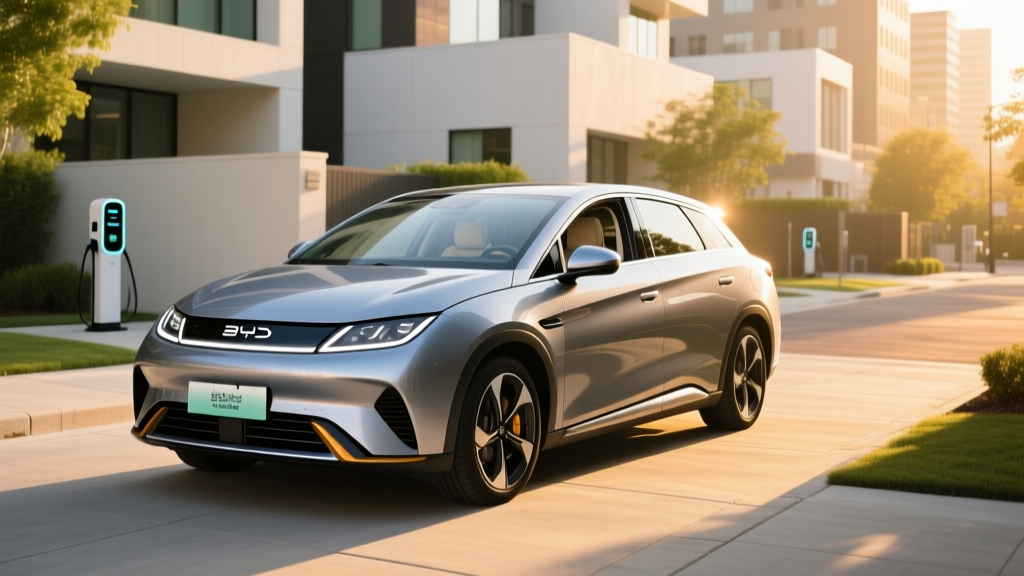
If you've seen BYD's global sales numbers — the Chinese automaker briefly surpassed Tesla as the world's top BEV seller — you've probably wondered about the BYD electric car cost for American buyers. The short answer: BYD does not currently sell passenger vehicles in the United States, and a combination of steep tariffs, federal tax-credit sourcing rules, and geopolitical trade barriers make a near-term U.S. launch unlikely. But understanding what a BYD would cost to own here — and how those economics compare to EVs you can buy — is essential for any research-heavy EV shopper tracking the global market.
This guide breaks down the hypothetical BYD ownership math using the best available global pricing data, U.S. tariff structures, and real 5-year EV ownership costs. We'll also show how similarly priced EVs that do qualify for federal incentives compare on total cost of ownership (TCO).
Why BYD Doesn't Sell Cars in the U.S. (Yet)
BYD operates in over 70 countries, offering models like the Seal (sedan), Atto 3 (compact SUV), Dolphin (hatchback), and Han (flagship sedan). Pricing in Europe and Asia ranges from roughly $25,000 to $55,000 USD equivalent. However, three barriers prevent U.S. sales:
- Import tariffs: The U.S. imposed a 100% tariff on Chinese-made EVs in 2024, effectively doubling any BYD's landed cost. A $35,000 Seal would carry a ~$35,000 tariff before dealer markup.
- Federal tax credit exclusion: Under IRS §30D rules, vehicles with battery components or critical minerals from a "foreign entity of concern" (FEOC) — which includes Chinese suppliers — are disqualified from the up-to-$7,500 clean vehicle credit. BYD vertically integrates its own Blade Battery (LFP chemistry), meaning 100% of its battery sourcing traces to China.
- No U.S. dealer/service network: BYD has commercial vehicle operations (electric buses) in California but no passenger retail infrastructure.
BYD executives have stated they are "studying" the U.S. market, but no timeline or models have been announced. Any figures below use global pricing converted to USD and adjusted for estimated tariff impact.
Estimated BYD Electric Car Cost: Global Pricing vs. U.S. Reality
Here's what BYD's key models cost internationally, and what they would cost if imported to the U.S. under current tariff rules:
| Model | Global Price (USD equiv.) | Battery / Chemistry | WLTP Range | Est. U.S. Price (w/ 100% Tariff) |
|---|---|---|---|---|
| Dolphin | ~$26,000 | 60.4 kWh / LFP Blade | 265 mi | ~$52,000+ |
| Atto 3 | ~$35,000 | 58.6 kWh / LFP Blade | 260 mi | ~$70,000+ |
| Seal | ~$42,000 | 82.5 kWh / LFP Blade | 354 mi | ~$84,000+ |
| Han EV | ~$52,000 | 85.4 kWh / LFP Blade | 323 mi | ~$104,000+ |
At tariff-inflated prices, a BYD Seal would compete with a BMW i4 or Mercedes EQB — not the affordable EVs it undercuts in Europe. This is the core reason BYD has no U.S. presence.
5-Year Total Cost of Ownership: BYD vs. Available U.S. EVs
Since you can't buy a BYD stateside, let's compare what a tariff-adjusted BYD Seal would cost to own over 5 years (75,000 miles) against two U.S.-available EVs in the ~$40,000-$45,000 pre-incentive range: the Hyundai Ioniq 6 SE (EPA 361 mi, ~$42,500 MSRP) and the Tesla Model 3 Long Range (EPA 341 mi, ~$42,880 MSRP).
| Cost Category (5 yr / 75k mi) | BYD Seal (Hypothetical, ~$84k) | Hyundai Ioniq 6 SE (~$42.5k) | Tesla Model 3 LR (~$42.9k) |
|---|---|---|---|
| Purchase price (after incentives) | $84,000 (no §30D credit) | $35,000 (est. $7,500 credit) | $35,380 (est. $7,500 credit) |
| Charging (home L2 @ $0.14/kWh) | ~$3,700 | ~$3,100 | ~$3,000 |
| Insurance (5 years) | ~$12,500 (est.) | ~$10,200 | ~$11,000 |
| Maintenance | ~$1,800 | ~$1,500 | ~$1,400 |
| Depreciation (est.) | ~$38,000 | ~$18,500 | ~$17,000 |
| 5-Year TCO | ~$140,000 | ~$68,300 | ~$67,780 |
Federal Tax Credit: Why a BYD Would Never Qualify
The IRS §30D clean vehicle credit offers up to $7,500 for qualifying new EVs, but BYD fails multiple eligibility tests simultaneously:
- Battery component sourcing: Beginning in 2024, any vehicle with battery components manufactured or assembled by a foreign entity of concern (FEOC) — which includes all Chinese companies — is disqualified. BYD manufactures its own Blade Battery cells in China.
- Critical minerals: At least 60% of critical mineral value must be sourced from the U.S. or FTA partners (2025 requirement; 70% for 2026). BYD's LFP supply chain is overwhelmingly China-domestic.
- Final assembly: Must occur in North America. BYD has no U.S. or North American assembly plant for passenger vehicles.
- MSRP caps: Sedans must not exceed $55,000 MSRP; SUVs/pickups/vans must not exceed $80,000. Even the Dolphin would blow past these caps after tariffs.
- Buyer income limits: Modified AGI must not exceed $150,000 (single), $225,000 (head of household), or $300,000 (joint). This applies to any qualifying EV, not just BYD.
For U.S. buyers, the point-of-sale transfer option (available since Jan 1, 2024) lets you apply the credit as an immediate down-payment reduction at the dealer — but only if the vehicle qualifies in the first place. BYD's vertical integration in China makes this impossible under current law.
Charging Cost vs. Gas: The Math That Works in BYD's Favor (If It Were Here)
One area where any efficient EV — BYD included — beats gasoline is per-mile fuel cost. Here's the comparison using the BYD Seal's estimated efficiency and a comparable gas sedan:
| Metric | BYD Seal (Est.) | Hyundai Ioniq 6 | Toyota Camry (Gas, 28 MPG combined) |
|---|---|---|---|
| Energy consumption | ~30 kWh/100 mi | 25 kWh/100 mi (140 MPGe) | 3.57 gal/100 mi |
| Cost per mile (home @ $0.14/kWh) | $0.042 | $0.035 | $0.125 (gas @ $3.50/gal) |
| Cost per mile (DCFC @ $0.40/kWh) | $0.120 | $0.100 | $0.125 |
| Annual fuel cost (12,000 mi, 80% home) | ~$690 | ~$580 | ~$1,500 |
At mostly home charging rates, an EV saves roughly $800-$900/year in fuel vs. a 28 MPG gas sedan. Over 5 years, that's $4,000-$4,500 in fuel savings — significant, but not enough to offset the $40,000+ tariff premium on a hypothetical BYD.
The Ioniq 6's superior efficiency (25 kWh/100 mi vs. the Seal's estimated 30) widens the gap further. Efficiency matters more than battery size when calculating long-term costs.
Maintenance Savings: Where EVs Win Universally
| Maintenance Item | Gas Vehicle (5 yr / 75k mi) | EV (5 yr / 75k mi) |
|---|---|---|
| Oil changes | $600-$1,000 (6-10 changes) | $0 |
| Brake pads/rotors | $800-$1,500 | $200-$400 (regen braking extends pad life 2-3x) |
| Transmission fluid | $150-$300 | $0 (single-speed reducer) |
| Air filters | $150-$250 | $50-$100 (cabin filter only) |
| Coolant/spark plugs | $200-$400 | $0-$100 |
| Tire rotation/replacement | $1,200-$2,000 | $1,400-$2,200 (EVs wear tires faster due to weight + torque) |
| Total (est.) | $3,100-$5,450 | $1,850-$3,100 |
Net EV maintenance savings run $1,000-$2,500 over 5 years. The biggest variable is tires — EVs' heavier curb weight and instant torque accelerate tread wear. Budget for EV-specific tires (many now carry an "EV" designation with low-rolling-resistance compounds and noise-reduction foam).
BYD's LFP Blade Battery adds a durability advantage: LFP chemistry typically sustains 3,000+ full charge cycles before reaching 80% capacity, compared to ~1,500-2,000 for NMC. That translates to 500,000+ miles of theoretical battery life — well beyond the vehicle's mechanical lifespan. However, this advantage is shared by the Tesla Model 3 RWD (also LFP) and doesn't require buying Chinese.
Insurance Reality: The Cost EV Buyers Often Overlook
EV insurance premiums run 15-25% higher than equivalent gas vehicles, according to industry data. The reasons are structural, not brand-specific:
- Higher repair costs: Battery pack replacement after collision damage can total $15,000-$25,000. Insurers price this risk into premiums.
- Specialized labor: High-voltage repairs require certified technicians, and fewer shops can handle them.
- Parts availability: For a hypothetical BYD in the U.S., parts sourcing from China would create weeks-long repair delays — a nightmare for insurance adjusters. This alone would likely push BYD insurance premiums 30-40% above comparable U.S./Korean/Japanese EVs.
- Higher purchase price: Collision/comprehensive coverage scales with vehicle value. A tariff-inflated $84,000 BYD Seal would carry premiums similar to a BMW iX.
For context, the average U.S. EV insurance premium in 2025 was approximately $2,100-$2,400/year, compared to $1,700-$1,900 for gas vehicles. Always get a personalized quote before purchase — premiums vary dramatically by ZIP code, driving record, and insurer.
Depreciation and Resale Value Trends
EV depreciation has been volatile. After a 2022-2023 price war (led by Tesla's aggressive cuts), used EV values dropped 25-35% in some segments. Current trends for 2025-2026 show stabilization, but EVs still depreciate faster than gas vehicles on average:
- Average 5-year EV depreciation: 50-60% (vs. 40-50% for gas vehicles)
- Tesla advantage: Model 3 and Model Y retain value better than most EVs (~45-50% depreciation at 5 years) due to Supercharger network access and brand recognition.
- Luxury EV penalty: High-end EVs (Mercedes EQS, BMW iX) lose 60-70% over 5 years — the tariff-inflated BYD would likely fall into this depreciation trap.
- Battery health matters: Vehicles with verifiable State of Health (SoH) data sell for more. BYD's LFP chemistry would theoretically help here, but without a U.S. service network, battery diagnostics and replacements would be nearly impossible.
For a hypothetical $84,000 BYD Seal, expect 5-year depreciation of $38,000-$46,000. The Ioniq 6 and Model 3, purchased at ~$35,000 after incentives, would depreciate $17,000-$20,000 — a massive advantage.
State and Local Incentives: The Wildcard
Even if BYD were available, state incentives would be unlikely to help:
- California (CVRP): Up to $2,000 rebate for income-qualified buyers, but requires the vehicle to be on the state's eligible list — which mirrors federal sourcing requirements.
- Colorado: Up to $5,000 state tax credit, but also references federal eligibility criteria.
- New York: Drive Clean Rebate up to $2,000, limited to vehicles meeting specific emissions and sourcing criteria.
- Utility rebates: Many utilities offer $250-$1,000 for home charger installation or off-peak charging credits — these apply regardless of vehicle brand and represent the most universally accessible incentive tier.
The pattern is clear: state programs increasingly piggyback on federal sourcing rules, meaning a Chinese-sourced BYD would be excluded at every level of government incentive.
What Should U.S. Buyers Do Instead?
If BYD's value proposition — affordable EVs with durable LFP batteries — appeals to you, these U.S.-available alternatives deliver similar benefits while qualifying for incentives:
| Alternative | MSRP (Base) | EPA Range | Battery | §30D Credit Eligible |
|---|---|---|---|---|
| Tesla Model 3 RWD | ~$38,990 | 272 mi | 60 kWh LFP | Yes (up to $7,500) |
| Hyundai Ioniq 6 SE | ~$42,500 | 361 mi | 77.4 kWh NMC | Yes (up to $7,500) |
| Chevrolet Equinox EV LT | ~$34,900 | 319 mi | 85 kWh NMC | Yes (up to $7,500) |
| Nissan Leaf SV Plus | ~$37,000 | 212 mi | 60 kWh NMC | Partial (check sourcing) |
The Tesla Model 3 RWD is the closest U.S. equivalent to BYD's LFP value play: it uses a CATL-sourced LFP battery (currently qualifying for partial credit under transitional rules), offers strong efficiency, and benefits from the Supercharger network. At ~$31,490 after the full $7,500 point-of-sale credit, it undercuts even BYD's unsubsidized global pricing.
Frequently Asked Questions
Will BYD ever sell cars in the United States?
No official timeline has been announced. The 100% tariff on Chinese EVs, FEOC battery-sourcing exclusions, and lack of a dealer network make a near-term launch improbable. BYD is focusing on Europe, Southeast Asia, South America, and Australia, where trade barriers are lower. Some analysts speculate BYD could build a North American factory (possibly in Mexico) to circumvent tariffs, but this remains speculation as of early 2026.
How much does it really cost to own an EV over 5 years?
For a U.S.-available EV like the Hyundai Ioniq 6 or Tesla Model 3 purchased at ~$35,000 after the federal credit, expect a 5-year TCO of $65,000-$70,000 including purchase price, home charging, insurance, maintenance, and depreciation. Gas vehicles in the same class typically run $72,000-$78,000 over the same period — the EV saves $5,000-$10,000 primarily through lower fuel and maintenance costs.
Do I qualify for the $7,500 federal EV tax credit?
Eligibility depends on four factors: your modified adjusted gross income (under $150k single / $300k joint), the vehicle's MSRP (under $55k for sedans / $80k for SUVs), battery component and critical mineral sourcing (no FEOC content), and North American final assembly. Since 2024, you can transfer the credit to the dealer at point of sale for an immediate price reduction. Check current rules at IRS.gov and verify specific vehicle eligibility at fueleconomy.gov.
Are EVs more expensive to insure?
Yes, typically 15-25% more than comparable gas vehicles. Higher repair costs (battery replacement), specialized labor requirements, and elevated purchase prices all factor in. For a ~$35,000 EV, expect annual premiums of $2,000-$2,400 vs. $1,700-$1,900 for a gas equivalent. Shop quotes from multiple insurers — some now offer EV-specific policies with battery coverage bundles.
How well do EVs hold their value?
Average 5-year EV depreciation sits at 50-60%, compared to 40-50% for gas vehicles. Teslas retain value best among EVs (~45-50% depreciation). LFP battery chemistry may help long-term resale as buyers increasingly understand that LFP degrades slower than NMC. However, rapid technology advancement and periodic price wars continue to pressure used EV values.