Quick Verdict: The BYD Electric Bus for Transit Fleets
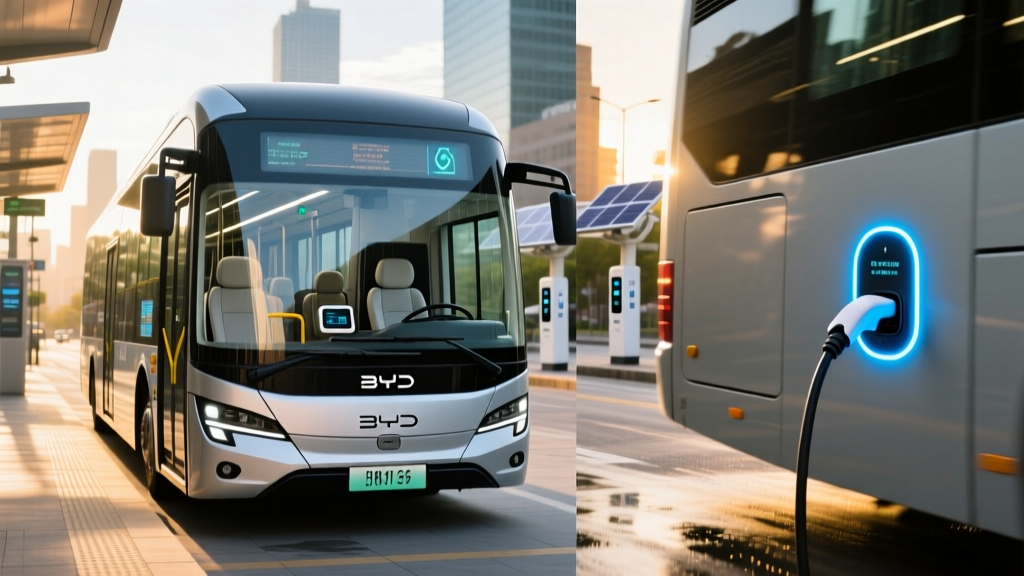
When fleet managers and transit agencies search for a BYD bus electric solution, they're typically evaluating the BYD K-series — the company's battery-electric transit bus platform that has been deployed in cities across the globe. For 2026, the most relevant model for North American consideration is the BYD K8M (40-foot standard transit bus) and the longer BYD K9M (40-foot, higher-capacity variant). These are heavy-duty commercial vehicles, not consumer automobiles, and their specifications, purchasing process, and economics differ fundamentally from passenger EVs.
This review examines the BYD electric bus platform with the same data-driven rigor we apply to passenger EVs: real-world range versus claims, charging infrastructure requirements, battery chemistry and longevity, and total cost of ownership. If you're a fleet procurement officer, transit planner, or simply curious about electric transit technology, this profile covers the numbers that matter.
BYD claims up to 155–187 miles for the K8M depending on configuration. In real-world transit duty — with frequent stops, HVAC loads, passenger weight, and urban stop-and-go — expect 120–150 usable miles on a full charge. Cold-weather operations (below 32°F) can reduce range by 20–35%, bringing effective winter range to approximately 85–115 miles. Transit agencies in northern climates typically spec routes under 100 miles or plan mid-day opportunity charging.
BYD K8M / K9M Specifications at a Glance
| Specification | BYD K8M (40-ft) | BYD K9M (40-ft HD) |
|---|---|---|
| Battery Capacity | 324 kWh (usable) | 435 kWh (usable) |
| Battery Chemistry | LFP (Lithium Iron Phosphate) | LFP (Lithium Iron Phosphate) |
| Claimed Range | ~155 miles (urban duty cycle) | ~187 miles (urban duty cycle) |
| Motor Output | 2 × 150 kW hub motors (~402 hp combined) | 2 × 150 kW hub motors (~402 hp combined) |
| Peak Torque | ~3,540 lb-ft (at wheels) | ~3,540 lb-ft (at wheels) |
| Max DC Charge Rate | ~150 kW (CCS1) | ~200 kW (CCS1) |
| 10–80% DC Charge Time | ~2.5–3 hours | ~2.8–3.5 hours |
| Passenger Capacity | ~72 (seated + standing) | ~80 (seated + standing) |
| GVWR | ~40,000 lbs | ~44,000 lbs |
| Estimated Base Price | ~$750,000–$850,000 | ~$850,000–$950,000 |
| Battery Warranty | 12 years / unlimited miles (to 80% SoH) | 12 years / unlimited miles (to 80% SoH) |
Battery Chemistry and Degradation: Why LFP Dominates Transit
BYD equips its K-series buses with lithium iron phosphate (LFP) cells — the same chemistry BYD manufactures in-house at massive scale and has increasingly adopted in passenger vehicles globally. For transit applications, LFP is the clear engineering choice over NMC (nickel manganese cobalt) for several reasons:
- Cycle life: LFP cells tolerate 3,000–5,000+ full charge-discharge cycles before reaching 80% state of health (SoH). A transit bus charging daily for 12 years accumulates roughly 4,380 cycles — squarely within LFP's durability envelope.
- Thermal stability: LFP chemistry is inherently more resistant to thermal runaway than NMC, a critical safety factor for vehicles carrying 70+ passengers through dense urban environments.
- No cobalt: LFP eliminates cobalt from the supply chain, reducing both cost and ethical sourcing concerns — a factor increasingly relevant for publicly funded fleet procurements.
- Energy density trade-off: LFP is heavier and bulkier per kWh than NMC. In a 40-foot bus with a GVWR over 40,000 lbs, this weight penalty is manageable. In a passenger car, it would be a significant constraint.
BYD's battery warranty for the K-series covers 12 years with a guaranteed 80% state of health — meaning the pack should retain at least 80% of its original capacity over the warranty period. This aligns with typical transit agency vehicle replacement cycles of 12–15 years, as defined by the Federal Transit Administration (FTA) guidelines.
Charging Infrastructure: What Depots Actually Need
Charging a BYD electric bus is fundamentally a depot-based operation. Unlike passenger EVs that can rely on a mix of home and public charging, transit buses require purpose-built depot infrastructure — and the capital costs are substantial.
| Charging Method | Power (kW) | Miles Added/Hour | Full Charge Time |
|---|---|---|---|
| Level 2 (AC Depot Charger) | 19.2–40 kW | ~8–18 mi/hr | 10–18 hours |
| DC Fast Charge (CCS1) | 150–200 kW | ~65–85 mi/hr | 3–4 hours (0–100%) |
| Pantograph (Overhead, optional) | up to 300 kW | ~130 mi/hr | 1.5–2 hours (0–100%) |
Most transit agencies deploying BYD buses use overnight Level 2 depot charging at 19.2–40 kW per vehicle, which fully replenishes the battery during an 8–10 hour layover. DC fast charging at 150–200 kW via CCS1 connectors is available for mid-day top-ups on longer routes, but sustained high-power charging generates heat in a 324–435 kWh pack, and the charge curve tapers significantly above 80% state of charge to protect cell longevity.
Infrastructure cost reality: Installing a single 150 kW DC fast charger at a bus depot typically costs $150,000–$300,000 including the charger hardware ($60,000–$120,000), electrical service upgrades, switchgear, conduit, and permitting. For a fleet of 20 buses requiring simultaneous overnight Level 2 charging, agencies budget $500,000–$1.5 million in depot electrical upgrades, depending on existing utility service capacity. Utility demand charges — the per-kW peak fees commercial customers pay — can add $5,000–$20,000/month to operating costs.
Performance and Driving Dynamics
The BYD K8M and K9M use dual rear-axle hub motors producing a combined ~402 horsepower and a massive ~3,540 lb-ft of torque at the wheels. That torque figure sounds extraordinary, but it's typical for heavy-duty electric drivetrains — hub motors multiply torque directly at the wheel without a traditional transmission, and the vehicle needs that force to accelerate 40,000+ pounds from a stop.
There is no meaningful 0–60 mph time for a transit bus — these vehicles are electronically governed to ~65 mph maximum speed and are designed for urban routes with frequent stops. Acceleration from 0–30 mph is brisk (roughly 6–8 seconds), which matters for merging into traffic and maintaining schedule adherence between closely spaced stops. Regenerative braking is aggressive enough to enable near-one-pedal operation in stop-and-go traffic, reducing brake wear significantly — a maintenance savings that transit agencies consistently report as one of the biggest operational benefits of electric buses.
Pricing, Federal Incentives, and Fleet Procurement
A BYD K8M typically costs between $750,000 and $850,000, while the higher-capacity K9M ranges from $850,000 to $950,000. For comparison, a new diesel transit bus costs roughly $500,000–$600,000. The upfront premium for electric is $200,000–$400,000 per vehicle — but the total cost equation shifts when fuel, maintenance, and federal subsidies are factored in.
Federal funding for transit electrification does not work like the consumer §30D tax credit. Commercial transit buses are typically purchased through:
- FTA Low-No Program: The FTA Low or No Emission Vehicle Program provides competitive grants covering up to 80–85% of the capital cost of electric buses and charging infrastructure for public transit agencies.
- EPA Clean School Bus Program: For school bus variants (BYD Type D), the EPA offers up to $375,000 per electric school bus plus $20,000 for charging infrastructure under the Clean School Bus Program.
- IRA Commercial Vehicle Credit (§45W): For private fleet operators (not public transit agencies), the IRS §45W Commercial Clean Vehicle Credit provides up to $40,000 for qualifying heavy-duty electric vehicles — far less than the bus price premium, but meaningful for private operators.
The consumer §30D tax credit (up to $7,500) does not apply to commercial transit buses. Private fleet operators should consult a tax professional regarding §45W eligibility, which has its own MSRP thresholds, domestic content requirements, and battery-sourcing rules that evolve annually.
Real-World Operations: What Transit Agencies Report
Multiple U.S. transit agencies have operated BYD electric buses in revenue service, and their published findings reveal consistent patterns:
Range in service: Agencies in warm climates (Southern California, Texas) report achieving 130–155 miles on a single charge in typical urban duty cycles. Agencies in cold climates (Minnesota, Massachusetts) report winter range of 85–110 miles — a 30–40% reduction driven by cabin heating demands and reduced battery efficiency at low temperatures. Many northern agencies install diesel- or electric-powered auxiliary heaters to reduce HVAC load on the traction battery.
Maintenance savings: Electric buses eliminate engine oil changes, transmission servicing, exhaust system repairs, and diesel particulate filter maintenance. Agencies typically report 40–60% lower maintenance cost per mile. However, early-model BYD buses in some U.S. deployments experienced issues with door systems, HVAC components, and software glitches — problems that are common across all new transit bus platforms, not unique to BYD.
The geopolitical factor: BYD is a Chinese-headquartered company, and the National Defense Authorization Act (NDAA) has included provisions restricting federal transit funding from being used to procure buses from certain Chinese manufacturers. This has effectively limited BYD's access to FTA-funded procurement in the United States since 2020. Agencies considering BYD buses should consult current federal procurement restrictions and state-level regulations before initiating a purchase.
Pros and Cons
- LFP battery chemistry offers excellent cycle life (3,000–5,000+ cycles) and thermal safety
- 12-year battery warranty to 80% SoH matches transit replacement cycles
- 40–60% lower maintenance cost per mile vs. diesel
- Regenerative braking drastically reduces brake wear
- Zero tailpipe emissions — critical for depot air quality and urban corridors
- Quiet operation improves rider experience and reduces noise pollution
- $200,000–$400,000 upfront premium over diesel equivalents
- Depot charging infrastructure requires $500K–$1.5M+ in electrical upgrades
- Cold-weather range loss of 20–40% limits winter route flexibility
- 3–4 hour DC fast charge time (0–100%) limits mid-day turnaround
- Federal procurement restrictions (NDAA) limit FTA-funded purchases in the U.S.
- Utility demand charges can add $5,000–$20,000/month to depot operating costs
Who Should Consider the BYD Electric Bus?
The BYD K-series electric bus is best suited for:
- Transit agencies in moderate climates with routes under 130 miles and overnight depot charging access.
- Agencies outside the U.S. or those with non-federal funding sources that are not subject to NDAA procurement restrictions.
- Private shuttle operators (airports, campuses, corporate parks) with predictable, short routes and dedicated charging facilities.
- School districts evaluating the BYD Type D electric school bus, where the EPA Clean School Bus Program can offset significant capital cost.
It is less suited for agencies in extreme cold climates without mid-day charging, long intercity routes exceeding 150 miles, or any U.S. public transit agency dependent on FTA Low-No grant funding due to current procurement restrictions.
Frequently Asked Questions
What is the real-world range of the BYD electric bus?
In warm-climate urban service, expect 130–155 miles on a full charge for the K8M. In cold weather (below 32°F), range drops to approximately 85–110 miles due to cabin heating loads and reduced battery efficiency. The K9M's larger 435 kWh pack extends these figures by roughly 20–25%.
How fast does a BYD bus charge?
Via CCS1 DC fast charging at 150–200 kW, a 10–80% charge takes approximately 2.5–3.5 hours. Overnight Level 2 depot charging at 19.2–40 kW requires 10–18 hours for a full charge, which aligns with typical overnight layover schedules.
Does the BYD electric bus qualify for the federal EV tax credit?
The consumer §30D credit does not apply to commercial transit buses. Private fleet operators may qualify for the IRS §45W Commercial Clean Vehicle Credit (up to $40,000 for heavy-duty vehicles), subject to battery sourcing and domestic content requirements. Public transit agencies typically rely on FTA Low-No grants or EPA Clean School Bus funding instead.
Is BYD still selling buses in the United States?
Federal procurement restrictions enacted through the NDAA have limited the ability of U.S. public transit agencies to use federal funds to purchase BYD buses. BYD continues to sell globally and maintains a manufacturing facility in Lancaster, California, but agencies should verify current eligibility before pursuing procurement.
How long will the BYD bus battery last?
BYD's LFP battery is warranted for 12 years at 80% state of health. LFP chemistry typically sustains 3,000–5,000+ charge cycles, which translates to 8–14 years of daily charging before meaningful capacity loss. Replacement battery packs for heavy-duty buses currently cost $150,000–$250,000 depending on capacity.
How does BYD compare to New Flyer, Proterra, and other competitors?
BYD is the world's largest electric bus manufacturer by volume, with cost advantages from vertical integration (they make their own batteries, motors, and semiconductors). New Flyer (Xcelsior CHARGE) offers similar range with U.S. Buy America compliance. Proterra's ZX5 provides up to 329 miles of claimed range with a larger battery option but at higher cost. The choice often comes down to procurement restrictions, Buy America compliance, and local dealer support rather than pure specifications.