Quick Verdict: A Bargain-Basement City Car With Global Ambitions
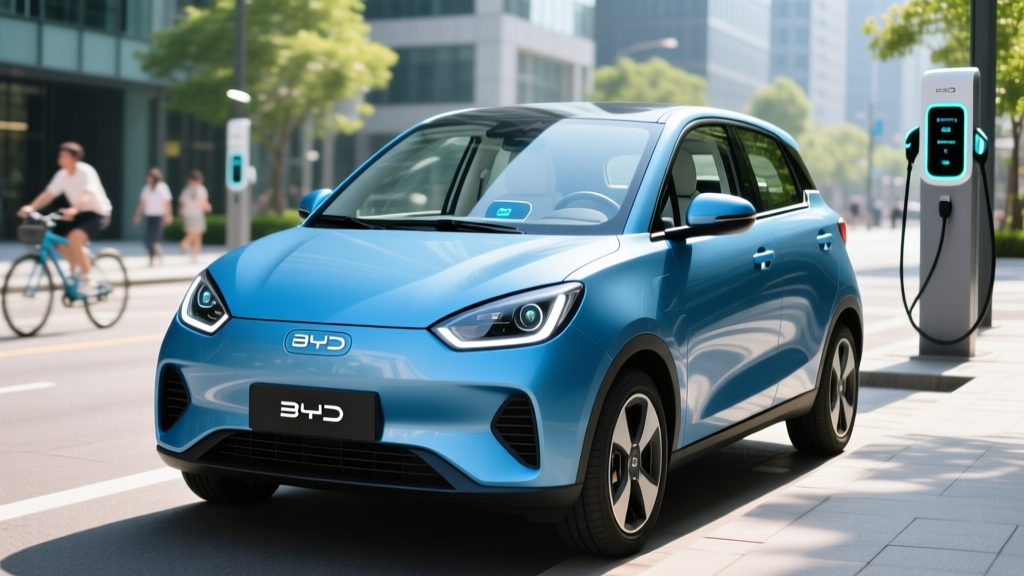
The BYD E1 is a subcompact electric hatchback originally launched for the Chinese domestic market, positioned as one of the most affordable EVs in BYD's lineup. Built on BYD's early e-Platform and powered by the company's trademark lithium iron phosphate (LFP) Blade Battery technology, the E1 targets urban commuters who need a low-cost, efficient runabout rather than a highway cruiser or family hauler.
As of 2026, the BYD E1 remains primarily available in China and select emerging markets. It is not officially sold in the United States, and BYD has not announced US passenger-vehicle sales due to ongoing tariff structures and regulatory barriers. This review examines the E1's specifications and capabilities to help international buyers evaluate it and to give US readers context on the global budget-EV landscape.
| Spec | Value |
|---|---|
| EPA-Equivalent Range (NEDC) | ~189 mi (305 km) |
| Estimated Real-World Range | ~120–145 mi |
| Battery Capacity | ~35.2 kWh (usable) |
| Battery Chemistry | LFP (Blade Battery) |
| Motor Output | ~61 hp (45 kW) / 110 Nm torque |
| Drivetrain | FWD, single motor |
| 0–60 mph (est.) | ~13–15 seconds |
| Top Speed | ~68 mph (110 km/h) |
| Max DC Fast Charge | ~40 kW (CCS/GB/T) |
| 10–80% DC Charge | ~50–60 minutes |
| Level 2 AC Charge Rate | ~6.6 kW |
| Length / Width / Height | 135.2 / 66.1 / 59.1 in |
| Cargo Volume (rear seats up) | ~8.5 cu ft |
| Curb Weight | ~2,645 lbs |
| Base MSRP (China) | ~¥69,800 (~$9,600 USD) |
| US Availability | Not available |
Range and Efficiency: Honest Numbers for a Small Pack
The BYD E1 carries a ~35.2 kWh LFP battery pack. BYD rates the vehicle at approximately 305 km (189 miles) on the older NEDC testing cycle, which is widely recognized as optimistic compared to the WLTP or US EPA standards. Translated to an EPA-equivalent estimate, expect roughly 140–155 miles under favorable conditions.
Real-World Range Expectations
NEDC Sticker: ~189 mi (305 km)
EPA-Equivalent Estimate: ~140–155 mi
Highway (65–70 mph sustained): ~105–120 mi
Cold Weather (below 32°F / 0°C): ~85–100 mi (LFP packs lose ~25–35% range in deep cold without active thermal preconditioning)
The E1's modest battery and lack of a heat pump in early trims mean cold-weather commuters should plan conservatively. For a 30-mile round-trip commute with climate control, the E1 handles daily needs easily in temperate climates but becomes tight in sub-freezing conditions.
Efficiency is the E1's strong suit. At roughly 25–28 kWh per 100 miles in mixed driving (equivalent to approximately 120–135 MPGe), the car sips electrons thanks to its featherweight curb weight of around 2,645 lbs. City driving with frequent regenerative braking pushes efficiency even higher.
Charging: Adequate for Overnight, Painful on Road Trips
The E1's charging profile reflects its budget positioning. BYD equipped the car with modest DC fast-charging capability that prioritizes battery longevity over speed.
| Charging Level | Power | Speed / Time |
|---|---|---|
| Level 1 (120V household) | ~1.4 kW | ~4–5 mi/hr; full charge ~24+ hr |
| Level 2 (240V home/public) | ~6.6 kW | ~18–22 mi/hr; 10–100% in ~5 hr |
| DC Fast Charge | ~40 kW peak | 10–80% in ~50–60 min |
The ~40 kW peak DC charge rate is the E1's most significant limitation for anything beyond city use. While competitors in the global subcompact segment (such as the Chevrolet Bolt EV at 55 kW or the Wuling Bingo at similar rates) aren't much faster, the E1's charge curve tapers noticeably above 60% state of charge. Expect sustained rates closer to 25–30 kW during the middle of the charging session.
For home Level 2 charging, the 6.6 kW onboard charger replenishes the 35 kWh pack overnight in about five hours — perfectly adequate for daily commuting. In China, the E1 uses the GB/T connector standard; export markets would require CCS2 or NACS adapters depending on region.
Performance and Drivetrain: Commuter Pace, Not Thrills
The E1's single front-mounted permanent magnet motor produces approximately 61 horsepower (45 kW) and 110 Nm (81 lb-ft) of torque. This is an urban-spec powertrain, and the 0–60 mph time of roughly 13–15 seconds reflects that reality.
Around town, the instant torque delivery makes the E1 feel peppy up to about 30 mph. Highway merging requires planning — the car's top speed is electronically limited to around 68 mph (110 km/h), and acceleration above 50 mph is leisurely. The front-wheel-drive layout and narrow tires prioritize efficiency over grip.
Ride quality is acceptable on smooth urban roads, but the short wheelbase (~95.7 inches) and torsion-beam rear suspension transmit bumps sharply on rougher surfaces. Steering is light and low-effort, ideal for parking but vague at speed.
Interior, Cargo, and Technology
Inside, the E1 follows a minimalist approach consistent with its price point:
- Infotainment: An 8-inch or 10.1-inch touchscreen (trim-dependent) with Bluetooth, basic navigation, and phone mirroring. No wireless Apple CarPlay or Android Auto in most trims.
- Instrument Cluster: A small digital display showing speed, range, and battery state.
- Climate: Manual air conditioning on base trims; automatic climate on higher trims. No heat pump on early models.
- Driver Assistance: Basic ABS, stability control, and dual front airbags. No adaptive cruise control, lane-keeping assist, or automatic emergency braking — this is a SAE Level 0 vehicle with no advanced driver-assistance systems.
Passenger space is tight. Front-seat occupants get adequate headroom and legroom, but the rear seats are best suited for children or short trips. Cargo volume behind the rear seats is approximately 8.5 cubic feet — enough for a few grocery bags but not much more. Folding the rear seats expands capacity to roughly 25 cu ft, though the load floor isn't flat.
Pricing, Tax Credits, and the US Availability Problem
In China, the BYD E1 starts at approximately ¥69,800 (~$9,600 USD), making it one of the least expensive four-door EVs on any market. Higher trims with the larger touchscreen and additional features push toward ¥85,000 (~$11,700 USD).
| Market | Price | Tax Credit Eligibility |
|---|---|---|
| China (base) | ~¥69,800 (~$9,600) | China NEV subsidies (domestic) |
| China (top trim) | ~¥85,000 (~$11,700) | China NEV subsidies (domestic) |
| United States | Not available | N/A — not sold; would not qualify for §30D credit due to battery sourcing and China-manufacture rules |
For US buyers wondering about the IRS §30D federal EV tax credit: even if the E1 were imported, it would almost certainly fail the critical-mineral and battery-component sourcing requirements that mandate North American manufacturing and free-trade-agreement partner sourcing. The credit's MSRP cap ($55,000 for sedans/hatchbacks) wouldn't be an issue, but the Made-in-China origin is disqualifying under current rules.
Battery Longevity, Warranty, and Ownership Costs
BYD's LFP Blade Battery is one of the E1's strongest selling points. LFP chemistry offers inherent advantages for budget EVs:
- Cycle life: 3,000+ full charge cycles before reaching 80% capacity — far exceeding NMC cells
- Thermal stability: LFP is significantly more resistant to thermal runaway than NMC/NCA chemistries
- Cost: Lower per-kWh manufacturing cost, which keeps the vehicle price down
The trade-off is lower energy density (meaning a heavier, bulkier pack for the same kWh) and worse cold-weather performance — both evident in the E1.
In China, BYD typically offers an 8-year/150,000 km (93,000 mi) battery warranty on the E1, with the broader vehicle warranty at 6 years/150,000 km. These terms are competitive for the segment.
Who Should Consider the BYD E1?
Pros
- Extremely low purchase price (~$9,600 in China)
- LFP Blade Battery offers exceptional cycle life and safety
- Excellent efficiency (~25–28 kWh/100 mi)
- Tiny footprint makes parking effortless
- Low operating costs (electricity + minimal maintenance)
Cons
- Not available in the US or most Western markets
- Real-world range of ~120–145 mi limits highway use
- Slow DC charging (~40 kW peak, 50–60 min 10–80%)
- No advanced driver-assistance features (Level 0)
- Tight rear seats and minimal cargo space
- No heat pump on early trims; significant cold-weather range loss
The BYD E1 is best suited for: Urban commuters in markets where it's sold, who need a second car or a solo commuter vehicle for short daily trips under 40 miles, have access to overnight home charging, and prioritize purchase price over technology or range.
It is not suited for: Anyone needing highway capability, family hauling, road-trip flexibility, or advanced safety technology. US buyers should look at the Chevrolet Bolt EV/EUV (used market), Nissan Leaf, or upcoming affordable models from Hyundai and Kia instead.
Frequently Asked Questions
What is the real-world range of the BYD E1?
Expect approximately 120–145 miles in mixed driving at moderate temperatures. Highway driving at sustained speeds drops this to around 105–120 miles, and sub-freezing weather can reduce range to 85–100 miles due to LFP chemistry characteristics and the lack of a heat pump on base trims.
How fast does the BYD E1 charge?
On DC fast charging, the E1 peaks at approximately 40 kW, taking about 50–60 minutes to charge from 10% to 80%. On a Level 2 home charger at 6.6 kW, a full charge takes roughly 5 hours. Level 1 (120V) charging is impractically slow at over 24 hours for a full charge.
Can I buy the BYD E1 in the United States?
No. As of 2026, BYD does not sell passenger vehicles in the US market. Tariffs on Chinese-manufactured vehicles and the §30D tax credit's battery-sourcing requirements make US introduction unlikely in the near term. BYD has focused its international expansion on Europe, Southeast Asia, and Latin America with higher-end models like the Atto 3 and Seal.
Does the BYD E1 qualify for any EV tax credits?
In China, the E1 qualifies for domestic NEV purchase incentives and exemption from vehicle purchase tax. In the US, it would not qualify for the federal §30D credit even if imported, because its battery components and critical minerals are China-sourced, failing the domestic-content requirements outlined by the IRS.
Is the BYD E1 worth buying vs. competitors?
In markets where it's available, the E1 competes against the Wuling Bingo, Changan Lumin, and Geely Panda Mini. The E1 wins on brand reputation and LFP battery durability but loses on interior space (Wuling Bingo is roomier) and charging speed. For buyers in China seeking a sub-¥80,000 EV, the E1 is a solid, if basic, choice. International buyers have no direct equivalent at this price point.
How long will the BYD E1 battery last?
BYD's LFP Blade Battery is rated for 3,000+ full charge cycles before degrading to 80% capacity. At the E1's ~140-mile real-world range, that translates to approximately 420,000 miles of driving before significant degradation — effectively exceeding the vehicle's structural lifespan. The 8-year/150,000 km warranty provides additional peace of mind.