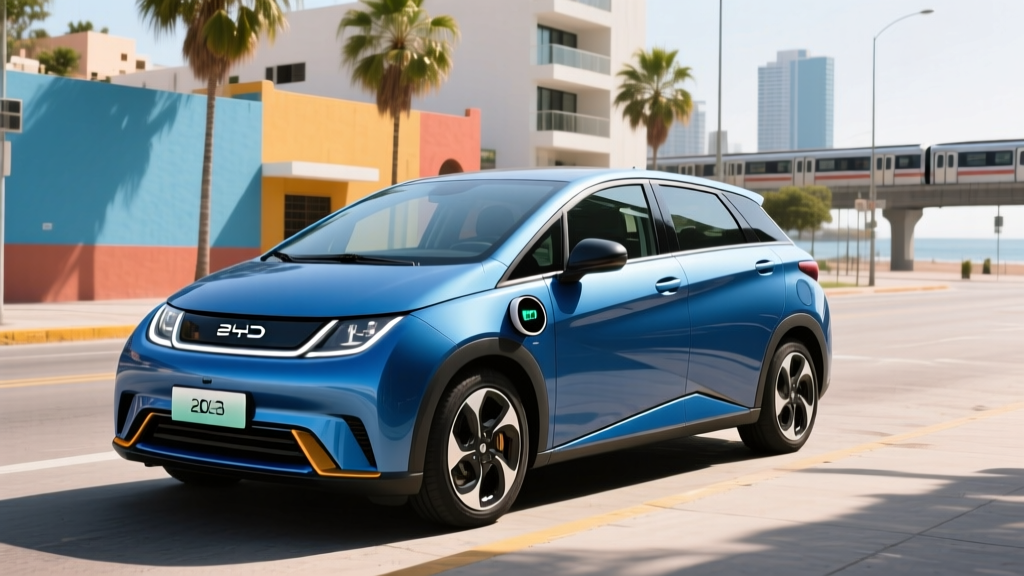
The BYD Dolphin has become one of the most talked-about affordable electric hatchbacks in Latin America, and Mexico is ground zero for its expansion. Launched in mid-2023 and updated through the 2025–2026 model years, the Dolphin undercuts many competitors on price while offering a practical 400+ km WLTP range and BYD's proven Blade Battery. But how does it actually perform on Mexican roads, and does it make sense for buyers who might also be considering U.S. purchase and import? This review breaks down every spec that matters — range, charging, pricing, and ownership realities — from a data-first perspective.
Range and Efficiency: What the Sticker Says vs. Reality
The BYD Dolphin sold in Mexico comes in two battery configurations depending on trim. The standard-range Essential trim carries a 44.9 kWh LFP (lithium iron phosphate) Blade Battery, while the higher Extended Range (sometimes labeled Premium or GS, depending on model year) packs a 60.4 kWh LFP pack. Because the Dolphin is not officially sold in the United States, there is no EPA range figure — BYD and Mexican regulators use the WLTP cycle instead.
Essential (44.9 kWh): WLTP 340 km (~211 mi) → Expect ~270–290 km (~168–180 mi) in mixed real-world driving; ~230 km (~143 mi) sustained highway at 110 km/h.
Extended Range (60.4 kWh): WLTP 427 km (~265 mi) → Expect ~340–370 km (~211–230 mi) mixed; ~280–300 km (~174–186 mi) sustained highway.
Cold-weather note: Mexico's climate is largely favorable for EVs, but owners in high-altitude cities like Mexico City (2,240 m) or Chihuahua in winter may see 10–15% range reduction when temperatures drop below 5°C (41°F), primarily due to cabin heating demands and reduced battery chemical efficiency. LFP chemistry is slightly more cold-sensitive than NMC at low states of charge.
Efficiency figures from owner reports and Latin American testing place the Extended Range Dolphin at roughly 15.5–17.0 kWh/100 km (equivalent to approximately 120–130 MPGe combined). That's competitive with the Chevrolet Bolt EV and slightly behind the Hyundai Kona Electric, but entirely respectable for a hatchback in this price bracket.
| Spec | Essential (44.9 kWh) | Extended Range (60.4 kWh) |
|---|---|---|
| Battery Chemistry | LFP (Blade) | LFP (Blade) |
| WLTP Range | 340 km (211 mi) | 427 km (265 mi) |
| Real-World Mixed | ~270–290 km (168–180 mi) | ~340–370 km (211–230 mi) |
| Efficiency | ~14.5 kWh/100 km | ~15.5–17.0 kWh/100 km |
| MPGe (est.) | ~135 MPGe | ~120–130 MPGe |
Charging Speed: DC Fast Charge and Home Level 2
Charging capability is where budget EVs often compromise, and the Dolphin is no exception — though it's adequate for its intended use case. The Extended Range model supports up to 80 kW DC fast charging, while the Essential trim peaks around 60 kW. These are modest figures compared to the 150–250 kW rates seen on premium EVs, but they're in line with rivals like the Chevrolet Bolt EV (55 kW with the old CCS setup) and the Nissan Leaf (50 kW CHAdeMO).
On a compatible DC fast charger, the Extended Range Dolphin charges from 10–80% in approximately 35–40 minutes. The charge curve is relatively flat for an LFP battery — BYD's Blade cells tolerate sustained mid-range charging rates better than some NMC packs, but you will see tapering above 80% SoC, where speeds drop to roughly 20–25 kW to protect cell longevity.
| Charging Level | Power / Rate | Time / Speed |
|---|---|---|
| Level 1 (120V household) | ~1.4 kW | ~4–5 km range per hour |
| Level 2 (240V home / public AC) | 7 kW (single-phase) | ~40–45 km per hour; 0–100% in ~8.5 hr (Extended) |
| DC Fast Charge (Extended) | Up to 80 kW peak | 10–80% in ~35–40 min |
| DC Fast Charge (Essential) | Up to 60 kW peak | 10–80% in ~40–45 min |
Connector note: The Dolphin sold in Mexico uses the GB/T charging standard for DC (Chinese standard), though some market versions include a CCS2 adapter or have been fitted with Type 2/CCS2 for AC charging. Mexican buyers should verify the connector type with their dealer and confirm compatibility with local public charging networks like EverCharge, Electropistas, and CFE's growing charger network. Adapter availability varies, and this is a genuine ownership consideration that many first-time EV buyers overlook.
Performance and Drivetrain
The Dolphin is tuned for urban comfort, not performance thrills. The Extended Range variant uses a single front-mounted permanent magnet synchronous motor producing 150 kW (201 hp) and 310 Nm (229 lb-ft) of torque. The Essential trim gets a smaller 70 kW (94 hp) motor with 180 Nm (133 lb-ft).
Acceleration for the Extended Range model hits 0–100 km/h (0–62 mph) in approximately 7.0 seconds. That's genuinely quick for a subcompact hatchback and makes highway merging and overtaking confident. The Essential trim, with its 94 hp motor, takes roughly 12–13 seconds to 100 km/h — adequate for city use but noticeably lethargic on freeway on-ramps.
All Dolphin variants are front-wheel drive. There is no AWD or dual-motor option. Regenerative braking offers two levels selectable via the drive mode interface, though it does not enable true one-pedal driving in the way a Nissan Leaf or Chevrolet Bolt does — you will still need the friction brake for complete stops.
Interior Space, Cargo, and Daily Practicality
Despite its subcompact exterior (4,125 mm long, 1,770 mm wide, 1,570 mm tall), the Dolphin's wheelbase of 2,700 mm — longer than many rivals — translates to surprisingly generous interior room. Rear-seat legroom is listed at approximately 890 mm (35 inches), which puts it ahead of the Chevrolet Bolt EV and on par with the Hyundai Kona Electric.
Cargo volume behind the rear seats is 345 liters (12.2 cu ft), expanding to approximately 1,310 liters (46.3 cu ft) with the 60/40 split rear seats folded. That's competitive but not class-leading — the Bolt EV offers 16.9 cu ft behind its rear seats. There is no front trunk (frunk); the space under the hood is occupied by the motor and power electronics.
The cabin materials are hard-plastic-heavy, which is expected at this price point, though the standard rotating 12.8-inch touchscreen (it pivots between landscape and portrait orientation) is a distinctive feature. Wireless Apple CarPlay and Android Auto are included on most trims. A 5-inch digital instrument cluster sits behind the steering wheel.
Pricing in Mexico and the U.S. Tax Credit Question
The BYD Dolphin is priced aggressively in Mexico. As of early 2026 model-year listings, approximate MSRPs are:
- Essential (44.9 kWh): ~MXN $439,900 (~USD $25,500 at prevailing exchange rates)
- Extended Range / Premium (60.4 kWh): ~MXN $529,900 (~USD $30,700)
These prices make the Dolphin one of the most affordable new EVs available in Mexico, undercutting the Chevrolet Bolt EUV and rivaling the JAC E-Sei4 and MG4 in the local market.
The BYD Dolphin is not sold in the United States and is not eligible for the IRS §30D New Clean Vehicle Credit. Even if a buyer were to import one, the §30D credit requires the vehicle to be assembled in North America (with limited exceptions), meet battery-component and critical-mineral sourcing thresholds, fall under MSRP caps ($55,000 for sedans/hatchbacks), and the buyer must meet adjusted gross income limits ($150,000 single / $300,000 joint). BYD's battery sourcing — predominantly Chinese-manufactured LFP cells — would almost certainly fail the foreign-entity-of-concern (FEOC) restrictions effective under current IRS rules.
For U.S.-based buyers cross-shopping, this means the Dolphin's price advantage narrows significantly compared to credit-eligible models like the Chevrolet Equinox EV or Hyundai Kona Electric.
Battery Warranty and Long-Term Ownership
BYD provides an 8-year / 160,000 km (roughly 100,000 mile) warranty on the Blade Battery pack and electric powertrain in the Mexican market. The vehicle bumper-to-bumper warranty is typically 5 years / 150,000 km. These terms are competitive with global norms (most manufacturers offer 8 years / 100,000 miles on the battery) and reflect confidence in LFP chemistry's cycle life.
LFP batteries, like BYD's Blade, are known for exceptional cycle longevity — typically rated for 3,000+ full charge cycles before degrading to 80% of original capacity. In practical terms, that translates to well over 1 million km of driving before meaningful degradation occurs. The trade-off is lower energy density compared to NMC chemistry, which is why the Dolphin's 60.4 kWh pack is physically larger and heavier than an equivalent-capacity NMC pack would be.
BYD's growing dealer and service network in Mexico — with presence in Mexico City, Guadalajara, Monterrey, and expanding to secondary cities — is a positive sign for parts availability. However, long-term service experience is still limited compared to legacy brands, and body-shop familiarity with BYD-specific parts remains a consideration for collision repair.
Driver Assistance and Safety Technology
The Dolphin comes equipped with BYD's DiPilot suite on higher trims, which includes:
- Adaptive cruise control (ACC)
- Lane-keeping assist (LKA)
- Automatic emergency braking (AEB)
- Blind-spot monitoring (BSM)
- 360-degree surround-view camera
These are SAE Level 1–2 driver-assistance features — they support the driver but do not replace active attention. The Dolphin does not offer anything comparable to Tesla's Autopilot or GM's Super Cruise in terms of hands-free highway capability. Lane centering is functional but not exceptional in our assessment, and the ACC system can be abrupt in stop-and-go traffic.
Safety ratings from Latin NCAP (the regional equivalent of Euro NCAP) awarded the Dolphin 4 stars in its assessment, with good adult-occupant protection but deductions for rear-seat safety and some ADAS consistency. For reference, see Latin NCAP results.
Who Should Buy the BYD Dolphin in Mexico?
• Urban commuters in Mexico City, Guadalajara, or Monterrey who drive 40–80 km daily and can charge at home overnight.
• Cost-conscious buyers who want a new EV under MXN $550,000 and don't need long-distance road-trip capability.
• Second-car households where the Dolphin handles daily errands and a longer-range vehicle covers intercity travel.
Look Elsewhere If:
• You regularly drive 300+ km highway routes — the 80 kW DC charging speed and ~300 km real-world range make road trips tedious.
• You need substantial cargo space — the 12.2 cu ft trunk is hatchback-modest.
• You're a U.S. buyer hoping to import for the tax credit — it won't qualify under current §30D rules.
How It Stacks Up: Dolphin vs. Mexico-Market Rivals
| Spec | BYD Dolphin Extended | MG4 EV | JAC E-Sei4 |
|---|---|---|---|
| Battery (kWh) | 60.4 LFP | 64 NMC | 50.1 LFP |
| WLTP Range | 427 km | 450 km | 400 km |
| DC Fast Charge | 80 kW | 135 kW | 60 kW |
| Power (hp) | 201 | 204 | 150 |
| Approx. Price (MXN) | $529,900 | $599,900 | $499,900 |
The MG4 offers faster DC charging and slightly more range but costs roughly MXN $70,000 more. The JAC E-Sei4 is cheaper but significantly slower to charge and less powerful. The Dolphin occupies a strong middle ground: solid range, adequate charging, competitive power, and BYD's brand cachet as the world's largest EV manufacturer.
Frequently Asked Questions
What is the real-world range of the BYD Dolphin in Mexico?
The Extended Range (60.4 kWh) Dolphin delivers approximately 340–370 km (211–230 miles) in mixed real-world driving. Highway-only driving at 110 km/h reduces this to around 280–300 km. The Essential trim (44.9 kWh) manages roughly 270–290 km mixed. WLTP sticker figures of 427 km and 340 km respectively are optimistic — plan your trips around the real-world numbers.
How fast does the BYD Dolphin charge at home and on the road?
At home on a 7 kW Level 2 charger, the Extended Range Dolphin adds roughly 40–45 km of range per hour, achieving a full charge in about 8.5 hours — fine for overnight charging. On DC fast chargers, it peaks at 80 kW (Extended) or 60 kW (Essential), reaching 10–80% in 35–40 minutes. Verify your local charger's connector compatibility, as the Dolphin uses GB/T in many markets.
Does the BYD Dolphin qualify for the U.S. federal EV tax credit?
No. The Dolphin is not sold in the U.S. and would not qualify for the IRS §30D credit even if imported. BYD's Chinese-manufactured battery cells fail the foreign-entity-of-concern (FEOC) sourcing requirements, and the vehicle is not assembled in North America. Mexican buyers should check local state-level incentives, which vary by jurisdiction.
Is the BYD Dolphin worth buying vs. the MG4 or Chevrolet Bolt?
If your priority is the lowest price with adequate range and you primarily drive in the city, the Dolphin is a strong value pick. If you need faster DC charging for road trips, the MG4's 135 kW capability is a meaningful advantage. The Chevrolet Bolt EV (if available used or remaining inventory) offers EPA-rated range familiarity for cross-border buyers but is no longer in production as of 2025.
What are the biggest pros and cons of the BYD Dolphin?
- Strong value — under MXN $530K for Extended Range
- LFP Blade Battery: exceptional cycle life, safe chemistry
- Spacious rear seat for its class (2,700 mm wheelbase)
- 201 hp Extended motor is quick for a hatchback
- Rotating 12.8" touchscreen is a fun differentiator
- BYD's global scale supports long-term parts availability
- 80 kW DC charging is slow for road trips
- GB/T connector limits public charger compatibility in Mexico
- Modest 12.2 cu ft cargo volume
- No frunk (front trunk)
- Lane-keeping assist is inconsistent at highway speeds
- Not eligible for U.S. tax credits; limited cross-border appeal
The BYD Dolphin in Mexico represents a pragmatic entry point into EV ownership for urban and suburban drivers. It won't win charging-speed contests or impress on cross-country road trips, but at its price point, with BYD's proven Blade Battery durability and adequate daily range, it delivers exactly what its target buyer needs: affordable, reliable electric commuting with minimal fuss.