The BYD D1: Purpose-Built for the Ride-Hail Era
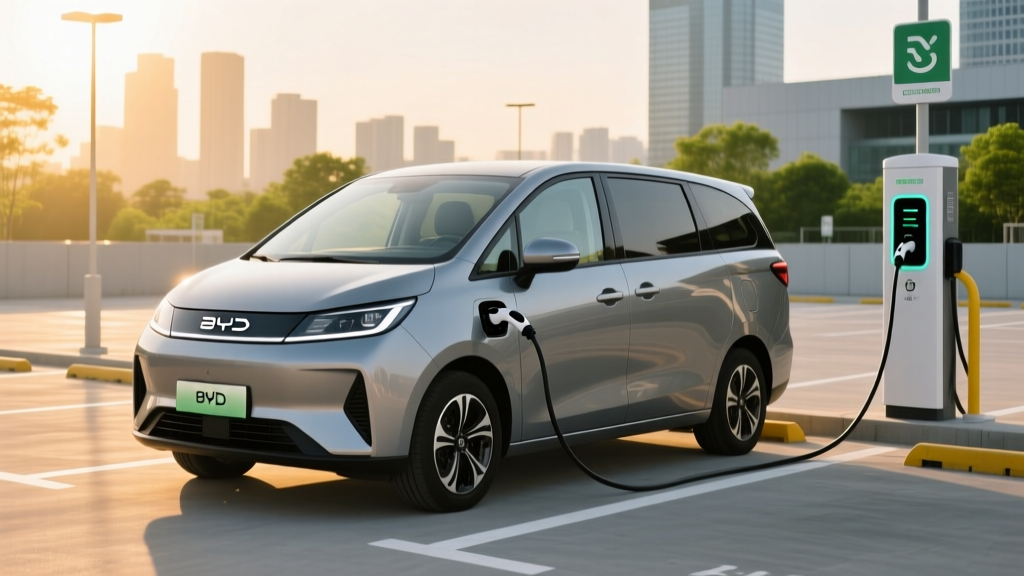
Most electric vehicles are designed to appeal to as broad a buyer base as possible. The BYD D1 takes the opposite approach. Co-developed with China's DiDi (the world's largest ride-hailing platform), the D1 is an electric minivan engineered specifically for drivers who spend 8–12 hours a day behind the wheel ferrying passengers. It's a vehicle born from data — DiDi's billions of completed trips informed everything from the sliding rear door to the seat foam density.
For the US-based EV shopper, the D1 presents a fascinating case study in purpose-built electrification. Whether you're a rideshare driver evaluating your next vehicle, a fleet operator, or simply curious about how the world's largest EV maker approaches a niche segment, this profile breaks down every spec that matters — from real-world range to charging curves to total cost of ownership.
EPA-estimated range: ~260 miles (CLTC-rated 418 km / ~260 mi equivalent)
Real-world expectation: 200–230 miles in mixed city/highway driving; expect 170–195 miles in sustained highway use at 70+ mph, and 160–180 miles in cold weather (below 32°F). The D1's boxy aerodynamic profile and 1,690 kg curb weight work against highway efficiency, but city regen-heavy driving plays to its strengths.
Battery, Range, and Efficiency
The BYD D1 is powered by BYD's proprietary Blade Battery — a lithium iron phosphate (LFP) cell architecture that has become one of the most talked-about battery technologies in the EV industry. Unlike the nickel-manganese-cobalt (NMC) chemistry found in many long-range EVs, LFP trades some energy density for superior thermal stability, longer cycle life, and lower raw-material cost.
| Spec | Value |
|---|---|
| Battery chemistry | LFP (Lithium Iron Phosphate) — Blade cell format |
| Battery capacity (total) | 55 kWh |
| Usable capacity | ~53 kWh |
| EPA-estimated range | ~260 miles |
| Efficiency (combined) | ~115 MPGe / ~29 kWh per 100 mi |
| Thermal management | Liquid cooling with heat pump |
Why LFP matters for the D1's use case: Ride-hail drivers typically charge daily, often to 100%. NMC batteries degrade faster when held at full charge and subjected to high cycle counts. LFP chemistry, by contrast, tolerates daily 100% charges with significantly less capacity loss over time. BYD rates the Blade Battery for over 3,000 charge cycles before reaching 80% state of health — that's roughly 780,000 miles of range throughput, far exceeding the vehicle's expected service life.
The trade-off is energy density. At 55 kWh total, the D1 carries less energy than similarly sized crossovers with NMC packs (the Tesla Model Y Long Range, for comparison, packs ~75 kWh). That's why the D1's range tops out around 260 miles rather than 330+. For a city-based ride-hail driver averaging 120–180 miles per shift, this is more than adequate — but it does mean highway-heavy drivers will need a mid-shift top-up.
The inclusion of a heat pump is a significant efficiency win. In cold weather, EVs without heat pumps can lose 30–40% of range to cabin heating. The D1's heat pump reduces that penalty to roughly 20–25%, which translates to roughly 20 additional miles of range on a freezing day compared to resistive heating alone.
Charging Speed: DC Fast, Level 2, and Real-World Curves
Charging speed is where purpose-built EVs either shine or disappoint. The D1, designed for drivers who can't afford long downtime, prioritizes practical fast-charging performance over headline-grabbing peak numbers.
| Charging Level | Power | Speed |
|---|---|---|
| Level 1 (120V household) | ~1.4 kW | ~4 miles per hour |
| Level 2 (240V home/public) | 7.2 kW | ~22 miles per hour; full charge in ~7.5 hours |
| DC Fast Charge (peak) | 80 kW | 10–80% in ~30 minutes |
Understanding the charge curve: The D1's 80 kW peak DC fast-charge rate may look modest next to vehicles boasting 250+ kW capability, but the real-world story is more nuanced. LFP batteries can sustain a higher percentage of their peak rate for longer. Where an NMC pack might hit 250 kW at 15% SoC and taper to 80 kW by 50%, the D1 holds close to its 80 kW peak from roughly 10% to 60% SoC before tapering. The result: a 10–80% session in approximately 30 minutes, which translates to about 155 miles of range added in a half-hour stop.
For a ride-hail driver on a lunch break, that's a practical workflow: plug in, eat, and return to roughly 80% charge. The 7.2 kW Level 2 rate means a full overnight charge from near-empty takes about 7.5 hours — perfectly suited for drivers who charge at home between shifts.
Connector note: The D1 uses the GB/T charging standard in its native Chinese market. Vehicles imported or adapted for other regions would require CCS1 or NACS compatibility, which affects availability and should be confirmed with the specific market variant.
Performance and Drivetrain
The D1 is not a performance vehicle, and it doesn't pretend to be. Its single front-mounted permanent magnet synchronous motor produces 100 kW (134 horsepower) and 180 Nm (133 lb-ft) of torque, driving the front wheels.
| Spec | Value |
|---|---|
| Motor type | Permanent magnet synchronous (front) |
| Horsepower | 134 hp (100 kW) |
| Torque | 133 lb-ft (180 Nm) |
| Drivetrain | Front-wheel drive (FWD) |
| 0–60 mph (estimated) | ~10.5 seconds |
| Top speed | ~81 mph (130 km/h, electronically limited) |
A 10.5-second 0–60 time puts the D1 firmly in "adequate for city merging" territory rather than "thrilling" territory. The electronically limited top speed of ~81 mph reflects its urban-focused design brief. Instant electric torque does make the D1 feel more responsive than the 0–60 number suggests in stop-and-go traffic — the 0–30 mph sprint is brisk enough to keep up with flow. Regenerative braking is strong enough to enable one-pedal driving in most urban conditions, which reduces driver fatigue over long shifts considerably.
Interior, Cargo, and Passenger Space
This is where the D1's DiDi collaboration becomes obvious. Every interior decision serves the ride-hail mission.
Rear passenger experience: The D1 features an electric sliding door on the right (passenger) side — a feature almost unheard of in this price segment. This allows curbside passenger entry without the swing-out door clearance issues that plague traditional hinged designs in tight urban streets. Rear legroom is generous at approximately 39.4 inches, and the flat floor (enabled by the skateboard-style battery pack) means the middle-seat passenger isn't straddling a transmission tunnel.
Cargo capacity: With all seats in place, the D1 offers approximately 17.5 cubic feet of rear cargo space — enough for multiple suitcases or grocery runs. Fold the rear seats and capacity expands significantly, though the D1 is primarily a people-mover rather than a cargo hauler.
Driver's station: The driver gets a 10.1-inch rotating infotainment touchscreen (a BYD signature), a dedicated driver-facing display for trip metrics, and a DiDi-integrated dispatch interface. The driver seat is tuned for long-duration comfort with denser foam than typical BYD consumer models. One notable drawback: the steering wheel lacks telescoping adjustment, which may affect ergonomics for taller drivers.
Pricing, Tax Credits, and Ownership Economics
The BYD D1 launched in China at a price point of approximately ¥150,000–180,000 RMB (roughly $21,000–$25,000 USD at prevailing exchange rates), making it one of the most affordable purpose-built electric fleet vehicles on the market. Pricing in other markets varies significantly based on import duties, homologation costs, and local incentives.
| Item | Estimated Cost |
|---|---|
| Base MSRP (China domestic) | ~$21,000–$25,000 USD equivalent |
| Estimated US import price (if available) | ~$30,000–$35,000 (with tariffs/homologation) |
| Federal §30D tax credit eligibility | Likely ineligible — see details below |
Federal tax credit analysis (IRS §30D): As of 2026, the IRS §30D Clean Vehicle Credit imposes strict requirements that make the D1 almost certainly ineligible for US buyers even if it were sold stateside:
- MSRP cap: Vans and SUVs must be under $80,000; sedans under $55,000 — the D1 would likely clear this threshold.
- Buyer income cap: $150,000 single / $225,000 head of household / $300,000 joint filers.
- Battery sourcing requirement: A percentage of critical minerals must be sourced from the US or free-trade-agreement countries, and battery components must be manufactured or assembled in North America (with escalating percentages each year through 2029).
- Foreign entity of concern (FEOC) restriction: Vehicles with battery components from a FEOC (which includes many Chinese manufacturers) are disqualified beginning in 2024, with critical-mineral FEOC restrictions tightening in 2025.
Because BYD is a Chinese-headquartered manufacturer using domestically sourced LFP cells, the D1 would fail the FEOC and North American assembly requirements under current rules. Always consult a tax professional and check the latest IRS guidance before making purchase decisions based on credit eligibility.
Warranty and Long-Term Reliability
BYD offers the D1 with a comprehensive warranty package that reflects the vehicle's fleet-oriented design life:
- Battery warranty: 8 years / 500,000 km (~310,000 miles) — significantly higher mileage coverage than consumer EVs, reflecting the high-utilization ride-hail use case
- Powertrain warranty: 8 years / 150,000 km (~93,000 miles)
- Vehicle (bumper-to-bumper): 6 years / 150,000 km (~93,000 miles)
The 310,000-mile battery warranty is one of the most generous in the industry and speaks to BYD's confidence in LFP Blade cell longevity. For context, most US-market EVs offer 8 years / 100,000 miles on the battery. The D1's coverage is designed for vehicles that will see 50,000+ miles per year in commercial service.
Who Should Consider the BYD D1?
The D1 is ideal for:
- Ride-hail and taxi drivers who need a durable, low-cost-per-mile EV with strong rear-seat comfort
- Fleet operators managing urban mobility services
- Drivers in markets where the D1 is sold natively (China, select Southeast Asian and Latin American markets)
- Anyone prioritizing battery longevity and daily 100% charging tolerance over maximum range
The D1 is NOT ideal for:
- US-based buyers — the D1 is not currently sold in the United States and likely wouldn't qualify for federal incentives
- Highway-heavy commuters who need 300+ mile range
- Drivers who prioritize acceleration and driving dynamics
- Buyers needing AWD capability for snow/ice conditions
Pros and Cons
- Exceptional battery warranty (310,000 mi)
- LFP chemistry tolerates daily 100% charging
- Electric sliding rear door for urban curbside access
- Low cost per mile for fleet/ride-hail use
- Heat pump for better cold-weather efficiency
- Spacious rear seat with flat floor
- Not available in the US market
- Modest 260-mile range; less on highway
- 80 kW peak DC charge rate is slow vs. competitors
- 134 hp is underpowered for highway merging
- No AWD option
- Unlikely to qualify for US federal tax credits
Frequently Asked Questions
What is the real-world range of the BYD D1?
The BYD D1 delivers approximately 260 miles of EPA-equivalent range in mixed driving. In real-world city-heavy ride-hail use with frequent regenerative braking, expect 220–240 miles. Sustained highway driving at 70+ mph reduces this to roughly 195–210 miles. Cold weather (below 32°F) further reduces range to approximately 170–195 miles, mitigated somewhat by the standard heat pump.
How fast does the BYD D1 charge?
On a DC fast charger, the D1 peaks at 80 kW and can charge from 10% to 80% in approximately 30 minutes, adding about 155 miles of range. At home on a Level 2 (240V, 7.2 kW) charger, a full charge takes roughly 7.5 hours. Level 1 (120V) charging adds about 4 miles per hour and is only practical for emergency or supplemental use.
How much does the BYD D1 cost after tax credits?
In its domestic Chinese market, the D1 is priced at roughly $21,000–$25,000 USD equivalent before local incentives. The vehicle is not currently sold in the United States, and even if imported, it would almost certainly fail the IRS §30D battery-sourcing and FEOC requirements, making it ineligible for the up-to-$7,500 federal tax credit.
Is the BYD D1 worth buying vs. competitors?
In markets where it's available, the D1 competes with vehicles like the Toyota bZ4X, MG5 Electric, and locally produced ride-hail EVs. Its strongest advantage is the combination of low purchase price, exceptional battery warranty, and purpose-built ride-hail features (sliding door, dispatch integration, LFP durability). Its weakest point is range and charging speed compared to newer 800V-architecture vehicles. For its intended use case — urban ride-hail — the D1 is highly competitive.
Does the BYD D1 have advanced driver-assistance features?
The D1 includes BYD's DiPilot suite with forward collision warning, automatic emergency braking, lane departure warning, and adaptive cruise control. This is SAE Level 2 driver assistance — the driver must remain fully engaged and attentive at all times. It is not a self-driving system.
Can I buy the BYD D1 in the United States?
No. As of 2026, BYD does not sell passenger vehicles in the US market. The company has focused its international expansion on Europe, Southeast Asia, Latin America, and Australia. Even if the D1 were imported, current tariff structures and §30D tax credit restrictions would make it economically uncompetitive against domestically assembled EVs.