The BYD Question Every US EV Shopper Is Asking
BYD has overtaken Tesla as the world's largest battery-electric vehicle manufacturer by volume, selling millions of EVs across China, Europe, Southeast Asia, and Latin America. But for US-based buyers searching for "BYD cost USD," the answer is more complicated than a simple price tag. As of early 2026, BYD does not sell passenger vehicles in the United States — a reality shaped by steep tariffs, geopolitical trade barriers, and the company's own strategic prioritization of other markets.
That doesn't mean BYD pricing is irrelevant to American shoppers. Understanding what BYD vehicles cost globally, why they're absent from US showrooms, and what alternatives exist at similar price points is essential context for anyone researching the EV market. This guide breaks down BYD's actual USD-equivalent pricing on its most popular global models, explains the tariff math that keeps them out of America, and identifies which EVs US buyers can actually purchase that compete on the same value proposition.
BYD's Global Lineup: What Models Cost in USD
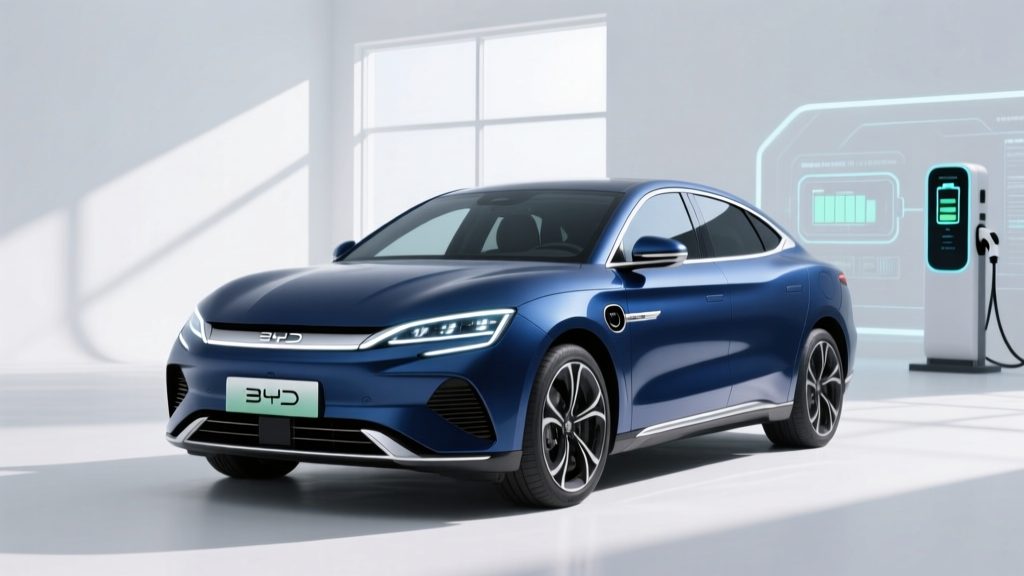
BYD's current passenger vehicle lineup spans compact hatchbacks to full-size SUVs, nearly all built on the company's e-Platform 3.0 architecture and equipped with its proprietary Blade Battery (lithium iron phosphate / LFP chemistry). Below is a snapshot of BYD's most popular global models with pricing converted to USD at early-2026 exchange rates. These are manufacturer MSRPs in their primary markets — not US prices, since the vehicles are not sold stateside.
| Model | Body Style | Battery (kWh) | Chemistry | WLTP Range | Base Price (USD Equiv.) | Primary Markets |
|---|---|---|---|---|---|---|
| BYD Dolphin | Compact Hatchback | 60.5 kWh | LFP Blade | 265 mi (WLTP) | ~$22,000 | China, Europe, Australia, SE Asia |
| BYD Atto 3 (Yuan Plus) | Compact SUV | 60.5 kWh | LFP Blade | 260 mi (WLTP) | ~$27,000 | Europe, Australia, Latin America, SE Asia |
| BYD Seal | Midsize Sedan | 82.5 kWh | LFP Blade | 355 mi (WLTP) | ~$35,000 | China, Europe, Australia |
| BYD Seagull (Dolphin Mini) | Subcompact Hatch | 38.9 kWh | LFP Blade | 190 mi (WLTP) | ~$12,000 | China, Latin America |
| BYD Tang | Midsize 3-Row SUV | 108.8 kWh | LFP Blade | 310 mi (WLTP) | ~$45,000 | Europe, Latin America, Middle East |
Why BYD EVs Aren't Sold in the US (The Tariff Problem)
The core reason BYD cost USD searches don't yield a US dealer price is trade policy. The United States imposes a 27.5% tariff on imported Chinese automobiles — a rate that was further escalated under Section 301 actions, with EVs from China facing an additional 100% tariff as of 2024, bringing the effective rate to approximately 127.5% on Chinese-made electric vehicles entering the US market.
This tariff structure makes importing BYD vehicles economically unviable. A BYD Atto 3 that costs roughly $27,000 at the factory gate in China would face over $34,000 in tariffs alone, pushing its landed US cost above $61,000 before dealer markup, logistics, or compliance modifications — obliterating the value proposition that makes BYD competitive globally.
BYD has acknowledged it has no near-term plans to enter the US passenger car market. The company has instead focused on markets with lower or no punitive tariffs, including building local factories in Thailand, Brazil, Hungary, and Indonesia. BYD does sell electric buses and commercial vehicles in the US, but these are a separate category from the passenger EVs most consumers are researching.
What US Buyers Can Get Instead: Competing EVs at BYD-Equivalent Prices
If BYD's global pricing has you excited about affordable EVs, several vehicles currently available in the US market target similar value — though typically at higher price points due to domestic manufacturing costs, different regulatory requirements, and the absence of Chinese supply-chain advantages.
| BYD Model | US Alternative | EPA Range | Battery (kWh) | US MSRP (Base) | After §30D Credit |
|---|---|---|---|---|---|
| Dolphin (~$22K) | Chevrolet Bolt EV | 259 mi | 65 kWh (NMC) | ~$28,000 | ~$20,500* |
| Atto 3 (~$27K) | Hyundai Kona Electric | 261 mi | 64.8 kWh (NMC) | ~$34,000 | ~$26,500* |
| Seal (~$35K) | Tesla Model 3 RWD | 272 mi | 60 kWh (LFP) | ~$39,000 | ~$31,500* |
| Seagull (~$12K) | No direct US equivalent | — | — | — | — |
| Tang (~$45K) | Kia EV9 (base RWD) | 230 mi | 76.1 kWh (NMC) | ~$56,000 | ~$48,500* |
*After-credit prices assume full $7,500 §30D eligibility. Not all vehicles or buyers qualify — see tax credit section below. Source: fueleconomy.gov, manufacturer MSRP data.
Federal Tax Credit Reality: §30D Eligibility for US EV Alternatives
Since you cannot buy a BYD in the US, the §30D federal EV tax credit is irrelevant to BYD vehicles specifically. However, for the US-available alternatives listed above, the credit can dramatically change the effective cost equation. Here's how the credit works under current 2026 IRS rules:
- Credit amount: Up to $7,500 for new qualifying EVs ($3,750 if only battery-sourcing or critical-minerals requirements are met, not both)
- MSRP caps: Vans, SUVs, and pickups must have an MSRP ≤ $80,000; sedans and other body styles ≤ $55,000
- Buyer income limits: Modified AGI must not exceed $300,000 (joint), $225,000 (head of household), or $150,000 (single)
- Battery sourcing: Increasing percentages of battery components must be manufactured/assembled in North America, and critical minerals must be sourced from the US or FTA partners
- Point-of-sale transfer: Eligible buyers can transfer the credit to the dealer at purchase, receiving the benefit as an immediate price reduction rather than waiting for a tax return
- FEOC exclusion: Vehicles with battery components from a "foreign entity of concern" (which includes most Chinese suppliers) are disqualified — this is another structural barrier that would exclude BYD even if it sold in the US
For detailed, up-to-date eligibility rules, consult the IRS §30D guidance page and verify with a tax professional before purchase. Eligibility changes as sourcing rules tighten annually.
BYD's Blade Battery: What US Buyers Should Know About the Tech
Even though BYD vehicles aren't available stateside, the company's Blade Battery technology influences the global EV market and is worth understanding — especially because LFP chemistry is increasingly adopted by US-market vehicles including the Tesla Model 3 RWD and Ford Mustang Mach-E Select.
| Attribute | LFP (BYD Blade) | NMC (Typical US EVs) |
|---|---|---|
| Energy Density | Lower (~150 Wh/kg cell-level) | Higher (~220–260 Wh/kg cell-level) |
| Cycle Life | 3,000–5,000+ cycles | 1,000–2,000 cycles |
| Thermal Stability | Excellent (resists thermal runaway) | Good (requires active thermal management) |
| Cold-Weather Performance | Moderate range loss (20–30% below freezing) | Moderate range loss (15–25% below freezing) |
| Cost | Lower (no cobalt or nickel) | Higher (cobalt/nickel supply-chain costs) |
| Recommended Charge Habit | Can charge to 100% daily without degradation concerns | Best kept 20–80% for daily use; 100% for trips only |
| Warranty (typical) | 8 yr / 100,000 mi (global markets) | 8 yr / 100,000 mi (US standard) |
BYD's Blade Battery uses a cell-to-pack design where long, thin LFP cells are arranged directly in the battery pack without intermediate modules. This improves volume utilization and structural rigidity. The result is a pack that's competitively energy-dense at the system level despite LFP's lower cell-level density, with exceptional safety characteristics — BYD has demonstrated the Blade Battery surviving nail-penetration tests without thermal runaway.
For US buyers, the practical takeaway is that LFP chemistry (whether from BYD's competitors like CATL or from other suppliers) is a mature, safe, and long-lasting option — particularly for buyers who want to charge to 100% daily without worrying about accelerated degradation.
Charging Specs: How BYD Models Compare to US Standards
While BYD vehicles sold globally use CCS2 connectors (the European/Asian standard) or China's GB/T connector, none use the NACS (Tesla) connector that is becoming the North American standard for 2025–2026 model-year EVs. Here's how BYD's global charging specs compare:
| Model | Max DC Fast Charge | 10–80% Time (est.) | Level 2 AC Rate | Connector (Global) |
|---|---|---|---|---|
| BYD Dolphin | 88 kW peak | ~29 min | 7 kW / ~25 mi/hr | CCS2 / GB/T |
| BYD Atto 3 | 88 kW peak | ~29 min | 7 kW / ~25 mi/hr | CCS2 / GB/T |
| BYD Seal | 150 kW peak | ~26 min | 11 kW / ~40 mi/hr | CCS2 / GB/T |
| Tesla Model 3 (US) | 170 kW peak | ~25 min | 11.5 kW / ~44 mi/hr | NACS |
| Hyundai Kona Electric (US) | 100 kW peak | ~43 min | 10.9 kW / ~38 mi/hr | CCS1 |
BYD's charging speeds are competitive but not class-leading. The 88 kW peak on the Dolphin and Atto 3 is modest by 2026 standards — vehicles like the Hyundai Ioniq 5 and Kia EV6 on the E-GMP platform peak at 240 kW (800V architecture) and complete 10–80% in roughly 18 minutes. The BYD Seal's 150 kW is more respectable, though it still trails the best 800V platforms.
A key charging-curve reality: BYD's LFP batteries tend to sustain a relatively flat charge curve up to about 80% SoC, then taper sharply. This means the published 10–80% time is representative, but charging from 80–100% takes disproportionately longer — a characteristic of LFP chemistry generally, not just BYD.
Performance and Practicality: What the Numbers Look Like
For buyers curious about how BYD's global models would stack up if they could buy them in the US, here's a consolidated spec snapshot of the most-searched model — the BYD Seal, which competes most directly with the Tesla Model 3:
| Specification | BYD Seal (Design RWD) | BYD Seal (Excellence AWD) |
|---|---|---|
| Battery | 82.5 kWh usable, LFP Blade | 82.5 kWh usable, LFP Blade |
| WLTP Range | 355 mi | 323 mi |
| Est. EPA-Equivalent Range | ~285–300 mi | ~260–275 mi |
| Horsepower | 308 hp | 523 hp |
| 0–60 mph | 5.9 sec | 3.8 sec |
| Drivetrain | Rear-Wheel Drive | Dual-Motor AWD |
| Cargo Volume | 14.1 cu ft (trunk) + 1.8 cu ft (frunk) | 14.1 cu ft (trunk) + 1.8 cu ft (frunk) |
| Rear Legroom | ~36.6 in | ~36.6 in |
| Efficiency (WLTP) | ~28 kWh/100 mi | ~31 kWh/100 mi |
| Global Base Price | ~$35,000 USD equiv. | ~$42,000 USD equiv. |
Pros and Cons: The BYD Ownership Proposition (If You Could Buy One)
✅ Pros (Global Market)
- Aggressive pricing — significantly undercuts US-market EVs at equivalent segments
- Blade Battery (LFP) offers exceptional cycle life and thermal safety
- Can charge to 100% daily without accelerated degradation concerns
- Competitive range across the lineup (260–355 mi WLTP)
- Strong infotainment with rotating 15.6" center display on Seal/Atto 3
- Generous standard equipment in most global markets
❌ Cons (US Relevance)
- Not available for purchase in the United States
- 127.5% effective tariff makes importing economically impossible
- No US service/parts network or warranty support
- CCS2/GB/T connectors incompatible with US public charging without adapters
- FEOC battery-sourcing rules would disqualify from §30D credit regardless
- DC fast-charge speeds (88–150 kW) trail best-in-class 800V competitors
- ADAS features not validated to US NHTSA/IIHS standards
Who Should Care About BYD Pricing — And What to Buy Instead
The "BYD cost USD" search typically comes from one of three buyer profiles:
1. The Value-First EV Shopper: You've seen headlines about $12,000 BYD Seagulls and $22,000 Dolphins and want to know if you can access those prices. The honest answer is no — not in the US. Your closest alternatives are the Chevrolet Bolt EV (~$28,000 MSRP, ~$20,500 after the full §30D credit) and the upcoming next-generation affordable EVs from Tesla, Hyundai, and Kia expected in 2026–2027.
2. The Tech-Curious Researcher: You're tracking BYD's technology and want to understand how it compares. The Blade Battery's LFP chemistry is genuinely excellent, and its adoption by Tesla, Ford, and others for base-trim models validates BYD's approach. The practical takeaway: when shopping US-market EVs, don't dismiss LFP-equipped trims — they offer longer cycle life and simpler charging habits.
3. The Expat or International Buyer: If you're a US citizen living abroad or planning to relocate, BYD vehicles may be accessible in your local market. In that case, the global pricing above applies, and you'll benefit from the lower cost of ownership — but be aware that bringing a BYD back to the US would face the same tariff and homologation barriers.
Choose a US-market alternative if: You need domestic service support, §30D tax credit eligibility, NACS/CCS1 charging compatibility, and NHTSA/IIHS safety ratings.
Consider BYD (if outside the US) if: You're in a market where BYD sells directly, you prioritize low purchase price, and you have access to CCS2 or GB/T charging infrastructure.
Frequently Asked Questions
Can I import a BYD vehicle to the United States?
Technically, you could attempt to import one under the 25-year rule (for vehicles not originally certified to FMVSS standards), but for a current-model BYD, this is not practical. The vehicle would need to be modified to meet US safety and emissions standards, and you'd pay the 127.5% tariff on Chinese-made EVs. The total landed cost would far exceed buying a comparable US-market EV. There is no legal pathway for a typical consumer to import a new BYD for daily use in 2026.
Does BYD qualify for the $7,500 federal EV tax credit?
No. Even if BYD sold vehicles in the US, they would almost certainly fail the §30D credit's battery-sourcing requirements. The FEOC (Foreign Entity of Concern) provision specifically excludes vehicles with battery components manufactured by Chinese companies — and BYD vertically integrates its entire battery supply chain in China. This makes BYD structurally ineligible for the credit regardless of any other factor.
What is the cheapest EV I can actually buy in the US in 2026?
The Chevrolet Bolt EV remains the most affordable new EV available, with a base MSRP around $28,000 and potential eligibility for the full $7,500 §30D credit (subject to buyer income limits and point-of-sale transfer rules), bringing the effective price to approximately $20,500. The Nissan Leaf starts around $29,000 but qualifies for a reduced credit due to battery-sourcing limitations. Several new sub-$30,000 models from Hyundai, Kia, and Tesla are expected to reach US showrooms in late 2026 or 2027.
Will BYD ever sell cars in the US?
BYD executives have stated publicly that the US market is not a near-term priority given the tariff environment. The company is investing heavily in local manufacturing in Thailand, Brazil, Hungary, and Indonesia to serve markets where it can compete without punitive import duties. A change in US trade policy — or BYD establishing North American manufacturing — would be required for a US launch, and neither appears imminent as of early 2026.
How does BYD's Blade Battery compare to Tesla's LFP battery?
Both use lithium iron phosphate chemistry, but BYD's Blade Battery uses a unique cell-to-pack architecture with long, blade-shaped cells that improve structural rigidity and volume utilization. Tesla sources LFP cells primarily from CATL (a BYD competitor) for Model 3 RWD vehicles. In practice, both offer similar benefits: long cycle life (3,000+ cycles), excellent thermal stability, and the ability to charge to 100% regularly without significant degradation. The main difference is that Tesla's LFP vehicles are available in the US with full Supercharger network access and §30D credit eligibility.
Sources: fueleconomy.gov (EPA range and efficiency data for US-market vehicles), irs.gov (§30D federal EV tax credit rules), BYD global press site for international model specifications and pricing. All USD conversions based on early-2026 exchange rates and are approximate.