The BYD Question: Will America's Largest EV Rival Ever Arrive?
Every few months, search interest spikes around a single question: Is BYD coming to the USA? As the world's largest manufacturer of plug-in electric vehicles — surpassing Tesla in total NEV (new energy vehicle) deliveries globally — BYD's absence from the American market is one of the biggest anomalies in the auto industry. For 2026, the short answer remains: no passenger BYD EVs are officially on sale in the United States. But the longer answer involves a shifting landscape of tariffs, a potential Mexico manufacturing play, and a lineup of vehicles that would immediately disrupt pricing if they ever crossed the border.
This profile examines what a US BYD launch would actually look like — the models most likely to arrive, their estimated specifications, the tariff math that keeps them out, and what BYD's global playbook tells us about a potential timeline.
Why BYD Isn't Selling Cars in the US (Yet)
BYD has sold electric buses and commercial vehicles in the US for years, with a Lancaster, California facility that assembled transit buses. But passenger vehicles face a wall of trade policy:
- 100% tariff on Chinese-made EVs: In May 2024, the Biden administration raised Section 301 tariffs on Chinese electric vehicles from 25% to 100%, effective 2024 and continuing through 2026. This makes importing a $30,000 BYD Seal effectively a $60,000 car before dealer markup — eliminating the price advantage entirely.
- Connected-vehicle ban: The US Department of Commerce proposed rules (effective 2027 for most vehicles) banning Chinese-made connected vehicle hardware and software, which would require BYD to rebuild its entire vehicle electronics stack for the US market.
- Battery sourcing rules (§30D): Federal EV tax credit rules exclude vehicles with battery components from a "foreign entity of concern" (FEOC) — a category that includes Chinese companies. BYD's vertically integrated supply chain (they make their own batteries) makes compliance structurally impossible for China-built vehicles.
These barriers are not minor speed bumps. They are designed to be prohibitive.
The Most Likely BYD Models for a US Launch
If BYD finds a path around these barriers — most realistically through a manufacturing plant in Mexico or Brazil, or through a licensing/JV arrangement — these are the vehicles Americans would see first, based on BYD's global export strategy and statements at international auto shows.
| Model | Segment | Battery (kWh) | Chemistry | Est. EPA Range | 0-60 mph | HP | Est. MSRP* |
|---|---|---|---|---|---|---|---|
| BYD Dolphin | Subcompact hatch | 60.5 kWh (usable) | LFP (Blade) | ~230 mi | ~7.0 sec | 201 hp | $28,000–$32,000 |
| BYD Seal | Midsize sedan | 82.5 kWh (usable) | LFP (Blade) | ~310 mi | ~5.9 sec (RWD) / 3.8 sec (AWD) | 312 hp (RWD) / 523 hp (AWD) | $38,000–$48,000 |
| BYD Atto 3 (Yuan Plus) | Compact crossover | 60.5 kWh (usable) | LFP (Blade) | ~240 mi | ~7.3 sec | 201 hp | $32,000–$38,000 |
| BYD Seal U (Song Plus EV) | Midsize crossover | 87 kWh (usable) | LFP (Blade) | ~290 mi | ~7.9 sec | 228 hp | $40,000–$46,000 |
*Estimated US MSRP assumes tariff-free manufacturing pathway (e.g., Mexico plant). If built in China with 100% tariff, add ~100% to these figures. Specs based on global-market versions; US-spec models may differ.
Deep Dive: The BYD Seal — Tesla Model 3's Global Nemesis
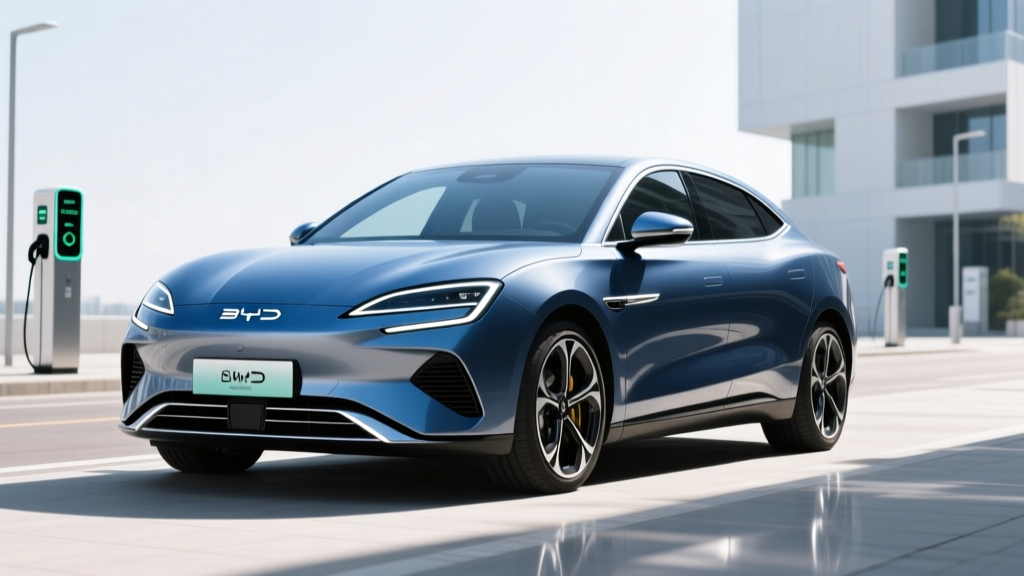
The BYD Seal is the model most frequently cited as a Tesla Model 3 competitor, and for good reason. In European and Australian markets, it undercuts the Model 3 on price while offering comparable range and a more upscale interior. Here's what we know from global-spec testing:
| Battery | 82.5 kWh usable, LFP Blade (CTB — cell-to-body integration) |
| WLTP Range | 570 km / ~354 mi (WLTP) — expect ~310 mi EPA equivalent |
| DC Fast Charge | 150 kW peak; 10–80% in ~26 minutes |
| Level 2 Charge | 11 kW AC (3-phase); ~7 hours for full charge |
| Drivetrain | RWD (single motor) or AWD (dual motor) |
| 0–60 mph | 5.9 sec (RWD) / 3.8 sec (AWD Performance) |
| Dimensions | 189.6" L × 72.8" W × 57.5" H; 115.0" wheelbase |
| Cargo | 14.1 cu ft trunk + 1.8 cu ft frunk |
| Curb Weight | ~4,575 lbs (RWD) |
WLTP ratings run ~15-20% higher than EPA equivalents. The Seal's 354-mile WLTP figure likely translates to an EPA rating around 300–310 miles. In real-world highway driving at 70–75 mph, expect 250–270 miles before needing a charge. In cold weather (below 32°F), LFP batteries experience more range loss than NMC — budget 200–220 miles in winter conditions. The Seal's cell-to-body (CTB) integration provides excellent structural rigidity but makes battery replacement more complex if needed.
Charging: BYD's Blade Battery on American Infrastructure
BYD's LFP Blade battery is known for safety (it passes nail-penetration tests without thermal runaway) and longevity (3,000+ cycle life). But charging speed is where BYD trails Korean and American competitors:
| Charging Level | Power | Time | Miles Added |
|---|---|---|---|
| Level 1 (120V household) | ~1.4 kW | ~59 hours (0–100%) | ~4 mi/hr |
| Level 2 (240V home, 48A) | 11 kW (vehicle-limited) | ~8.5 hours (0–100%) | ~30 mi/hr |
| DC Fast Charge (peak) | 150 kW | ~26 min (10–80%) | ~180 mi in 26 min |
| DC Fast Charge (sustained avg) | ~110 kW (10–80%) | — | — |
At 150 kW peak, the Seal charges respectably but not class-leading. The Hyundai Ioniq 6 (800V architecture) peaks at 240 kW and does 10–80% in ~18 minutes. The Tesla Model 3 Highland peaks around 250 kW. For road-trippers who DC fast-charge frequently, this 8-minute gap per session adds up over long drives.
One advantage: LFP batteries can be charged to 100% regularly without the degradation concerns of NMC chemistry. BYD recommends periodic 100% charges to maintain cell balancing — the opposite of Tesla's NMC guidance.
Pricing, Tariffs, and the Tax Credit Problem
BYD's global pricing is aggressively low. The Seal starts at roughly €45,000 in Europe (~$48,000) and the Dolphin at ~€35,000 (~$37,000). In China, the same vehicles sell for the equivalent of $20,000–$28,000 — prices made possible by BYD's vertical integration (they own battery plants, chip fabs, and shipping vessels).
| Scenario | BYD Seal Est. Price | Federal Tax Credit (§30D) | Effective Price |
|---|---|---|---|
| China-built + 100% tariff | ~$76,000 | $0 (FEOC battery) | ~$76,000 |
| Mexico-built (hypothetical plant) | ~$40,000 | Unlikely — FEOC sourcing rules | ~$40,000 |
| Tesla Model 3 (for comparison) | $38,990 | Up to $7,500 | ~$31,490 |
The critical issue: even if BYD built a Mexico factory (bypassing the 100% China tariff under USMCA), the IRS §30D tax credit requires battery components and critical minerals to be sourced from the US or free-trade-agreement partners — not from a "foreign entity of concern." Since BYD manufactures its own Blade batteries and sources lithium/cathode materials through Chinese supply chains, a BYD vehicle is extremely unlikely to qualify for the $7,500 federal credit regardless of where it's assembled. This erases BYD's price advantage against credit-eligible competitors like the Tesla Model 3, Chevy Equinox EV, and Hyundai Ioniq 5.
Tech, Interior, and Driver Assistance
BYD's interior design language is distinctive — the Seal features a 15.6" rotating center touchscreen (portrait or landscape), a 10.25" instrument cluster, and a crystal gear selector. Materials quality in global-spec models is competitive with European brands at similar price points, with soft-touch surfaces and genuine stitching.
Infotainment: BYD's DiLink system runs Android-based software. In global markets, it supports wireless Apple CarPlay and Android Auto. US-spec models would likely need significant software localization, including integration with American navigation, charging networks, and voice assistants.
Driver Assistance: BYD offers its "DiPilot" ADAS suite, which includes adaptive cruise control, lane-keeping assist, automatic emergency braking, and blind-spot monitoring. This is SAE Level 2 driver assistance — the driver must remain engaged at all times. It does not approach the capability of Tesla FSD (Supervised) or GM Super Cruise for hands-free highway driving. BYD has not announced any Level 3+ system for export markets.
BYD DiPilot is a Level 2 driver-assistance system. It requires continuous driver supervision — hands on or near the wheel, eyes on the road. It is not autonomous or "self-driving." Features like lane-centering and adaptive cruise do not relieve the driver of responsibility.
Warranty and Ownership Considerations
In European markets, BYD offers a 6-year/93,000-mile vehicle warranty and an 8-year/124,000-mile battery warranty (covering capacity below 70% of original). These terms would likely carry over to a US launch, though American consumers typically expect the 8-year/100,000-mile battery warranty standard set by most manufacturers and aligned with NHTSA reporting norms.
Ownership unknowns for a hypothetical US launch:
- Dealer network: BYD would need to build a US dealer and service network from scratch, or adopt a Tesla-style direct-sales model (which is legally restricted in many states).
- Parts availability: Early adopters of any new brand face longer wait times for collision and warranty parts.
- Insurance: New EV brands without US crash-test data from IIHS or NHTSA often carry higher insurance premiums until ratings are established.
- Resale value: Without brand recognition or established reliability data, depreciation is unpredictable and likely steeper than established brands in the first 3–5 years.
The Verdict: Should You Wait for BYD?
- LFP Blade battery — exceptional safety and cycle life (3,000+ cycles)
- Potentially class-leading value pricing (if tariff-free pathway exists)
- Strong build quality and upscale interiors vs. price point
- Competitive range (Seal ~310 mi EPA est.)
- LFP allows daily 100% charging without degradation worry
- No US launch confirmed — 100% tariff makes China-built cars uncompetitive
- Almost certainly ineligible for $7,500 federal tax credit (§30D FEOC rules)
- DC fast charging (150 kW peak) trails competitors (Ioniq 5: 240 kW, Model 3: 250 kW)
- No US dealer, service, or parts network exists
- No NHTSA/IIHS crash-test ratings — insurance costs uncertain
- ADAS is basic Level 2 — no hands-free highway capability
Wait for BYD if: You're not buying in the next 2–3 years, you want a sub-$35,000 EV, and you're willing to accept first-brand risk (no dealer network, unknown resale, no crash ratings yet).
Buy now instead if: You need a vehicle in 2026. The Tesla Model 3 ($38,990, up to $7,500 credit = ~$31,490), Hyundai Ioniq 5 (~$42,000, credit-eligible), and Chevy Equinox EV (~$33,000, credit-eligible) all offer established dealer networks, proven charging infrastructure compatibility, and federal tax credit eligibility that BYD almost certainly cannot match.
Timeline: When Could BYD Actually Sell Cars in America?
BYD has announced plans to build a factory in Mexico (location TBD as of early 2026) and has expanded aggressively in Brazil, Thailand, Hungary, and Indonesia. A Mexico plant could theoretically supply the US market under USMCA, but the 2024 US political environment has included explicit proposals to impose tariffs on Chinese-brand vehicles built in Mexico as well.
Realistic timeline estimates:
- 2026–2027: No US passenger vehicle sales. BYD focuses on Mexico plant construction and other export markets.
- 2028–2029: Possible US launch if Mexico production begins AND US trade policy permits AND BYD can address connected-vehicle ban requirements. Highly uncertain.
- 2030+: More plausible window for meaningful US market presence, assuming geopolitical conditions shift.
Frequently Asked Questions
Is BYD coming to the USA in 2026?
No. As of 2026, BYD does not sell passenger vehicles in the United States. A 100% tariff on Chinese-made EVs, connected-vehicle restrictions, and battery sourcing rules under §30D make a near-term launch economically unviable. BYD sells electric buses commercially in the US but has no confirmed timeline for passenger car sales.
Would BYD cars qualify for the $7,500 federal EV tax credit?
Almost certainly not. The IRS §30D credit excludes vehicles with battery components from a "foreign entity of concern" (FEOC), which includes Chinese manufacturers. Since BYD produces its own batteries, even a Mexico-assembled BYD would likely fail the battery-sourcing requirement.
What BYD model would be most likely to come to America?
The BYD Seal (midsize sedan, Model 3 competitor) and Atto 3/Yuan Plus (compact crossover) are BYD's primary global export models and the most likely candidates for a US launch. The Dolphin (budget hatchback) could disrupt the sub-$30,000 segment if tariffs were overcome.
How does BYD's Blade battery compare to other EV batteries?
BYD's LFP (lithium iron phosphate) Blade battery excels in safety (passes nail penetration without fire) and longevity (3,000+ charge cycles vs. ~1,500–2,000 for NMC). The trade-off is lower energy density (heavier for the same range), worse cold-weather performance (~25-30% range loss below freezing vs. ~15-20% for NMC), and slower DC fast charging (150 kW peak vs. 240–350 kW for competitors).
Should I wait for BYD or buy an EV now?
Buy now. A BYD US launch is at minimum 2–3 years away and faces substantial regulatory barriers. Current options like the Tesla Model 3, Hyundai Ioniq 5, and Chevy Equinox EV offer established dealer support, tax credit eligibility, and proven charging compatibility that BYD cannot match in the foreseeable future.
Does BYD have any US presence at all?
Yes — BYD has operated a facility in Lancaster, California, assembling electric buses for American transit agencies since 2013. However, this is a commercial vehicle operation and does not indicate passenger car sales infrastructure.