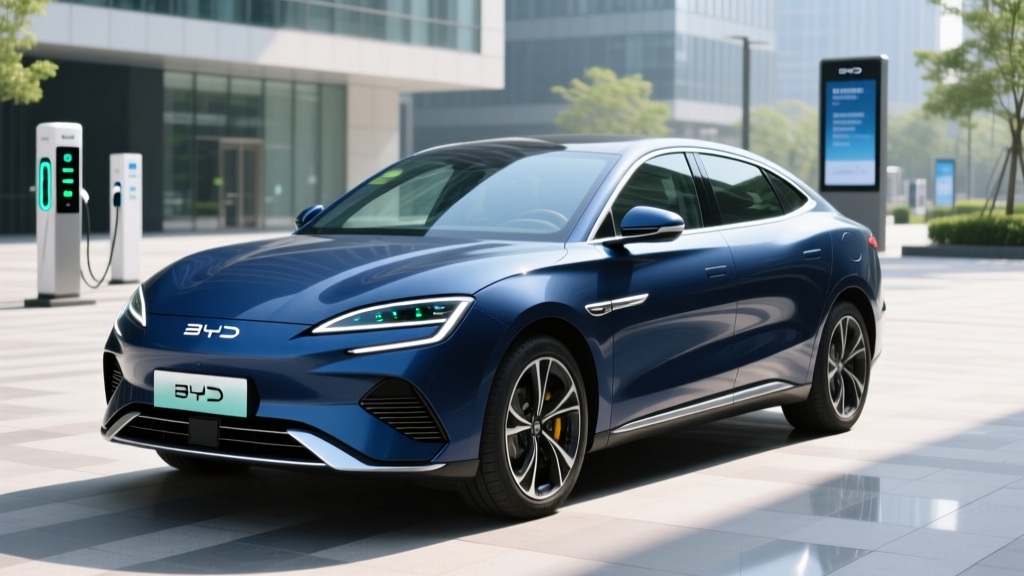
The Short Answer: BYD Passenger Cars Are Not Sold in the US (Yet)
If you've seen BYD's global sales numbers — the Chinese automaker briefly surpassed Tesla as the world's top-selling EV brand in late 2023 and has been trading the crown ever since — you're probably wondering: are BYD cars available in the USA? As of 2026, the answer for passenger vehicles remains no. BYD does not sell cars, SUVs, or trucks to American consumers through dealerships or direct sales.
However, BYD does have a commercial presence in the United States. The company operates a bus manufacturing facility in Lancaster, California, producing electric transit buses and commercial trucks for fleet operators. So while you can't walk into a dealership and buy a BYD Seal or Atto 3, the brand's electric drivetrain technology is already operating on American roads in heavy-duty applications.
This article breaks down exactly why BYD's passenger cars are absent from the US market, what models you might eventually see, how tariffs and trade policy factor in, and what comparable EVs you can actually buy right now.
Why BYD Passenger Vehicles Aren't Sold in America
Several overlapping barriers keep BYD's consumer lineup out of the US market. None of them are related to vehicle quality — BYD's Blade Battery (LFP chemistry) is widely regarded as one of the safest and most cost-effective battery packs in the industry.
1. Tariffs and Trade Policy
The most significant barrier is the US tariff structure on Chinese-made automobiles. In May 2024, the Biden administration announced tariffs on Chinese EVs that would reach 100% under Section 301 of the Trade Act. These tariffs, which took effect in August 2024 and remain in place as of 2026, effectively double the price of any Chinese-manufactured EV imported to the United States. A BYD Seagull that sells for roughly $10,000 in China would cost American buyers well over $20,000 before any dealer markup, shipping, or compliance costs — erasing the price advantage that makes BYD competitive globally.
According to the IRS §30D clean vehicle credit rules, vehicles must also meet battery component and critical mineral sourcing requirements that specifically exclude entities of concern — a category that includes Chinese battery manufacturers. This means even if BYD could sell in the US, buyers would almost certainly not qualify for the $7,500 federal tax credit.
2. Federal Safety and Compliance Certification
Every vehicle sold in the US must meet NHTSA Federal Motor Vehicle Safety Standards (FMVSS). This is a separate and more rigorous certification process than the UNECE standards used in Europe, Asia, and many other markets. BYD would need to redesign certain components — lighting, crash structures, airbag systems, and software — to meet FMVSS requirements before selling any passenger vehicle in America.
3. Dealer Network and Brand Infrastructure
Establishing a US dealer network, parts distribution system, service training, and warranty infrastructure requires billions of dollars and years of lead time. Tesla spent over a decade building its US presence, and BYD would face similar challenges — compounded by geopolitical headwinds and consumer skepticism toward Chinese automotive brands.
BYD's Global Lineup: What Models Exist and Their Specs
Even though you can't buy them stateside, understanding BYD's global lineup helps contextualize what the US market is missing — and what competitors are benchmarking against. Here are the most notable BYD models sold internationally as of 2026:
| Model | Segment | Battery (kWh) | WLTP Range | 0-62 mph | Max DC Charge | Approx. Global Price |
|---|---|---|---|---|---|---|
| BYD Seagull (Dolphin Mini) | Subcompact hatch | 38.9 kWh (LFP) | ~252 mi | ~11.0 sec | ~40 kW | ~$10,000 |
| BYD Dolphin | Compact hatch | 60.5 kWh (LFP) | ~265 mi | ~7.0 sec | ~88 kW | ~$30,000 |
| BYD Atto 3 (Yuan Plus) | Compact SUV | 60.5 kWh (LFP) | ~260 mi | ~7.3 sec | ~88 kW | ~$35,000 |
| BYD Seal | Mid-size sedan | 82.5 kWh (LFP) | ~354 mi | ~3.8 sec (AWD) | ~150 kW | ~$45,000 |
| BYD Han EV | Full-size sedan | 85.4 kWh (LFP) | ~320 mi | ~3.9 sec (AWD) | ~120 kW | ~$50,000 |
| BYD Tang EV | 3-row SUV | 108.8 kWh (LFP) | ~280 mi | ~4.6 sec (AWD) | ~120 kW | ~$55,000 |
Important range note: The range figures above are WLTP estimates, which tend to run 10-15% higher than EPA estimates used in the US. If these models were EPA-certified, expect the BYD Seal to land around 300-310 miles EPA, the Atto 3 around 220-235 miles, and the Dolphin around 225-240 miles. Cold-weather range loss for LFP batteries typically runs 20-30% in sub-freezing temperatures, consistent with industry averages.
BYD's Blade Battery: LFP Chemistry Explained
BYD's signature technology is the Blade Battery, a cell-to-pack lithium iron phosphate (LFP) design that uses long, thin prismatic cells arranged directly in the battery pack without intermediate modules. This architecture offers several advantages:
- Safety: LFP chemistry is inherently more thermally stable than NMC (nickel manganese cobalt). The Blade Battery passes nail penetration tests without thermal runaway — a benchmark that most NMC packs fail.
- Longevity: LFP cells typically sustain 3,000+ charge cycles before reaching 80% capacity retention, compared to roughly 1,500-2,000 cycles for many NMC chemistries. In real-world terms, that's well over 500,000 miles of driving before significant degradation.
- Cost: LFP uses no cobalt or nickel, reducing raw material costs by 20-30% compared to NMC packs of similar capacity.
- Trade-off — energy density: LFP is heavier per kWh than NMC, which is why BYD vehicles tend to have slightly heavier curb weights for a given range. The Blade's structural design partially offsets this.
| Attribute | LFP (BYD Blade) | NMC (Typical) |
|---|---|---|
| Energy density (cell-level) | ~170 Wh/kg | ~250 Wh/kg |
| Cycle life (to 80% SoH) | 3,000-5,000 cycles | 1,500-2,000 cycles |
| Thermal runaway risk | Very low | Moderate |
| Cold-weather range loss | ~25-30% | ~20-25% |
| Recommended daily SoC | 100% (no degradation concern) | 80% (for longevity) |
| Cobalt/nickel content | None | Yes (supply chain + ethical concerns) |
| Relative cost per kWh | Lower | Higher |
For US buyers who prioritize battery longevity and safety over maximum range-per-pound, LFP is increasingly attractive. Tesla already uses LFP packs in the Model 3 Standard Range, and Ford has licensed BYD battery technology for certain applications — a sign that the industry recognizes LFP's strengths even as trade policy keeps BYD-branded vehicles out.
Could BYD Enter the US Market? Realistic Scenarios for American Buyers
BYD executives have publicly stated interest in the US market, but several pathways would need to converge to make it happen:
Scenario 1: Local Manufacturing (Most Likely Long-Term Path)
Building a factory in the US, Mexico, or another trade-agreement partner country could allow BYD to sidestep the 100% import tariff. However, a US factory would still face scrutiny under the §30D battery sourcing requirements, which phase out credits for vehicles with battery components from foreign entities of concern (FEOC) — a designation that includes Chinese companies. Even a US-built BYD would likely not qualify for the $7,500 credit due to its Chinese battery supply chain.
Scenario 2: Tariff Reduction or Trade Agreement
A bilateral trade deal between the US and China specifically addressing EVs could lower tariffs, but given the current geopolitical climate and bipartisan support for protecting domestic auto manufacturing, this scenario is unlikely before 2028 at the earliest.
Scenario 3: Mexico or Third-Country Assembly
BYD has announced plans to build a factory in Mexico. Vehicles assembled there could potentially enter the US under USMCA rules if enough content originates from North America. However, US lawmakers have signaled they would close this loophole if BYD attempted to use it for passenger vehicle imports.
What to Buy Instead: US-Available Alternatives to BYD Models
If BYD's global lineup appeals to you, here are the closest US-market equivalents you can actually purchase today, with exact specs and pricing:
| BYD Model | US Alternative | EPA Range | Battery (kWh) | Max DC kW | Base MSRP | §30D Credit Eligible? |
|---|---|---|---|---|---|---|
| Seagull | Chevrolet Equinox EV (base) | 319 mi | 85 kWh (NMC) | 150 kW | ~$33,600 | Yes (partial/full varies) |
| Dolphin | Nissan Leaf (60 kWh) | 212 mi | 60 kWh (NMC) | 100 kW | ~$30,590 | Yes (check sourcing) |
| Atto 3 | Hyundai Kona Electric | 261 mi | 65 kWh (NMC) | 100 kW | ~$34,975 | Yes |
| Seal | Tesla Model 3 LR AWD | 341 mi | 79 kWh (NMC) | 250 kW | ~$45,380 | Yes (partial) |
| Han EV | Hyundai Ioniq 6 LR | 361 mi | 77.4 kWh (NMC) | 350 kW (peak) | ~$42,450 | Yes |
| Tang EV | Kia EV9 (LR AWD) | 280 mi | 99.8 kWh (NMC) | 239 kW | ~$59,900 | Yes (check sourcing) |
The US alternatives generally offer faster DC charging (especially Hyundai/Kia's 800V architecture at up to 350 kW peak), broader Supercharger/CCS network access, and eligibility for the federal §30D tax credit — which can reduce your effective purchase price by up to $7,500 at the point of sale, subject to MSRP caps ($55,000 for sedans, $80,000 for SUVs/trucks), buyer income limits ($150K single / $300K joint AGI), and battery sourcing compliance.
What BYD Does Sell in the US: Commercial Electric Vehicles
While passenger cars are off the table, BYD's American operations are not zero. The company's Lancaster, California facility has produced electric transit buses, school buses, and commercial trucks. These heavy-duty vehicles serve municipal transit agencies and private fleet operators across the country.
BYD's US commercial lineup includes:
- BYD K-series transit buses — 40-foot and 60-foot battery-electric buses with up to 250 miles of range on a single charge, used by agencies in Los Angeles, Indianapolis, and elsewhere.
- BYD D-series school buses — Type D electric school buses with ranges up to 135 miles, increasingly adopted by school districts pursuing zero-emission fleet mandates.
- BYD Class 8 trucks — Battery-electric drayage and yard trucks for port and warehouse operations.
These commercial vehicles are exempt from the consumer-facing tariff structure that blocks BYD's passenger cars, though they have faced their own political and procurement challenges, including Buy America requirements for federally funded transit purchases.
Frequently Asked Questions
Can I import a BYD car to the US myself?
Technically, NHTSA allows individuals to import vehicles not originally manufactured for the US market under the "show or display" exemption (limited to 2,500 miles/year) or the 25-year rule for classics. However, importing a current BYD model for daily use is not practical — the vehicle would need to be modified to meet all FMVSS standards at your expense, which typically costs tens of thousands of dollars and is rarely approved for modern vehicles.
Will BYD ever sell cars in the United States?
BYD has expressed long-term interest, but the combination of 100% tariffs, §30D tax credit ineligibility (due to Chinese battery sourcing), FMVSS compliance costs, and the need for a nationwide dealer and service network means 2028-2030 is the earliest realistic window — and only if trade policy shifts significantly.
Is BYD's Blade Battery used in any US-market vehicles?
Ford has announced plans to license BYD's LFP battery technology for use in certain North American EV models. Tesla also uses LFP chemistry (sourced from CATL, not BYD) in the Model 3 Standard Range. So while you can't buy a BYD-branded car in the US, the battery chemistry principles behind the Blade are increasingly present in vehicles you can buy.
What's the cheapest EV I can buy in the US that compares to a BYD?
The Chevrolet Equinox EV starts around $33,600 (before incentives) and offers 319 miles of EPA range — significantly more than any current BYD model's expected EPA equivalent. With the §30D credit potentially reducing the price by up to $7,500 at the point of sale, the Equinox EV can approach the $26,000 range, making it the closest US-market answer to BYD's value proposition.
Does BYD qualify for any US tax credits or incentives?
No. Even if BYD sold passenger vehicles in the US, they would not qualify for the §30D federal clean vehicle credit. The credit requires battery components and critical minerals to be sourced from the US or free-trade-agreement partners, and specifically excludes vehicles with battery components from "foreign entities of concern" — a category that includes Chinese manufacturers. State incentives vary by jurisdiction; check your state's energy office for local program details.