The BYD Question: Are Chinese EVs Finally Coming to Canada?
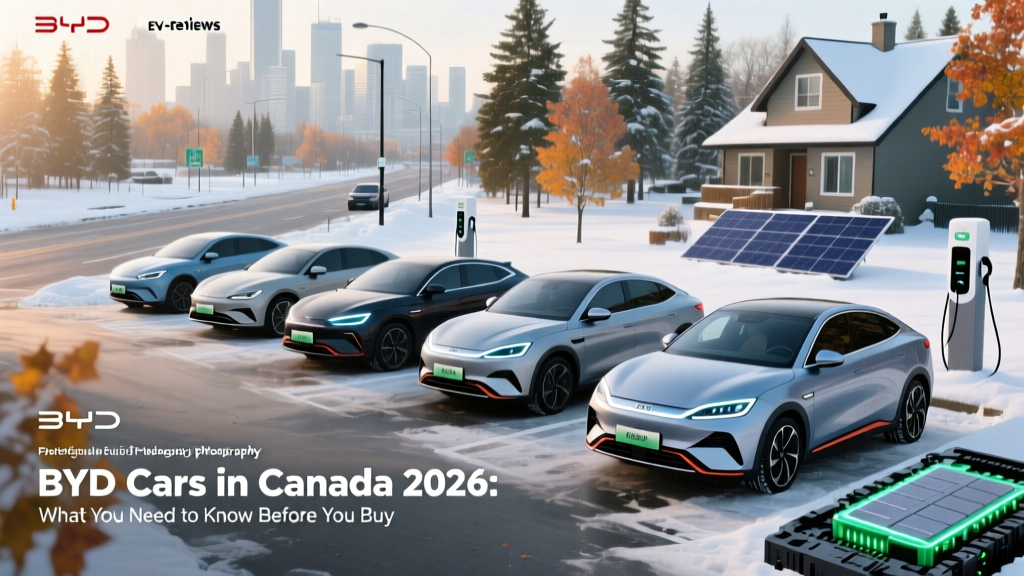
BYD — Build Your Dreams — has become the world's largest electric vehicle manufacturer by volume, surpassing Tesla in total EV deliveries. The Shenzhen-based automaker sells a full lineup of affordable, feature-rich electric cars across Europe, Australia, Southeast Asia, and Latin America. But for Canadian shoppers searching for BYD cars in Canada, the answer in 2026 remains complicated: BYD passenger vehicles are still not officially sold through Canadian dealerships, and significant regulatory, tariff, and geopolitical barriers stand between Canadian buyers and the brand's budget-friendly EVs.
This guide breaks down exactly where BYD stands in the Canadian market as of 2026, profiles the models most likely to arrive, provides full specs based on global-market data, and explains what Canadian EV buyers should consider right now.
Why BYD Isn't Sold in Canada (Yet)
Several intersecting factors have kept BYD cars out of Canadian showrooms:
- 100% EV tariff: In August 2024, Canada imposed a 100% surtax on Chinese-made electric vehicles, mirroring U.S. trade policy. This tariff effectively doubles the landed cost of any BYD vehicle manufactured in China, eliminating the brand's primary advantage — aggressive pricing.
- CMVSS compliance: All vehicles sold in Canada must meet the Canada Motor Vehicle Safety Standards (CMVSS), which differ from U.S. FMVSS and European UNECE regulations. BYD's global models are homologated for European and other markets but have not undergone Canadian certification as of 2026.
- No dealer network: BYD has not announced a Canadian dealership partnership or direct-to-consumer retail plan. Building a sales, service, and parts infrastructure from scratch is a multi-year, multi-million-dollar undertaking.
- Geopolitical climate: Ongoing tensions between Canada and China, combined with concerns about data security in connected vehicles, have created a hostile regulatory environment for Chinese automakers.
BYD has not publicly stated a timeline for Canadian market entry. Industry analysts suggest that unless the tariff is reduced or BYD begins manufacturing vehicles outside China (their Thailand, Brazil, and Hungary plants are candidates), a formal Canadian launch remains unlikely before 2028 at the earliest.
BYD Models Canadian Buyers Are Watching
Even without official availability, several BYD models have attracted significant Canadian interest based on global reviews and European sales data. Here are the three most discussed models, with specs drawn from BYD's international markets.
BYD Seal (Sedan — Tesla Model 3 Competitor)
| Spec | Design (RWD) | Excellence (AWD) |
|---|---|---|
| Battery Capacity | 82.5 kWh (LFP Blade) | 82.5 kWh (LFP Blade) |
| WLTP Range | 570 km (354 mi) | 520 km (323 mi) |
| EPA Est. Range (Projected)* | ~310 mi | ~285 mi |
| Horsepower | 308 hp | 523 hp |
| 0-100 km/h (0-62 mph) | 5.9 sec | 3.8 sec |
| Max DC Fast Charge | 150 kW | 150 kW |
| 10-80% DC Charge Time | ~26 min | ~26 min |
| Level 2 AC Charge Rate | 11 kW | 11 kW |
| Drivetrain | RWD (single motor) | AWD (dual motor) |
| Length / Width / Height | 4,800 mm / 1,875 mm / 1,460 mm | |
| Cargo Volume | 400 L (14.1 cu ft) trunk + 53 L (1.9 cu ft) frunk | |
| Global Price (Europe) | €44,900 (~C$66,000) | €48,900 (~C$72,000) |
*EPA range is projected based on typical WLTP-to-EPA conversion ratios (~85-88%). BYD has not published EPA figures as the Seal is not sold in North America.
BYD Atto 3 (Compact SUV — Hyundai Kona Electric / Kia Niro EV Rival)
| Spec | Value |
|---|---|
| Battery Capacity | 60.48 kWh (LFP Blade) |
| WLTP Range | 420 km (261 mi) |
| EPA Est. Range (Projected)* | ~225 mi |
| Horsepower | 201 hp |
| 0-100 km/h (0-62 mph) | 7.3 sec |
| Max DC Fast Charge | 88 kW |
| 10-80% DC Charge Time | ~29 min |
| Level 2 AC Charge Rate | 7 kW (single-phase markets) / 11 kW (three-phase) |
| Cargo Volume | 440 L (15.5 cu ft) rear / 1,340 L (47.3 cu ft) folded |
| Global Price (Europe) | €38,000 (~C$56,000) |
The Atto 3's 88 kW peak DC charging rate is its most significant weakness — it trails the Hyundai Kona Electric's 100+ kW capability and the Kia EV6's 239 kW. On a road trip, the slower charge curve means longer stops and less flexibility. The Atto 3 also lacks a frunk (front trunk), reducing total cargo utility compared to competitors.
BYD Dolphin (Subcompact Hatchback — Budget EV Segment)
| Spec | Active (Standard Range) | Design (Extended Range) |
|---|---|---|
| Battery Capacity | 44.9 kWh (LFP Blade) | 60.48 kWh (LFP Blade) |
| WLTP Range | 310 km (193 mi) | 427 km (265 mi) |
| Horsepower | 94 hp | 201 hp |
| 0-100 km/h (0-62 mph) | 12.3 sec | 7.0 sec |
| Max DC Fast Charge | 60 kW | 88 kW |
| 10-80% DC Charge Time | ~34 min | ~29 min |
| Cargo Volume | 345 L (12.2 cu ft) rear / 1,310 L (46.3 cu ft) folded | |
| Global Price (Europe) | €30,000 (~C$44,000) | €36,000 (~C$53,000) |
The Dolphin's value proposition is compelling on paper — a sub-C$45,000 EV with over 300 km of real-world range. However, the standard-range model's 60 kW DC charging speed and 94 hp output make it best suited for city commuting rather than highway driving or road trips.
BYD Blade Battery: LFP Chemistry Explained
All current BYD passenger vehicles use the company's proprietary Blade Battery, a cell-to-pack lithium iron phosphate (LFP) design. Understanding this chemistry is essential for Canadian buyers weighing BYD against alternatives:
| Factor | LFP (BYD Blade) | NMC (Tesla, Hyundai, VW) |
|---|---|---|
| Energy Density | Lower (~160 Wh/kg cell-level) | Higher (~250-300 Wh/kg cell-level) |
| Cold-Weather Performance | More range loss in sub-zero temps (25-35%) | Better cold-weather retention (15-25% loss) |
| Cycle Life | 3,000-5,000+ cycles | 1,500-2,500 cycles |
| Thermal Stability | Excellent — highly resistant to thermal runaway | Good, but requires more active thermal management |
| Recommended Charging | Can charge to 100% regularly without accelerated degradation | Best kept at 80% daily; 100% for trips only |
| Cost | Lower — no cobalt or nickel | Higher — dependent on critical mineral prices |
For Canadian winters, the LFP cold-weather penalty is a real consideration. BYD's Blade Battery uses a cell-to-pack architecture that improves volumetric efficiency (more cells in less space), partially offsetting LFP's lower energy density. The Blade design also passed nail penetration testing without thermal runaway — a safety advantage BYD heavily promotes.
On the positive side, LFP batteries tolerate regular 100% charging, which means a BYD owner can charge fully every night without the long-term degradation concerns that NMC owners manage by limiting daily charge to 80%. This effectively gives LFP vehicles more usable daily range, even if the total capacity is smaller.
Charging Infrastructure Compatibility in Canada
If BYD were to enter Canada, charging compatibility would be a critical question. Here's where things stand:
| Standard | BYD Global Models | Canadian Infrastructure (2026) |
|---|---|---|
| AC Level 2 | Type 2 (European models) | J1772 / NACS (Tesla) |
| DC Fast Charge | CCS2 (European models) | CCS1 / NACS (Tesla Supercharger) |
| Adapter Required? | Yes — CCS2 to CCS1 adapter, or CCS2 to NACS adapter | |
European-market BYD vehicles use the CCS2 connector, which is physically incompatible with North American CCS1 and NACS (Tesla) charging stations. BYD would need to re-engineer the charge port for North American models — a non-trivial engineering and certification effort. This is another reason why a Canadian launch requires significant lead time.
For context, Canada's public charging network in 2026 includes approximately 12,000+ public charging ports, with the Natural Resources Canada database tracking deployment. Networks like Petro-Canada, Electrify Canada, Flo, and Tesla Superchargers (now open to non-Tesla EVs via NACS or adapter) dominate the landscape.
Pricing, Tariffs, and the Tax Credit Problem
Even if BYD could sell cars in Canada today, the economics are severely challenged by the 100% tariff on Chinese-made EVs:
| Model | European MSRP | Equivalent C$ (Pre-Tariff) | With 100% Tariff |
|---|---|---|---|
| BYD Dolphin (Active) | €30,000 | ~C$44,000 | ~C$88,000 |
| BYD Atto 3 | €38,000 | ~C$56,000 | ~C$112,000 |
| BYD Seal (Design) | €44,900 | ~C$66,000 | ~C$132,000 |
At tariff-inflated prices, BYD vehicles lose their entire value proposition. A C$132,000 BYD Seal competes with the BMW i4, Mercedes EQB, and Tesla Model S — none of which are comparisons BYD wants.
Federal iZEV Rebate and Provincial Incentives
Canada's federal iZEV program offers up to C$5,000 for eligible battery-electric vehicles with a base MSRP under C$55,000 (or C$60,000 for SUVs/pickups). Provincial rebates add further value:
- Quebec: Up to C$7,000 provincial rebate (income-dependent)
- British Columbia: Up to C$4,000 (income-tested through CEVforBC)
- Other provinces: Varying or no additional incentives
However, even if BYD entered Canada, the tariff-inflated prices would exceed the iZEV MSRP caps, making federal rebates unavailable. And unlike the U.S. IRS §30D tax credit, Canada's iZEV does not currently have battery-sourcing or critical-mineral requirements — though this could change as trade policy evolves.
What Canadian Buyers Should Do Instead (For Now)
If you're drawn to BYD's combination of value, range, and technology, here are the closest alternatives currently available in Canada in 2026:
| If You Want... | Consider Instead | EPA Range | Starting MSRP (C$) |
|---|---|---|---|
| BYD Seal (sporty sedan) | Tesla Model 3 RWD | 363 mi (584 km) | ~C$53,000 |
| BYD Seal (AWD performance) | Hyundai Ioniq 6 Preferred AWD | 316 mi (509 km) | ~C$58,000 |
| BYD Atto 3 (compact SUV) | Hyundai Kona Electric | 261 mi (420 km) | ~C$46,000 |
| BYD Atto 3 (compact SUV) | Kia Niro EV | 239 mi (385 km) | ~C$47,000 |
| BYD Dolphin (budget hatch) | Nissan Leaf SV Plus | 212 mi (341 km) | ~C$44,000 |
All of the above vehicles are CMVSS-compliant, eligible for the federal iZEV rebate (depending on trim and MSRP), supported by Canadian dealer networks, and compatible with North American charging infrastructure.
Warranty and Service: The Unknown Factor
BYD offers strong warranty coverage in its established markets:
- Vehicle warranty: 6 years / 150,000 km (varies by market)
- Blade Battery warranty: 8 years / 160,000 km, retaining at least 70% capacity
- Drive unit warranty: 8 years / 150,000 km
These terms are competitive with Canadian-market norms (most manufacturers offer 8-year/160,000 km battery warranties per Transport Canada iZEV eligibility requirements). However, warranty coverage is only as good as the service network behind it. Without Canadian dealerships, parts depots, and trained technicians, a BYD warranty would be extremely difficult to honor. This is a dealbreaker for most mainstream buyers and a key reason why grey-market imports remain rare.
Frequently Asked Questions
Can I buy a BYD car in Canada right now?
No. As of 2026, BYD does not sell passenger vehicles through authorized Canadian dealerships. There is no official timeline for a Canadian launch. Grey-market imports are theoretically possible but involve complex CMVSS compliance modifications, no warranty support, and potential insurance difficulties.
Why doesn't BYD sell cars in Canada?
Three main barriers: Canada's 100% tariff on Chinese-made EVs (imposed August 2024), the need for CMVSS safety certification, and the absence of a dealer/service network. The tariff alone makes BYD's value-oriented pricing impossible in the Canadian market.
Would the BYD Seal qualify for Canadian EV rebates?
At its European-equivalent price (~C$66,000 before tariff), the BYD Seal Design trim exceeds the federal iZEV program's C$55,000 sedan MSRP cap. Even without the tariff, higher trims would likely be ineligible. With the 100% tariff applied, the price makes rebate eligibility irrelevant.
Is BYD's Blade Battery better than Tesla or Hyundai batteries?
It depends on the metric. The LFP Blade Battery excels in cycle life (3,000+ cycles), thermal safety, and cost. It tolerates daily 100% charging better than NMC batteries. However, it has lower energy density and worse cold-weather performance — both significant factors for Canadian ownership. For cold-climate buyers, NMC-based EVs from Tesla, Hyundai, and others currently offer better winter range retention.
What's the best alternative to a BYD in Canada?
For sedan buyers, the Tesla Model 3 and Hyundai Ioniq 6 offer comparable or superior range, charging speed, and technology at competitive Canadian prices. For compact SUV buyers, the Hyundai Kona Electric and Kia Niro EV provide the closest match to the Atto 3's size and utility. All are eligible for Canadian federal and provincial rebates at qualifying trims.
Will BYD ever come to Canada?
Industry analysts suggest it's unlikely before 2028-2029, and only if one or more of these conditions change: the 100% tariff is reduced or removed, BYD begins manufacturing in a tariff-exempt country (e.g., their planned Hungary or Brazil plants), or Canada establishes a bilateral EV trade agreement with China. BYD has expressed interest in North American expansion but has prioritized markets without prohibitive tariffs, such as Mexico and South America.