The BYD Question Every EV Shopper Is Asking
Search for "BYD cars in America" and you'll find a paradox: the world's largest plug-in vehicle manufacturer — selling over 3 million new-energy vehicles globally in 2024 — has virtually zero retail footprint in the United States. If you're an American EV shopper hoping to grab a bargain-priced BYD Dolphin or Seal, the 2026 reality requires some cold-water context before we get to the specs.
This guide covers what BYD actually sells, the tariff walls keeping them out of US showrooms, the models most likely to arrive if trade policy shifts, and which currently-available EVs fill the gap BYD would occupy. We'll also run hard numbers on BYD's most globally popular models so you know exactly what you're missing — or what might arrive.
Why BYD Doesn't Sell Cars in the US (Yet)
As of early 2026, BYD has no authorized passenger-vehicle dealerships in the United States. The reasons are layered:
- Section 301 Tariffs: Chinese-manufactured EVs face a 100% tariff under US trade policy, effectively doubling the sticker price of any BYD imported from China and making them uncompetitive overnight.
- No US Dealer Network: BYD has made no public announcement of a US retail rollout timeline. Their American operations focus on commercial vehicles (electric buses built in Lancaster, California) and battery/energy-storage supply.
- IRA Sourcing Restrictions: The Inflation Reduction Act's §30D tax credit explicitly disqualifies vehicles with battery components from a "foreign entity of concern" (FEOC) — a designation that includes Chinese manufacturers. Even if BYD sold here, buyers would get $0 federal credit.
- Political Climate: Bipartisan skepticism of Chinese auto imports means any policy shift is unlikely before the late 2020s at the earliest.
BYD has hinted at a North American passenger-vehicle entry, potentially through a Mexico-based assembly plant to leverage USMCA trade terms. But as of 2026, this remains speculative — no site, timeline, or model lineup has been confirmed.
BYD's Global Lineup: The Models Americans Want
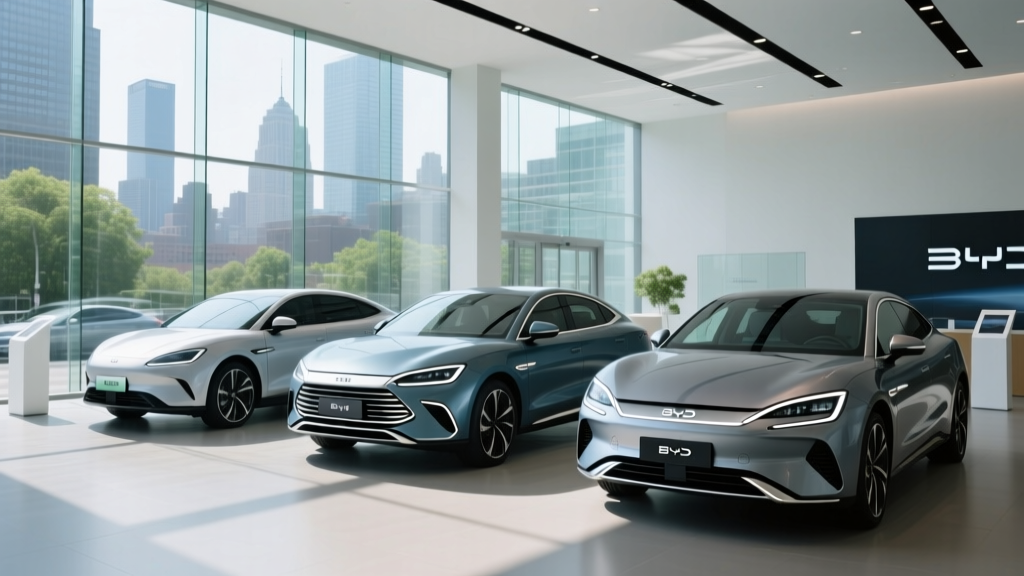
Even though you can't walk into a US dealership and buy one, understanding BYD's global catalog helps explain why the brand generates so much search interest. Here are the models most frequently discussed for eventual US arrival:
| Model | Body Style | Battery (kWh) | Chemistry | WLTP Range | Est. EPA Range | Peak DC Charge | 0-60 mph | HP |
|---|---|---|---|---|---|---|---|---|
| Dolphin | Hatchback | 60.4 kWh | LFP (Blade) | 265 mi | ~230 mi | 88 kW | 7.0s | 201 |
| Atto 3 (Yuan Plus) | Compact SUV | 60.4 kWh | LFP (Blade) | 260 mi | ~225 mi | 88 kW | 7.3s | 201 |
| Seal | Sedan | 82.5 kWh | LFP (Blade) | 354 mi | ~300 mi | 150 kW | 5.9s (RWD) | 313 |
| Seal U | Mid-Size SUV | 87.0 kWh | LFP (Blade) | 310 mi | ~270 mi | 140 kW | 7.9s | 215 |
| Han EV | Full-Size Sedan | 85.4 kWh | LFP (Blade) | 323 mi | ~280 mi | 120 kW | 7.9s | 241 |
| Tang EV | 3-Row SUV | 108.8 kWh | LFP (Blade) | 335 mi | ~290 mi | 120 kW | 4.6s (AWD) | 510 |
Note: WLTP is the European/Chinese testing standard and typically overstates range by 10-20% vs. the US EPA cycle. "Est. EPA Range" is AutoEdgeView's projection based on observed WLTP-to-EPA conversion ratios for similar LFP-platform vehicles. Source: BYD Global.
BYD's Blade Battery: LFP Chemistry Explained
Every current BYD passenger EV uses the company's proprietary Blade Battery — a cell-to-pack lithium iron phosphate (LFP) design that BYD claims passes nail-penetration tests without thermal runaway. Here's what that means for buyers:
| Attribute | LFP (BYD Blade) | NMC (Tesla, Hyundai, Ford) |
|---|---|---|
| Energy Density | Lower (~160 Wh/kg cell) — heavier packs for same range | Higher (~250 Wh/kg cell) — lighter, more range-dense |
| Cycle Life | 3,000+ cycles to 80% SoH | 1,000-2,000 cycles to 80% SoH |
| Cold-Weather Performance | Greater range loss below 32°F (~30-40%) | Moderate range loss (~20-30%) |
| Thermal Safety | Excellent — resists thermal runaway | Good — requires robust BMS/cooling |
| Charging to 100% | Recommended periodically for BMS calibration | Generally avoid; 80% daily max preferred |
| Cost per kWh | Lower — key to BYD's pricing advantage | Higher — cobalt/nickel supply costs |
BYD's LFP advantage is cost and longevity. The trade-off is cold-weather range and charging speed. If you live in Minnesota or Maine, an LFP BYD would lose more winter range than an NMC-equipped Hyundai Ioniq 5 or Tesla Model Y. In Southern California or Texas, that trade-off barely registers.
Charging Speeds: BYD's Weak Point for US Buyers
Here's where BYD falls behind the competition American shoppers are already familiar with. DC fast-charging speeds on BYD's global models peak well below what Tesla, Hyundai/Kia, and GM now offer:
| Model | Max DC kW | 10-80% Time | Level 2 (AC) Rate | Connector |
|---|---|---|---|---|
| BYD Dolphin | 88 kW | ~29 min | 7 kW (~25 mi/hr) | CCS2 / GB/T |
| BYD Seal | 150 kW | ~26 min | 7 kW (~30 mi/hr) | CCS2 / GB/T |
| BYD Atto 3 | 88 kW | ~29 min | 7 kW (~24 mi/hr) | CCS2 / GB/T |
| Tesla Model 3 (2026) | 250 kW | ~15 min | 11.5 kW (~44 mi/hr) | NACS |
| Hyundai Ioniq 5 (2026) | 240 kW | ~18 min | 10.9 kW (~40 mi/hr) | NACS |
| Chevy Equinox EV (2026) | 150 kW | ~25 min | 11.5 kW (~35 mi/hr) | NACS |
BYD's 88 kW peak on the Dolphin and Atto 3 is a meaningful limitation for US road-trip driving. On an Electrify America or EVgo station capable of 150-350 kW, you'd be charging at less than half the station's capacity. The Seal's 150 kW is more competitive but still trails the 800V architecture in Hyundai/Kia and Porsche models. The charge curve also tapers significantly above 80% SoC — expect 80-100% to take as long as 10-80%.
Pricing: What BYD Would Cost If They Sold Here
BYD's global pricing is the main reason American shoppers search for them. In Europe and Australia, BYD undercuts competitors by 15-25%. Here's what the lineup costs internationally, translated to USD, with a reality check on what US pricing would look like with tariffs:
| Model | Europe/AU Price (USD equiv.) | +100% Tariff | US Market Equivalent | Competitor Price (2026) |
|---|---|---|---|---|
| Dolphin | ~$28,000 | ~$56,000 | Not competitive | Chevy Bolt EUV: ~$28,000 |
| Atto 3 | ~$32,000 | ~$64,000 | Not competitive | Hyundai Kona Electric: ~$33,000 |
| Seal | ~$42,000 | ~$84,000 | Not competitive | Tesla Model 3: ~$39,000 |
| Seal U | ~$45,000 | ~$90,000 | Not competitive | Ford Mustang Mach-E: ~$43,000 |
The math is brutal. Even before the tariff wall, BYD's US pricing would need to account for dealer network buildout, NACS connector licensing or adapter costs, US-spec safety compliance (NHTSA FMVSS), and software localization. The 100% Section 301 tariff makes direct China-to-US import economically impossible for passenger vehicles.
Federal Tax Credit: A Non-Starter
Even in a hypothetical where BYD established US retail sales, the IRS §30D clean vehicle credit would almost certainly not apply:
- FEOC Battery Rule: Vehicles with battery components manufactured by a Chinese entity are ineligible for the $7,500 credit. BYD manufactures its own Blade Batteries — an automatic disqualification.
- Critical Minerals Sourcing: The credit requires a growing percentage of battery minerals to be sourced from the US or FTA partners. BYD's supply chain is heavily China-domestic.
- MSRP Caps: The credit applies to sedans under $55,000 MSRP and SUVs/trucks under $80,000. Some BYD models would qualify on price, but the sourcing rules moot the point.
- Income Limits: Buyer AGI must not exceed $150,000 (single) / $300,000 (joint) — this applies to all buyers regardless of brand.
The Best US-Market Alternatives to BYD
Since you can't buy a BYD in America, here are the models that occupy the price and size segments BYD would target, all available now with current federal tax credit eligibility where applicable:
If You Want a BYD Dolphin (Budget Hatchback)
Buy instead: Chevrolet Bolt EV/EUV (~$26,000-$28,000)
- EPA range: 259 mi (EV) / 247 mi (EUV)
- 65.5 kWh NMC battery
- Eligible for $7,500 §30D credit (check current IRS rules)
- NACS charging port (2026 model year)
- Real-world highway range: ~200-220 mi
If You Want a BYD Atto 3 (Compact SUV)
Buy instead: Hyundai Kona Electric (~$33,000)
- EPA range: 261 mi
- 65.4 kWh NMC battery
- NACS port for Tesla Supercharger access
- 10-80% DC charge in ~43 min (100 kW peak)
- Eligible for $7,500 credit (verify sourcing rules)
If You Want a BYD Seal (Mid-Size Sedan)
Buy instead: Tesla Model 3 (~$39,000) or Hyundai Ioniq 6 (~$38,000)
- Model 3: EPA 341 mi (LR), 250 kW charging, NACS native
- Ioniq 6: EPA 361 mi (SE LR), 240 kW charging, NACS
- Both have vastly superior DC charge rates vs. the Seal's 150 kW
- Tesla's Supercharger network remains the US gold standard
If You Want a BYD Seal U (Mid-Size Family SUV)
Buy instead: Tesla Model Y (~$44,000) or Ford Mustang Mach-E (~$43,000)
- Model Y: EPA 320 mi (LR), NACS, Supercharger access
- Mach-E: EPA 320 mi (Ext Range), NACS adapter included
- Both offer US dealer service networks and credit eligibility
- Model Y qualifies for $7,500 point-of-sale credit
Will BYD Ever Sell Cars in America?
The honest answer: not before 2028 at the earliest, and more likely not until the 2030s. Here's the decision framework for anyone tracking this:
BYD enters the US market IF:
- Section 301 tariffs on Chinese EVs are reduced below ~50% (currently 100%) — requires major trade policy shift
- BYD completes a North American factory (likely Mexico) that satisfies USMCA rules of origin — under evaluation but unconfirmed as of 2026
- BYD restructures battery supply chain to reduce FEOC exposure enough for partial §30D eligibility — extremely difficult given vertical integration
- US-China diplomatic relations improve enough to reduce political risk for both the company and potential dealer partners
Bottom line: Don't delay an EV purchase waiting for BYD. The regulatory, trade, and political barriers are structural, not temporary. If you need an EV in 2026, the US market has strong alternatives at every price point BYD would target.
BYD's Real US Presence: Commercial & Battery Supply
BYD isn't entirely absent from American roads — just from consumer showrooms. The company operates:
- BYD Lancaster (California): An electric bus manufacturing facility producing transit buses for US municipalities. This facility exists because commercial vehicles have different tariff structures and "Buy America" compliance pathways.
- Battery Supply: BYD supplies LFP cells to non-automotive energy storage companies and has explored partnerships with US-based firms for grid-scale battery projects.
- Global Fleet Sales: BYD electric taxis and commercial vans operate in some US territories and through fleet importers, though not through standard retail channels.
For NHTSA compliance purposes, BYD has not submitted crash-test data for any of its current passenger vehicles under the US FMVSS framework — a prerequisite for retail sales that typically takes 2-3 years of preparation.
Frequently Asked Questions
Can I import a BYD from Canada or Mexico to avoid US tariffs?
No. US customs applies tariffs based on the country of manufacture, not the point of sale. A BYD built in China and purchased in Mexico would still face the 100% Section 301 tariff upon US importation. Additionally, the vehicle would need to meet FMVSS safety standards, which no current BYD passenger model is certified for.
Is BYD's Blade Battery safer than other EV batteries?
BYD's Blade Battery has demonstrated strong thermal stability in nail-penetration and crush tests, with LFP chemistry inherently more resistant to thermal runaway than NMC. However, US-market EVs from Tesla, Ford, Hyundai, and GM all meet stringent NHTSA safety standards and have excellent real-world safety records. "Safer battery chemistry" does not automatically mean "safer vehicle."
Does BYD use NACS or CCS connectors?
In global markets, BYD uses CCS2 (Europe) and GB/T (China). Neither is the North American NACS (Tesla) standard now adopted by nearly all major automakers for US-market vehicles. If BYD enters the US, they would need to either adopt NACS natively or provide a CCS-to-NACS adapter — adding cost and complexity.
How does BYD's warranty compare to US competitors?
BYD offers an 8-year/125,000-mile battery warranty in most global markets, with a 70% capacity retention threshold. This is competitive with the US federal minimum (8 years/100,000 miles required for §30D eligibility) but slightly below Hyundai's 10-year/100,000-mile battery warranty. The 70% threshold is standard; Tesla and Ford also use 70%, while some competitors guarantee 75%.
What's the cheapest BYD car available anywhere in the world?
The BYD Seagull (sold in some markets as the Dolphin Mini) starts at approximately $8,000-$10,000 USD equivalent in China. It's a subcompact hatchback with a 30-40 kWh LFP battery and ~190 miles of CLTC range. Even with 100% tariffs, it would be the cheapest new EV in America — but there are no plans to sell it here, and it would not meet US crash-safety requirements without significant redesign.
Should I wait for BYD to enter the US market before buying an EV?
No. With tariffs at 100%, no confirmed US retail timeline, FEOC credit disqualification, and no NHTSA certification process underway, BYD passenger vehicles are years away from US availability at best. Current US-market EVs from Chevrolet, Hyundai, Tesla, Ford, and others offer competitive range, superior charging speeds, established service networks, and federal tax credit eligibility right now.