The Short Answer: Yes, BYD Sells EVs in Mexico — But US Buyers Face Major Hurdles
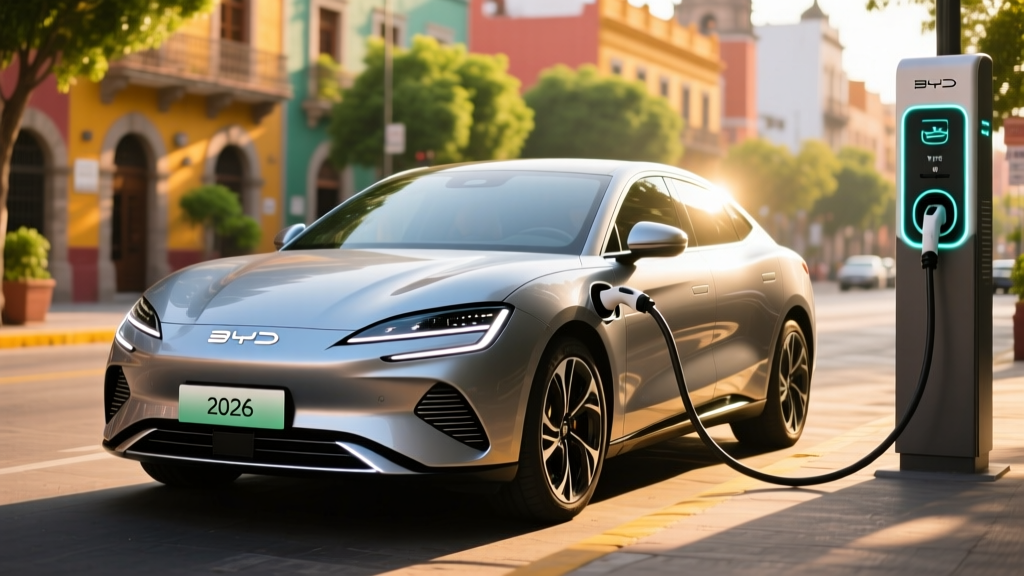
BYD (Build Your Dreams) has rapidly expanded into Mexico, making it one of the brand's strongest markets in the Americas. As of early 2026, BYD sells several electric and plug-in hybrid models through a growing dealer network across Mexico's major cities. If you're asking "can I buy a BYD car in Mexico?" the answer is straightforward: yes, Mexican residents and visitors can purchase BYD vehicles at authorized dealerships.
But if you're a US-based EV shopper hoping to snag a bargain BYD south of the border and drive it home, the picture gets complicated fast. Tariffs, EPA certification gaps, and IRS tax-credit ineligibility make cross-border BYD purchases impractical for most US buyers. This guide breaks down exactly which BYD models are available in Mexico for 2026, their real specs, and what the import reality looks like.
BYD Models Available in Mexico for 2026
BYD's Mexican lineup has expanded significantly since the brand entered the market in 2023. The current roster focuses on affordable electric crossovers and sedans that undercut most competitors on price. Here's what's on showroom floors:
| Model | Body Style | Battery (kWh) | Chemistry | Range (NEDC/WLTP) | Motor Output | 0-100 km/h | Base Price (MXN) |
|---|---|---|---|---|---|---|---|
| BYD Dolphin | Hatchback | 44.9 kWh usable | LFP (Blade) | ~340 km WLTP | 95 hp (70 kW) | ~12.3 sec | ~$549,900 |
| BYD Dolphin Mini (Seagull) | Subcompact Hatch | 38.9 kWh usable | LFP (Blade) | ~305 km WLTP | 75 hp (55 kW) | ~13.5 sec | ~$399,900 |
| BYD Yuan Plus (Atto 3) | Compact SUV | 58.56 kWh usable | LFP (Blade) | ~420 km WLTP | 201 hp (150 kW) | ~7.3 sec | ~$699,900 |
| BYD Seal | Sport Sedan | 82.5 kWh usable | LFP (Blade) | ~570 km WLTP | 313 hp (AWD) | ~3.8 sec | ~$899,900 |
| BYD Han EV | Full-Size Sedan | 85.4 kWh usable | LFP (Blade) | ~521 km NEDC | 244 hp (FWD) | ~7.9 sec | ~$1,099,900 |
Currency note: At early-2026 exchange rates (~17 MXN/USD), the Dolphin Mini starts around $23,500 USD and the Yuan Plus around $41,000 USD — prices that seem remarkable to US shoppers accustomed to $40,000+ entry points for comparable EVs.
Real-World Range Reality Check
BYD Mexico publishes range figures on the NEDC or WLTP cycle, both of which are more generous than the US EPA test. As a rule of thumb, expect EPA-equivalent range to be roughly 15-25% lower than WLTP figures. For the BYD Yuan Plus, that translates to an estimated ~200-220 miles EPA-equivalent in mixed driving. Highway driving at 70+ mph will reduce that further to perhaps 180 miles. In cold weather (below 40°F / 4°C), LFP batteries can lose 15-30% of range, though BYD's Blade battery thermal management helps mitigate this somewhat. The Dolphin Mini realistically delivers around 140-160 miles in everyday use.
Charging Speed: DC Fast Charge and Home Level 2
Charging infrastructure in Mexico is growing but remains concentrated in Mexico City, Guadalajara, Monterrey, and along major toll highways. Here's what BYD's Mexican models support:
| Model | Max DC Fast Charge (kW) | 10-80% DC Time | Level 2 AC Rate (kW) | Level 2 Full Charge Time | Connector |
|---|---|---|---|---|---|
| Dolphin Mini | 40 kW | ~45 min | 6.6 kW | ~6 hours | CCS2 / GB/T |
| Dolphin | 60 kW | ~35 min | 7 kW | ~6.5 hours | CCS2 / GB/T |
| Yuan Plus | 80 kW | ~30 min | 7 kW | ~8.5 hours | CCS2 / GB/T |
| Seal | 150 kW | ~26 min | 11 kW | ~7.5 hours | CCS2 / GB/T |
| Han EV | 80 kW | ~35 min | 7 kW | ~12 hours | CCS2 / GB/T |
A few things US buyers should notice: BYD uses CCS2 (the European/Mexican standard) or GB/T (Chinese standard) connectors depending on the batch. Neither is directly compatible with North American CCS1 or NACS (Tesla) connectors without an adapter, and CCS2-to-CCS1 adapters are not widely certified or available. This is a significant practical barrier to charging on US networks.
The charging speeds are modest by 2026 standards. The Yuan Plus peaks at 80 kW — adequate but not competitive with vehicles like the Hyundai Ioniq 5 (which peaks at 240 kW on 800V architecture). The BYD Seal's 150 kW peak is more respectable but still trails the segment leaders. Expect charge-curve taper above 80% to extend the final 20% significantly, as is typical with LFP chemistry.
Battery Technology: BYD's Blade Battery Advantage
Every BYD model sold in Mexico uses the company's proprietary Blade Battery, which is based on lithium iron phosphate (LFP) chemistry arranged in a cell-to-pack blade configuration. Here's why that matters:
| Attribute | LFP (BYD Blade) | NMC (Typical Competitors) |
|---|---|---|
| Energy Density | Lower (~160 Wh/kg cell) | Higher (~250 Wh/kg cell) |
| Cycle Life | 3,000+ cycles | 1,000-2,000 cycles |
| Thermal Stability | Excellent — no thermal runaway in nail test | Good but requires more cooling |
| Cold-Weather Performance | Reduced range in freezing temps | Better low-temp discharge |
| Cobalt/Nickel | None — lower supply-chain risk | Contains cobalt and/or nickel |
| Cost | Lower per kWh | Higher per kWh |
BYD's Blade Battery has earned a reputation for exceptional safety. The nail penetration test — where a steel nail is driven through a fully charged cell — produces no fire or explosion with LFP Blade cells, a result most NMC cells cannot match. For buyers prioritizing long-term durability and safety over maximum range, LFP is a strong choice.
BYD typically warrants its Blade Battery for 8 years or 160,000 km (~100,000 miles) in Mexico, with a capacity retention guarantee of 70% over that period. Some models carry a 6-year/150,000 km vehicle warranty. Always confirm exact terms with the specific dealer, as warranty coverage has shifted with model-year updates.
Can a US Resident Buy a BYD in Mexico and Drive It Home?
This is where the practical answer diverges sharply from the theoretical one. Here are the key barriers:
EPA Certification and Federal Import Rules
BYD does not sell vehicles in the United States as of 2026, and none of its models carry EPA certification for emissions compliance. The US National Highway Traffic Safety Administration (NHTSA) requires all vehicles sold or imported for road use to meet Federal Motor Vehicle Safety Standards (FMVSS). BYD's Mexico-spec vehicles are built to Mexican NOM standards and Chinese GB standards, which overlap with but do not fully satisfy FMVSS requirements.
Importing a non-certified vehicle is technically possible under limited exemptions (show-or-display, 25-year rule, or Canadian-spec vehicles that are substantially similar to US models), but none of these apply to a brand-new BYD from Mexico. US Customs and Border Protection would likely refuse entry or require the vehicle to be exported.
The 100%+ Tariff Wall
Even if certification weren't a barrier, the US imposed tariffs of 100% on Chinese-made EVs under Section 301 trade actions, effective 2024 and continuing through 2026. Since BYD manufactures its Mexico-bound vehicles in China (though the company has announced plans for a Mexican factory), a $23,500 Dolphin Mini would effectively cost $47,000+ after tariffs — destroying the price advantage entirely.
Mexico has also faced US pressure to prevent Chinese EV transshipment, meaning future policy changes could further restrict even re-export pathways.
No Federal Tax Credit
Under IRS §30D rules, the federal clean vehicle credit of up to $7,500 requires that the vehicle be manufactured by a qualified manufacturer, assembled in North America (for new-vehicle credits post-2023), and meet battery-sourcing and critical-mineral requirements. BYD vehicles are not on the IRS qualified manufacturer list, are assembled in China, and would fail multiple sourcing requirements. There is zero path to a federal tax credit for a BYD import.
BYD Mexico vs US Alternatives: Value Comparison
For buyers who can actually purchase in either market, here's how BYD's Mexican pricing stacks up against what US shoppers can buy:
| Vehicle | Market | Est. EPA Range | Base Price (USD) | After Tax Credit | DC Fast Charge Peak |
|---|---|---|---|---|---|
| BYD Dolphin Mini | Mexico | ~150 mi (est.) | $23,500 | $23,500 (no credit) | 40 kW |
| Chevrolet Equinox EV | US | 319 mi | $33,600 | ~$26,100 | 150 kW |
| BYD Yuan Plus | Mexico | ~210 mi (est.) | $41,000 | $41,000 (no credit) | 80 kW |
| Hyundai Ioniq 5 (Std Range) | US | 245 mi | $42,600 | ~$35,100 | 180 kW |
| BYD Seal | Mexico | ~340 mi (est.) | $53,000 | $53,000 (no credit) | 150 kW |
| Tesla Model 3 RWD | US | 363 mi | $38,990 | ~$31,490 | 170 kW |
The numbers tell a clear story: BYD's sticker prices in Mexico are genuinely low, but once you factor in the impossibility of US tax credits, the tariff barrier, and import illegality, US-market alternatives actually deliver more range, faster charging, and full legal compliance for comparable or even lower effective cost.
Who Should Buy a BYD in Mexico?
Pros
- Exceptionally low purchase price — Dolphin Mini under $24K USD
- LFP Blade Battery offers excellent safety and long cycle life
- Growing dealer and service network in Mexico's major metros
- No range anxiety for city commuting on Mexico's shorter daily drives
- Competitive infotainment with rotating center screen (Seal, Yuan Plus)
Cons
- Cannot legally import to or register in the United States
- No federal tax credit eligibility (IRS §30D)
- Modest DC fast-charge speeds (40-150 kW depending on model)
- CCS2/GB-T connectors incompatible with US CCS1/NACS networks
- Mexican charging infrastructure still limited outside major cities
- Real-world range significantly below published NEDC/WLTP figures
- No NHTSA/IIHS crash-test ratings available for US reference
Best for: Mexico-based residents with home charging access, urban commuters in Mexico City, Guadalajara, or Monterrey who drive less than 100 km daily, and buyers who want the lowest possible EV entry price without caring about US compatibility.
Not for: US residents looking for an import loophole, road-trippers who need fast DC charging on long routes, or anyone who needs verified crash-test safety ratings from NHTSA or IIHS.
Bottom Line: BYD in Mexico Is Real — and Impressive for the Market
BYD's Mexican expansion is one of the most significant EV-market stories in the Americas. The vehicles are genuinely affordable, the Blade Battery technology is proven and safe, and the dealer network is maturing. If you live in Mexico or are relocating there, models like the Dolphin Mini and Yuan Plus represent some of the best value-per-peso EVs available anywhere.
For US-based shoppers, the answer to "can I buy a BYD car in Mexico and bring it home?" remains a firm no — at least under current 2026 trade, tariff, and certification rules. The smarter play is to channel that price-consciousness toward US-market EVs that qualify for the §30D federal tax credit, offer EPA-certified range, and provide access to the continent's largest fast-charging networks.
Frequently Asked Questions
Can I buy a BYD car in Mexico as a US citizen?
You can physically purchase a BYD at a Mexican dealership, but you cannot legally register, insure, or permanently import it for road use in the United States. It would need to remain in Mexico. Some US citizens with Mexican residences keep BYDs as secondary vehicles.
Does BYD plan to sell cars in the US?
As of early 2026, BYD has not announced a US launch timeline. The company has stated it is evaluating the American market but faces the 100% Section 301 tariff on Chinese-made EVs, which makes direct import economically unviable. A potential Mexican or Brazilian factory could theoretically serve the US market in the future, but this remains speculative.
What is the real-world range of the BYD Yuan Plus?
The BYD Yuan Plus (Atto 3) carries a WLTP rating of approximately 420 km (261 miles). In real-world mixed driving, expect roughly 200-220 EPA-equivalent miles. Highway driving at sustained 70 mph reduces this to around 180 miles, and cold weather (below 40°F) can push it down to 150-165 miles due to LFP chemistry characteristics.
How fast does the BYD Seal charge?
The BYD Seal peaks at 150 kW on a DC fast charger, achieving a 10-80% charge in approximately 26 minutes under ideal conditions. On a Level 2 home charger at 11 kW, a full charge takes about 7.5 hours. The charge curve tapers significantly above 80%, as is typical with LFP batteries.
Does any BYD model qualify for the US federal EV tax credit?
No. Under current IRS §30D rules, BYD is not a qualified manufacturer, its vehicles are not assembled in North America for the US market, and they do not meet battery-component or critical-mineral sourcing requirements. There is no pathway to the $7,500 credit for any BYD model as of 2026.
Is BYD's Blade Battery safe?
Yes — BYD's LFP Blade Battery has demonstrated exceptional safety in independent testing, including nail penetration tests where cells showed no thermal runaway, fire, or explosion. LFP chemistry is inherently more thermally stable than NMC. The trade-off is lower energy density and reduced cold-weather performance compared to nickel-based chemistries.
What connector does BYD use in Mexico?
BYD Mexico vehicles typically use CCS2 (the European/Mexican standard) or GB/T (Chinese standard) connectors for DC fast charging, and Type 2 for AC Level 2 charging. These are not directly compatible with US CCS1 or NACS (Tesla) connectors. Adapters between CCS2 and CCS1 exist but are not widely certified for safety.