The State of BYD in Canada for 2026
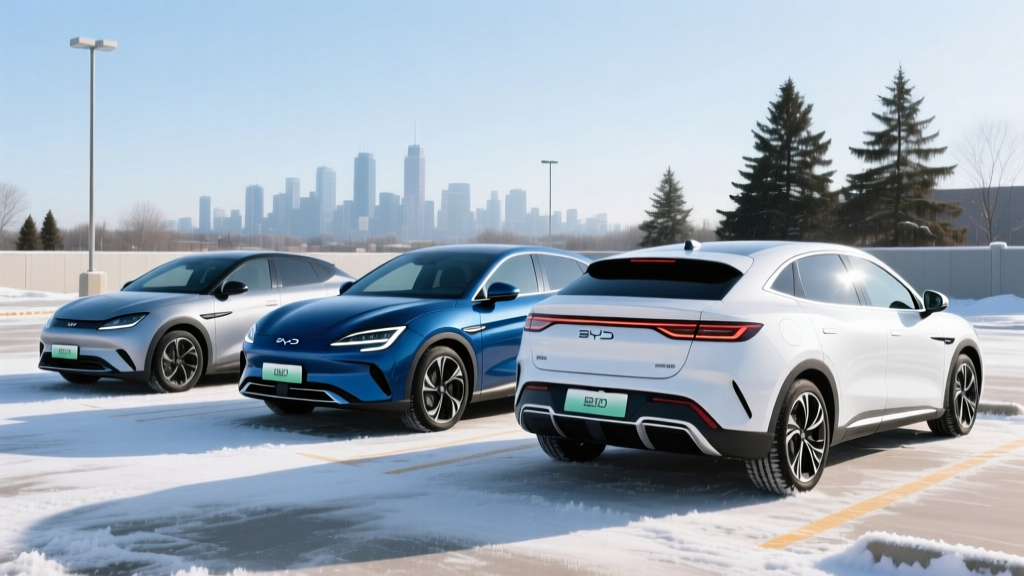
BYD — the Chinese automaker that has overtaken Tesla in global BEV sales volume — has been aggressively expanding into international markets. For Canadian EV shoppers searching for a BYD car in Canada, the picture in 2026 is one of cautious optimism mixed with real-world obstacles. BYD has confirmed its intent to enter the Canadian market, but as of early 2026, no BYD model is officially available for purchase through Canadian dealerships. That said, the brand's global lineup — particularly the Seal sedan, Atto 3 (Yuan Plus) crossover, and Dolphin hatchback — gives us a strong basis for what Canadian buyers can expect in terms of specs, pricing, and ownership experience once sales begin.
This profile breaks down the three most likely BYD models to arrive in Canada, using confirmed global specifications, preliminary Canadian pricing estimates, and the real-world ownership considerations that matter most: range in cold weather, charging speed, battery chemistry, and tax-credit eligibility under Canada's federal iZEV program and provincial incentives.
BYD Seal: The Tesla Model 3 Competitor
The BYD Seal is a mid-size electric sedan positioned squarely against the Tesla Model 3 and Hyundai Ioniq 6. It rides on BYD's e-Platform 3.0 and features the company's proprietary Blade Battery — a lithium iron phosphate (LFP) cell design known for thermal stability and long cycle life.
| Attribute | Standard Range (RWD) | Extended Range (RWD) | Performance (AWD) |
|---|---|---|---|
| Battery (usable) | 61.4 kWh LFP | 82.5 kWh LFP | 82.5 kWh LFP |
| WLTP Range | 440 km (273 mi) | 570 km (354 mi) | 520 km (323 mi) |
| Est. EPA Range | ~240 mi | ~310 mi | ~285 mi |
| Horsepower | 201 hp | 308 hp | 523 hp |
| 0-100 km/h (0-62 mph) | 7.5 sec | 5.9 sec | 3.8 sec |
| Drivetrain | RWD | RWD | AWD (dual-motor) |
| Max DC Charge Rate | 110 kW | 150 kW | 150 kW |
| 10-80% DCFC Time | ~36 min | ~26 min | ~26 min |
| Level 2 AC Charge | 7 kW (~22 mi/hr) | 11 kW (~35 mi/hr) | 11 kW (~35 mi/hr) |
| Est. Efficiency | ~26 kWh/100mi | ~27 kWh/100mi | ~29 kWh/100mi |
Note: BYD publishes WLTP range figures, which are typically 10-15% more optimistic than EPA estimates. The EPA figures above are author estimates based on WLTP-to-EPA conversion ratios observed in similar vehicles. Official EPA numbers will be available if and when the Seal is certified for North American sale.
Estimated EPA: ~310 miles | Expect ~260-280 miles in mixed highway driving at 70 mph. In Canadian winter conditions (-10°C to -25°C), plan for 200-240 miles of usable range. LFP batteries are more resistant to cold-induced degradation long-term, but cold still reduces available capacity per charge by 20-35%. The Seal's standard heat pump (confirmed on global-spec models) helps mitigate cabin-heating energy draw.
Interior, Cargo, and Tech
The Seal measures 4,800 mm long with a 2,920 mm wheelbase, giving it rear legroom competitive with the Model 3 (~35.4 inches). Cargo volume is approximately 14.1 cu ft (400 L) in the trunk, plus a small 53 L frunk on RWD trims. The interior features a 15.6-inch rotating center touchscreen, 10.25-inch digital instrument cluster, wireless phone charging, and a panoramic glass roof.
Driver-assistance features on global-spec models include adaptive cruise control, lane-keeping assist, blind-spot monitoring, and a 360-degree camera. These represent SAE Level 2 functionality — the driver must remain fully engaged at all times.
BYD Atto 3 (Yuan Plus): The Compact SUV Option
The Atto 3 is BYD's best-selling EV globally and the model most frequently cited as the likely first entrant for the Canadian market. It's a compact crossover competing with the Hyundai Kona Electric, Kia Niro EV, and Volvo EX30.
| Attribute | Standard Range | Extended Range |
|---|---|---|
| Battery (usable) | 49.9 kWh LFP | 60.5 kWh LFP |
| WLTP Range | 345 km (214 mi) | 420 km (261 mi) |
| Est. EPA Range | ~190 mi | ~230 mi |
| Horsepower | 201 hp | 201 hp |
| 0-100 km/h | 7.3 sec | 7.3 sec |
| Max DC Charge | 70 kW | 88 kW |
| 10-80% DCFC Time | ~40 min | ~29 min |
| Level 2 AC | 7 kW (~20 mi/hr) | 7 kW (~20 mi/hr) |
The Atto 3's Blade Battery is fully LFP — no cobalt, no nickel — which means lower energy density than NMC competitors but significantly better thermal safety and longer cycle life (BYD rates it for 5,000+ charge cycles before reaching 80% state of health). Cargo space is approximately 15.6 cu ft (440 L) behind the rear seats, expanding to roughly 47.0 cu ft with seats folded.
Estimated EPA: ~230 miles | Expect ~195-210 miles in mixed driving. In Canadian winters, plan for 150-175 miles. The Atto 3's smaller battery and less aggressive thermal management mean cold-weather range loss hits harder here than in the Seal. Preconditioning via the BYD app while plugged in is essential for winter commuters.
BYD Dolphin: The Budget Hatchback
The Dolphin is BYD's entry-level EV, a compact hatchback that could undercut most competitors on price if it reaches Canada. It shares the e-Platform 3.0 architecture with its siblings but in a smaller, lighter package.
| Attribute | Standard Range | Extended Range |
|---|---|---|
| Battery (usable) | 44.9 kWh LFP | 60.5 kWh LFP |
| WLTP Range | 310 km (193 mi) | 427 km (265 mi) |
| Est. EPA Range | ~170 mi | ~235 mi |
| Horsepower | 94 hp | 201 hp |
| 0-100 km/h | 12.3 sec | 7.0 sec |
| Max DC Charge | 60 kW | 88 kW |
| 10-80% DCFC Time | ~41 min | ~29 min |
The Dolphin's appeal is straightforward: affordable electric mobility with decent range. Its drawbacks are equally clear — the Standard Range model's 94 hp motor and ~170-mile estimated EPA range make it strictly a city commuter. The Extended Range version is far more capable but pushes the price higher, closer to Atto 3 territory.
Charging Speed and Infrastructure Compatibility
Charging speed is where BYD's LFP Blade Battery strategy reveals its trade-off. LFP cells generally accept lower peak charge rates than NMC chemistries, and BYD's models reflect this:
| Model | Peak DC kW | 10-80% Time | Level 2 kW | L2 Miles/Hour | Connector |
|---|---|---|---|---|---|
| Seal (ER/AWD) | 150 kW | ~26 min | 11 kW | ~35 mi/hr | CCS2 (likely NACS for NA) |
| Atto 3 (ER) | 88 kW | ~29 min | 7 kW | ~20 mi/hr | CCS2 (likely NACS for NA) |
| Dolphin (ER) | 88 kW | ~29 min | 7 kW | ~20 mi/hr | CCS2 (likely NACS for NA) |
What this means in practice: The Seal's 150 kW peak is respectable but trails the Hyundai Ioniq 5's 240 kW and the Tesla Model 3 Highland's 250 kW. On a road trip, you'll spend roughly 26 minutes at a DC fast charger to go from 10% to 80% — adequate but not class-leading. The Atto 3 and Dolphin, capped at 88 kW, will feel slow on longer highway trips, especially when competitors in the same price range offer 150+ kW charging.
One critical unknown for Canadian buyers: which connector BYD will adopt. Global-spec BYD vehicles use CCS2 (the European standard). For North America, BYD would need to equip either CCS1 or, increasingly likely given the 2025-2026 industry shift, the Tesla NACS connector. This decision will determine whether BYD owners can access the Tesla Supercharger network natively — a major factor in charging convenience across Canada.
Pricing, Tax Credits, and Canadian Incentives
BYD's global pricing strategy undercuts most competitors by 15-25%. If that pricing translates to Canada, here's what buyers might expect:
| Model | Est. Base MSRP (CAD) | Federal iZEV | BC/ QC Provincial | Est. Net Price (CAD) |
|---|---|---|---|---|
| Dolphin (Std Range) | ~$32,000 | $5,000 | Up to $4,000 | ~$23,000 |
| Atto 3 (ER) | ~$42,000 | $5,000 | Up to $4,000 | ~$33,000 |
| Seal (ER RWD) | ~$48,000 | $5,000 | Up to $4,000 | ~$39,000 |
| Seal (AWD Perf.) | ~$58,000 | $5,000 | Varies | ~$49,000+ |
Canadian Federal iZEV Program Eligibility
Canada's Transport Canada iZEV program offers up to $5,000 CAD for eligible battery-electric vehicles with a base MSRP under $55,000 CAD (for passenger cars) or $60,000 CAD (for SUVs/pickups). Key requirements:
- MSRP cap: Base model must be under the price threshold; higher trims may lose eligibility if the base model's MSRP exceeds the cap
- Vehicle must be on the eligible list: Transport Canada must certify the specific model — BYD models would need to be added after launch
- Provincial stacking: BC offers up to $4,000 additional rebate (income-tested); Quebec offers up to $7,000 (decreasing annually). Other provinces vary
- Point of sale: The federal rebate is applied at purchase/lease
Warranty and Battery Longevity
BYD offers one of the most competitive battery warranties in the global market. On international-spec vehicles:
- Battery warranty: 8 years / 160,000 km (~100,000 mi), covering capacity retention above 70% state of health
- Powertrain warranty: 8 years / 160,000 km
- Vehicle warranty: 6 years / 150,000 km (varies by market)
The LFP Blade Battery chemistry is a significant longevity advantage. Independent testing and BYD's own data suggest the Blade Battery retains approximately 80% capacity after 3,000-5,000 full charge cycles — far exceeding typical NMC cells (1,000-2,000 cycles to 80%). For a driver charging daily, that translates to well over 15 years of service before meaningful degradation. LFP also eliminates cobalt and nickel, reducing supply-chain ethical concerns and fire risk.
The trade-off: LFP batteries are heavier per kWh and less energy-dense, which is why BYD models tend to have slightly lower range figures than NMC-equipped competitors with similar battery sizes. LFP also shows less accurate state-of-charge estimation — BYD recommends periodic full charges to 100% to recalibrate the BMS, unlike NMC where daily 80% charges are preferred.
BYD vs. the Competition: Who Wins?
✅ Pros
- Aggressive pricing — potentially $5,000-$10,000 CAD below equivalent competitors
- LFP Blade Battery: excellent thermal safety, long cycle life, no cobalt
- Competitive range (Seal ER: ~310 mi est. EPA)
- Strong standard equipment (rotating screen, heat pump, V2L)
- AWD Performance Seal: 523 hp, 3.8s 0-62 mph at a fraction of Model 3 Performance pricing
❌ Cons
- Not yet available in Canada — no confirmed launch date
- DC fast-charge speeds trail class leaders (88-150 kW vs. 240-350 kW competitors)
- WLTP-only range figures create uncertainty until EPA certification
- Unknown Canadian dealer/service network depth
- Resale value unproven in North America
- Software/infotainment UX may not match Tesla or Hyundai's polish
- Cold-weather range loss hits smaller-battery models hard
Head-to-Head: BYD Seal vs. Tesla Model 3 vs. Hyundai Ioniq 6
| Spec | BYD Seal ER (est.) | Tesla Model 3 LR | Hyundai Ioniq 6 LR |
|---|---|---|---|
| Est. EPA Range | ~310 mi | 341 mi | 361 mi |
| Battery | 82.5 kWh LFP | ~75 kWh NMC | 77.4 kWh NMC |
| Peak DC Charge | 150 kW | 250 kW | 240 kW |
| 10-80% Time | ~26 min | ~18 min | ~18 min |
| 0-60 mph | ~5.9 sec | 4.2 sec | 5.1 sec |
| Est. Base MSRP (CAD) | ~$48,000 | $59,990 | $54,999 |
The BYD Seal's value proposition is clear: similar range to the Model 3 Long Range at a substantially lower price, with the trade-off of slower charging and an unproven service network. If BYD can deliver the Seal in Canada near the estimated $48,000 CAD mark — and especially if it qualifies for the full $5,000 iZEV plus provincial rebates — it would be one of the most affordable 300+ mile EVs on the market.
Who Should Wait for BYD in Canada?
Decision Framework
Consider waiting for a BYD if:
- You want a 300+ mile EV under $40,000 CAD (after incentives) and can wait 12-24 months
- You prioritize battery longevity and safety over peak charging speed
- You're a city/suburban commuter who charges at home and rarely road-trips more than 250 km
- You value LFP chemistry's cobalt-free supply chain
Buy an existing competitor now if:
- You need an EV within the next 6 months
- You road-trip frequently and need 200+ kW DC fast charging for minimal stop times
- You want an established dealer/service network across Canada
- Resale value predictability matters for your financial planning
- You need proven cold-weather performance data from Canadian owners
Frequently Asked Questions
Can I buy a BYD car in Canada right now?
No. As of early 2026, BYD has not launched retail sales in Canada. The company has signaled intent to enter the market, but no models are available for purchase or order through Canadian dealerships. Grey-market imports are not recommended due to warranty, certification, and service complications.
What is the real-world range of BYD models in Canadian winters?
Based on European cold-weather testing and LFP chemistry characteristics, expect 20-35% range loss in temperatures below -10°C. The Seal Extended Range (~310 mi est. EPA) would deliver roughly 200-240 miles in deep winter. The Atto 3 Extended Range (~230 mi est.) would drop to approximately 150-175 miles. Preconditioning while plugged in and using the heat pump (standard on most trims) are essential for maximizing winter range.
Will BYD models qualify for Canadian EV incentives?
Likely yes, provided the MSRP stays under Transport Canada's iZEV thresholds ($55,000 CAD for cars, $60,000 for SUVs) and the models are added to the eligible vehicle list. The Dolphin and Atto 3 would almost certainly qualify. The Seal Extended Range should qualify at its estimated ~$48,000 CAD price. The AWD Performance Seal may push the $55,000 cap depending on final pricing.
How does BYD's Blade Battery compare to Tesla or Hyundai batteries?
BYD's Blade Battery uses LFP chemistry, which offers superior thermal stability (near-zero fire risk in nail penetration tests), longer cycle life (3,000-5,000 cycles vs. 1,000-2,000 for NMC), and no cobalt. The trade-off is lower energy density (heavier battery for the same range) and slower peak charging speeds. Tesla's Model 3 Standard Range also uses LFP (from CATL), so the chemistry itself is proven in North America. Hyundai/Kia primarily use NMC for higher energy density and faster charging.
What charging connector will BYD use in Canada?
This is unconfirmed. Global BYD models use CCS2 (European). For the North American market, BYD would need to adopt either CCS1 or the Tesla NACS standard. Given the 2025-2026 industry-wide shift toward NACS — with Ford, GM, Hyundai, and others adopting it — NACS is the most likely choice. This would grant BYD owners native access to the Tesla Supercharger network, a significant advantage.
Is it worth waiting for BYD or should I buy now?
If you need a vehicle in 2026, the answer is to buy now. Competitors like the Hyundai Kona Electric (~$44,000 CAD, 420 km WLTP), Tesla Model 3 (~$59,990 CAD, 576 km WLTP), and upcoming models from VW and Kia offer proven Canadian service networks, confirmed incentive eligibility, and known cold-weather performance. If you're 12-24 months out from a purchase and want maximum value per dollar, BYD's pricing could be worth the wait — but monitor launch announcements closely and have a backup plan.