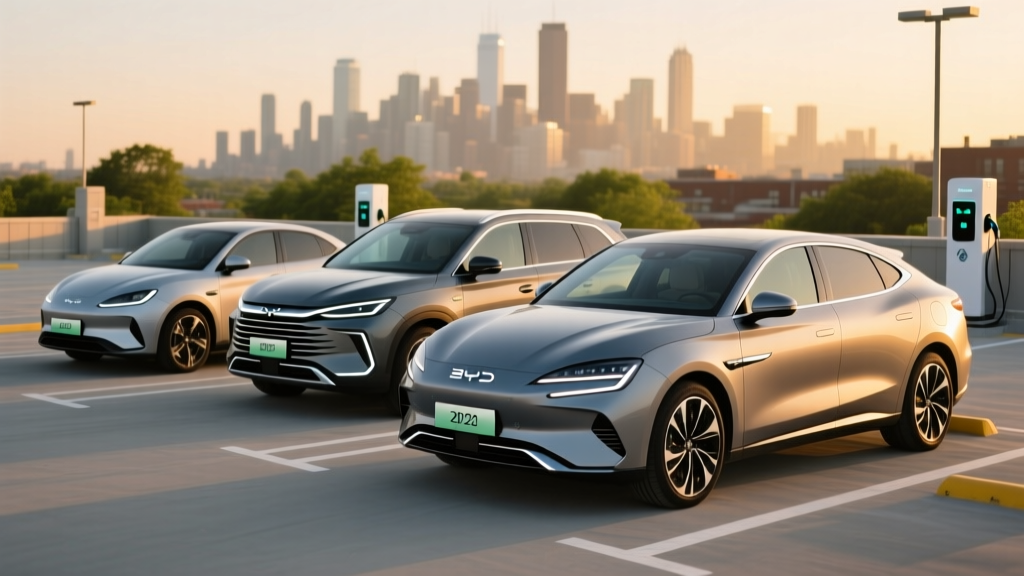
BYD — the world's largest plug-in electric vehicle manufacturer by volume — has confirmed its entry into the Canadian market, with dealership rollouts and vehicle homologation underway for 2026. For Canadian EV shoppers, this raises a flood of questions: Which models will actually arrive? What range and charging speeds can you expect from BYD's signature LFP Blade Battery? And critically, will these vehicles qualify for Canada's federal iZEV rebate or any provincial incentives?
This guide cuts through the speculation. We profile the three models most likely to launch in Canada first — the BYD Seal sedan, the BYD Atto 3 (known globally as the Yuan Plus) compact SUV, and the BYD Dolphin hatchback — with hard specs, real-world range expectations, charging data, and a clear-eyed look at pricing and incentive eligibility.
BYD Seal: The Tesla Model 3 Challenger
The BYD Seal is the automaker's most credible shot at the North American midsize electric sedan segment, competing directly with the Tesla Model 3, Hyundai Ioniq 6, and BMW i4. Built on BYD's e-Platform 3.0 with Cell-to-Body (CTB) architecture — where the battery is structurally integrated into the chassis — the Seal delivers impressive rigidity, low center of gravity, and competitive interior space.
| Spec | Detail |
|---|---|
| Battery | 82.5 kWh usable (LFP Blade Battery, Cell-to-Body) |
| Range (WLTP) | ~570 km (354 mi) — Design RWD trim |
| Est. EPA Range | ~310–330 mi (pending Transport Canada certification) |
| Drivetrain | RWD (single motor, 312 hp) or AWD (dual motor, 530 hp) |
| 0–100 km/h (0–62 mph) | 5.9 sec (RWD) / 3.8 sec (AWD Excellence) |
| DC Fast Charge (peak) | 150 kW (10–80% in ~26 min) |
| Level 2 AC Charge | 11 kW (~35 mi/hr added) |
| Efficiency (WLTP) | ~16.6 kWh/100 km (~26.7 kWh/100 mi) |
| Cargo | 14.1 cu ft trunk + front storage |
| Est. Canadian MSRP | CAD $48,000–$58,000 (preliminary) |
Seal Charging Reality
The Seal's 150 kW peak DC charge rate is adequate but not class-leading — the Hyundai Ioniq 6 peaks at 240 kW, and the Tesla Model 3 Highland at roughly 250 kW. The practical implication: at a 150 kW station, the Seal's LFP battery charges relatively linearly from 10–80% in about 26 minutes, but you won't see the ultra-fast 18-minute 10–80% times that 800V architectures deliver.
At home on a Level 2 charger (240V, 48A), the 11 kW onboard charger replenishes the 82.5 kWh battery in roughly 8 hours — practical for overnight charging. BYD has not yet confirmed whether Canadian models will ship with NACS (Tesla-style) or CCS1 connectors; this will be critical for Supercharger access.
BYD Atto 3 (Yuan Plus): The Compact SUV Entry
The Atto 3 is BYD's global volume hero — a compact electric crossover competing with the Hyundai Kona Electric, Kia Niro EV, and Volvo EX30. It's the most likely BYD model to arrive in Canada first, given its global sales volume and suitability for the crossover-obsessed Canadian market.
| Spec | Detail |
|---|---|
| Battery | 60.5 kWh usable (LFP Blade Battery) |
| Range (WLTP) | 420 km (261 mi) |
| Est. EPA Range | ~230–245 mi (pending certification) |
| Drivetrain | FWD, single motor, 201 hp / 229 lb-ft |
| 0–100 km/h | 7.3 seconds |
| DC Fast Charge (peak) | 88 kW (10–80% in ~29 min) |
| Level 2 AC Charge | 7 kW (~22 mi/hr added) |
| Efficiency (WLTP) | ~15.6 kWh/100 km (~25.1 kWh/100 mi) |
| Cargo | 15.6 cu ft (rear seats up) / 47.6 cu ft (folded) |
| Est. Canadian MSRP | CAD $39,000–$45,000 (preliminary) |
The Atto 3's 88 kW DC fast-charge peak is its most significant limitation for Canadian road-trippers. On a Trans-Canada drive, you'll spend roughly 30 minutes at each DC stop for a 10–80% top-up — noticeably slower than the Kona Electric (100 kW+) or Ioniq 5 (240 kW). For daily commuting and home-charging owners, this is a non-issue; for frequent highway travelers, it's a real constraint.
BYD Dolphin: The Budget EV Hatchback
The Dolphin is BYD's affordable electric hatchback — a segment with shockingly few competitors in North America. If priced aggressively, it could undercut every other new EV on the Canadian market.
| Spec | Detail |
|---|---|
| Battery | 60.4 kWh usable (LFP Blade Battery) |
| Range (WLTP) | 427 km (265 mi) |
| Est. EPA Range | ~235–250 mi (pending certification) |
| Drivetrain | FWD, single motor, 201 hp |
| 0–100 km/h | 7.0 seconds |
| DC Fast Charge (peak) | 88 kW (10–80% in ~29 min) |
| Level 2 AC Charge | 7 kW (~22 mi/hr added) |
| Cargo | 12.2 cu ft (rear up) / 36.8 cu ft (folded) |
| Est. Canadian MSRP | CAD $32,000–$37,000 (preliminary) |
The LFP Blade Battery: Chemistry, Longevity & Cold-Weather Reality
Every BYD model destined for Canada uses the company's proprietary Blade Battery — a lithium iron phosphate (LFP) cell in a unique elongated form factor that BYD claims passes nail-penetration testing without thermal runaway. Here's what that chemistry means for Canadian owners:
| Factor | LFP (BYD Blade) | NMC (Tesla, Hyundai, Kia) |
|---|---|---|
| Cycle Life | 3,000–5,000+ cycles (excellent) | 1,000–2,000 cycles |
| Degradation (10 yr est.) | ~8–12% capacity loss | ~10–15% capacity loss |
| Cold-Weather Range Loss | 25–35% (more sensitive) | 15–25% |
| Charging to 100% Daily | Recommended (no degradation penalty) | Not recommended (80% daily limit) |
| Energy Density | Lower (heavier pack for same kWh) | Higher (lighter, more range-dense) |
| Thermal Runaway Risk | Very low (inherent LFP stability) | Higher (requires active BMS management) |
| SoC Estimation Accuracy | Less precise (flat voltage curve) | More precise |
The Canadian cold-weather caveat: LFP batteries lose more range in sub-zero temperatures than NMC cells. In testing, LFP-equipped EVs have shown 25–35% range reduction at -15°C compared to their rated range, versus 15–25% for NMC packs. BYD's Blade Battery uses a heat-pump HVAC system and battery preconditioning to mitigate this, but prairie and northern Canadian buyers should plan conservatively — a Seal rated at 330 miles EPA may deliver only 215–230 miles on a -20°C January highway drive.
On the upside, LFP's longevity is exceptional. BYD warranties the Blade Battery for 8 years / 160,000 km (whichever comes first) with a capacity retention threshold of 70%. Real-world data from Chinese fleet vehicles suggests LFP cells routinely exceed 3,000 full charge cycles with minimal degradation — that's well over 500,000 km of driving before significant capacity loss.
Charging Infrastructure: What Connector Will BYD Use in Canada?
This is the single most consequential unanswered question for prospective BYD Canada buyers. As of early 2026, the North American charging landscape has largely consolidated around NACS (Tesla's connector), with Ford, GM, Hyundai, Kia, and others adopting it and gaining Supercharger access. CCS1 is still widely available but increasingly legacy.
BYD has not officially confirmed its Canadian connector choice. Possibilities include:
- NACS native — most buyer-friendly; enables Tesla Supercharger access from day one
- CCS1 native — works with Electrify America, Petro-Canada, and most existing Canadian networks, but misses Supercharger access without an adapter
- CCS1 with NACS adapter included — a compromise approach some OEMs have taken
Until BYD confirms the connector, buyers should factor in adapter costs ($200–$400) or potential Supercharger access limitations. We'll update this article as soon as BYD Canada announces its charging standard.
| Level | Seal | Atto 3 | Dolphin |
|---|---|---|---|
| Level 1 (120V, 12A) | ~1.4 kW (~5 mi/hr) | ~1.4 kW (~5 mi/hr) | ~1.4 kW (~5 mi/hr) |
| Level 2 (240V, 48A) | 11 kW (~35 mi/hr) | 7 kW (~22 mi/hr) | 7 kW (~22 mi/hr) |
| DC Fast Charge (peak) | 150 kW | 88 kW | 88 kW |
| DC 10–80% Time | ~26 min | ~29 min | ~29 min |
Canadian Pricing, Incentives & Total Cost Outlook
Canada's federal iZEV (Incentives for Zero-Emission Vehicles) program offers a CAD $5,000 rebate for eligible battery-electric vehicles with a base MSRP under CAD $55,000 (for cars) or CAD $60,000 (for SUVs/pickups). Provincial incentives stack on top in several provinces:
- British Columbia: Up to CAD $4,000 (income-tested, CEV for BC program)
- Quebec: Up to CAD $7,000 (Roulez vert program, income-tested)
- Other provinces: No additional provincial EV rebates as of 2026
Here's how BYD's expected Canadian pricing intersects with incentive eligibility:
| Model | Est. Base MSRP (CAD) | Federal iZEV ($5,000) | After Federal Rebate |
|---|---|---|---|
| Dolphin | $32,000–$37,000 | ✅ Eligible | ~$27,000–$32,000 |
| Atto 3 | $39,000–$45,000 | ✅ Eligible | ~$34,000–$40,000 |
| Seal (RWD) | $48,000–$52,000 | ✅ Eligible (under $55K cap) | ~$43,000–$47,000 |
| Seal (AWD Excellence) | $55,000–$58,000 | ⚠️ May exceed car cap | TBD — depends on classification |
Critical caveat: The iZEV program applies to vehicles on Transport Canada's approved list. BYD's models must complete homologation and be added before buyers can claim the rebate. Additionally, the federal iZEV program has been subject to funding renewals — confirm current availability at Transport Canada's iZEV page before purchasing. Provincial programs in BC and Quebec have their own income thresholds and application processes.
For US readers comparing to the IRS §30D credit: BYD vehicles are not eligible for the US federal $7,500 tax credit, as BYD does not manufacture vehicles in North America and its battery supply chain is China-based — failing both the critical-minerals and battery-component sourcing requirements under current IRS §30D rules.
BYD vs the Competition: How Does It Stack Up?
Here's how BYD's expected Canadian lineup compares to established competitors on the metrics that matter most:
| Metric | BYD Seal (RWD) | Tesla Model 3 LR | Hyundai Ioniq 6 SEL |
|---|---|---|---|
| Est. EPA Range | ~320 mi | 363 mi | 361 mi |
| Battery / Chemistry | 82.5 kWh / LFP | 75 kWh / NMC | 77.4 kWh / NMC |
| Peak DC Charge | 150 kW | ~250 kW | 240 kW |
| 10–80% DC Time | ~26 min | ~18 min | ~18 min |
| 0–60 mph | 5.9 sec | 4.2 sec | 5.1 sec |
| Supercharger Access | TBD (connector unconfirmed) | ✅ Native | ✅ (NACS adapter) |
| Est. Canadian Price | ~CAD $48K | ~CAD $55K | ~CAD $53K |
The BYD Seal's value proposition is price — undercutting rivals by CAD $5,000–$7,000 while offering competitive range and a durable LFP battery. Its weakness is charging speed: 150 kW peak means longer stops on road trips. The Atto 3 faces the same trade-off at a lower price point versus the Kona Electric and Niro EV.
✅ Pros
- Aggressive pricing — potentially the most affordable EVs in their segments
- LFP Blade Battery: exceptional cycle life, very low thermal runaway risk
- Recommended to charge to 100% daily (no 80% limit anxiety)
- Strong build quality and interior materials (based on global-market reviews)
- Heat-pump HVAC standard (critical for Canadian winters)
- 8-yr / 160,000 km battery warranty
❌ Cons
- Slower DC fast charging than competitors (88–150 kW vs 240+ kW)
- LFP cold-weather range loss is significant (25–35% in deep freeze)
- Canadian connector (NACS vs CCS) still unconfirmed — Supercharger access uncertain
- No established Canadian dealer/service network yet — parts and service availability is a risk
- Driver-assist systems (ADAS) untested by NHTSA/IIHS for Canadian-market trims
- Resale value unknown — new brand in Canada carries depreciation uncertainty
Who Should Buy a BYD in Canada?
Choose BYD If:
- You're a home-charging commuter who rarely road-trips — BYD's slower DC charging matters less when 90% of charging happens overnight at Level 2
- You prioritize battery longevity — LFP's 3,000+ cycle life means the battery will likely outlast the car's body
- You want the lowest possible purchase price for a new EV — the Dolphin and Atto 3 could be the most affordable EVs in Canada post-rebate
- You live in BC or Quebec where stacking federal + provincial rebates makes the effective price remarkably low
Look Elsewhere If:
- You road-trip frequently — the Atto 3 and Dolphin's 88 kW peak will add 10+ minutes per DC stop versus an Ioniq 5 or Model 3
- You live in extreme cold (Prairies, Northern Canada) — LFP's cold-weather range penalty is real and measurable
- You need established service infrastructure — BYD's Canadian dealer network is nascent; warranty service logistics are unproven
- Supercharger access is non-negotiable — until BYD confirms NACS, this remains uncertain
Frequently Asked Questions
Is BYD officially selling cars in Canada yet?
As of early 2026, BYD is in the pre-launch phase — completing Transport Canada homologation, establishing dealer partnerships, and preparing logistics. Vehicles are expected to go on sale during 2026, but exact timing has not been confirmed. No BYD EV is currently purchasable from a Canadian dealer.
Will BYD qualify for the Canadian federal iZEV rebate?
Likely yes, for models under the MSRP cap (CAD $55,000 for cars, $60,000 for SUVs). The Dolphin and Atto 3 should qualify comfortably. The Seal's eligibility depends on final trim pricing and whether Transport Canada classifies it as a car or SUV. The iZEV program requires the vehicle to be on Transport Canada's approved list — confirm before purchasing.
How does BYD's Blade Battery compare to Tesla's 4680 cells?
Different chemistries, different strengths. BYD's LFP Blade Battery offers superior cycle life (3,000+ vs ~1,500 cycles), better thermal stability, and tolerance for daily 100% charging. Tesla's 4680 NMC cells deliver higher energy density (more range per kg) and better cold-weather performance. For longevity-focused buyers, LFP wins; for maximum range and cold-weather driving, NMC has the edge.
What charging connector will BYD use in Canada?
Not yet confirmed. The North American market is consolidating on NACS (Tesla's connector), but BYD has used CCS2 in Europe and GB/T in China. Canadian buyers should wait for an official announcement before assuming Supercharger compatibility.
Is BYD's driver-assist technology competitive?
BYD's ADAS suite (branded as DiPilot) includes adaptive cruise control, lane-keeping, and automatic emergency braking. It is a SAE Level 2 driver-assistance system — meaning the driver must remain fully engaged at all times. It is not autonomous driving. Independent testing by Euro NCAP has rated BYD models well, but North American IIHS/NHTSA evaluations of Canadian-spec vehicles are not yet available.
What is BYD's warranty coverage in Canada?
Based on global-market terms, expect an 8-year / 160,000 km battery warranty (70% capacity retention threshold) and a 6-year / 150,000 km vehicle warranty. Canadian-specific warranty terms will be confirmed at launch. Compare this to Hyundai's 8-year/160,000 km battery warranty and Tesla's 8-year/192,000 km coverage.
Sources: Transport Canada iZEV Program, BYD Global product specifications, IRS §30D Clean Vehicle Credit rules (for US comparison). All pricing and range figures are preliminary estimates pending Canadian market launch confirmation.