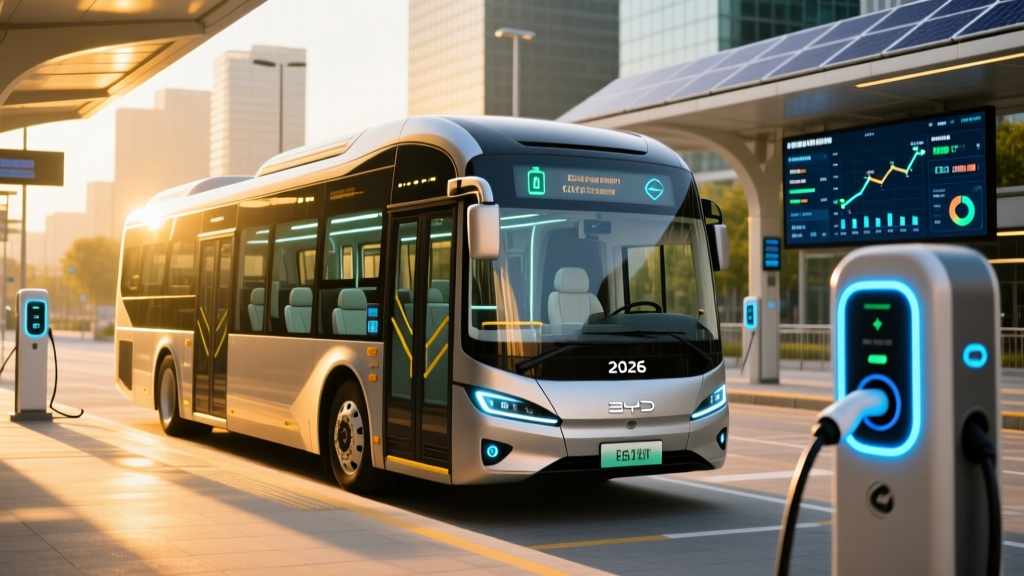
BYD has quietly become the world's largest manufacturer of battery-electric commercial vehicles, and its transit and coach buses are now operating in dozens of countries. For U.S. fleet managers, transit agencies, and private operators researching BYD buses, the questions are practical: What is the real-world range under a full passenger load? How long does a depot charge take? What does total cost of ownership look like versus diesel or hydrogen? This profile breaks down the current BYD bus lineup available to North American and global fleet buyers, with exact specs, charging data, and ownership economics.
BYD Bus Lineup: K-Series Transit and C-Series Coaches
BYD's commercial bus portfolio centers on two families. The K-Series (K7M, K8M, K9M, K11M) covers transit applications from 30-foot midibuses to 60-foot articulated buses. The C-Series (C9, C10) targets intercity coach and shuttle operations. In the U.S. market, the K8M (40-foot) and K9M (40-foot, higher capacity) have been the most widely deployed models among transit agencies that have adopted them, though BYD's U.S. footprint has been heavily constrained by federal procurement restrictions (more on that below).
Unlike consumer EVs, BYD buses are built to order with highly configurable battery packs, HVAC systems, and interior layouts. The specs below reflect the most common North American-spec configurations as of the 2025–2026 model cycle.
| Attribute | K8M (40 ft) | K9M (40 ft HD) |
|---|---|---|
| Battery Capacity | 348 kWh (usable) | 440 kWh (usable) |
| Battery Chemistry | LFP (Lithium Iron Phosphate) | LFP |
| EPA / Certified Range | ~220 mi (ZEMO/Altoona tested) | ~245 mi (ZEMO/Altoona tested) |
| Motor Output | 2 × 150 kW wheel-hub motors (402 HP equiv.) | 2 × 180 kW wheel-hub motors (483 HP equiv.) |
| Peak Torque | ~3,100 lb-ft combined | ~3,540 lb-ft combined |
| 0–30 mph (loaded) | ~9.5 sec | ~10.2 sec |
| Max Speed | 65 mph (governed) | 65 mph (governed) |
| Seated + Standing Capacity | ~70 passengers | ~80 passengers |
| GVWR | ~40,000 lbs | ~44,000 lbs |
| DC Fast Charge (Max) | 150 kW (CCS1) | 180 kW (CCS1) |
| Depot AC Charge | 80 kW (3-phase) | 80 kW (3-phase) |
| Base Price (approx.) | $750,000–$850,000 | $850,000–$950,000 |
| Warranty (Battery) | 8 years / 500,000 mi (80% SoH) | 8 years / 500,000 mi (80% SoH) |
Real-World Range: What Fleet Operators Actually See
Certified Range (K9M): ~245 miles (Altoona/ZEMO standardized test cycle)
Real-World Range (loaded, mixed urban/suburban): 170–200 miles
Cold-Weather Range (below 32°F, HVAC heat on): 120–150 miles
Highway-Only (65 mph, intercity shuttle): ~140–160 miles
Transit buses don't get EPA Monroney stickers like passenger cars. Range certification comes from the Altoona Bus Research and Testing Center (Pennsylvania), which runs standardized duty cycles that simulate urban transit routes with frequent stops. The K9M's ~245-mile certified figure reflects that stop-and-go cycle, which actually favors EVs thanks to regenerative braking.
In real-world fleet operations, range depends heavily on passenger load, terrain, ambient temperature, and HVAC demand. Agencies in temperate climates (Los Angeles, Miami) report achieving 190–210 miles on a full charge with a loaded K9M on typical urban routes. In cold climates (Chicago, Minneapolis), winter range drops 30–40% because cabin heating draws heavily from the traction battery — BYD buses use resistive electric heaters rather than heat pumps, which is a significant energy draw at scale.
For C-Series coaches running highway-speed intercity routes, aerodynamic drag at 65 mph cuts range substantially. Expect 140–160 real-world miles for a loaded C9 coach, which limits it to short-haul shuttle routes (airport-to-city, commuter corridors) rather than long-distance intercity service.
Charging Infrastructure: Depot and Opportunity Charging
BYD buses support two primary charging strategies: overnight depot charging and mid-route opportunity charging. Understanding both is essential for fleet planners.
| Charging Method | Power (kW) | Connector | 10–80% Time | Miles Added/Hour (est.) |
|---|---|---|---|---|
| Depot AC (3-phase) | 80 kW | Hardwired / CCS1 AC pins | ~3.5–4.5 hours | ~45–55 mi/hr |
| DC Fast Charge | 150–180 kW (peak) | CCS1 | ~1.5–2 hours | ~110–130 mi/hr |
| Pantograph (opportunity, K-series option) | Up to 300 kW | SAE J3105 overhead | 6–10 min (partial) | N/A — route top-up |
The 80 kW depot charger is the workhorse for most BYD bus fleets. A full overnight charge from 10% to 100% takes roughly 4.5–5.5 hours for the K9M's 440 kWh pack, which aligns well with typical 8–10 hour layover windows. The charge curve is relatively flat on LFP chemistry — BYD's battery management system allows sustained high-rate charging through a wider state-of-charge window than NMC packs, which taper more aggressively above 80%.
DC fast charging at 150–180 kW is useful for mid-day top-ups but is rarely used as the primary strategy. The large battery pack means even at peak power, a 10–80% session takes 1.5–2 hours — far longer than a passenger EV because the energy volume is 5–6× larger. Opportunity pantograph chargers (overhead conductive) at route terminals can add 20–40 miles in 6–10 minutes, which some agencies use to extend range on high-frequency routes without returning to the depot.
Depot electrical infrastructure is the real bottleneck. A 10-bus depot charging at 80 kW simultaneously requires ~800 kW of continuous electrical service — typically a dedicated medium-voltage transformer upgrade. Fleet operators should budget $150,000–$400,000+ for depot electrical upgrades depending on existing service capacity and local utility interconnection requirements.
Performance and Drivetrain
BYD uses in-wheel hub motors on its K-Series buses — a design that eliminates the need for a conventional axle, differential, and driveshaft. This frees up underfloor space for battery packs and lowers the center of gravity. The dual rear-axle hub motors on the K9M produce a combined 360 kW (~483 HP equivalent) with massive low-end torque, which is exactly what a 44,000-lb vehicle needs to accelerate from stops.
0–60 mph times are largely irrelevant for transit buses (they're governed to 65 mph and rarely reach it loaded), but 0–30 mph matters for merging and intersection clearance. A loaded K9M hits 30 mph in roughly 10 seconds, which is competitive with a diesel CNG bus of the same size. The instant torque delivery makes EVs feel more responsive in stop-and-go urban traffic than their diesel counterparts, and operators consistently report smoother rides and reduced passenger complaints about acceleration jerk.
Regenerative braking on BYD buses is aggressive and configurable through the fleet management telematics system. Most agencies run high-regen settings that recover significant energy during the constant braking of urban transit routes — this is a major factor in why certified transit-cycle range exceeds highway range.
Pricing, Procurement, and the U.S. Market Reality
BYD K9M (40-ft Transit) — Indicative Pricing
| Base Vehicle MSRP | $850,000–$950,000 |
| Charger Hardware (per bus, depot AC) | $35,000–$55,000 |
| Depot Electrical Infrastructure (amortized per bus) | $40,000–$100,000+ |
| Total Acquisition Cost per Bus | $925,000–$1,105,000 |
| Federal Transit Admin. (FTA) Low-No Grant Coverage | Up to 80–85% of vehicle + infrastructure |
| Net Cost to Agency (with FTA grant) | $140,000–$220,000 |
Here's the critical context for U.S. buyers: BYD buses face significant procurement barriers in the American market. The 2020 National Defense Authorization Act (NDAA) prohibits the use of federal funds to procure buses from BYD and other Chinese-domiciled manufacturers. Since most U.S. transit agencies rely on Federal Transit Administration (FTA) grants to fund bus purchases, this effectively locks BYD out of the majority of the U.S. transit procurement market.
This does not apply to private fleet operators, airport shuttles, university campuses, or corporate transportation services that purchase without federal funding. For these buyers, BYD buses can be significantly cheaper than domestic alternatives — a comparable New Flyer Xcelsior CHARGE or Proterra ZX5 often runs $1.0–$1.3 million before infrastructure.
The IRS §30D federal tax credit that applies to consumer EVs (up to $7,500) does not apply to commercial buses. However, the §45W Commercial Clean Vehicle Credit provides up to $40,000 for qualifying zero-emission commercial vehicles over 14,000 lbs GVWR — but BYD's Chinese manufacturing origin raises battery-sourcing and critical-mineral compliance questions that fleet buyers should verify with a tax professional before assuming eligibility.
Total Cost of Ownership: BYD Electric Bus vs. Diesel
The purchase premium of an electric bus over a diesel bus ($400,000–$550,000 more) is recovered through fuel and maintenance savings over a 12–15 year service life. Here's a simplified 12-year TCO comparison for a 40-foot transit bus running 45,000 miles/year:
| Cost Category | BYD K9M (Electric) | Diesel 40-ft Transit |
|---|---|---|
| Vehicle Acquisition | $900,000 | $500,000 |
| Charging Infrastructure (amortized) | $80,000 | $0 |
| Fuel / Electricity (12 yrs) | $180,000 | $520,000 |
| Maintenance (12 yrs) | $150,000 | $380,000 |
| Battery Replacement (if needed, yr 10+) | $120,000–$180,000 | $0 |
| Total 12-Year Cost | $1,430,000–$1,490,000 | $1,400,000 |
| Cost per Mile | $2.65–$2.76 | $2.59 |
The TCO gap narrows to near-parity at 12 years and typically crosses in favor of electric by year 13–14, assuming the battery lasts its warranted life. LFP chemistry gives BYD an edge here: LFP cells tolerate more charge cycles (3,000–5,000 cycles to 80% SoH) than NMC, which matters for buses that charge daily. Many fleet operators report BYD LFP packs retaining 85–90% capacity after 5 years of daily cycling, which aligns with the chemistry's published degradation curves.
Technology, Safety, and Fleet Management
BYD buses come equipped with the company's proprietary fleet telematics platform, which provides real-time state-of-charge monitoring, energy consumption per route, driver behavior scoring, and predictive maintenance alerts. The system integrates with common third-party fleet management software (Geotab, Fleetio) via API.
Safety and driver-assistance features on current K-Series models include:
- Forward collision warning with automatic emergency braking (AEB)
- Blind-spot monitoring with audible alerts
- 360° surround-view camera system
- Lane departure warning
- Pedestrian detection (front and door-side)
- Electronic stability control with rollover mitigation
Automation Level: SAE Level 1. BYD bus driver-assistance features provide warnings and can intervene with braking in emergencies, but the driver must remain fully engaged at all times. These are not autonomous or driverless vehicles.
Notable drawbacks reported by fleet operators include limited HVAC performance in extreme cold (resistive heaters are slow to warm a large cabin), occasional software glitches in the telematics platform requiring manual resets, and longer lead times for replacement parts compared to domestic manufacturers like New Flyer or Gillig. BYD's North American parts and service network is thinner than competitors, which can mean extended downtime for non-routine repairs.
BYD Buses vs. Key Competitors
| Attribute | BYD K9M | New Flyer Xcelsior CHARGE NG | Proterra ZX5 | Gillig Battery Electric |
|---|---|---|---|---|
| Battery (kWh) | 440 (LFP) | 525 (NMC) | 492 (NMC) | 444 (NMC) |
| Certified Range | ~245 mi | ~260 mi | ~250 mi | ~235 mi |
| DC Fast Charge (kW) | 180 | 250 | 250 | 150 |
| Base Price (approx.) | $850K–$950K | $1.1M–$1.3M | $1.0M–$1.2M | $1.0M–$1.15M |
| Battery Warranty | 8 yr / 500K mi | 8 yr / 500K mi | 8 yr / 500K mi | 8 yr / 500K mi |
| U.S. FTA Procurement Eligible | No (NDAA restriction) | Yes | Yes | Yes |
| Buy America Compliant | No | Yes | Yes | Yes |
Pros
- LFP battery chemistry offers superior cycle life and thermal stability vs. NMC competitors
- Lower acquisition cost ($150K–$300K less than domestic alternatives)
- Proven global track record — 70,000+ BYD buses in operation worldwide
- In-wheel hub motor design frees underfloor space and simplifies drivetrain maintenance
- Strong regenerative braking tuned for urban transit duty cycles
Cons
- Ineligible for FTA-funded procurement in the U.S. (NDAA restriction)
- Thinner North American parts and service network vs. New Flyer, Gillig
- Resistive cabin heating reduces winter range significantly — no heat pump option
- DC fast-charge rate (180 kW peak) lags competitors at 250 kW
- §45W commercial tax credit eligibility uncertain due to battery-sourcing rules
Who Should Consider BYD Buses?
BYD buses are a strong fit if:
- You are a private fleet operator, university, airport authority, or corporate campus purchasing without federal transit funds
- You operate in a temperate climate where cold-weather range loss is manageable
- Your routes are under 180 miles per day, allowing comfortable margin on a single depot charge
- You prioritize lowest acquisition cost and LFP battery longevity over domestic sourcing
Look at New Flyer, Proterra, or Gillig if:
- Your agency relies on FTA grants or requires Buy America compliance
- You operate in severe cold climates where range loss and cabin heating are critical
- You need faster DC charging (250 kW) for tight turnaround schedules
- Domestic parts availability and rapid warranty service are non-negotiable
Frequently Asked Questions
What is the real-world range of a BYD K9M bus?
The BYD K9M is certified for approximately 245 miles on a standardized transit duty cycle. In real-world loaded operation, expect 170–200 miles in temperate conditions and 120–150 miles in cold weather with cabin heating active. Highway-speed operation (65 mph) reduces range further to roughly 140–160 miles.
How fast does a BYD bus charge?
Using an 80 kW depot AC charger, a full charge takes approximately 4.5–5.5 hours. DC fast charging at up to 180 kW (K9M) can bring the battery from 10–80% in roughly 1.5–2 hours. The LFP battery's charge curve is relatively flat, meaning it sustains higher charge rates deeper into the session than NMC packs.
Can U.S. transit agencies buy BYD buses?
Only if they do not use federal funds. The 2020 NDAA prohibits FTA-funded procurement of BYD vehicles. Private operators, universities, and airports purchasing with non-federal funds face no such restriction, but should verify state-level procurement rules and §45W tax credit eligibility independently.
Does the federal EV tax credit apply to BYD buses?
The §30D consumer credit does not apply to commercial buses. The §45W Commercial Clean Vehicle Credit provides up to $40,000 for qualifying zero-emission vehicles over 14,000 lbs GVWR, but battery-sourcing and critical-mineral requirements tied to Chinese manufacturing may disqualify BYD buses. Consult a tax professional and review current IRS guidance on §45W before assuming eligibility.
How long do BYD bus batteries last?
BYD's LFP batteries are warranted for 8 years or 500,000 miles at 80% state of health. LFP chemistry typically supports 3,000–5,000 full charge cycles before reaching 80% capacity, which translates to 8–12+ years of daily charging in transit service. Fleet operators report 85–90% capacity retention at the 5-year mark under normal use.
How does BYD bus maintenance compare to diesel?
Electric buses eliminate engine oil, filters, exhaust aftertreatment (DEF/DPF), and transmission maintenance. BYD estimates 30–50% lower maintenance costs versus diesel equivalents. The primary long-term maintenance risk is battery replacement after warranty expiration — a 440 kWh LFP pack replacement currently costs $120,000–$180,000, though prices are declining.