What Is the BYD Blade 2 Battery?
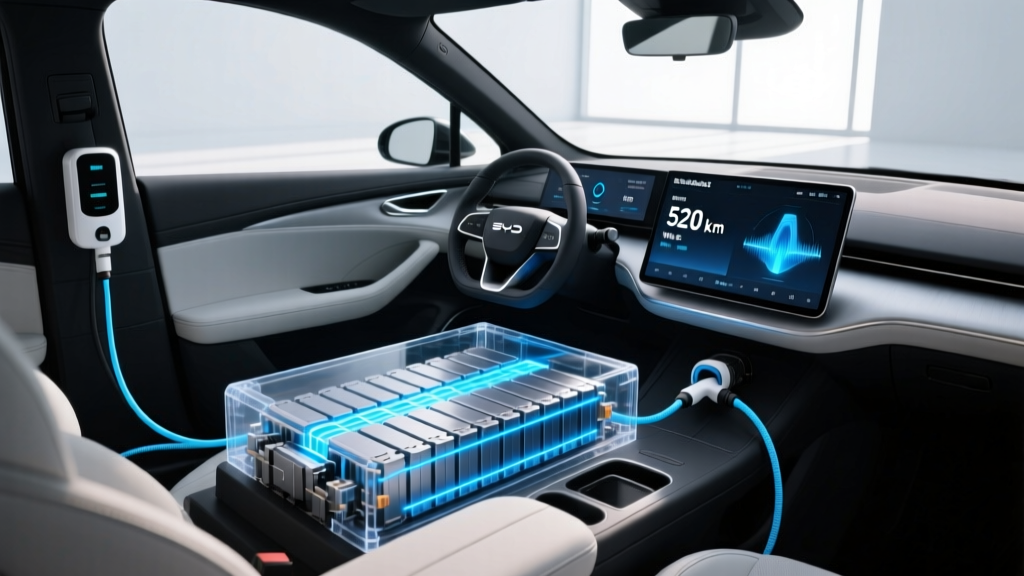
BYD's Blade 2 is the second generation of the company's signature lithium iron phosphate (LFP) battery cell architecture, officially detailed in late 2025 and beginning production rollout in select Chinese-market vehicles for the 2026 model year. The original Blade battery debuted in 2020 and became known for its exceptional thermal stability, nail-penetration safety, and cell-to-pack (CTP) structural design that eliminated modules entirely.
The Blade 2 iteration targets the primary criticism of first-gen LFP packs: lower energy density compared to nickel-manganese-cobalt (NMC) chemistries. BYD claims a volumetric energy density improvement of roughly 15–20% over the original Blade cell, achieved through thinner electrode coatings, refined electrolyte formulations, and tighter cell packaging within the same structural tray architecture.
For US-based EV shoppers, the relevance is indirect but significant. BYD does not currently sell passenger vehicles in the United States — the company's US presence is limited to commercial electric buses and trucks. However, BYD supplies batteries to other manufacturers, and the Blade 2's competitive pressure influences the pricing and chemistry decisions of every automaker selling stateside. Understanding this battery helps you evaluate the LFP-equipped vehicles you can buy, from the Tesla Model 3 RWD to the Ford Mustang Mach-E Select.
| Specification | Blade 1 (2020) | Blade 2 (2025/2026) |
|---|---|---|
| Chemistry | LFP (LiFePO₄) | LFP (LiFePO₄) |
| Cell Energy Density | ~150 Wh/kg | ~180 Wh/kg (claimed) |
| Pack Energy Density | ~140 Wh/kg | ~160–170 Wh/kg (claimed) |
| Cell-to-Pack Ratio | ~60% volume utilization | ~65–70% volume utilization |
| Cycle Life (to 80% SoH) | 3,000+ cycles | 3,500+ cycles (claimed) |
| Nail Penetration Test | Pass (no fire/smoke) | Pass (no fire/smoke) |
| Max Charge C-Rate | ~1C sustained | ~1.5C sustained (claimed) |
Energy Density Gains: What Blade 2 Actually Changes
The headline number — roughly 180 Wh/kg at the cell level — narrows the gap between LFP and mid-nickel NMC chemistries, which typically operate at 220–260 Wh/kg. At the pack level, BYD's structural CTP design gives Blade 2 an effective density around 160–170 Wh/kg, compared to roughly 140 Wh/kg for the original Blade pack.
Translate that to a real vehicle: a mid-size sedan that previously carried a 60 kWh Blade pack weighing ~430 kg could now fit a ~68 kWh pack in the same physical envelope at a similar weight, or retain 60 kWh in a lighter, more compact pack. The practical outcome is either more range without a weight penalty, or the same range at lower cost and weight.
For context, compare this to what's currently available in the US market:
| Vehicle (2026) | Chemistry | Usable kWh | Pack Weight (est.) | Pack Wh/kg |
|---|---|---|---|---|
| Tesla Model 3 RWD | LFP (CATL) | 57.5 kWh | ~380 kg | ~151 |
| Ford Mustang Mach-E Select (LFP) | LFP (CATL) | 72 kWh | ~470 kg | ~153 |
| BYD Seal (Blade 1) | LFP (BYD Blade) | 61.4 kWh | ~440 kg | ~140 |
| BYD Seal (Blade 2, projected) | LFP (BYD Blade 2) | ~68 kWh | ~425 kg | ~160 |
The gap between Blade 2 and CATL's current LFP offerings — which supply Tesla and Ford — narrows to roughly 5–8% at the pack level. That's meaningful but not transformative for vehicle packaging. The bigger story is cost: BYD vertically integrates cell production, cathode material sourcing, and pack assembly, which historically gives Blade packs a 10–15% cost advantage over equivalent CATL LFP cells at scale.
Charging Performance: Faster, but With LFP Caveats
BYD claims Blade 2 supports sustained charge rates up to ~1.5C, compared to roughly 1C for the first-generation Blade. For a 68 kWh pack, that translates to a peak DC fast-charge rate around 100–105 kW, tapering as the state of charge climbs.
| Charging Level | Power / Rate | Estimated Speed |
|---|---|---|
| Level 1 (120V household) | ~1.4 kW | ~4–5 miles of range per hour |
| Level 2 (240V / 32A) | ~7.7 kW | ~25–28 miles of range per hour |
| Level 2 (240V / 48A) | ~11.5 kW | ~38–42 miles of range per hour |
| DC Fast Charge (peak) | ~100–105 kW | 10–80% in ~32–36 minutes |
| DC Fast Charge (sustained avg.) | ~75–85 kW | 10–80% realistic average |
These numbers won't match the 250 kW peak rates you see from NMC-equipped vehicles like the Hyundai Ioniq 5 or Porsche Taycan. LFP chemistry fundamentally charges slower at the top end because the voltage curve is flatter, making it harder for the battery management system to accurately estimate cell state and balance cells during rapid charging. BYD's 1.5C claim is an improvement, but expect the charge curve to taper noticeably above 70% SoC.
One LFP advantage worth noting: BYD recommends periodic charging to 100% for Blade packs, unlike NMC owners who are advised to daily-charge to 80%. This means the usable daily range of a 68 kWh Blade 2 pack is effectively closer to the full EPA-rated figure, whereas a 75 kWh NMC pack charged to 80% daily yields only ~60 kWh of usable capacity.
Real-World Range Implications for Blade 2 Vehicles
Because the Blade 2 is a battery platform — not a specific vehicle — real-world range depends entirely on the vehicle it's installed in. However, we can project based on BYD's current lineup and known efficiency figures.
Projected Range: BYD Seal with Blade 2 (68 kWh usable)
CLTC (China): ~580 km / 360 miles (BYD's likely claimed figure)
EPA-equivalent estimate: ~290–310 miles (CLTC typically overstates by 20–25% vs. EPA)
Real-world highway (70 mph, moderate temps): ~250–270 miles
Real-world cold weather (30°F, highway): ~210–230 miles (LFP packs lose 20–30% range in freezing temps without a heat pump; ~15% with one)
LFP's cold-weather disadvantage remains the chemistry's Achilles heel. The Blade 2 does not fundamentally alter the electrochemistry — it's still lithium iron phosphate. BYD's newer vehicles use a heat pump for cabin and battery thermal management, which mitigates but does not eliminate cold-weather range loss. If you live in the northern US or Canada, expect a meaningful winter range hit regardless of which LFP pack is under the floor.
Safety, Longevity, and Warranty
The Blade architecture's defining feature is its nail-penetration safety. BYD's published test data — verified by independent labs including China's CATARC — shows that a steel nail driven completely through a fully charged Blade cell produces no flame, no smoke, and surface temperatures below 60°C. This contrasts sharply with NMC pouch or cylindrical cells, which can enter thermal runaway under the same conditions.
Cycle life is where LFP truly separates from NMC. BYD claims 3,500+ full charge-discharge cycles to 80% state of health for Blade 2. At a hypothetical 300-mile EPA range per cycle, that's over 1 million miles before the pack degrades to 80% capacity. In practice, partial cycles (the way most people actually charge) extend this further. Real-world degradation data from first-gen Blade packs in BYD's ride-hailing fleet vehicles in China shows roughly 8–10% capacity loss at 200,000 km (~124,000 miles), consistent with the 3,000-cycle claim.
For vehicles BYD sells directly (in markets where it operates), the typical battery warranty is 8 years / 160,000 km (roughly 8 years / 100,000 miles) with a capacity retention threshold of 70%. If the Blade 2 enters any supply agreement with automakers selling in the US, expect the standard federal minimum of 8 years / 100,000 miles to apply, though automakers may offer more generous terms.
US Availability: Can You Actually Buy a Blade 2 Vehicle?
As of early 2026, the answer is no — not directly. BYD does not sell passenger vehicles in the United States, and has no announced plans to do so. The company faces a 100% tariff on Chinese-manufactured vehicles imported to the US, making direct sales economically unviable under current trade policy.
However, the Blade 2's impact reaches US buyers through two channels:
- Supply agreements: BYD supplies LFP cells to Toyota (for the bZ3 sedan sold in China) and has been in discussions with European automakers. Any future supply deal with a manufacturer that assembles vehicles in North America could bring Blade 2 chemistry to the US market.
- Competitive pressure: Blade 2's cost-per-kWh advantage forces CATL, LG Energy Solution, and Samsung SDI to accelerate their own LFP development and pricing. This benefits every US buyer shopping an LFP-equipped vehicle, regardless of brand.
If you're considering an LFP vehicle available in the US today, the relevant comparisons are the CATL-supplied packs in the Tesla Model 3 RWD and the Ford Mustang Mach-E Select. Both use prismatic LFP cells with energy densities in the 150–155 Wh/kg pack range — roughly where Blade 1 sits, not Blade 2.
Federal Tax Credit Implications
Because no Blade 2-equipped vehicle is currently sold in the US, IRS §30D tax credit eligibility is not applicable. But the broader LFP tax-credit landscape is worth understanding if you're shopping this chemistry category:
- Battery sourcing requirement: Under current §30D rules, qualifying for the full $7,500 credit requires that a percentage of critical minerals and battery components are sourced from the US or free-trade-agreement partners. LFP cells manufactured in China by BYD or CATL generally do not meet this requirement, which is why many LFP-equipped vehicles sold in the US qualify for only $3,750 (half credit) or no credit at all.
- FEOC exclusion: Vehicles containing battery components from a "foreign entity of concern" (a designation that includes Chinese state-influenced companies) are disqualified from the credit entirely starting in 2024 for components and 2025 for critical minerals. This effectively excludes BYD-supplied packs from US credit eligibility unless assembled under a qualifying joint venture outside China.
- MSRP and income caps: Even for qualifying vehicles, the §30D credit is limited to buyers under income thresholds ($150K single / $300K joint) and vehicles under MSRP caps ($55K for sedans, $80K for SUVs/trucks).
Pros and Cons of Blade 2 Technology
Pros
- Superior thermal safety — no thermal runaway in nail penetration tests
- 3,500+ cycle life to 80% SoH — outlasts most NMC packs by 50–80%
- 100% daily charging recommended — full usable capacity every day
- Lower cost per kWh than NMC — savings passed to buyers in competitive markets
- 15–20% energy density improvement over Blade 1 narrows the LFP gap
- No cobalt or nickel — fewer ethical supply-chain concerns
Cons
- Still 15–20% lower energy density than NMC — heavier packs for equivalent range
- DC fast charging peaks at ~100 kW — slower than 200+ kW NMC competitors
- Significant cold-weather range loss (20–30% in freezing temps)
- Not available in any US-market vehicle as of 2026
- BYD passenger vehicles face 100% US tariff — unlikely to enter market soon
- LFP voltage curve makes accurate SoC estimation harder — range display can be less precise
Who Should Pay Attention to Blade 2?
Even though you can't buy a Blade 2 vehicle in the US today, this technology matters if you fall into any of these categories:
Cost-prioritized EV shoppers: Blade 2's cost-per-kWh advantage is accelerating the industry-wide shift to LFP for base-trim and mid-range EVs. When you see a new model announced with an LFP option at a lower price point, BYD's competitive pressure is partly why.
High-mileage drivers and fleet operators: If you drive 20,000+ miles annually, LFP's superior cycle life means your pack will retain more capacity over 5–8 years of heavy use. This matters for total cost of ownership more than peak range.
Safety-focused buyers: The nail-penetration safety data is not marketing — it's a measurable physical advantage of LFP's olivine crystal structure over NMC's layered oxide. If battery fire risk is a primary concern, any LFP vehicle (not just BYD) offers a margin of safety.
Frequently Asked Questions
What is the real-world range of a vehicle with the BYD Blade 2 battery?
For a mid-size sedan carrying a projected 68 kWh Blade 2 pack, expect roughly 290–310 miles EPA-equivalent, with real-world highway driving yielding 250–270 miles in moderate temperatures and 210–230 miles in freezing conditions. Actual range depends on the specific vehicle's aerodynamics, weight, and thermal management system.
How fast does the Blade 2 charge?
BYD claims a sustained charge rate of ~1.5C, which for a 68 kWh pack translates to a peak of ~100–105 kW on a DC fast charger. Expect a 10–80% charge in roughly 32–36 minutes, with the average sustained rate closer to 75–85 kW due to charge-curve taper above 70% SoC. Home Level 2 charging at 11.5 kW (48A) adds roughly 38–42 miles per hour.
Is the Blade 2 battery available in any US vehicle?
No. BYD does not sell passenger vehicles in the United States, and no US-market vehicle currently uses Blade 2 cells. US buyers looking for LFP chemistry can find it in the Tesla Model 3 RWD, Ford Mustang Mach-E Select, and select trims of other models using CATL-supplied LFP packs.
Does a Blade 2 vehicle qualify for the federal EV tax credit?
Not applicable — no Blade 2 vehicle is sold in the US. More broadly, LFP packs manufactured in China by BYD or CATL generally do not meet the §30D battery-sourcing requirements, and FEOC rules further restrict eligibility. Always verify current-year rules on IRS.gov before making a purchase decision based on tax credit eligibility.
How does Blade 2 compare to CATL's LFP cells used in Tesla and Ford?
Blade 2's claimed pack-level energy density (~160–170 Wh/kg) is roughly 5–8% higher than CATL's current prismatic LFP packs (~150–155 Wh/kg) used in US-market vehicles. The safety profile is comparable — both pass nail penetration testing. CATL's cells may charge slightly faster due to different cell geometry and BMS tuning. The real differentiator is cost: BYD's vertical integration historically yields lower per-kWh pricing.
Will BYD ever sell cars in the United States?
BYD has not announced US passenger vehicle sales plans. A 100% tariff on Chinese-manufactured vehicles makes direct import economically unfeasible. The company has explored manufacturing in Mexico and other markets, but any North American production that could circumvent tariffs remains speculative. For now, BYD's US presence is limited to commercial electric buses and heavy trucks.