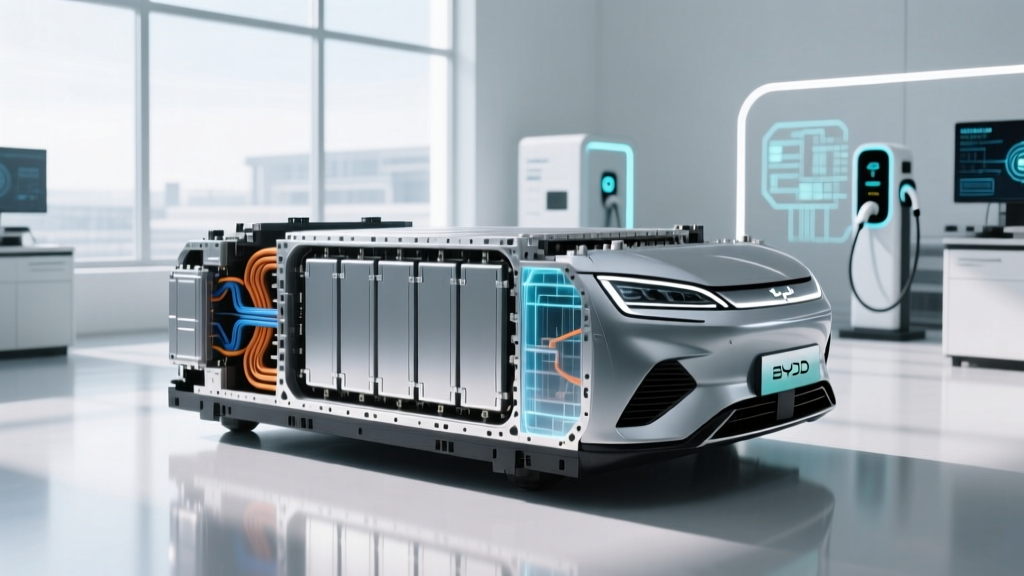
BYD's original Blade Battery redefined what lithium iron phosphate (LFP) could deliver: cobalt-free chemistry, exceptional thermal stability, and a structural cell-to-pack design that survived nail-penetration tests without thermal runaway. For 2026, the company is rolling out what it calls Blade 2.0 — a second-generation LFP platform promising higher energy density, faster charging, and broader integration across BYD's expanding global lineup. But announced specs and showroom reality are two different things. Here's what we know, what's preliminary, and what it means if you're shopping for a BYD EV or a vehicle using BYD-supplied cells.
Blade 2.0: What's New vs. the Original Blade Battery
The first-generation Blade Battery, introduced in 2020, used long, thin LFP cells arranged directly into the pack (cell-to-pack, or CTP), eliminating模组 (module) hardware and boosting volumetric utilization to roughly 60%. It delivered system-level energy density around 140–150 Wh/kg — competitive for LFP at the time, but trailing NMC packs that routinely hit 200+ Wh/kg.
Blade 2.0 targets that gap. BYD has announced several engineering changes:
- Higher cell-level energy density: BYD claims cell-level improvements approaching 190–200 Wh/kg through refined cathode formulations and thinner separator materials, narrowing the gap with NMC.
- Improved C-rate (charge speed): The new cell architecture supports higher charge acceptance, with BYD targeting peak DC fast-charge rates above 200 kW on larger packs — a meaningful jump from gen-1 Blade packs that typically peaked around 80–115 kW.
- Enhanced cold-weather performance: A revised thermal management system and electrolyte formulation aim to reduce the range loss LFP is known for in sub-freezing temperatures.
- Shorter blade cells for flexible packaging: Gen-1 Blade cells were extremely long (up to ~960 mm). Gen-2 introduces shorter cell variants, making the platform compatible with smaller vehicles and non-BYD applications.
As of early 2026, Blade 2.0 specifications are based on BYD's official announcements and Chinese-market vehicle filings. Vehicles equipped with Blade 2.0 are beginning sales in China and select international markets. US availability remains limited — BYD does not currently sell passenger vehicles in the United States, though its batteries are supplied to other manufacturers. Final EPA range figures for any US-bound models using Blade 2.0 have not been published. All figures below are preliminary or based on WLTP/CLTC testing cycles, which tend to overstate range vs. EPA estimates by 10–20%.
Projected Range and Efficiency: What the Numbers Look Like
Because Blade 2.0 is a battery platform — not a single vehicle — range depends entirely on the vehicle it's installed in. However, we can project based on BYD's announced pack sizes and the vehicles expected to receive gen-2 cells first, including the BYD Seal, Seal U (Atto 3 successor in some markets), and Han sedan.
| Vehicle | Pack Size (kWh usable) | Chemistry | WLTP Range | Est. EPA Range | Est. Efficiency (kWh/100 mi) |
|---|---|---|---|---|---|
| BYD Seal (RWD sedan) | 82.5 | LFP (Blade 2.0) | ~570 km (354 mi) | ~290–310 mi | ~27–29 |
| BYD Seal U (compact SUV) | 72.0 | LFP (Blade 2.0) | ~500 km (311 mi) | ~255–275 mi | ~29–32 |
| BYD Han (flagship sedan) | 85.4 | LFP (Blade 2.0) | ~605 km (376 mi) | ~310–330 mi | ~26–28 |
| BYD Dolphin (subcompact) | 60.5 | LFP (Blade 2.0) | ~420 km (261 mi) | ~215–235 mi | ~28–30 |
Real-world range caveat: EPA estimates assume a mix of city and highway driving at moderate temperatures. In practice, expect 10–15% range reduction at sustained highway speeds (70+ mph), and 20–35% reduction in cold weather (below 32°F / 0°C), even with BYD's improved thermal management. LFP chemistry historically suffers more cold-weather loss than NMC, though Blade 2.0's revised electrolyte aims to narrow this gap. Independent cold-weather testing of gen-2 packs is not yet available for US climates.
Charging Speed: The Biggest Practical Upgrade
First-generation Blade packs were a known weak point for DC fast charging. Most peaked at 80–115 kW, meaning a 10–80% session on a 60 kWh pack took roughly 35–45 minutes — noticeably slower than Hyundai/Kia's 800V architecture (240 kW peak, ~18 min 10–80%) or Tesla's 250 kW V3 Superchargers.
Blade 2.0 addresses this directly. BYD has announced peak DC charge rates up to 220 kW on larger packs (82+ kWh), with the company claiming a 10–80% time of approximately 20–25 minutes under optimal conditions. Here's the projected charging breakdown:
| Charging Level | Power / Rate | Speed (miles of range added) | Notes |
|---|---|---|---|
| Level 1 (120V household) | ~1.4 kW | ~4–5 mi/hr | Emergency/trickle only |
| Level 2 (240V home) | 7.2–11 kW | ~25–40 mi/hr | Full charge overnight (~8–10 hrs for 82 kWh pack) |
| DC Fast Charge (peak) | Up to 220 kW | ~600+ mi/hr at peak | 10–80% in ~20–25 min (preliminary) |
| DC Fast Charge (sustained avg) | ~130–150 kW | ~400 mi/hr avg | Real-world avg accounting for charge-curve taper above 80% |
Charge-curve reality check: The 220 kW figure is a peak, not a sustained rate. Like all EVs, Blade 2.0 packs will taper charging speed as state of charge (SoC) climbs — typically dropping significantly above 80% SoC to protect cell longevity. Expect the 10–80% average to land closer to 130–150 kW in real-world conditions at a 350 kW-capable charger. Preconditioning the battery (warming it via the vehicle's navigation system before arriving at a charger) will be essential to hitting peak rates, especially in cooler weather.
Performance and Drivetrain Configurations
Blade 2.0 is chemistry- and packaging-agnostic — it supports single-motor RWD, dual-motor AWD, and performance-oriented configurations. Based on vehicles announced with gen-2 packs:
- BYD Seal RWD: 230 kW (308 hp) rear motor, 0–100 km/h (0–62 mph) in ~5.9 seconds
- BYD Seal AWD Performance: Combined 390 kW (523 hp), 0–100 km/h in ~3.8 seconds
- BYD Han AWD: Combined 380 kW (510 hp), 0–100 km/h in ~3.9 seconds
These are competitive figures, though the Seal AWD trails the Tesla Model 3 Performance (0–60 in ~3.1 sec) and Hyundai Ioniq 6 AWD (~4.5 sec). The emphasis with Blade 2.0 remains efficiency and safety over outright performance — this is a battery platform optimized for the mass market, not the track.
Pricing, Availability, and the US Tax Credit Question
Here's the critical point for US readers: BYD does not sell passenger vehicles in the United States as of 2026. The company has no US dealer network for cars (it sells commercial electric buses and trucks), and its vehicles are not eligible for the IRS §30D federal EV tax credit because they are not sold through US franchised dealers and do not meet North American final-assembly requirements.
However, BYD's Blade 2.0 battery cells are supplied to other manufacturers. If a US-market vehicle from another brand incorporates BYD-supplied Blade 2.0 cells, that vehicle's tax-credit eligibility would depend on the full §30D requirements:
- Final assembly: Vehicle must be assembled in North America
- MSRP caps: ≤$80,000 for SUVs/pickups/vans; ≤$55,000 for sedans
- Buyer income caps: ≤$150,000 single / ≤$300,000 joint AGI
- Battery component sourcing: Increasingly strict requirements for North American manufacture and critical-mineral sourcing (phased in annually through 2029)
- Point-of-sale transfer: Eligible buyers can transfer the credit to the dealer for an upfront price reduction
Source: IRS.gov — Clean Vehicle Credits
For buyers in markets where BYD vehicles are sold (Europe, Australia, Southeast Asia, Latin America), Blade 2.0-equipped vehicles are priced aggressively. The BYD Seal, for example, starts at approximately €45,000–€48,000 in European markets — undercutting the Tesla Model 3 and BMW i4 by a significant margin. In China, pricing is even lower, with the Seal starting around ¥180,000 (~$25,000 USD equivalent).
Who Blade 2.0 Suits Best — and Who Should Look Elsewhere
- You prioritize battery safety and longevity over maximum range (LFP excels at cycle life — 3,000+ charge cycles to 80% capacity retention)
- You want cobalt-free chemistry for ethical sourcing reasons
- You charge primarily at home (LFP batteries tolerate regular 100% charging better than NMC)
- You live in a market where BYD sells directly and offers competitive pricing
- You value structural battery pack safety (nail-penetration resistance) as a top priority
- You need maximum range per kWh (NMC still leads in energy density)
- You regularly drive in extreme cold (NMC retains range better in sub-zero temps)
- You need US availability and federal tax credit eligibility
- You want the fastest possible DC charging (Hyundai/Kia 800V architecture still leads at ~18 min 10–80%)
Warranty and Longevity Expectations
BYD offers some of the most generous battery warranties in the industry, reflecting confidence in LFP's inherent cycle-life advantage. In markets where BYD sells directly:
- Battery warranty: 8 years / 160,000 km (~100,000 miles), with capacity retention guaranteed above 70%
- Powertrain warranty: 8 years / 150,000 km (~93,000 miles)
- Vehicle warranty: 6 years / 150,000 km
LFP chemistry is known for exceptional longevity — many gen-1 Blade packs are projected to retain 80%+ capacity after 3,000 full charge cycles, which translates to roughly 600,000+ miles of driving before hitting the 80% threshold. Blade 2.0 should maintain or improve on this, though long-term degradation data won't be available until vehicles accumulate real-world mileage over 2–3 years.
Pros and Cons at a Glance
- Cobalt-free LFP chemistry — ethical sourcing and lower raw-material cost
- Exceptional thermal stability — no thermal runaway in nail-penetration tests
- Projected 20–25 min 10–80% DC charge — major improvement over gen-1
- 3,000+ cycle life potential — outlasts most NMC packs by a wide margin
- Aggressive pricing in international markets
- Tolerates daily 100% charging without accelerated degradation
- No US passenger-vehicle availability as of 2026
- Energy density still trails NMC — less range per kWh
- Cold-weather range loss remains higher than NMC, even with gen-2 improvements
- Real-world EPA range data not yet available for US comparison
- DC charge speed still behind 800V platforms (Hyundai/Kia, Porsche)
- BYD's driver-assistance systems (ADAS) lag behind Tesla Autopilot, GM Super Cruise in sophistication
Frequently Asked Questions
Is BYD Blade 2.0 a car or a battery?
Blade 2.0 is a battery platform — a second-generation lithium iron phosphate (LFP) cell and pack architecture manufactured by BYD. It's installed in various BYD vehicles (Seal, Han, Dolphin, Seal U) and is also supplied to other automakers. It is not a standalone vehicle.
Can I buy a BYD Blade 2.0 vehicle in the United States?
No. As of 2026, BYD does not sell passenger vehicles in the US market. The company has indicated interest in future US entry, but no timeline has been announced. US buyers can find BYD Blade batteries in some third-party products (e.g., certain energy storage systems), but not in consumer vehicles.
How does Blade 2.0 compare to Tesla's 4680 cells or CATL's Shenxing battery?
Blade 2.0 competes directly with CATL's Shenxing LFP battery (which also targets 200+ Wh/kg and ultra-fast charging) and contrasts with Tesla's 4680 NMC cells, which prioritize energy density over the cobalt-free and safety advantages of LFP. In terms of charge speed, Tesla's 4680 packs in the Model Y can accept ~250 kW peak, slightly ahead of Blade 2.0's projected 220 kW. CATL's Shenxing claims 10–80% in ~15 minutes at comparable density.
Is LFP safe in a crash?
LFP is widely considered the safest lithium-ion chemistry available for EVs. BYD's Blade cell design has passed nail-penetration tests — the most severe abuse test for battery cells — without fire or thermal runaway. This is a significant advantage over NMC cells, which can enter thermal runaway under similar conditions.
Should I wait for Blade 2.0 vehicles to reach my market?
If you're in the US, waiting isn't currently an option since BYD hasn't announced US passenger-vehicle sales. If you're in Europe, Australia, or other BYD markets, Blade 2.0-equipped vehicles are arriving throughout 2026 and represent a meaningful upgrade over gen-1 in charging speed and energy density. Check your local BYD dealer for model-specific availability.