BYD's Q3 2025 BEV Sales Surge: The Numbers Behind the Headlines
BYD's battery electric vehicle sales percentage in Q3 2025 shattered expectations, with the Chinese automaker reporting that fully electric BEVs now represent over 58% of its total new-energy vehicle (NEV) sales — up from roughly 52% in the same quarter a year prior. Combined with plug-in hybrids, BYD moved approximately 1.13 million NEVs in Q3 2025 alone, cementing its position as the world's largest seller of electrified vehicles. For US-based EV shoppers tracking global trends, these figures raise an immediate question: when — and whether — BYD's lineup will be available stateside.
This analysis breaks down what BYD's Q3 2025 BEV sales percentage means in practical terms, examines the models driving the growth, and provides a realistic assessment of BYD's US market prospects and what alternatives American buyers should consider today.
What's Driving BYD's Record BEV Sales Percentage?
BYD's shift toward a higher BEV sales mix in Q3 2025 reflects several converging factors:
- Blade Battery platform maturation: BYD's proprietary lithium iron phosphate (LFP) Blade Battery architecture now underpins nearly every model in its lineup, offering competitive energy density with superior thermal stability compared to NMC chemistries.
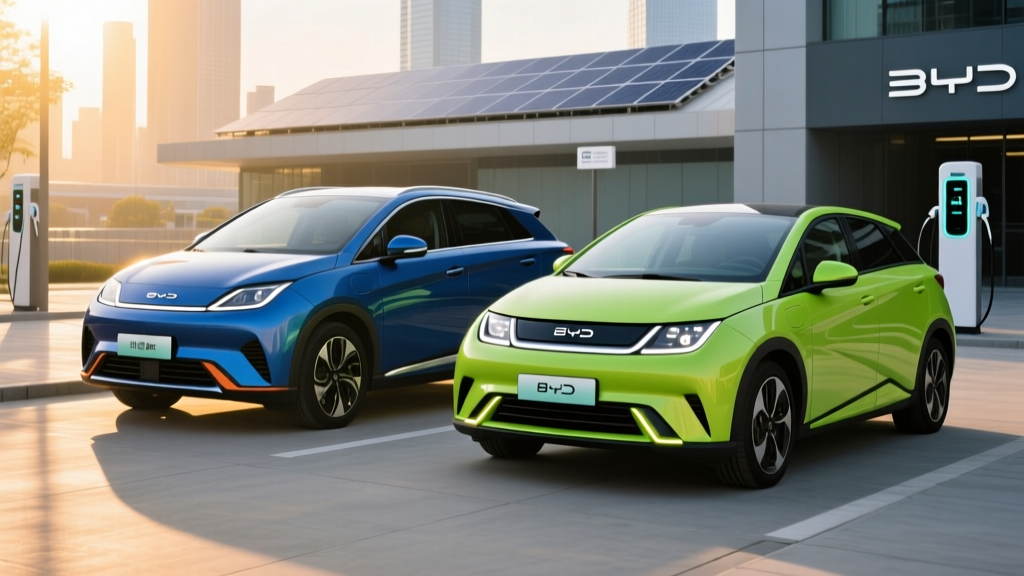
- Model expansion: The Seal, Atto 3 (Yuan Plus), Dolphin, Han, and newer Seal U have broadened BYD's appeal across sedan, crossover, and hatchback segments in export markets including Europe, Southeast Asia, and Latin America.
- Price competitiveness: BYD's vertical integration — it manufactures its own batteries, semiconductors, and electric motors — allows aggressive pricing that undercuts most competitors by 15-25% in markets where it operates.
- PHEV-to-BEV migration: As charging infrastructure matures in China and key export markets, buyers who previously chose BYD's DM-i plug-in hybrids are increasingly opting for pure BEV variants.
BYD's Core BEV Lineup: Specs That Explain the Sales Momentum
To understand why BYD's BEV sales percentage continues climbing, you need to look at the spec sheets. Below are the key models driving global volume, with specifications based on currently available international-market configurations. Note that these are not US-spec vehicles and lack EPA certification.
| Model | Battery (kWh) | WLTP Range | Peak DC Charge | 0-100 km/h | Starting Price (Europe) |
|---|---|---|---|---|---|
| BYD Seal | 82.5 kWh LFP | 354 mi (WLTP) | 150 kW | 5.9s (RWD) | ~€45,000 |
| BYD Atto 3 | 60.5 kWh LFP | 260 mi (WLTP) | 88 kW | 7.3s | ~€38,000 |
| BYD Dolphin | 60.4 kWh LFP | 265 mi (WLTP) | 88 kW | 7.0s | ~€35,000 |
| BYD Han | 85.4 kWh LFP | 320 mi (WLTP) | 120 kW | 7.9s | ~€72,000 |
| BYD Seal U | 87.0 kWh LFP | 310 mi (WLTP) | 140 kW | 6.7s (AWD) | ~€42,000 |
Important context on range figures: WLTP range estimates used in Europe and China typically run 10-15% higher than US EPA estimates for the same vehicle. A BYD Seal rated at 354 miles WLTP would likely achieve an EPA-estimated 290-310 miles if certified for the US market. Real-world highway driving at 70+ mph and cold-weather operation (below 40°F) can further reduce range by 15-30%, meaning expect roughly 220-260 miles of usable highway range from the Seal in winter conditions.
Charging Performance: Where BYD Faces Criticism
One area where BYD's BEVs lag behind competitors like Hyundai/Kia's E-GMP platform or Tesla's architecture is DC fast-charging speed. The BYD Seal peaks at 150 kW on a DC fast charger, which translates to a 10-80% charge in approximately 35-37 minutes. The Atto 3 and Dolphin are limited to 88 kW peak, pushing their 10-80% times to roughly 40-45 minutes.
For comparison, a Hyundai Ioniq 5 peaks at 240 kW and achieves 10-80% in approximately 18 minutes on a 350 kW charger. A Tesla Model 3 Highland peaks at around 250 kW on V3 Superchargers.
BYD's more conservative charge curves are partly a function of LFP chemistry — which tends to have a flatter but lower peak charge rate compared to NMC — and partly a deliberate design choice to maximize battery longevity. BYD's Blade Battery is rated for over 3,000 charge cycles before reaching 80% state of health, which is exceptional. But for road-trippers who depend on quick DC charging stops, the slower charge times are a meaningful drawback.
Level 2 home charging across BYD's lineup supports up to 7 kW (single-phase) in most markets, adding roughly 25-30 miles of range per hour of charging — adequate for overnight replenishment but slower than the 11-19 kW AC rates some competitors support on three-phase power.
US Availability: The 100% Tariff Wall and What It Means
Despite BYD's Q3 2025 BEV sales percentage demonstrating massive global demand, American consumers cannot purchase these vehicles. The US imposed a 100% tariff on Chinese-made electric vehicles effective August 2024, effectively doubling the landed cost of any BYD imported from China. This tariff, combined with existing 2.5% auto import duties, makes BYD's price advantage nonexistent in the US market.
BYD has not announced any US-market entry timeline, manufacturing facility, or EPA certification program as of early 2026. The company has stated it is "studying" the US market but has prioritized expansion in Europe, Southeast Asia, Australia, Brazil, and Mexico — markets without prohibitive tariffs.
What this means for US buyers: If you're researching BYD because of its global sales dominance and wondering when you can buy one domestically, the honest answer is that there is no confirmed timeline. Even if BYD built a US or Mexico factory (which would face its own political and regulatory hurdles), EPA certification, dealer network establishment, and federal tax credit (§30D) qualification would require years of lead time.
What US Buyers Should Consider Instead
If BYD's value proposition — competitive range, LFP battery longevity, and aggressive pricing — appeals to you, here are the closest US-market alternatives currently available with EPA certification and federal tax credit eligibility:
| BYD Equivalent | US Alternative | EPA Range | Peak DC kW | Base MSRP | §30D Credit |
|---|---|---|---|---|---|
| BYD Seal | Tesla Model 3 RWD | 272 mi | 170 kW | $38,990 | $7,500* |
| BYD Atto 3 | Hyundai Kona Electric | 261 mi | 100 kW | $32,975 | $7,500* |
| BYD Dolphin | Chevrolet Equinox EV | 319 mi | 150 kW | $33,600 | $7,500* |
| BYD Seal U | Tesla Model Y LR | 320 mi | 250 kW | $44,990 | $7,500* |
*Federal §30D tax credit eligibility is subject to MSRP caps ($55,000 for sedans, $80,000 for SUVs/trucks), buyer income limits ($150K single / $300K joint AGI), and battery component/critical mineral sourcing requirements. Always verify current eligibility at irs.gov and consult a tax professional. Point-of-sale transfer is available at participating dealers.
BYD's LFP Blade Battery: Longevity Data That Matters
One reason BYD's BEV sales percentage continues to climb is consumer confidence in the Blade Battery. BYD's cell-to-pack LFP architecture has demonstrated strong longevity in fleet and taxi applications across China:
- Rated cycle life: 3,000+ full charge cycles to 80% state of health (SoH) — translating to roughly 600,000+ miles of driving before significant degradation.
- Thermal stability: LFP chemistry is inherently more resistant to thermal runaway than NMC. BYD's nail penetration test (a standard abuse test) shows no fire or smoke from the Blade cell.
- Warranty in export markets: Typically 8 years / 160,000 km (approximately 100,000 miles) on the battery pack, with a 70% capacity retention guarantee — consistent with industry norms.
- Real-world degradation: Early fleet data from BYD taxis in China suggests approximately 8-12% capacity loss over 200,000 km (124,000 miles), which is competitive with Tesla's NMC/NCA packs and superior to some early-generation LFP implementations.
The trade-off with LFP is lower energy density (roughly 160-180 Wh/kg at the cell level vs. 250-300 Wh/kg for high-nickel NMC), which means BYD vehicles tend to be heavier for a given range. The BYD Seal, for instance, weighs approximately 4,560 lbs — about 300 lbs more than a Tesla Model 3 Long Range with a comparable range figure.
Technology and Driver Assistance: Competitive but Not Class-Leading
BYD's infotainment and ADAS (advanced driver assistance systems) offerings are competent but lag behind Tesla, Hyundai, and GM in the US market context:
- Infotainment: 15.6-inch rotating touchscreen (portrait/landscape), BYD DiLink OS, wireless Apple CarPlay and Android Auto. The interface is functional but not as polished as Tesla's or BMW's iDrive.
- Driver assists: BYD's DiPilot system includes adaptive cruise control, lane-keeping assist, automatic emergency braking, and blind-spot monitoring. This is SAE Level 2 driver assistance — the driver must remain fully engaged at all times. It is not autonomous or "self-driving."
- Notable gaps: No hands-free highway driving feature comparable to GM's Super Cruise or Ford's BlueCruise. No over-the-air software update ecosystem as mature as Tesla's. Limited English-language optimization in infotainment for export markets.
The Bottom Line: What BYD's Q3 2025 Numbers Mean for You
BYD's BEV sales percentage in Q3 2025 — roughly 58% of its total NEV output — is a milestone that reflects genuine product competitiveness in global markets. The company's vertical integration, LFP battery technology, and aggressive pricing have built a formidable lineup that sells on merit, not just subsidies.
For US buyers, however, the practical takeaway is this: BYD vehicles are not available for purchase, and the 100% tariff on Chinese EVs makes near-term entry unlikely. The best response is to use BYD's global pricing as a benchmark when evaluating US-market alternatives. If a Tesla Model 3, Hyundai Kona Electric, or Chevrolet Equinox EV is priced competitively relative to what BYD charges overseas (adjusted for tariffs and market differences), you're getting fair value.
Who Should Track BYD's Progress?
- US EV buyers in no rush: If your purchase timeline extends 3-5+ years, BYD's eventual US entry (or entry via a Mexico/Brazil plant, though USMCA rules complicate this) could shift market pricing.
- Competitive benchmarking: Use BYD's international pricing to pressure-test dealer quotes on comparable US models.
- LFP battery interest: If BYD's Blade Battery longevity data interests you, Tesla's Model 3 RWD and Model Y Standard Range already use LFP cells (sourced from CATL) — giving you similar chemistry benefits with US availability and Supercharger access.
Frequently Asked Questions
What was BYD's BEV sales percentage in Q3 2025?
BYD reported that battery electric vehicles (BEVs) accounted for approximately 58% of its total new-energy vehicle (NEV) sales in Q3 2025, up from roughly 52% in Q3 2024. The remainder were plug-in hybrid electric vehicles (PHEVs) under BYD's DM-i and DM-p platforms.
Can I buy a BYD electric vehicle in the United States?
No. As of early 2026, BYD does not sell passenger vehicles in the US market. A 100% tariff on Chinese-made EVs (effective August 2024) makes importing BYD vehicles economically unviable. BYD has not announced plans for US manufacturing or EPA certification.
How does BYD's Blade Battery compare to Tesla's LFP packs?
Both use lithium iron phosphate (LFP) chemistry, which offers excellent cycle life (3,000+ cycles) and thermal stability but lower energy density than NMC. BYD's Blade Battery uses a cell-to-pack design with blade-shaped cells that serve as structural members, while Tesla sources LFP cells from CATL in a conventional cylindrical/prismatic format. Real-world degradation data for both is competitive, with approximately 8-12% loss over 120,000+ miles.
Would BYD vehicles qualify for the US federal EV tax credit?
Even if BYD vehicles were sold in the US, they would face significant hurdles qualifying for the §30D federal tax credit. The credit requires battery components and critical minerals to be sourced from the US or free-trade-agreement partners, with escalating percentage requirements each year. Chinese-manufactured battery cells and minerals would likely disqualify BYD models from the full $7,500 credit under current sourcing rules.
What's the closest US-market alternative to the BYD Seal?
The Tesla Model 3 (RWD from $38,990 or Long Range AWD from $42,490) is the closest US-market competitor in terms of size, range, and positioning. The Hyundai Ioniq 6 (EPA 361 mi, from $37,500) is also comparable. Both offer significantly faster DC charging than the BYD Seal's 150 kW peak and have established US service networks.
Is BYD's global sales volume bigger than Tesla's?
In total NEV sales (BEV + PHEV combined), BYD has exceeded Tesla since late 2022. In pure BEV sales, BYD and Tesla have traded the #1 position quarterly through 2024-2025. In Q3 2025, BYD's approximately 655,000 BEVs sold likely exceeded Tesla's quarterly BEV deliveries, though exact Tesla Q3 2025 figures should be verified via Tesla's investor relations page.