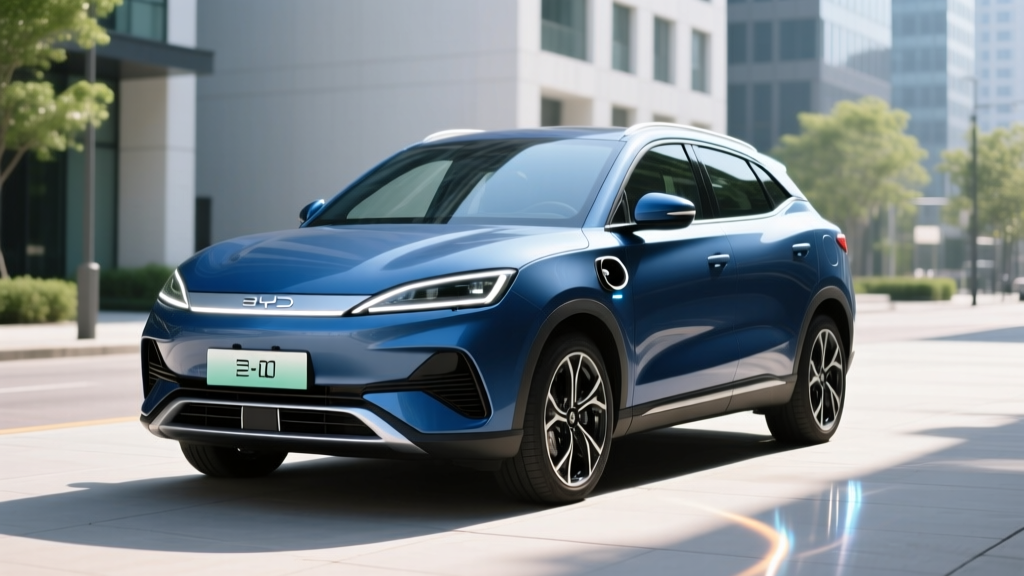
BYD is the world's largest plug-in vehicle manufacturer, and the BYD Atto 3 (sold as the Yuan Plus in China) is its global-volume electric crossover. For US shoppers searching for a BYD EV car, the Atto 3 raises an immediate question: can you actually buy one in America? This review covers the 2026 model-year specs, real-world range, charging performance, and the tariff-and-regulatory realities that determine whether this compact SUV is a viable option on US soil.
Quick Verdict: A Global EV With US Caveats
The 2026 BYD Atto 3 is a competent, value-oriented compact electric crossover built around BYD's proprietary Blade LFP battery. In markets where it is sold, it undercuts rivals like the Hyundai Kona Electric and Kia Niro EV on price while delivering competitive range and practical packaging. However, BYD does not currently sell passenger vehicles in the United States, and 100% tariffs on Chinese-built EVs imposed in 2024 make near-term US availability unlikely. Buyers in Latin America, Southeast Asia, Europe, and Australia have full access; US readers should treat this profile as a benchmark for what BYD offers globally and a signal of competitive pressure on domestic offerings.
Range, Battery & Efficiency
Real-World Expectation: Expect 210–235 miles on sustained highway driving at 70 mph; cold-weather (below 32°F) can reduce range by 15–25%, dropping effective distance to roughly 180–200 miles with cabin heating active.
| Spec | Value |
|---|---|
| Battery Capacity (usable) | 58.56 kWh |
| Battery Chemistry | LFP (Lithium Iron Phosphate) — BYD Blade |
| EPA-Est. Range | 265 mi (WLTP 420 km) |
| Efficiency | 124 MPGe combined / 27 kWh/100 mi |
| Motor Output | 150 kW (201 hp) / 310 Nm (229 lb-ft) |
| Drivetrain | FWD (single motor, front axle) |
| 0–60 mph | 7.3 seconds |
| Top Speed | 99 mph (electronically limited) |
| Cargo Volume (rear seats up) | 15.6 cu ft |
| Cargo Volume (rear seats folded) | 46.3 cu ft |
| Rear Legroom | 35.6 in |
| Curb Weight | ~3,680 lbs |
Blade LFP Battery: What It Means for Owners
BYD's Blade battery uses lithium iron phosphate (LFP) cells arranged in a cell-to-pack architecture that eliminates intermediate modules. The result is higher volumetric efficiency and exceptional thermal stability — LFP cells are far less prone to thermal runaway than NMC chemistries. The trade-off is lower energy density, which is why the Atto 3 carries a relatively modest 58.56 kWh pack yet still achieves competitive range through efficient powertrain tuning and a lightweight platform.
LFP batteries also tolerate regular 100% state-of-charge (SoC) without accelerated degradation, meaning owners can charge to full daily without the 80% ceiling recommended for NMC packs. Cycle life typically exceeds 3,000 full cycles before reaching 80% state of health (SoH), translating to well over 300,000 miles in normal use.
Charging Speed: DC Fast & Home Level 2
| Charging Level | Rate | Time / Miles Added |
|---|---|---|
| Level 1 (120V household) | ~1.4 kW | ~4 mi/hr of charging |
| Level 2 (240V, 7 kW) | 7 kW | ~22 mi/hr; full charge in ~9 hrs |
| DC Fast Charge (peak) | 80 kW (CCS) / 88 kW (GB/T) | 10–80% in ~29 min |
| DC Sustained (above 60% SoC) | ~45–50 kW | 80–100% adds ~20 min |
The Atto 3's 80 kW peak DC fast-charge rate is its most notable limitation versus competitors. The Hyundai Kona Electric peaks at 100+ kW, and the Volkswagen ID.4 can pull 170 kW on compatible chargers. On a road trip, the Atto 3's 29-minute 10–80% session is acceptable for a meal break but noticeably slower than the 18–20 minute stops possible in rivals with higher charge rates.
The charge curve tapers significantly above 60% SoC — a common LFP characteristic. Drivers planning highway road trips should target 80% SoC stops to avoid the slow top-off phase. For daily commuting, a home Level 2 charger at 7 kW replenishes the pack overnight with ample margin.
Performance & Driving Dynamics
The single front-mounted motor produces 201 hp and 229 lb-ft of torque, delivering a 7.3-second 0–60 mph time. That's adequate for merging and passing but trails the dual-motor AWD options in competitors like the Kia Niro EV (which offers a sportier GT-Line) or the Subaru Solterra. The Atto 3 is tuned for efficiency and urban comfort, not sporty driving.
Regenerative braking offers two levels selectable via the center console, but it does not achieve true one-pedal driving — the vehicle will creep at low speeds rather than coming to a complete stop. Drivers accustomed to strong regen in vehicles like the Chevrolet Bolt EV or Tesla Model Y will notice the difference.
Interior, Tech & Safety
Infotainment & Cockpit
The cabin centers on a 12.8-inch rotating touchscreen (landscape for navigation, portrait for climate/media menus) running BYD's DiLink OS. Wireless Apple CarPlay and Android Auto are standard. A 5-inch digital instrument cluster sits behind a flat-bottom steering wheel. Build quality uses soft-touch materials on upper surfaces with harder plastics on lower door panels and the center console — appropriate for the price segment.
Driver Assistance (ADAS)
The Atto 3 includes BYD's DiPilot suite: adaptive cruise control with stop-and-go, lane-keeping assist, automatic emergency braking (front and rear), blind-spot monitoring, and a 360-degree camera. This is SAE Level 2 driver assistance — the driver must maintain hands-on-wheel engagement and full situational awareness at all times. It is not autonomous driving.
Safety Ratings
The Atto 3 earned a 5-star overall rating from Euro NCAP (2022 protocol), with strong scores in adult occupant protection (91%) and safety assist (74%). NHTSA and IIHS have not tested the Atto 3, as it is not sold in the US market.
Pricing & Tax Credit Eligibility
| Market / Trim | MSRP (Local) | Approx. USD |
|---|---|---|
| Australia — Standard Range | AUD $44,990 | ~$29,500 |
| Australia — Extended Range | AUD $49,990 | ~$32,800 |
| UK — Design | £37,695 | ~$47,500 |
| Thailand — Premium | THB 1,199,900 | ~$34,000 |
| US — Not Available | N/A | N/A |
Federal EV Tax Credit (§30D): Does the Atto 3 Qualify?
No — the BYD Atto 3 does not qualify for the US federal EV tax credit, because BYD does not sell passenger vehicles through US dealerships. Even if it did, the vehicle would face significant §30D hurdles:
- MSRP Cap: SUVs must be under $80,000 — Atto 3 pricing would clear this.
- Buyer Income Cap: AGI ≤ $150,000 (single) / $300,000 (joint) — buyer-dependent.
- Battery Sourcing: Critical minerals and battery components must meet escalating North American or FTA-partner thresholds; BYD's vertically integrated Chinese supply chain would likely fail these requirements through 2030.
- Final Assembly: Must occur in North America — Atto 3 is assembled in China, Thailand, Brazil, and India, none of which qualify.
For current §30D rules, consult IRS.gov's clean vehicle credit page or a qualified tax professional.
Warranty & Long-Term Ownership
In most markets, BYD provides a 6-year / 150,000 km (93,000 mi) vehicle warranty and an 8-year / 160,000 km (100,000 mi) battery warranty with a 70% state-of-health retention guarantee. These terms are competitive with the Hyundai/Kia 10-year/100,000-mile battery warranty available in the US, though the shorter duration on the base vehicle is notable.
LFP chemistry gives the Atto 3 a longevity advantage: degradation curves are flatter than NMC packs, and owners who charge to 100% daily (permitted with LFP) should see minimal range loss over 5–7 years of typical use. Replacement cost data is limited outside BYD's direct markets, but the Blade pack's modular construction is designed for cell-level repair rather than full-pack replacement.
Who Should Consider a BYD EV Car (And Who Shouldn't)
- You live in a market where BYD sells directly (Australia, SE Asia, Latin America, Europe) and want a value-priced compact EV crossover.
- You prioritize battery longevity and thermal safety over peak charging speed.
- Your daily commute is under 150 miles round-trip and you have home Level 2 charging.
- You prefer LFP chemistry's tolerance for 100% daily charging without degradation anxiety.
- You are a US-based buyer — BYD is not available, and tariffs make it unlikely before 2028+.
- You take frequent road trips requiring fast DC charging (80 kW peak is slow vs. 150+ kW rivals).
- You need AWD or dual-motor performance for snow/towing — Atto 3 is FWD only.
- You require NHTSA/IIHS crash-test validation (unavailable for non-US models).
Competitor Comparison: Atto 3 vs. the Field
| Spec | BYD Atto 3 | Hyundai Kona Electric | Kia Niro EV | Volkswagen ID.4 |
|---|---|---|---|---|
| EPA Range | 265 mi (WLTP) | 261 mi | 239 mi | 291 mi (LR RWD) |
| Battery (kWh) | 58.56 (LFP) | 65.4 (NMC) | 64.8 (NMC) | 82 (NMC) |
| Peak DC kW | 80 kW | 100+ kW | 85 kW | 170 kW |
| 10–80% Time | ~29 min | ~24 min | ~28 min | ~18 min |
| Horsepower | 201 hp | 201 hp | 201 hp | 282 hp (AWD) |
| 0–60 mph | 7.3 sec | 7.2 sec | 7.2 sec | 5.4 sec (AWD) |
| US Base MSRP | N/A | $33,975 | $39,600 | $40,790 |
| US Tax Credit | N/A | Partial/None* | Partial/None* | Up to $7,500** |
*Credit eligibility varies by trim, sourcing, and buyer income — verify on fueleconomy.gov. **ID.4 US-built models may qualify; confirm per IRS rules.
Pros & Cons
- LFP Blade battery offers exceptional cycle life and thermal safety
- Competitive range from a modest 58.56 kWh pack (efficient powertrain)
- Permits 100% daily charging without degradation concern
- Well-equipped cabin with rotating 12.8" touchscreen
- 5-star Euro NCAP safety rating
- Strong value proposition in non-US markets
- 80 kW peak DC charging is slow for 2026 standards
- FWD only — no AWD option for snow or light towing
- Regen does not achieve true one-pedal driving
- Not available in the US; no NHTSA/IIHS testing
- DiPilot ADAS is functional but unremarkable vs. BlueCruise or Tesla Autopilot
- Rear visibility limited by thick C-pillars
Frequently Asked Questions
What is the real-world range of the BYD Atto 3?
In mixed driving, expect 230–250 miles from a full charge. Sustained highway speeds (70+ mph) reduce this to roughly 210–235 miles. In freezing temperatures with cabin heating, effective range can drop to 180–200 miles. The WLTP rating of 420 km (261 mi) is more optimistic than real-world highway use but achievable in urban/suburban driving at moderate speeds.
How fast does the BYD Atto 3 charge?
On a DC fast charger, it peaks at 80 kW and reaches 10–80% SoC in approximately 29 minutes. Above 60% SoC, the charge rate tapers to 45–50 kW, making the final 20% noticeably slower. At home on a 7 kW Level 2 charger, a full 0–100% charge takes about 9 hours. Level 1 (120V) trickle charging adds roughly 4 miles per hour.
Can I buy a BYD EV car in the United States?
As of 2026, BYD does not sell passenger vehicles in the US. The company focuses on commercial vehicles (buses, trucks) in the American market. Additionally, 100% tariffs on Chinese-built EVs enacted in 2024 make importing BYD passenger cars economically unviable. BYD has hinted at future Latin American manufacturing that could theoretically serve the US, but no timeline exists.
Does the BYD Atto 3 qualify for the $7,500 federal EV tax credit?
No. Because BYD does not sell the Atto 3 through US dealers, it is ineligible for the IRS §30D clean vehicle credit. Even if it were sold here, the vehicle's Chinese battery sourcing and final assembly would fail the critical-mineral and North American assembly requirements under current law.
Is the BYD Atto 3 worth buying vs. a Hyundai Kona Electric or Kia Niro EV?
In markets where all three are sold, the Atto 3 competes on price and battery longevity (LFP chemistry). However, the Kona Electric and Niro EV offer faster DC charging, available AWD in some trims, and established dealer networks. For US buyers, the Kona and Niro are the only realistic choices. If BYD ever enters the US with a locally assembled or FTA-partner-built model, the value proposition could shift significantly.
How long will the BYD Blade LFP battery last?
LFP chemistry is rated for 3,000+ full charge cycles before degrading to 80% SoH. At an average of 250 miles per cycle, that equates to 750,000+ miles — far beyond the vehicle's mechanical lifespan. In practice, calendar aging and partial cycles mean most owners will see 10–15 years of service with less than 10–15% range loss. BYD's 8-year/100,000-mile battery warranty backs this with a 70% SoH guarantee.
Sources: Euro NCAP Atto 3 Rating, IRS §30D Clean Vehicle Credit, BYD global specifications (2026 model year).