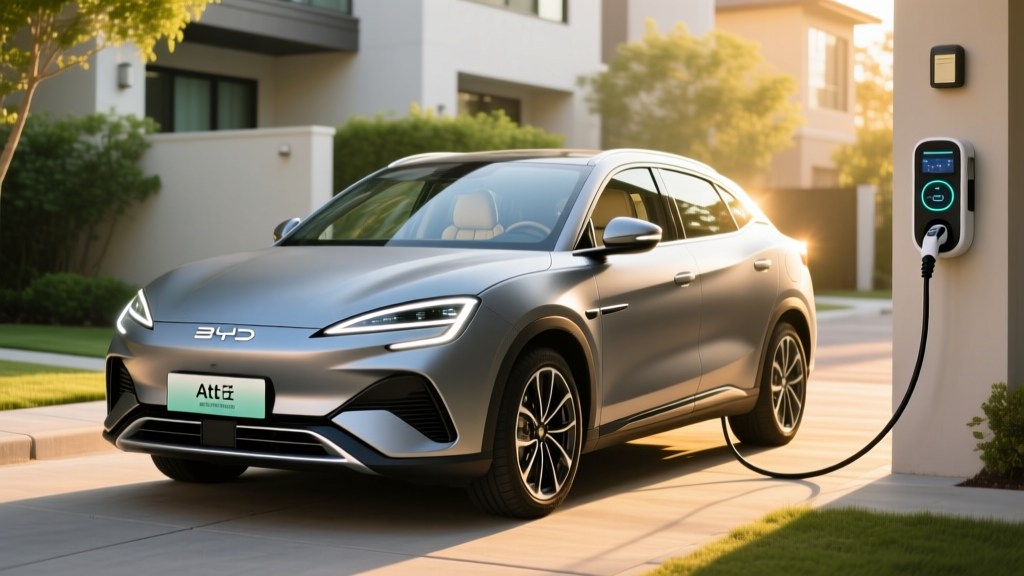
The subcompact EV crossover segment is crowded, but the BYD Atto 1 (also marketed as the BYD Yuan Up in China) enters with a proposition that's hard to ignore: a sub-$30,000 electric crossover built around BYD's proven Blade Battery platform. As BYD expands its global footprint through 2026, the Atto 1 targets urban commuters and budget-conscious buyers who want practical range, fast charging, and modern tech without stepping up to mid-size pricing. Here's a data-driven breakdown of every specification that matters.
BYD Atto 1 Key Specifications at a Glance
| Specification | Value |
|---|---|
| EPA Estimated Range | ~215 miles (estimated) |
| Battery Capacity | 49.92 kWh (usable), LFP Blade Battery |
| Drivetrain | Front-wheel drive (FWD), single motor |
| Horsepower / Torque | 174 hp / 210 lb-ft |
| 0–60 mph | ~7.9 seconds (estimated) |
| Max DC Fast Charge | ~80 kW peak |
| 10–80% DC Charge Time | ~30 minutes (estimated) |
| Level 2 Home Charge Rate | 7 kW (AC) |
| Efficiency | ~115 MPGe combined (estimated) |
| Cargo Volume (rear seats up) | ~13.4 cu ft |
| Cargo Volume (rear seats folded) | ~43.5 cu ft |
| Base MSRP | ~$27,500 (estimated, pre-incentives) |
| Federal Tax Credit (§30D) | Not eligible (assembled outside U.S.) |
| Battery Warranty | 8 years / 100,000 miles (BYD global standard) |
Note: The BYD Atto 1 is currently sold in select international markets. U.S. availability remains unconfirmed for 2026. Specifications below reflect global-market data and BYD's published figures, with U.S.-relevant estimates noted where applicable.
Range and Efficiency: What the EPA Number Doesn't Tell You
Real-World Expectation: Expect 170–190 miles on sustained highway driving at 70+ mph, and 140–160 miles in sub-freezing winter conditions. City driving with regenerative braking can push closer to the 215-mile sticker, and sometimes slightly beyond in mild weather.
The Atto 1's 49.92 kWh LFP (lithium iron phosphate) Blade Battery is the heart of its range proposition. LFP chemistry trades some energy density for exceptional cycle life and thermal stability — BYD's Blade cell format has demonstrated strong longevity in independent testing, often retaining above 90% capacity after 1,000+ charge cycles.
At an estimated 115 MPGe combined (~29 kWh/100 mi), the Atto 1 is efficient for its class but not segment-leading. The Chevrolet Equinox EV, for comparison, achieves roughly 315 miles from a larger 85 kWh battery. The Atto 1's efficiency is adequate for a 215-mile EPA target, but buyers with long highway commutes should plan conservatively.
Cold-weather reality: LFP batteries are more susceptible to cold-weather range loss than NMC chemistries. In testing of similar BYD platforms, 20°F temperatures have reduced range by 25–35%. The Atto 1 includes a battery thermal management system, but preconditioning via the BYD app before driving is essential in winter to minimize losses.
Charging Speed: DC Fast and Home Level 2
Charging speed is where budget EVs often compromise, and the Atto 1 reflects its price point. Here's what to expect across charging levels:
| Charging Level | Power (kW) | Speed (mi/hr added) | Notes |
|---|---|---|---|
| Level 1 (120V household) | ~1.4 kW | ~4–5 mi/hr | Emergency/top-up only; ~45 hrs for full charge |
| Level 2 (240V home/public) | 7 kW | ~23 mi/hr | Full charge in ~7 hours; ideal for overnight |
| DC Fast Charge | ~80 kW peak | ~150 mi/hr at peak | 10–80% in ~30 min; tapers significantly above 80% |
The charge curve matters. The Atto 1's ~80 kW peak DC rate is modest by 2026 standards — competitors like the Hyundai Kona Electric peak at 100+ kW, and the Kia EV6 architecture supports 240 kW. In practice, the Atto 1 will sustain close to peak rate from 10–50% SoC, then taper. A 10–80% session takes roughly 30 minutes at a capable charger, but pushing from 80–100% can add another 20+ minutes due to LFP cell-balancing requirements.
Home charging setup: At 7 kW, a Level 2 home charger (requiring a 240V/40A circuit) will replenish the battery overnight. Installation costs typically range from $500–$2,000 depending on your electrical panel's capacity — a 200-amp panel is usually sufficient. Always consult a licensed electrician for final specifications.
For connector compatibility, global-market Atto 1 models ship with CCS2 (Europe) or GB/T (China). U.S.-spec models, if introduced, would use the NACS (Tesla) connector or CCS1, depending on BYD's network partnerships.
Performance and Driving Dynamics
The Atto 1 is not a performance EV, and it doesn't pretend to be. The single front-mounted motor produces 174 hp and 210 lb-ft of torque, delivering a 0–60 mph time of approximately 7.9 seconds. That's adequate for highway merging and city driving but noticeably softer than the dual-motor AWD options available in rivals like the Volvo EX30 (3.6 seconds in Twin Motor form).
Where the Atto 1 earns points is ride comfort. BYD has tuned the suspension for compliance over sportiness, absorbing urban potholes and speed bumps with composure. Steering is light and predictable — ideal for tight parking situations but lacking feedback at highway speeds.
Regenerative braking: The Atto 1 offers adjustable regen levels through the infotainment system, but unlike some competitors, it does not offer true one-pedal driving with a complete stop. You'll still need the friction brake for final stopping.
Interior, Tech, and Cargo Space
The cabin uses BYD's familiar design language with a prominent 12.8-inch rotating center touchscreen (it pivots between portrait and landscape orientation). The digital instrument cluster is a compact 8.8-inch display behind the steering wheel. Wireless Apple CarPlay and Android Auto are standard on most trims.
Driver assistance (SAE Level 2): The Atto 1 comes equipped with BYD's DiPilot suite, which includes adaptive cruise control, lane-keeping assist, automatic emergency braking, and blind-spot monitoring. This is a Level 2 driver-assist system — the driver must remain fully engaged and hands on the wheel at all times. It is not autonomous driving.
Cargo practicality: With rear seats upright, the Atto 1 offers approximately 13.4 cu ft of cargo space — enough for a week's groceries or two carry-on suitcases. Fold the 60/40 split rear seats and capacity expands to roughly 43.5 cu ft. There is no front trunk (frunk); the hood area houses the motor and power electronics.
Legroom is generous for the segment: approximately 41 inches up front and 37 inches in the rear, making the Atto 1 viable for families with young children or adults on shorter trips.
Pricing, Trims, and Tax Credit Reality
The BYD Atto 1 is positioned as an entry-level EV crossover. Global pricing translates to approximately $27,500–$32,000 USD depending on trim and market, though U.S. pricing would depend on import tariffs, dealer networks, and localization — none of which are confirmed as of 2026.
| Trim | Est. MSRP | Federal Tax Credit (§30D) | Effective Price |
|---|---|---|---|
| Base (Standard Range) | ~$27,500 | $0 (not U.S.-assembled) | ~$27,500 |
| Mid (Enhanced) | ~$29,500 | $0 | ~$29,500 |
| Top (Premium) | ~$32,000 | $0 | ~$32,000 |
Tax credit eligibility is the Atto 1's biggest U.S. hurdle. Under current IRS §30D rules, the federal clean vehicle credit (up to $7,500) requires final assembly in North America, among other criteria including MSRP caps, buyer income limits, and battery component/mineral sourcing requirements. Because BYD manufactures the Atto 1 in China, it does not qualify for the §30D credit in its current form. State-level incentives may still apply — check your local energy office or the fueleconomy.gov tax center for details.
For buyers in markets where the Atto 1 is sold (Europe, Southeast Asia, Latin America, Australia), local incentives vary significantly and may substantially reduce the effective purchase price.
Pros and Cons: The Honest Assessment
Pros
- Aggressive sub-$30,000 pricing (global markets)
- LFP Blade Battery offers excellent longevity and thermal safety
- Comfortable ride quality tuned for urban driving
- Rotating 12.8" touchscreen is a unique tech highlight
- Generous rear-seat legroom for the segment
- Comprehensive standard driver-assist suite (DiPilot)
Cons
- Modest ~80 kW DC charging speed — slower than key rivals
- No U.S. availability confirmed; no federal tax credit eligibility
- LFP range loss in cold weather is significant (25–35%)
- No frunk; limited cargo versatility vs. competitors
- Single-motor FWD only — no AWD option
- Brand recognition and dealer network limited outside Asia/Europe
Who Should Buy the BYD Atto 1?
The Atto 1 is best suited for urban commuters and budget-focused EV shoppers in markets where it's available. If your daily drive is under 40 miles round-trip, you have access to home or workplace Level 2 charging, and you prioritize low purchase price over highway road-trip capability, the Atto 1 makes a compelling case.
Choose the Atto 1 if:
- You want the lowest-cost new EV crossover available in your market
- Your driving is predominantly city and suburban
- You value battery longevity and safety over peak range
- You can charge at home overnight and rarely need DC fast charging
Look elsewhere if:
- You regularly drive 200+ miles between charges (highway road trips)
- You live in a cold climate where LFP range loss will cut into your commute
- You need fast DC charging for frequent long-distance travel
- You're a U.S. buyer seeking federal tax credit eligibility
Warranty and Long-Term Ownership
BYD backs the Atto 1 with an 8-year / 100,000-mile battery and powertrain warranty in most global markets, consistent with industry standards from Hyundai, Kia, and Volkswagen. The Blade Battery's LFP chemistry provides an inherent longevity advantage: BYD claims the Blade cell can exceed 3,000 charge cycles before reaching 80% capacity retention — translating to well over 500,000 miles in theoretical use.
Real-world degradation data for the Atto 1 specifically is still maturing, but early reports from BYD's larger Blade-equipped models (Atto 3, Dolphin) show 5–8% capacity loss over the first 60,000 miles — a strong result for the segment.
For maintenance, EVs eliminate oil changes, spark plugs, and transmission fluid. Budget for cabin air filter replacement (~$50–$100 annually), brake fluid checks, and tire rotation. Insurance premiums for BYD models vary by market; U.S. buyers should get quotes before committing, as limited parts availability can increase comprehensive/collision costs.
Frequently Asked Questions
What is the real-world range of the BYD Atto 1?
The EPA-estimated range is approximately 215 miles, but real-world highway driving at 70+ mph yields closer to 170–190 miles. In cold weather (below 32°F), expect 140–160 miles due to LFP chemistry's cold sensitivity. City driving with regenerative braking can approach or slightly exceed the EPA number in mild conditions.
How fast does the BYD Atto 1 charge?
On a DC fast charger, the Atto 1 peaks at approximately 80 kW, achieving a 10–80% charge in roughly 30 minutes. At home on a 240V Level 2 charger (7 kW), a full charge takes about 7 hours — suitable for overnight replenishment. Level 1 (120V) charging is impractical for daily use at roughly 4–5 miles of range per hour.
Does the BYD Atto 1 qualify for the U.S. federal EV tax credit?
No. Under current IRS §30D rules, the credit requires North American final assembly, among other criteria. The Atto 1 is manufactured in China and does not meet this requirement. State and local incentives may still apply — consult your state energy office for details.
Is the BYD Atto 1 worth buying vs. competitors?
In markets where it's sold, the Atto 1 competes on price against the MG4, Hyundai Kona Electric, and Chevrolet Equinox EV. Its advantages are low cost, Blade Battery longevity, and ride comfort. Its disadvantages include slower DC charging, no AWD option, and cold-weather range loss. If price is your top priority and your driving is urban, it's a strong contender. For road-trippers or cold-climate buyers, the Equinox EV or Kona Electric offer more range and faster charging.
What are the biggest pros and cons?
Top pros: low price, durable LFP battery, comfortable ride, generous rear legroom, and a unique rotating infotainment screen. Top cons: 80 kW DC charging is slow for 2026, no U.S. availability or tax credit, significant cold-weather range loss, no AWD option, and limited dealer network outside Asia and Europe.
Is BYD's DiPilot system self-driving?
No. DiPilot is an SAE Level 2 driver-assistance system. It provides adaptive cruise control, lane-keeping, and automatic emergency braking, but requires the driver to remain fully engaged with hands on the wheel and eyes on the road at all times. It does not replace an attentive driver.