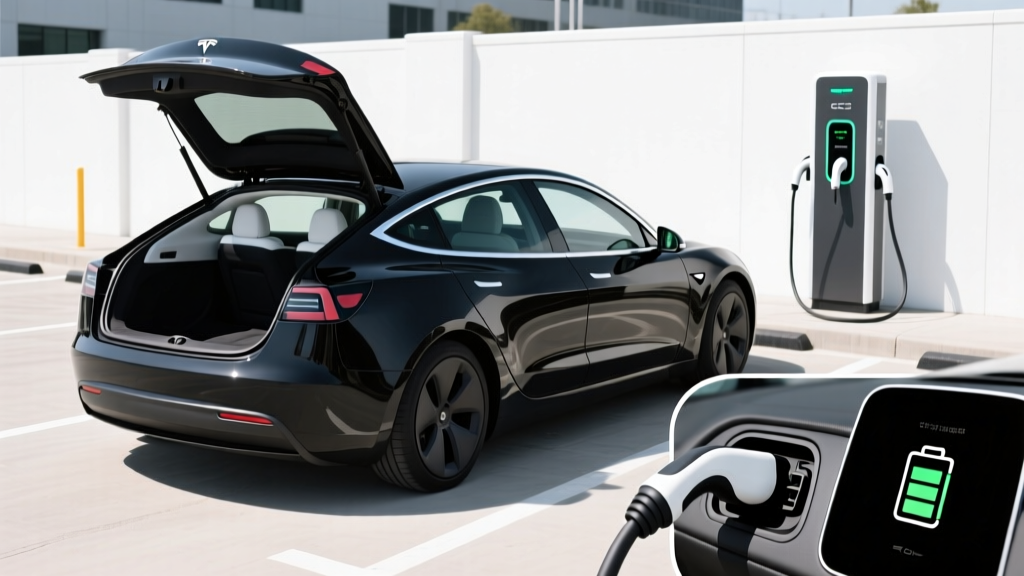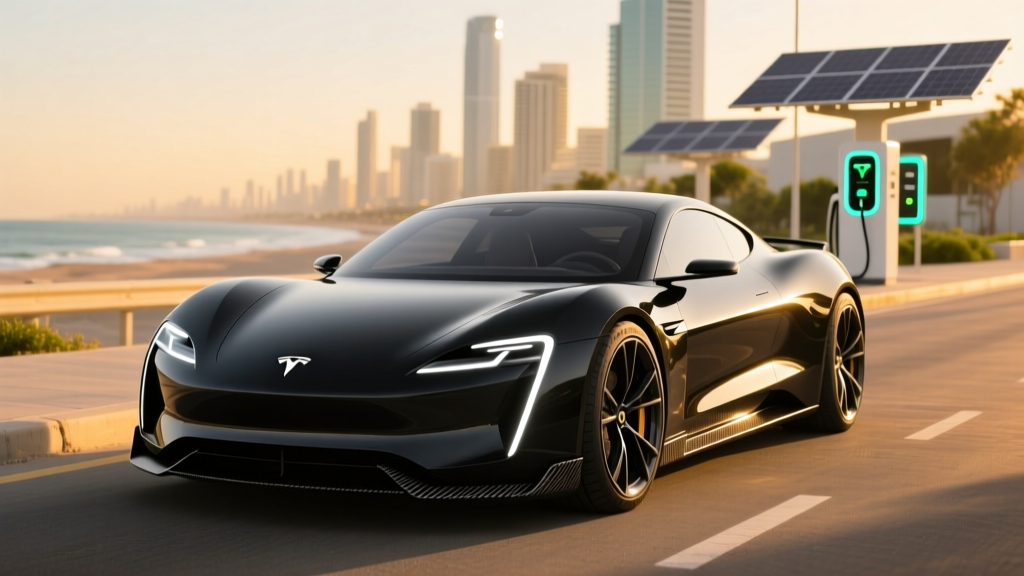
The Tesla Roadster has occupied a strange space in the EV world since Elon Musk first unveiled the second-generation model in November 2017. Nearly a decade later, the car remains unreleased — perpetually "next year" — while the EV market has exploded with high-performance competitors that you can actually drive today. If you're researching buying a Tesla Roadster, you need a clear-eyed assessment of what Tesla has promised, what's realistic, and whether waiting makes financial sense in 2026.
This profile treats the Roadster as what it is: an announced, not-yet-delivered vehicle. All specifications below are based on Tesla's most recent public statements and are marked as preliminary. We'll also benchmark it against performance EVs you can buy right now.
What We Know: Tesla Roadster Preliminary Specs
Tesla has revised the Roadster's target specifications several times since 2017. The figures below reflect the most recent claims from Tesla's product pages and earnings calls through early 2026. Treat them as engineering targets, not guaranteed production specs.
| Specification | Tesla Claim (Preliminary) |
|---|---|
| EPA Range (targeted) | 620 miles |
| Battery Capacity | ~200 kWh (estimated, NMC chemistry likely) |
| Drivetrain | Tri-motor AWD (1 front, 2 rear) |
| Horsepower | ~1,000+ hp (estimated, with SpaceX package potentially higher) |
| 0–60 mph | 1.9 seconds (base); 1.1 sec (SpaceX cold-gas thruster package) |
| Top Speed | 250+ mph |
| Quarter Mile | 8.8 seconds (claimed) |
| Max DC Fast Charge | ~250 kW (estimated, CCS/NACS) |
| 10–80% DC Charge Time | Not officially disclosed; estimated 40–50 min at 250 kW |
| Level 2 Home Charging | ~11.5 kW / ~34–40 mi/hr (estimated) |
| Seating | 2+2 (two front, two small rear) |
| Base MSRP (announced) | $200,000 (base); $250,000 (Founders Series) |
| Reservation Deposit | $50,000 (fully refundable historically) |
| Battery/Powertrain Warranty | Not disclosed; likely 8 yr / 150,000 mi based on Model S |
Range Reality: 620 Miles on Paper, But What About Real Driving?
Real-World Expectation: ~480–540 miles in mixed driving; ~400–450 miles sustained highway at 75+ mph; ~350–400 miles in cold weather (below 32°F). These estimates assume the 200 kWh pack achieves production-grade efficiency of roughly 3.0–3.2 mi/kWh — ambitious but not physically impossible given Tesla's motor and aero track record.
A 620-mile EPA rating would shatter every production EV on the road in 2026. For context, the Lucid Air Grand Touring achieves 516 miles EPA from a 112 kWh pack, and the Chevrolet Silverado EV 4WT manages ~450 miles with a massive 200+ kWh pack. Tesla's claim implies efficiency around 3.2 mi/kWh from a 200 kWh battery — a figure that would require extraordinary aerodynamic optimization (a drag coefficient well under 0.20 Cd) and best-in-class motor efficiency.
In practice, highway driving at 75–80 mph typically reduces EV range by 15–25% versus the EPA combined cycle. Cold weather (20–32°F) can cut range by 20–30% due to battery resistance and cabin heating demands, even with a heat pump. A Roadster owner on a winter road trip from Denver to Salt Lake City should plan around 350–400 miles of usable range and one charging stop.
Charging: The 200 kWh Problem
Here's where physics imposes hard limits. Even if Tesla equips the Roadster with a 250 kW peak DC fast-charge rate (the current Supercharger V3/V4 maximum), filling a 200 kWh battery from 10% to 80% requires pushing roughly 140 kWh into the pack. At a sustained 250 kW — which no EV maintains for an entire session due to charge-curve taper — that's a minimum of 34 minutes. In reality, charge rates taper significantly above 50–60% state of charge, pushing realistic 10–80% times to 40–50 minutes.
Should Tesla deploy next-generation 350–400 kW Superchargers by the time the Roadster ships, 10–80% could drop to 25–35 minutes. But that infrastructure doesn't broadly exist today, and the Roadster's battery management system would need to support the higher C-rate without accelerating degradation of the NMC cells.
At home on a Level 2 charger (11.5 kW / 48A), a full charge from near-empty would take approximately 17–18 hours. Most Roadster owners would charge overnight from 20–80% (roughly 8–9 hours), which is manageable but means you can't rely on a quick top-off for back-to-back road trips.
Performance: The Numbers That Justify the Price
This is the Roadster's core value proposition. A claimed 1.9-second 0–60 mph time (base tri-motor) would make it the quickest production car ever sold, eclipsing the Rimac Nevera (1.85 sec, $2.4M) at a fraction of the cost. The optional "SpaceX package" — which integrates cold-gas thrusters around the body for downforce and launch traction — targets an almost absurd 1.1-second 0–60.
The tri-motor layout (one front, two rear) enables torque vectoring across the rear axle, improving cornering dynamics beyond what the dual-motor Model S Plaid offers. Tesla has also hinted at active aerodynamics and a removable glass roof panel (targa-style), though neither has been shown in production form.
For comparison, the Model S Plaid delivers 1,020 hp and a 1.99-second 0–60 for $89,990. The Roadster would need to offer meaningfully more — in exclusivity, handling, and range — to justify more than double the price.
Pricing, Tax Credits, and the $200,000 Question
Tesla announced a base MSRP of $200,000 and a limited "Founders Series" at $250,000. A $50,000 reservation deposit has been required historically, though Tesla's reservation terms can change without notice.
- MSRP Cap: The §30D credit caps eligible vehicles at $55,000 MSRP for sedars/coupes. At $200,000+, the Roadster is categorically ineligible.
- Income Cap: Even if it somehow qualified, buyers must fall under $150K (single) / $300K (joint) modified AGI.
- Battery Sourcing: Critical-mineral and battery-component sourcing requirements further restrict eligibility — unlikely to matter at this price point.
- Bottom Line: Expect zero federal tax credit. Budget the full MSRP plus destination, taxes, and registration.
Source: IRS §30D Clean Vehicle Credits
At $200,000 with no credit, the Roadster competes in rarefied air. Buyers at this price point should also factor in insurance (expect $6,000–$10,000+ annually for a 250-mph EV), potential track-day wear on tires and brakes, and the depreciation curve that hits hypercars hard in years 2–4.
Interior, Tech, and Daily Usability
Tesla has shown only prototype interiors, but expect a minimalist cabin centered on a large touchscreen (likely 17+ inches, similar to the refreshed Model S). The 2+2 seating layout means rear seats suitable for children or cargo overflow, not adults on long trips. Cargo space is unconfirmed, but a front trunk (frunk) plus a modest rear area is likely — expect roughly 8–12 cu ft total, far less than a Model 3's 23 cu ft.
On the driver-assistance front, the Roadster will ship with Tesla's latest hardware suite supporting Autopilot and Full Self-Driving (Supervised). A critical reminder:
Standout expected tech includes a yoke or conventional steering wheel option, over-the-air performance updates, Tesla's app-based vehicle controls, and potentially a track mode with detailed telemetry. Drawbacks? The 2+2 layout limits practicality, the removable roof panel may introduce cabin noise, and Tesla's panel-gap and build-quality consistency remains a known concern at any price point.
Roadster vs. Competitors You Can Buy Today
| Spec | Tesla Roadster (Announced) | Model S Plaid | Lucid Air Sapphire | Rimac Nevera |
|---|---|---|---|---|
| Status | Unreleased | Available | Available | Limited production |
| EPA Range | 620 mi (target) | 396 mi | 427 mi | ~300 mi (est.) |
| 0–60 mph | 1.9 sec | 1.99 sec | 1.89 sec | 1.85 sec |
| Horsepower | ~1,000+ | 1,020 | 1,234 | 1,914 |
| Battery (kWh) | ~200 | ~100 | 118 | 120 |
| Base MSRP | $200,000 | $89,990 | $249,000 | $2,400,000 |
| Federal Credit | No (MSRP cap) | No (MSRP cap) | No (MSRP cap) | No |
The Model S Plaid delivers 90% of the Roadster's performance for less than half the price — and you can buy one today. The Lucid Air Sapphire offers even more horsepower and genuine four-door luxury at $249,000. The Roadster's differentiators would be its 620-mile range target, the SpaceX thruster gimmick, and Tesla brand cachet. If those matter to you, the wait might be justified. If you want performance now, the Plaid or Sapphire are proven alternatives.
Who Should Consider the Roadster — And Who Shouldn't
- You want the highest-range performance EV ever built and can absorb a $200K+ spend with no tax credit.
- You're a Tesla enthusiast who values exclusivity and the "first to own" factor.
- You don't need a daily driver — this is a weekend/track car.
- You need a car in 2026. The Roadster has slipped timelines for 8+ years.
- Practicality matters — two small rear seats, limited cargo, and a low ride height limit daily use.
- You want proven build quality and dealer service infrastructure. Consider Porsche, Lucid, or BMW.
- You want federal tax credit eligibility — look below the $55,000 MSRP cap.
Frequently Asked Questions
What is the real-world range of the Tesla Roadster?
Tesla targets a 620-mile EPA rating from an estimated 200 kWh battery. Real-world range will likely fall to 480–540 miles in mixed driving, 400–450 miles at sustained highway speeds, and 350–400 miles in freezing temperatures. These are estimates until EPA testing is completed on production vehicles.
How fast does the Roadster charge at home and on the road?
Estimated peak DC fast charging is ~250 kW, which would deliver a 10–80% charge in roughly 40–50 minutes given the massive 200 kWh battery and typical charge-curve taper. Home Level 2 charging at 11.5 kW would add roughly 34–40 miles per hour, requiring 8–9 hours for a 20–80% session.
How much does the Tesla Roadster cost after tax credits?
The base MSRP is $200,000 (Founders Series $250,000). The Roadster does not qualify for the federal §30D tax credit because it far exceeds the $55,000 MSRP cap for sedans/coupes. Expect to pay full MSRP plus destination, state taxes, and registration — likely $210,000–$265,000 out the door depending on your state.
Is the Tesla Roadster worth buying vs. the Model S Plaid or Lucid Air Sapphire?
If you can wait indefinitely and value exclusivity plus the 620-mile range target, possibly. If you want proven, available performance today, the Model S Plaid ($89,990) delivers nearly identical acceleration at less than half the price. The Lucid Air Sapphire ($249,000) offers more horsepower and luxury in a package you can drive now.
Does the Tesla Roadster qualify for the federal EV tax credit?
No. Under current IRS §30D rules, the credit is limited to new EVs with an MSRP at or below $55,000 for sedans and coupes. The Roadster's $200,000+ price makes it categorically ineligible regardless of buyer income or battery sourcing. Consult a tax professional for your specific situation via IRS.gov.
When will the Tesla Roadster actually be available?
Tesla has not confirmed a firm production date as of early 2026. The vehicle was originally announced in 2017 with a 2020 target, which has slipped repeatedly. Reservation holders should treat any announced date with caution until Tesla shows a production-spec vehicle undergoing EPA certification testing.
What are the biggest pros and cons?
- Class-leading 620-mile targeted range
- Sub-2-second 0–60 mph (base tri-motor)
- Tri-motor AWD with torque vectoring
- Tesla Supercharger network access
- OTA updates and Tesla app integration
- Not available — 8+ years of delays
- $200,000+ with no federal tax credit
- 2+2 seating limits practicality
- Massive 200 kWh battery means long charge times
- Tesla build-quality inconsistency at any price
- Specs remain preliminary and unverified by EPA
Sources: Tesla product pages, fueleconomy.gov for competitor EPA data, IRS §30D Clean Vehicle Credit rules. All Roadster specifications are preliminary and subject to change. This article does not constitute purchase advice for an unreleased vehicle.