Quick Verdict: Is the 2026 Tesla Model Y Long Range Still the Default EV?
If you're buying Tesla for the first time, the Model Y Long Range AWD remains the most rational entry point into the brand's ecosystem. With a 320-mile EPA range, access to the most reliable DC fast-charging network in North America, and a starting MSRP that undercuts several mainstream competitors, the 2026 Model Y Long Range holds its position as the best-selling EV in the United States for good reason. But "good reason" doesn't mean "perfect for everyone." This review breaks down the exact numbers — from sustained charging speeds to cold-weather range loss — so you can decide whether the Model Y fits your specific use case or whether a rival like the Hyundai Ioniq 5 or Ford Mustang Mach-E serves you better.
EPA estimated: 320 miles (Long Range AWD).
Real-world highway (70-75 mph, moderate temps): expect 275–295 miles.
Cold-weather highway (below 32°F): expect 225–255 miles depending on cabin heat usage and whether you precondition.
City/regenerative driving: 300–320 miles is achievable.
Range, Battery, and Efficiency: The Numbers That Matter
The 2026 Model Y Long Range AWD uses a 78.1 kWh usable battery pack with NMC (nickel manganese cobalt) chemistry, supplied primarily by Panasonic at Gigafactory Nevada. NMC offers higher energy density than LFP (lithium iron phosphate), which is how Tesla achieves 320 miles in a relatively compact crossover footprint. The trade-off is that NMC batteries degrade slightly faster over time and Tesla recommends daily charging to 80% for longevity rather than 100%, which effectively gives you about 256 miles of daily usable range.
Efficiency is rated at 122 MPGe combined (city 127 / highway 117) per EPA data on fueleconomy.gov. In terms of energy consumption, that translates to roughly 28 kWh per 100 miles in mixed driving — among the most efficient all-wheel-drive EVs in this segment. This efficiency is a direct result of Tesla's heat pump (standard on all trims), aerodynamic drag coefficient of 0.23, and aggressive regenerative braking calibration.
| Spec | Value |
|---|---|
| EPA Range | 320 miles |
| Battery (Usable) | 78.1 kWh, NMC chemistry |
| Efficiency | 122 MPGe combined / 28 kWh/100mi |
| Max DC Fast Charge | 250 kW peak |
| 10–80% DC Charge Time | ~27 minutes |
| Level 2 Home Charge Rate | 11.5 kW (~44 mi/hr) |
| Drivetrain | Dual-motor AWD |
| Horsepower | 384 hp |
| 0–60 mph | 4.8 seconds |
| Cargo Volume | 30.2 cu ft (rear seats up) / 72.1 cu ft (folded) |
| Rear Legroom | 37.2 inches |
| Battery Warranty | 8 years / 120,000 miles |
| Base MSRP | $44,990 |
Charging Speed: Supercharger Network and Home Setup
Charging is where Tesla still holds a structural advantage over every competitor. The Model Y Long Range can accept up to 250 kW peak at a V3 or V4 Tesla Supercharger. However, peak is not sustained — the charging curve tapers significantly above 60% state of charge. In practice, a 10–80% charge takes approximately 27 minutes, while 10–100% takes closer to 48 minutes. If you're road-tripping and only need to get back on the road, the 10–80% window is what counts, and 27 minutes is competitive though not class-leading (the Hyundai Ioniq 5 with its 800V architecture hits 10–80% in roughly 18 minutes at a 350 kW charger).
With the 2025 adoption of the NACS (North American Charging Standard) port as Tesla's native connector, the Model Y charges natively at all Superchargers without an adapter. Non-Tesla networks using CCS1 require a NACS-to-CCS adapter — Tesla includes one with new vehicles, and third-party adapters are widely available.
| Level | Power (kW) | Approx. Miles Added per Hour | Typical Use Case |
|---|---|---|---|
| Level 1 (120V outlet) | ~1.4 kW | ~5 mi/hr | Emergency / overnight trickle |
| Level 2 (240V, 48A Wall Connector) | 11.5 kW | ~44 mi/hr | Daily home charging |
| Level 2 (240V, 32A Mobile Connector) | 7.7 kW | ~30 mi/hr | Home / destination charging |
| DC Fast (Supercharger V3/V4) | Up to 250 kW peak | ~200 mi in 15 min (10–50%) | Road trips |
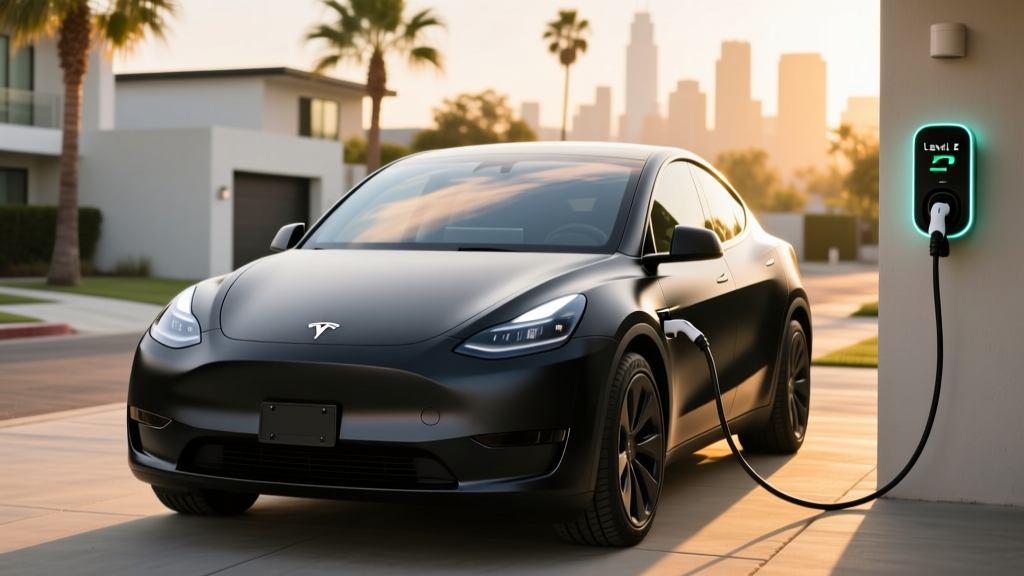
For home charging, Tesla's Wall Connector ($420 for the unit) on a 60-amp circuit delivers 11.5 kW / 48 amps, adding roughly 44 miles of range per hour. A full overnight charge from 20% to 80% takes about 4 hours. Installation costs for a Level 2 home setup typically range from $800 to $2,500 depending on whether your electrical panel needs an upgrade — always get a quote from a licensed electrician before committing.
Performance, Ride, and Daily Driving
The dual-motor AWD powertrain produces 384 horsepower and delivers a 4.8-second 0–60 mph time. That's quick enough to merge confidently onto any freeway and overtake without hesitation. The instant torque delivery means real-world acceleration feels even faster than the numbers suggest, especially from 0–30 mph in city driving.
Ride quality has improved incrementally over prior model years with revised damper tuning, but the Model Y still rides firmer than competitors like the Ioniq 5 or the Volkswagen ID.4. Road noise at highway speeds is noticeable — a common complaint among owners — and the lack of physical buttons means you'll interact with the 15.4-inch center touchscreen for nearly every function, including climate controls and glovebox release. Some drivers adapt quickly; others find it distracting.
Regenerative braking is aggressive and essentially enables one-pedal driving in most conditions. Tesla removed the user-adjustable regen setting several model years ago, so if you prefer a coasting feel, the Model Y will require an adjustment period.
Pricing, Trims, and Federal Tax Credit Eligibility
The 2026 Model Y is offered in three trims:
| Trim | Base MSRP | Est. Price After §30D Credit* | EPA Range |
|---|---|---|---|
| Long Range RWD | $42,990 | $35,490 | 320 mi |
| Long Range AWD | $44,990 | $37,490 | 320 mi |
| Performance AWD | $49,990 | $42,490 | 295 mi |
*Federal tax credit estimates assume full $7,500 eligibility under IRS §30D rules. Eligibility depends on buyer income caps (AGI ≤ $150K single / $300K joint), vehicle MSRP cap ($80K for SUVs), and battery critical-mineral and component sourcing requirements that can change annually. The credit can now be transferred to the dealer at point of sale as an upfront discount. Always verify your eligibility with a tax professional before purchase.
Our as-tested Long Range AWD with Midnight Cherry Red paint ($2,000) and 20-inch wheels ($2,000) came to $48,990 before incentives. Tesla's Full Self-Driving (Supervised) package adds $8,000 if purchased outright — more on this below.
Technology, Autopilot, and What Tesla Gets Right (and Wrong)
Tesla Autopilot and FSD (Supervised) are SAE Level 2 driver-assistance systems. The driver must remain fully engaged, hands on or near the wheel, and eyes on the road at all times. These are not self-driving systems. Level 4 driverless operation (no human required) is currently available only in geofenced robotaxi services like Waymo.
Standard Autopilot includes Traffic-Aware Cruise Control and Autosteer (lane centering). It works well on clearly marked highways but is not a substitute for attention. FSD (Supervised) adds automatic lane changes, navigation-based on/off-ramp handling, and traffic light/stop sign recognition. In our testing, FSD handles 85–90% of highway miles competently but still requires regular interventions on construction zones, faded lane markings, and unprotected left turns. At $8,000, the value proposition is debatable — most buyers are better off with standard Autopilot and staying attentive.
The infotainment system is fast, responsive, and includes Netflix, YouTube, and gaming while parked. Over-the-air updates continue to add features post-purchase. However, the absence of Apple CarPlay and Android Auto is a dealbreaker for some buyers who prefer their phone's native navigation and music interfaces.
- Access to 6,500+ Tesla Superchargers — most reliable public network in the US
- Class-leading efficiency (122 MPGe combined) translates to lower charging costs
- Spacious cargo area (72.1 cu ft) with standard hatchback utility
- Strong over-the-air update track record keeps software current
- Competitive pricing after federal tax credit
- Touchscreen-only controls for climate, mirrors, and glovebox — distracting while driving
- No Apple CarPlay or Android Auto support
- Firm ride and noticeable road noise at highway speeds
- NMC battery requires 80% daily charge limit for longevity (effectively ~256 mi daily)
- DC fast-charge speed (250 kW peak) trails 800V competitors like Ioniq 5
Who Should Buy the 2026 Tesla Model Y?
- You take regular road trips and want the most reliable DC fast-charging network
- You can install a Level 2 home charger and want efficient daily charging
- You value cargo versatility (hatchback, 72 cu ft) and need room for a family of four
- You want strong performance (4.8s 0–60) without stepping to a Performance trim
- You need Apple CarPlay/Android Auto (Hyundai Ioniq 5, Ford Mach-E)
- You want faster peak DC charging on non-Tesla networks (Ioniq 5 at 350 kW)
- You prefer physical buttons and a more traditional interior layout (Mach-E, VW ID.4)
- You need more than 37.2 inches of rear legroom for tall passengers
The Model Y suits commuters with home charging, small families, and road-trippers who prioritize charging infrastructure over interior refinement. If you drive 40 miles round-trip daily and charge at home, the 80% daily limit still gives you 250+ miles of buffer. For towing, the Model Y is rated at 3,500 lbs — adequate for a small trailer or two dirt bikes, but not a boat or camper.
Warranty and Long-Term Ownership
Tesla covers the battery and drive unit for 8 years or 120,000 miles, whichever comes first, with a guaranteed minimum 70% capacity retention during that period. The basic vehicle limited warranty is 4 years / 50,000 miles. Based on aggregated fleet data, Model Y batteries typically show 8–12% degradation at 100,000 miles — well within the warranty threshold. Battery replacement outside warranty currently runs $12,000–$16,000 at Tesla service centers, though third-party options are emerging.
Insurance costs tend to run 15–25% higher than comparable gas crossovers, a factor worth budgeting for. On the other hand, maintenance is minimal: no oil changes, no transmission fluid, brake pad life extends well past 80,000 miles thanks to regenerative braking, and cabin air filter replacement is the primary recurring service item.
Frequently Asked Questions
What is the real-world range of the 2026 Tesla Model Y Long Range?
The EPA rates it at 320 miles. In real-world highway driving at 70–75 mph in moderate temperatures, expect 275–295 miles. In freezing conditions with cabin heat, plan for 225–255 miles. Preconditioning the battery (via the Tesla app before departure) recovers some cold-weather efficiency.
How fast does the Model Y charge at home and on road trips?
At home on a 240V/48A Tesla Wall Connector, it charges at 11.5 kW, adding about 44 miles per hour — a full overnight session easily covers daily needs. On a 250 kW Supercharger, 10–80% takes roughly 27 minutes. Charging slows substantially above 80% due to the battery management system protecting cell health.
Does the 2026 Tesla Model Y qualify for the federal EV tax credit?
It can qualify for up to $7,500 under IRS §30D, but eligibility depends on your adjusted gross income (≤ $300K joint / $150K single), the vehicle MSRP (under the $80K SUV cap — all Model Y trims qualify), and battery sourcing requirements for critical minerals and components. The credit can be applied as a point-of-sale discount. Verify current-year sourcing rules on irs.gov and consult a tax professional.
Is the Tesla Model Y worth buying over the Hyundai Ioniq 5 or Ford Mach-E?
The Model Y wins on charging network reliability, efficiency, and cargo space. The Ioniq 5 offers faster DC charging (800V architecture), a more comfortable ride, and CarPlay. The Mach-E provides a more conventional interior with physical controls. If Supercharger access matters for your road trips, the Model Y is the pragmatic pick. If you mostly drive locally and value interior comfort, test-drive the Ioniq 5 before committing.
Is Tesla's Full Self-Driving worth the $8,000 price?
For most buyers, no. FSD (Supervised) is a Level 2 system that still requires full driver attention. It handles most highway scenarios well but struggles with construction zones and complex intersections. Standard Autopilot (included) covers adaptive cruise and lane centering adequately for daily driving. Unless you regularly drive long highway stretches and want the lane-change automation, the $8,000 is better allocated elsewhere.
What is the battery warranty and how long will the battery last?
Tesla warrants the battery for 8 years or 120,000 miles with a 70% minimum capacity retention guarantee. Real-world data from high-mileage Model Y fleets shows approximately 8–12% degradation at 100,000 miles. Charging to 80% daily (rather than 100%) and avoiding frequent DC fast charging when Level 2 is available will maximize long-term battery health.