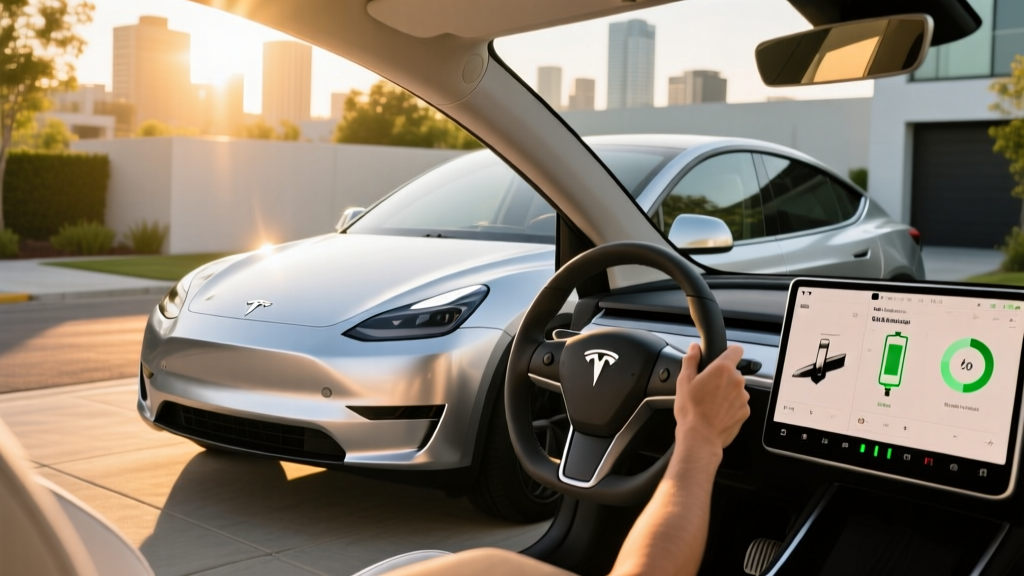
The 2026 Tesla Model Y at a Glance
The Model Y remains Tesla's volume leader and the default entry point for many first-time EV buyers. For 2026, Tesla has streamlined the lineup to three core trims, standardized the NACS charge port across all units, and continued iterating on efficiency through firmware and minor hardware tweaks. If you're buying a Tesla for the first time, the Model Y is the model most likely to satisfy a broad set of use cases — daily commuting, family hauling, and road-trip charging on the Supercharger network.
But spec sheets only tell half the story. Below we reconcile EPA numbers with real-world driving, unpack the charge curve, and clarify exactly what the federal tax credit requires in 2026.
| Spec | Long Range RWD | Long Range AWD | Performance |
|---|---|---|---|
| EPA Range | 320 mi | 308 mi | 285 mi |
| Battery (usable) | ~75 kWh (NMC) | ~75 kWh (NMC) | ~75 kWh (NMC) |
| Peak DC Fast Charge | 250 kW | 250 kW | 250 kW |
| 10–80% DC Time | ~24 min | ~24 min | ~24 min |
| Level 2 Rate | 11.5 kW (~44 mi/hr) | 11.5 kW (~44 mi/hr) | 11.5 kW (~44 mi/hr) |
| 0–60 mph | 6.5 sec | 4.8 sec | 3.5 sec |
| Horsepower | 346 hp | 514 hp | 514 hp |
| Drivetrain | RWD | Dual-Motor AWD | Dual-Motor AWD |
| MPGe (combined) | 122 MPGe | 116 MPGe | 111 MPGe |
| Efficiency | 28 kWh/100 mi | 29 kWh/100 mi | 30 kWh/100 mi |
| Base MSRP | $44,990 | $47,990 | $52,490 |
Range: What the EPA Sticker Doesn't Tell You
Real-World Expectation: Plan for ~265–280 mi at sustained 75 mph highway speeds in moderate weather. In winter conditions (below 32°F), expect a 15–25% reduction — roughly 210–240 mi on the AWD trim. City driving with regenerative braking recovers closer to the EPA sticker.
The 2026 Model Y Long Range AWD's 308-mile EPA figure is competitive with the Hyundai Ioniq 5 (305 mi) and slightly ahead of the Ford Mustang Mach-E Extended Range (290 mi). But EPA testing uses a low-speed, mixed-cycle protocol that flatters EVs. Sustained highway driving at 75–80 mph pushes consumption to roughly 33–35 kWh/100 mi on the AWD trim, which nets about 250–260 real highway miles before the buffer runs out.
Cold weather is the bigger wildcard. Lithium-ion chemistry loses efficiency in freezing temperatures, and cabin heating draws heavily from the pack. Tesla's heat pump (standard on all 2026 trims) mitigates this compared to resistive heaters, but owners in northern climates should budget 20% off the sticker for January commutes. Preconditioning the battery while plugged in — a feature in the Tesla app — recovers some of that loss by warming the pack before departure.
Source: EPA Fuel Economy — 2026 Tesla Model Y
Charging Speed and the Supercharger Advantage
| Level | Power (kW) | Miles Added per Hour | Typical Use |
|---|---|---|---|
| Level 1 (120V) | ~1.4 kW | ~5 mi/hr | Overnight trickle; emergency top-up |
| Level 2 (240V, 48A) | 11.5 kW | ~44 mi/hr | Home daily charging (Wall Connector) |
| DC Fast (Supercharger V3/V4) | Peak 250 kW | ~1,000+ mi/hr (peak) | Road trips; 10–80% in ~24 min |
The Model Y's 250 kW peak DC fast-charge rate is the headline, but peak is not sustained. The charge curve holds near 250 kW from roughly 10% to 30% State of Charge, then tapers progressively — dropping to ~150 kW by 50% and ~75 kW by 70%. This is why Tesla quotes 10–80% in roughly 24 minutes rather than a full 0–100% time. Pushing past 80% at a DC fast charger is painfully slow (the final 20% can take as long as the first 70%), so road-trip strategy should involve shorter, more frequent stops between 10% and 80%.
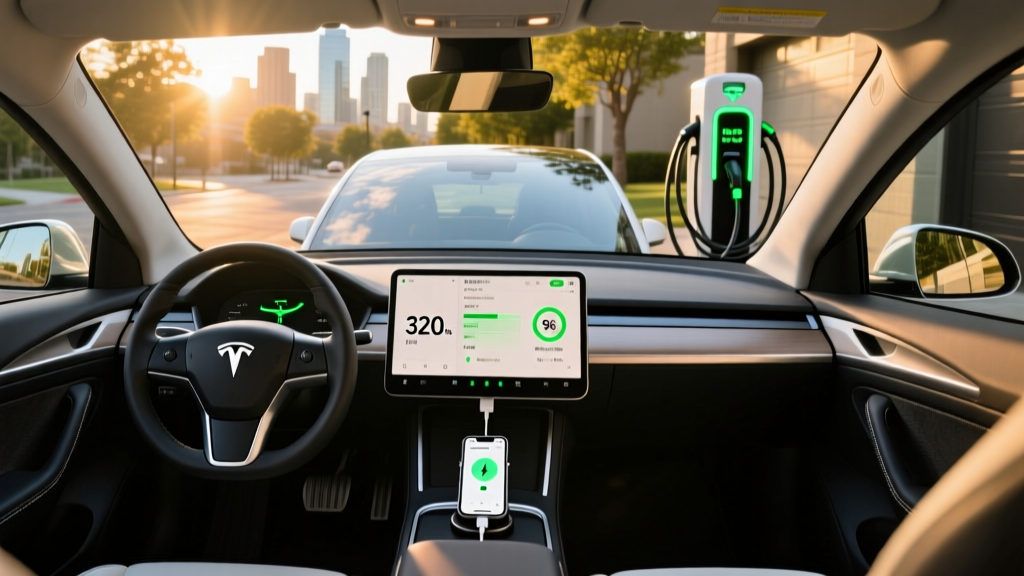
At home on a Level 2 Tesla Wall Connector (48 amps, hardwired to a 60-amp breaker), you'll add about 44 miles of range per hour. An overnight session from 20% to 80% takes roughly 5–6 hours — plenty for daily use. Installation costs for a 240V/60A circuit typically run $800–$2,000 depending on panel proximity and local permitting, on top of the $475 Wall Connector unit.
One major ownership perk: native access to the Tesla Supercharger network, which remains the most reliable and geographically dense DC fast-charging network in North America. With NACS now standardized on the 2026 Model Y, adapters are no longer needed at Tesla stalls, and third-party NACS chargers (from Electrify America, ChargePoint, and others) are increasingly available.
Performance and Driving Dynamics
Even the base Long Range RWD hits 60 mph in 6.5 seconds with 346 hp — quicker than most gas-powered compact SUVs in this price bracket. The dual-motor AWD variant drops that to 4.8 seconds with 514 hp, and the Performance trim shaves it to 3.5 seconds. All trims use a single-speed direct-drive transmission; acceleration is linear and immediate with no gear shifts.
The dual-motor AWD models use a permanent-magnet synchronous motor on the rear axle and an induction motor up front, which allows the front motor to freewheel (reducing drag) during light-load cruising. This contributes to the Model Y's strong efficiency numbers relative to its weight (~4,300 lbs for AWD).
Ride quality has improved with the 2025–2026 suspension revisions — the cabin is noticeably quieter and less jittery over broken pavement than the 2022–2023 models. That said, the Model Y still leans sporty-firm rather than plush. If ride comfort is a top priority, test-drive it back to back with the Hyundai Ioniq 5 or Kia EV6, which favor a softer tune.
Interior, Cargo, and Technology
The Model Y's minimalist cabin centers on a 15.4-inch touchscreen that controls virtually every vehicle function — there are no physical buttons for climate, mirrors, or glovebox. This polarizes buyers. If you prefer tactile controls, budget time in a test drive to build muscle memory with the touchscreen interface.
Cargo space is a strong suit: 30.2 cubic feet behind the second row and 72.1 cubic feet with the rear seats folded. The rear trunk includes a deep under-floor storage well, and the front trunk (frunk) adds 4.1 cubic feet — enough for a charging cable bag and a small duffel. Rear legroom measures 38.7 inches, adequate for adults on longer trips.
Standard tech includes:
- Over-the-air (OTA) software updates that add features post-purchase
- Tesla app with remote preconditioning, charge monitoring, and location tracking
- Basic Autopilot (SAE Level 2) — adaptive cruise + lane centering on highways
- Sentry Mode (dashcam-based security recording while parked)
- Dashcam and USB media playback
The optional FSD (Supervised) package costs $8,000 as a one-time purchase or $99/month as of early 2026. Whether it's worth it depends on your commute — it excels on well-marked divided highways but still requires active supervision in construction zones, unmapped areas, and adverse weather.
Pricing, Tax Credits, and Total Cost
| Trim | Base MSRP | Destination | Federal Credit (§30D) | Effective Price* |
|---|---|---|---|---|
| Long Range RWD | $44,990 | $1,390 | Up to $7,500 | ~$38,880 |
| Long Range AWD | $47,990 | $1,390 | Up to $7,500 | ~$41,880 |
| Performance | $52,490 | $1,390 | Up to $7,500 | ~$46,380 |
*Effective price assumes full §30D credit eligibility. Your actual credit may be $0, $3,750, or $7,500 depending on battery-sourcing compliance, buyer income, and tax liability.
The Model Y qualifies for the IRS §30D Clean Vehicle Credit — but eligibility is not automatic. Here is what determines whether you receive the full $7,500, a partial $3,750, or nothing:
- MSRP Cap: SUVs must have a base MSRP ≤ $80,000. All Model Y trims clear this.
- Buyer Income Cap: AGI must not exceed $150,000 (single), $225,000 (head of household), or $300,000 (joint). Exceed these thresholds and the credit phases out entirely.
- Battery Component Sourcing: $3,750 of the credit requires battery components manufactured or assembled in North America. $3,750 requires critical minerals sourced from the US or a free-trade-agreement partner. Both must be met for the full $7,500.
- Point-of-Sale Transfer: As of 2024, you can transfer the credit to the dealer at purchase, reducing the purchase price directly rather than waiting for a tax refund. Tesla supports this at delivery.
- Tax Liability: The credit is non-refundable. If your federal tax liability is less than the credit amount, you cannot claim the excess.
Battery-sourcing requirements tighten annually. As of 2026, a significant percentage of critical minerals and battery components must meet North American or FTA-partner thresholds. Tesla manufactures Model Y battery packs at Giga Nevada and sources some cells domestically, but the exact credit amount per trim can shift mid-year as supply chains adjust. Always verify current eligibility on fueleconomy.gov before committing to a purchase order.
Warranty and Long-Term Battery Outlook
Tesla covers the Model Y's battery and drive unit for 8 years or 120,000 miles (Long Range/Performance trims), whichever comes first, with a minimum 70% capacity retention guarantee during that period. The basic vehicle warranty is 4 years / 50,000 miles.
The 2026 Model Y uses NMC (nickel-manganese-cobalt) battery chemistry across all trims. NMC offers higher energy density than LFP (lithium iron phosphate), which translates to more range in a lighter pack — but it's less tolerant of sustained 100% State of Charge. Tesla recommends daily charging to 80% for NMC packs and only charging to 100% before long road trips. Following this guideline keeps degradation to roughly 8–12% over the first 100,000 miles based on aggregated fleet data.
Out-of-warranty battery replacement remains expensive — estimated at $12,000–$16,000 for the Model Y pack as of 2026. However, the vast majority of Tesla packs outlast their warranty period with capacity to spare. Failures within the warranty window are replaced at no cost.
Pros, Cons, and Who Should Buy
Pros
- Supercharger network access — still the most reliable DC fast-charging ecosystem
- Class-leading efficiency (28–30 kWh/100 mi) means lower charging costs per mile
- Strong cargo capacity (72.1 cu ft) with flat load floor
- OTA updates continuously add features and refine performance
- Point-of-sale tax credit transfer reduces upfront cost immediately
Cons
- Touchscreen-only controls require learning curve; no physical climate or mirror buttons
- Firm ride quality on rough roads compared to Hyundai/Kia competitors
- NMC battery requires 80% daily charge limit — LFP owners can charge to 100% freely
- FSD (Supervised) costs $8,000 extra and remains Level 2, not autonomous
- No Apple CarPlay or Android Auto — Tesla's native infotainment only
- You road-trip regularly and want the most proven DC fast-charging network
- You can install a Level 2 home charger and charge daily to 80%
- You value cargo space and efficiency over ride plushness
- You meet §30D income and sourcing requirements for the full $7,500 credit
- You prefer physical buttons, Apple CarPlay, or a softer ride
- You want an LFP battery option for unrestricted 100% daily charging
- 800V architecture (faster 10–80% charging on Ioniq 5/EV6) is a priority
Frequently Asked Questions
What is the real-world range of the 2026 Tesla Model Y?
The EPA rates the Long Range AWD at 308 miles, but sustained highway driving at 75 mph typically yields 250–270 miles in moderate weather. In sub-freezing winter conditions, expect 210–240 miles. City driving with frequent regenerative braking can approach or match the EPA sticker.
How fast does the Model Y charge at home and on the road?
On a home Level 2 Tesla Wall Connector (11.5 kW), you'll add about 44 miles of range per hour — a full overnight session covers most daily needs. At a 250 kW Supercharger, 10–80% takes roughly 24 minutes, though the charge curve tapers significantly above 50% SoC.
Does the 2026 Model Y qualify for the $7,500 federal tax credit?
It can — all trims are under the $80,000 SUV MSRP cap. However, the full $7,500 requires the buyer's AGI to be within IRS limits ($150K single / $300K joint) and the battery to meet 2026 critical-mineral and component-sourcing thresholds. The credit can be transferred at point of sale to reduce your purchase price directly. Verify current eligibility on fueleconomy.gov before ordering.
Is the Model Y worth buying over the Ioniq 5 or Mach-E?
The Model Y wins on efficiency (lower cost per mile), cargo space (72.1 cu ft vs. 59.3 in the Ioniq 5), and charging-network reliability. The Ioniq 5 and EV6 charge faster (10–80% in ~18 min on 800V architecture) and offer physical controls, Apple CarPlay, and a softer ride. If road-trip charging infrastructure is your top concern, the Model Y's Supercharger access is still the advantage.
How long will the Model Y battery last?
Tesla warranties the battery for 8 years / 120,000 miles with a 70% capacity retention floor. Real-world fleet data suggests NMC packs lose roughly 8–12% capacity over 100,000 miles when charged daily to 80%. Many Tesla packs exceed 200,000 miles before approaching the warranty threshold. Out-of-warranty replacement costs $12,000–$16,000.
Is Tesla Autopilot or FSD self-driving?
No. Both Autopilot and FSD (Supervised) are SAE Level 2 driver-assist systems. You must remain fully attentive, keep your hands on or near the wheel, and be prepared to take over instantly. FSD adds automated lane changes and highway navigation, but it does not make the vehicle autonomous.