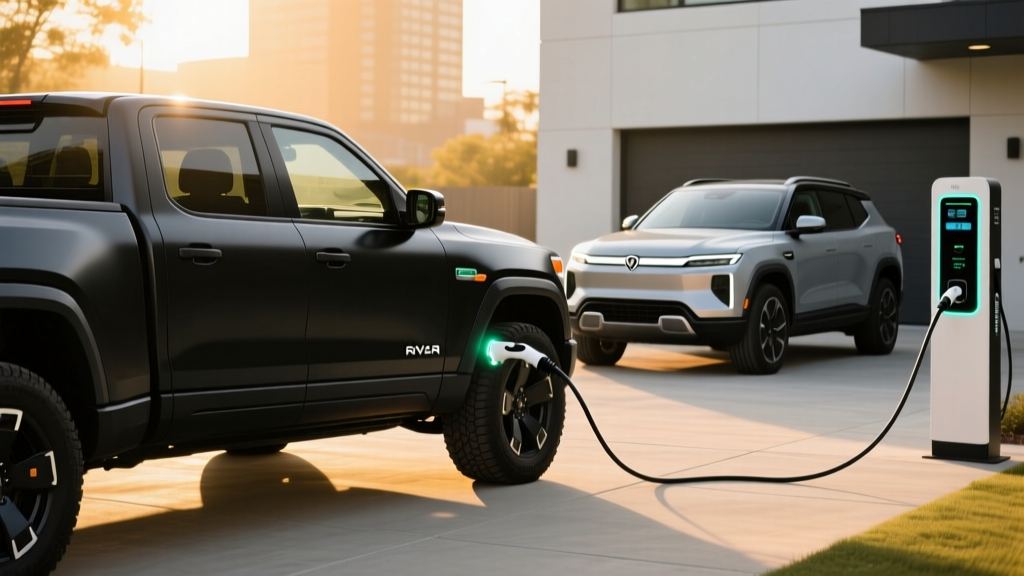
If you're buying a Rivian in 2026, you're choosing between two closely related electric platforms: the R1T pickup and the R1S three-row SUV. Both ride on Rivian's updated Gen 2 skateboard, share battery chemistries and powertrain options, and target the same adventure-oriented buyer. But the differences in cargo geometry, third-row practicality, towing capacity, and price positioning matter more than the spec sheet implies.
This guide consolidates the data points that actually drive ownership satisfaction — real-world range versus EPA stickers, sustained DC fast-charge rates (not just peak kW), tax credit eligibility under current IRS §30D rules, and the total cost picture once insurance and charging are factored in. No fluff, no marketing copy — just the numbers and what they mean on the ground.
R1T vs R1S: Core Specs at a Glance
| Spec | R1T (Dual-Motor Standard) | R1S (Dual-Motor Standard) |
|---|---|---|
| EPA Range | ~270 mi (Standard) / ~352 mi (Max) | ~270 mi (Standard) / ~340 mi (Max) |
| Battery Capacity (usable) | ~92 kWh (Standard, LFP) / ~128 kWh (Max, NMC) | ~92 kWh (Standard, LFP) / ~128 kWh (Max, NMC) |
| Drivetrain | Dual-Motor AWD (optional Tri/Quad) | Dual-Motor AWD (optional Tri/Quad) |
| Horsepower (Dual-Motor) | 533 hp | 533 hp |
| 0-60 mph | ~4.5 sec (Dual) / ~3.0 sec (Quad) | ~4.5 sec (Dual) / ~3.0 sec (Quad) |
| Max DC Fast Charge | ~200 kW peak (Standard) / ~220 kW (Max) | ~200 kW peak (Standard) / ~220 kW (Max) |
| 10-80% DCFC Time | ~28 min (Standard) / ~36 min (Max) | ~28 min (Standard) / ~36 min (Max) |
| Level 2 Home Charge | 11.5 kW (~25 mi/hr) | 11.5 kW (~25 mi/hr) |
| MPGe (combined, Dual Std) | ~73 MPGe | ~70 MPGe |
| Efficiency | ~46 kWh/100 mi | ~48 kWh/100 mi |
| Towing Capacity | 11,000 lb | 7,700 lb |
| Cargo (bed / behind 3rd / max) | 54 cu ft bed + 11 cu ft frunk | 10 cu ft frunk / 46 cu ft behind 3rd / 104 cu ft max |
| Ground Clearance (max) | 14.9 in (air suspension) | 14.9 in (air suspension) |
| Warranty (basic / powertrain / battery) | 5 yr/60k mi / 8 yr/100k mi / 8 yr/175k mi (70% retention) | 5 yr/60k mi / 8 yr/100k mi / 8 yr/175k mi (70% retention) |
| Base MSRP (2026 Dual Std) | $69,900 | $74,900 |
Sources: Rivian R1T specs, Rivian R1S specs, fueleconomy.gov. Figures reflect 2026 model-year configurations; confirm trim-specific numbers at order time.
Real-World Range: What the EPA Sticker Doesn't Tell You
Highway cruise (70-75 mph, 70°F): ~280-300 mi
Mixed city/highway (moderate climate): ~310-330 mi
Cold weather (below 32°F, highway): ~220-250 mi
Towing 7,000 lb trailer (flat terrain): ~160-180 mi
Rivian's boxy adventure styling creates more aerodynamic drag than a Tesla Model Y or Hyundai Ioniq 5, and that drag dominates at highway speeds. Expect roughly 15-20% range reduction from the EPA figure at sustained 75 mph, even in mild weather. Cold temperatures compound the penalty: LFP chemistry in the Standard pack is more resilient to cold degradation long-term, but NMC in the Max pack loses more immediate range to cabin and battery heating demands.
If your typical drive is suburban and below 60 mph, you'll see numbers close to or slightly above the EPA sticker thanks to regenerative braking. But if you're buying a Rivian for cross-country road trips or towing, plan your charging stops around the real-world highway and towing figures above — not the 352-mile headline.
Charging Speed and the Gen 2 Charge Curve
Rivian's Gen 2 platform upgraded the electrical architecture for faster DC charging, but peak kW numbers tell only part of the story. The charge curve matters more: how long the vehicle sustains near-peak power before tapering as the battery warms and state of charge climbs.
| Level | Power | R1T Miles Added/Hour | Notes |
|---|---|---|---|
| Level 1 (120V household) | ~1.4 kW | ~3 mi/hr | Emergency/trickle only |
| Level 2 (240V home, 48A) | 11.5 kW | ~25 mi/hr | Full charge overnight (~10 hr Max pack) |
| DC Fast (Standard pack) | ~200 kW peak | ~140 mi in 20 min | 10-80% in ~28 min; tapers sharply above 80% |
| DC Fast (Max pack) | ~220 kW peak | ~160 mi in 20 min | 10-80% in ~36 min; sustained plateau to ~60% |
The Max Battery pack sustains its charge plateau longer because the larger NMC pack can absorb more current at a lower C-rate per cell. The Standard LFP pack charges quickly to ~60%, then tapers more aggressively. For road trips, this means Max-pack owners spend less time at chargers per mile added — a meaningful difference on 500+ mile days.
Rivian uses the NACS connector natively on 2026 models, granting direct access to the Tesla Supercharger network (over 25,000 stalls in North America). The Rivian Adventure Network adds proprietary 350+ kW chargers at destination-adjacent locations, though coverage remains limited compared to Electrify America or Superchargers.
Performance, Drivetrain, and the Tri/Quad Motor Decision
The Dual-Motor AWD layout (one motor per axle) delivers 533 hp and a 4.5-second 0-60 time — more than adequate for merging, passing, and trail use. The Tri-Motor (one front, two rear) and Quad-Motor (one per wheel) configurations push output to 850+ hp and sub-3.0-second sprints, but at a $15,000-$20,000 price premium and a 10-15% range penalty from added weight and drivetrain losses.
For 90% of buyers, the Dual-Motor is the rational choice. Quad-Motor shines only if you need torque vectoring for technical off-road trails or want the performance halo. The air suspension is standard across trims and delivers 14.9 inches of ground clearance in Off-Road mode — competitive with a Jeep Wrangler Rubicon — while lowering for highway efficiency at speed.
Pricing, Trims, and the Federal Tax Credit Reality
Rivian's pricing has shifted repeatedly as the company scales production and responds to competition from the Tesla Cybertruck, Ford F-150 Lightning, and Chevrolet Silverado EV. Here's where the 2026 lineup lands before incentives:
| Configuration | Base MSRP | As-Tested Typical | §30D Credit Eligibility |
|---|---|---|---|
| R1T Dual-Motor Standard | $69,900 | $73,500 (w/ premium wheels, tow pkg) | Eligible (under $80k truck cap) — up to $7,500 if sourcing/income rules met |
| R1T Dual-Motor Max | $83,900 | $88,000 | Exceeds $80k MSRP cap — no §30D credit |
| R1T Tri/Quad Max | $99,000+ | $105,000+ | No §30D credit |
| R1S Dual-Motor Standard | $74,900 | $78,500 | Eligible (under $80k SUV cap) — up to $7,500 if sourcing/income rules met |
| R1S Dual-Motor Max | $88,900 | $93,000 | Exceeds $80k MSRP cap — no §30D credit |
Critical caveat on the §30D credit: Eligibility hinges on three simultaneous requirements per IRS rules: (1) MSRP must fall below the vehicle-class cap ($80,000 for trucks/SUVs/vans), (2) buyer modified adjusted gross income must not exceed $300,000 joint / $150,000 single, and (3) the battery must meet critical-mineral and component-sourcing thresholds that tighten annually. Rivian has worked to shift supply chains, but the exact credit amount ($3,750, $7,500, or $0) depends on the build month's sourcing compliance. Confirm eligibility with your tax professional before ordering — do not assume the full $7,500.
The point-of-sale transfer option allows you to apply the credit as a down-payment reduction at delivery if you qualify, rather than waiting to claim it on your tax return.
Interior Space, Tech, and Daily Usability
The R1T's 54-cubic-foot bed is shorter than a midsize Tacoma or Colorado, but the gear tunnel (an 11-cubic-foot pass-through behind the cab) adds secure, lockable storage that competitors lack. The frunk (front trunk) holds 11 cubic feet — enough for charging cables, groceries, or a soft cooler.
The R1S offers a genuine third row, but it's best for children or short trips. Legroom behind the third row is tight at 10 cubic feet of cargo space; fold it down and you get 46 cubic feet, competitive with a midsize SUV. For families regularly hauling six adults, a larger SUV or minivan remains more practical.
Infotainment runs on Rivian's proprietary OS with a 12.8-inch center display. Wireless Apple CarPlay and Android Auto are supported, navigation includes EV-aware route planning with charging stops, and the software receives regular OTA updates. The Driver+ system is a Level 2 SAE driver-assist — hands-on-wheel, eyes-on-road — with lane centering and adaptive cruise. It is not self-driving and does not compete with Tesla FSD or GM Super Cruise in hands-free capability on mapped highways.
Warranty, Reliability, and Ownership Costs
Rivian's warranty structure is competitive but not class-leading:
- Basic: 5 years / 60,000 miles
- Powertrain: 8 years / 100,000 miles
- Battery: 8 years / 175,000 miles (retains 70% capacity)
The battery warranty's 70% retention threshold is industry-standard (Tesla, Ford, and Hyundai use similar benchmarks). Real-world degradation data from Gen 1 owners (2022-2024 models) suggests ~5-7% loss at 50,000 miles for NMC packs, with LFP packs showing slightly better retention but less public data due to their later introduction.
Insurance premiums for Rivians run 15-25% higher than comparable gas trucks and SUVs, driven by repair costs for aluminum body panels, sensor calibration, and limited aftermarket parts. Get a quote before ordering — the premium can erase projected fuel savings for low-mileage drivers.
Home charging installation for a 48-amp Level 2 charger (requiring a 60-amp circuit) typically costs $800-$2,500 depending on panel capacity and conduit run length. If your home has a 100-amp main panel, a $2,000-$4,000 panel upgrade may be necessary. Budget for this upfront.
Who Should (and Shouldn't) Buy a Rivian
Buy the R1S if: You need three rows for occasional passengers; prefer an enclosed cargo area; and want similar capability to the R1T in an SUV form factor.
Look elsewhere if: You need maximum highway range (consider Tesla Model Y or Lucid Gravity); you regularly tow over 7,000 lb on long trips (the range hit is punishing); or your budget requires the full $7,500 tax credit to make the math work — Rivian's MSRP and sourcing rules make that uncertain.
Rivian vs. the Competition
The R1T competes most directly with the Tesla Cybertruck (more polarizing design, 4670-architecture battery, lower starting price but build-quality concerns), Ford F-150 Lightning (more traditional truck, lower performance, broader dealer network), and Chevrolet Silverado EV (massive range on top trims, but polarizing styling and limited availability). The R1S has fewer direct rivals: the Tesla Model X (falcon-wing doors, aging platform), Kia EV9 (more affordable, less performance), and the upcoming Lucid Gravity (luxury-focused, unproven).
Rivian's edge is build quality refinement (Gen 2 addressed most early panel-gap and software complaints), genuine off-road capability, and the NACS connector granting Supercharger access. Its weakness is price — the base Standard pack trims are attainable, but the Max Battery configurations that deliver the advertised range push well past $80,000 and out of tax-credit territory.
- Best-in-class off-road capability with air suspension and quad/dual-motor torque control
- NACS connector for seamless Tesla Supercharger access
- Strong build quality on Gen 2 vehicles
- Gear tunnel (R1T) and frunk add practical storage
- OTA updates continue to add features post-delivery
- Max Battery trims exceed $80k MSRP cap — no §30D credit
- Real-world highway range falls 15-20% below EPA sticker
- Insurance premiums significantly above gas truck/SUV averages
- Third row in R1S is tight for adults
- Driver+ is Level 2 only — no hands-free highway driving
FAQ: Buying a Rivian in 2026
What is the real-world range of a Rivian R1T or R1S?
The Max Battery R1T achieves 352 miles EPA, but expect 280-300 miles at highway speeds in mild weather, and 220-250 miles in freezing temperatures. Standard pack models deliver ~270 miles EPA, with ~210-230 miles real-world highway. Towing cuts range roughly in half.
How fast does a Rivian charge at home and on the road?
At home on a 240V Level 2 charger (48A), both models add ~25 miles per hour, fully charging overnight. On DC fast chargers, the Standard pack peaks at ~200 kW (10-80% in ~28 minutes) and the Max pack at ~220 kW (10-80% in ~36 minutes). Above 80% SoC, charging slows sharply — plan to charge to 80% and go.
Does a Rivian qualify for the $7,500 federal EV tax credit?
Only the Standard Battery trims (under $80,000 MSRP) are eligible, and only if your income is below $300,000 (joint) or $150,000 (single) and the battery meets current-year critical-mineral and component-sourcing rules. The Max Battery and Tri/Quad trims exceed the MSRP cap and do not qualify. Confirm with a tax professional and the IRS §30D guidance before ordering.
Is the Rivian R1T better than the Ford F-150 Lightning or Tesla Cybertruck?
The R1T offers superior off-road capability and build quality versus the Cybertruck, and more performance and tech than the F-150 Lightning. The Lightning wins on price and dealer service network; the Cybertruck wins on starting MSRP and stainless-steel polarizing appeal. For adventure use and towing under 10,000 lb, the R1T is the most complete package — at a premium price.
What are the biggest complaints from Rivian owners?
Gen 1 (2022-2023) owners cited software bugs, panel gaps, and service-center wait times. Gen 2 (2025-2026) vehicles have largely resolved the first two, and Rivian has expanded service centers and mobile service vans. The most persistent complaint remains the cost of Max Battery trims and the resulting loss of tax credit eligibility.
Should I get the Standard or Max Battery pack?
If you can charge at home daily and your longest trips are under 300 miles with charging stops, the Standard pack saves $14,000 and keeps you under the tax credit MSRP cap. If you regularly drive 400+ mile days in cold weather or tow frequently, the Max pack's sustained charge curve and extra kWh are worth the premium — but budget for no tax credit and higher insurance.