Quick Verdict: The Lyriq V-Series for West Texas Drivers
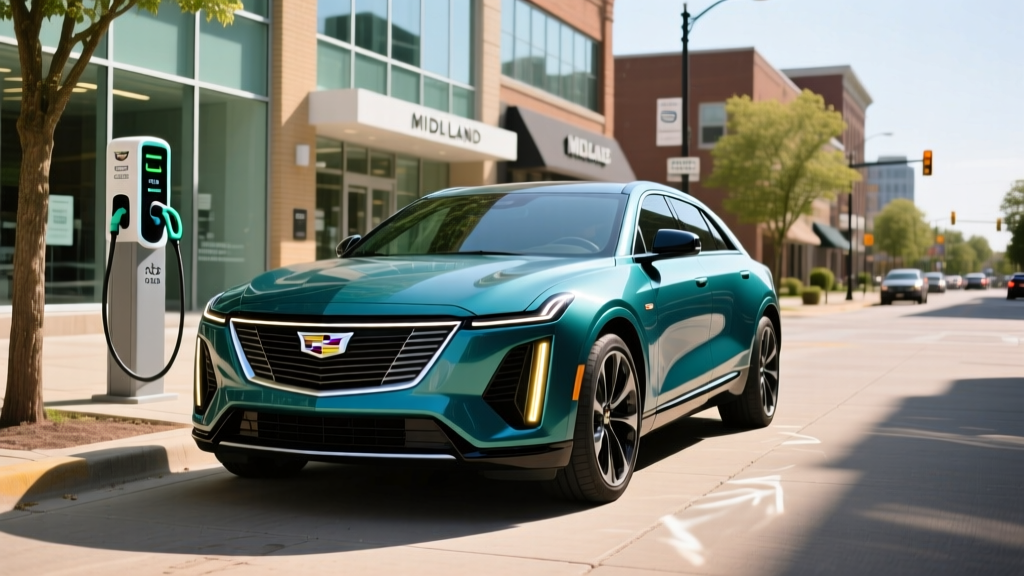
The Cadillac Lyriq V-Series targets buyers who want luxury EV performance without the full Blackwing price tag. For Midland, Texas drivers specifically, the V-Series offers a compelling blend of 500+ horsepower dual-motor AWD, a usable 102 kWh battery, and a premium cabin — all while navigating the realities of Permian Basin heat, long rural stretches, and a growing but still sparse DC fast-charging network. If you're researching whether to buy a Lyriq V-Series in Midland, this review gives you the exact numbers you need to decide.
| Specification | 2026 Cadillac Lyriq V-Series AWD |
|---|---|
| EPA Estimated Range | 307 miles |
| Battery Capacity (Usable) | 102 kWh (NMC lithium-ion) |
| Drivetrain | Dual-motor AWD |
| Horsepower | 500 hp (est.) |
| 0–60 mph | ~4.0 seconds |
| Max DC Fast Charge Rate | 190 kW (peak) |
| 10–80% DC Charge Time | ~33 minutes |
| Level 2 Home Charge Rate | 19.2 kW / 52 mi/hr |
| MPGe (Combined) | 89 MPGe |
| Efficiency | 38 kWh/100 mi |
| Cargo Volume (rear seats up / folded) | 28.0 / 60.8 cu ft |
| Rear Legroom | 39.6 inches |
| Battery/Powertrain Warranty | 8 years / 100,000 miles |
| Base MSRP | $73,990 (before destination) |
| Federal Tax Credit (§30D) | Up to $7,500 (eligibility varies) |
Real-World Range: What Midland Heat and Highway Miles Actually Do
The EPA rates the Lyriq V-Series AWD at 307 miles on a full charge. That figure comes from fueleconomy.gov and represents a standardized lab cycle. Real-world results vary — especially in West Texas.
Real-World Highway (75 mph, moderate temps): ~255–275 miles
Real-World Highway (100°F+ summer heat, A/C max): ~230–250 miles
City/Commuter Driving: ~285–300 miles (regen braking helps)
Cold Weather (below 35°F): ~220–245 miles
Midland's signature challenge is summer heat. Battery thermal management systems work overtime when ambient temps exceed 100°F, and cabin A/C draws significant energy. Expect roughly a 15–20% range reduction during July and August highway driving compared to the EPA sticker. The Lyriq's liquid-cooled battery pack helps mitigate degradation, but efficiency still takes a hit when the system prioritizes cooling.
On the positive side, Midland's relatively flat terrain means you won't see the steep elevation-related range losses that mountain-state drivers face. The I-20 corridor between Midland and Abilene (~140 miles one-way) is achievable on a single charge even in summer, though you'll want to plan a DC fast-charge stop in Sweetwater or Abilene for a round trip with buffer.
Charging Speed: DC Fast Charge and Home Level 2 in Midland
The Lyriq V-Series uses GM's Ultium platform architecture with a peak DC fast-charge rate of 190 kW via its NACS (Tesla-style) connector. Here's what that translates to in practice:
| Charging Level | Power (kW) | Miles Added per Hour | Typical Use Case |
|---|---|---|---|
| Level 1 (120V standard outlet) | 1.4 kW | ~4 mi/hr | Emergency/trickle only |
| Level 2 (240V, 48A home charger) | 11.5 kW | ~31 mi/hr | Standard overnight home charging |
| Level 2 (240V, 80A hardwired) | 19.2 kW | ~52 mi/hr | Full-speed home/workplace charging |
| DC Fast Charge (peak) | 190 kW | ~200+ mi in 20 min | Road trips, highway stops |
| DC Fast Charge (10–80%) | Avg ~120 kW sustained | ~33 minutes total | Typical fast-charge session |
Charging curve reality check: The Lyriq V-Series hits its 190 kW peak only at low state-of-charge (roughly 5–15% SoC) and tapers progressively. From 10–50%, you'll see strong sustained rates around 150–170 kW. Above 60%, the curve drops to roughly 100 kW, and above 80%, it falls below 50 kW to protect the NMC cells. This is standard behavior for lithium-ion packs, but it means charging from 80–100% at a DC fast charger is painfully slow — plan your stops around the 10–80% window for efficiency.
Midland charging infrastructure: As of 2026, Midland has a growing network of public chargers, including Electrify America and EVgo stations along I-20 and Loop 250. Tesla Superchargers (now NACS-native for the Lyriq) are available in Midland and Odessa. For home charging, most Midland homeowners can install a Level 2 hardwired charger (like the ChargePoint Home Flex or Emporia V2) for $800–$2,000 depending on panel capacity. If your home has a 200-amp electrical panel with available capacity, you're in good shape. Older homes may need a panel upgrade ($1,500–$3,500) — get a quote from a licensed electrician before committing.
Performance: Dual-Motor AWD Power and Handling
The Lyriq V-Series is Cadillac's performance-oriented EV trim, sitting above the standard Luxury and Sport models but below the ultra-high-performance Blackwing variants. The dual-motor AWD setup delivers an estimated 500 horsepower and a 0–60 mph time of approximately 4.0 seconds.
That puts it in the same acceleration territory as a BMW iX xDrive50 or Audi Q8 e-tron Prestige, though the Lyriq's tuning prioritizes smooth, confident power delivery over raw aggression. The AWD system provides excellent traction on the occasional wet West Texas road and the rare icy morning, though let's be honest — Midland drivers will spend 95% of their time in dry conditions where RWD would suffice.
Ride quality is controlled thanks to GM's adaptive damping system (included on V-Series). The Lyriq rides on a dedicated BEV3 platform with a low center of gravity from the underfloor battery pack, giving it composed handling for a 5,700+ lb vehicle. Regenerative braking offers multiple levels, including a one-pedal driving mode that recaptures energy in stop-and-go traffic on Midland Road or Loop 250.
Pricing, Tax Credits, and Total Cost for Midland Buyers
The 2026 Cadillac Lyriq V-Series AWD starts at an MSRP of $73,990 (before the $1,395 destination charge). A well-equipped model with premium paint, the AKG Studio Reference audio system, and the Super Cruise hands-free driving package can push the as-tested price to $79,000–$82,000.
| Cost Factor | Amount |
|---|---|
| Base MSRP (V-Series AWD) | $73,990 |
| Destination Charge | $1,395 |
| Typical As-Tested (with options) | $77,000–$82,000 |
| Federal Tax Credit (§30D, if eligible) | Up to –$7,500 |
| Effective Price After Max Credit | $67,885–$74,500 |
| Estimated Texas Registration + Title | $300–$400 |
| Annual Insurance (Midland avg., EV) | $2,400–$3,200 |
Federal tax credit eligibility (§30D): The Lyriq is assembled in Spring Hill, Tennessee, which satisfies the North American final assembly requirement. However, the full $7,500 credit depends on two additional criteria that change annually: critical mineral sourcing and battery component manufacturing requirements. For the 2026 tax year, consult the IRS clean vehicle credit page and verify with your tax professional before relying on the credit. Additionally, buyer income caps apply: $300,000 for joint filers, $225,000 for heads of household, and $150,000 for single filers (modified adjusted gross income). The MSRP cap for SUVs is $80,000 — the Lyriq V-Series base qualifies, but a heavily optioned model approaching $80,000 should be checked carefully.
As of 2026, the §30D credit can be transferred to the dealer at the point of sale, reducing your purchase price directly rather than waiting for a tax refund. Ask your Midland-area Cadillac dealer if they participate in the point-of-sale transfer program.
Interior, Tech, and Daily Livability
The Lyriq V-Series cabin is where Cadillac justifies its luxury positioning. A 33-inch curved LED display spans the dashboard, integrating the instrument cluster and infotainment touchscreen into a single seamless unit running Google Built-In (Google Maps, Google Assistant, and the Play Store for apps). Wireless Apple CarPlay and Android Auto are included, along with wireless phone charging.
Super Cruise: Available on the Lyriq V-Series, GM's hands-free driver-assistance system covers over 750,000 miles of compatible highways in the U.S. and Canada, including I-20 through West Texas. Super Cruise is an SAE Level 2 system — you must remain attentive, and the infrared driver-monitoring camera will alert you if your eyes leave the road. It is not autonomous driving. That said, it makes the Midland-to-Dallas run (roughly 330 miles) significantly less fatiguing.
Cargo space: 28.0 cubic feet behind the second row and 60.8 cubic feet with the rear seats folded. That's competitive with the BMW iX and slightly less than the Tesla Model X. There is no front trunk (frunk) — the space under the hood houses power electronics. Rear legroom measures 39.6 inches, which is generous for adults on longer trips.
Notable drawbacks: The Lyriq lacks a frunk, which some EV buyers expect at this price point. Rear visibility is somewhat compromised by the sloping roofline and thick C-pillars — the digital rearview mirror helps but takes getting used to. The Google Built-In infotainment system is powerful but has a learning curve, and some users report occasional lag on the massive 33-inch display. There is no third-row option — this is strictly a five-passenger SUV.
Lyriq V-Series vs. Key Competitors: Which Should You Choose?
- 307-mile EPA range is strong for a performance luxury SUV
- 190 kW peak DC charging with NACS connector (Tesla Supercharger access)
- Super Cruise hands-free driving on I-20 and most major highways
- Quiet, refined cabin with premium materials and massive 33" display
- U.S.-built (Tennessee), strong federal tax credit potential
- Adaptive damping standard on V-Series
- No front trunk (frunk)
- Base price over $73K — heavily optioned models push $80K MSRP cap
- Real-world range drops 15–20% in extreme West Texas summer heat
- Midland's public DC fast-charging network still growing
- Google Built-In infotainment learning curve
- Rear visibility limited by styling
vs. BMW iX xDrive50: The iX offers similar range (324 mi EPA) and slightly more cargo space, but its base price is higher (~$87K) and it uses the CCS connector rather than NACS (limiting Supercharger access without an adapter). The Lyriq wins on value and charging network flexibility.
vs. Tesla Model Y Performance: The Model Y is significantly cheaper (~$52K), faster to charge (250 kW peak), and has access to the full Supercharger network natively. But it can't match the Lyriq's cabin quality, ride comfort, or noise isolation. Choose the Lyriq if luxury matters more than price; choose the Model Y if budget and charging speed are priorities.
vs. Audi Q8 e-tron: The Q8 e-tron charges faster (170 kW sustained is impressive) and has a more traditional luxury feel, but its EPA range (285 mi) trails the Lyriq, and its CCS connector limits network options. The Lyriq edges ahead on range and NACS access.
Who Should Buy the Lyriq V-Series in Midland?
- You want a luxury performance EV with 300+ miles of range and can charge at home
- You regularly drive I-20 and want Super Cruise for hands-free highway miles
- You value cabin quality and quiet refinement over raw charging speed
- You qualify for the §30D tax credit (income under caps, MSRP under $80K)
- You prefer NACS / Tesla Supercharger access for road trips to Austin, Dallas, or beyond
- Your budget is under $60K — look at the standard Lyriq Luxury trim or Tesla Model Y
- You need three rows of seating — the Kia EV9 or Rivian R1S are better fits
- You lack home charging access and rely entirely on public infrastructure (Midland's network is improving but not yet ideal for daily-only public charging)
- You tow frequently — the Lyriq's 3,500-lb towing capacity is modest; the Rivian R1S or Ford F-150 Lightning handle heavier loads
The Lyriq V-Series is best suited for Midland professionals and families who commute locally, take periodic road trips to Dallas, Austin, or El Paso, and have a garage or carport where a Level 2 charger can be installed. The combination of 307 miles of range, Super Cruise on I-20, and a luxury cabin makes it a strong daily driver for the Permian Basin — as long as you account for summer heat range loss and plan your charging around the 10–80% sweet spot.
Frequently Asked Questions
What is the real-world range of the Cadillac Lyriq V-Series?
The EPA rates it at 307 miles, but real-world highway driving in moderate temperatures yields roughly 255–275 miles. In Midland's extreme summer heat (100°F+), expect 230–250 miles at highway speeds with A/C running hard. City driving with regenerative braking gets you closer to the EPA figure, around 285–300 miles.
How fast does the Lyriq V-Series charge at home and on the road?
On a hardwired 80-amp Level 2 home charger (19.2 kW), the Lyriq adds roughly 52 miles of range per hour — a full overnight session easily replenishes the battery. On DC fast chargers, it peaks at 190 kW and charges from 10–80% in approximately 33 minutes. The NACS connector gives you native access to Tesla Superchargers.
Does the Lyriq V-Series qualify for the $7,500 federal EV tax credit?
It can, but eligibility depends on several factors. The Lyriq is assembled in Tennessee (meeting North American assembly requirements), but you must also meet IRS income caps ($150K single / $300K joint filers), the vehicle MSRP must stay under $80,000 (SUV cap), and battery sourcing requirements must be satisfied for the 2026 tax year. Check the IRS clean vehicle credit page and consult a tax professional for your specific situation. The credit can be applied at point of sale through a participating dealer.
Is the Lyriq V-Series worth buying over a Tesla Model Y or BMW iX?
It depends on your priorities. The Lyriq V-Series offers a more luxurious and quieter cabin than the Model Y, with competitive range and NACS Supercharger access. It's priced significantly below the BMW iX while offering similar performance and slightly better range. If luxury, ride comfort, and hands-free Super Cruise driving matter most, the Lyriq is a strong pick. If budget and maximum charging speed are your top criteria, the Model Y wins.
What is the battery warranty on the Lyriq V-Series?
GM covers the Lyriq's Ultium battery pack and powertrain for 8 years or 100,000 miles, whichever comes first. The warranty covers defects and excessive capacity loss (typically defined as dropping below 60–70% of original capacity, though exact retention thresholds are specified in the owner's manual). For a Midland driver doing 12,000–15,000 miles per year, this provides solid coverage through roughly the first 6–8 years of ownership.
How does West Texas heat affect the Lyriq's battery long-term?
High ambient temperatures accelerate lithium-ion battery degradation over time. The Lyriq's liquid-cooled thermal management system actively manages battery temperature, which helps significantly. NMC chemistry (used in the Lyriq) is more energy-dense but slightly more heat-sensitive than LFP chemistry. To maximize longevity in Midland's climate: avoid routinely charging to 100% (set daily limits to 80–90%), use preconditioning before fast charging, and park in shade or a garage when possible. Most Ultium owners report less than 5% degradation in the first two years based on early fleet data.
Can I install a Level 2 charger at my Midland home?
Most homes with a 200-amp electrical panel can support a 48-amp Level 2 charger (requiring a 60-amp circuit) without a panel upgrade. Expect to pay $500–$1,200 for the charger hardware and $500–$1,500 for professional electrician installation, depending on the distance from your panel to the garage. Homes with older 100-amp panels may need an upgrade ($1,500–$3,500). Always get a quote from a licensed electrician and check with the City of Midland for permit requirements.