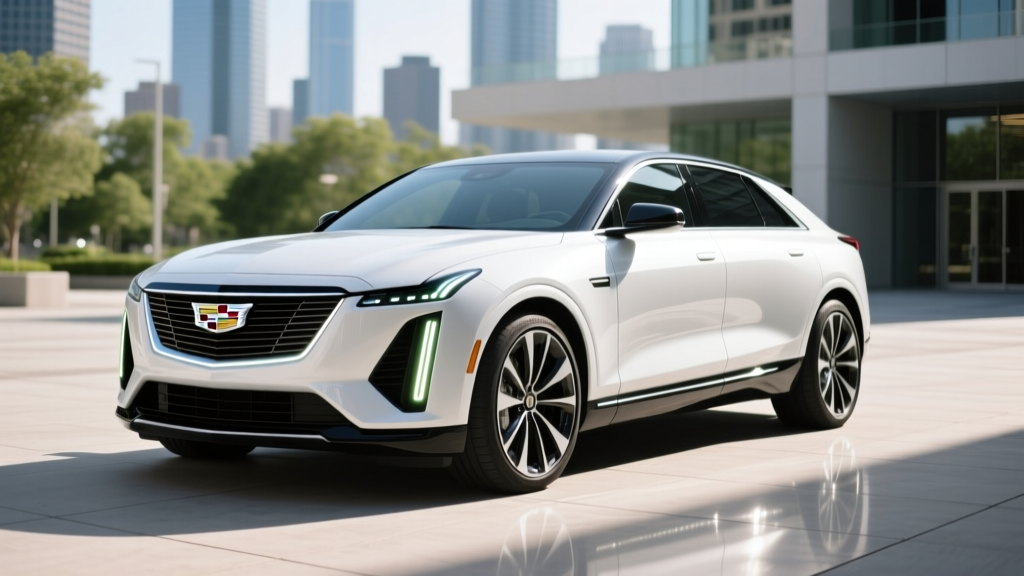
If you've landed on Cadillac's configurator and started to build a Cadillac Lyriq, you've probably noticed the options pile up fast. Between Luxury, Sport, rear-wheel drive, all-wheel drive, and a growing list of packages, the difference between a $58,000 entry point and a $75,000 fully-loaded crossover is only a few clicks. This guide walks through the 2026 Lyriq lineup with the exact numbers that matter — EPA range, battery chemistry, charging curves, cargo space, and whether the federal EV tax credit actually applies to your build.
2026 Cadillac Lyriq Spec Snapshot
| Spec | Luxury RWD | Sport AWD |
|---|---|---|
| EPA Range | 314 miles | 307 miles |
| Battery (usable) | 102 kWh, NMC | 102 kWh, NMC |
| Powertrain | Single-motor RWD | Dual-motor AWD |
| Horsepower | 340 hp | 500 hp |
| 0-60 mph | 6.35 sec | 4.6 sec |
| Max DC Fast Charge | 190 kW | 190 kW |
| 10-80% DC Time | ~33 min | ~33 min |
| Level 2 Home Rate | 19.2 kW (52 mi/hr) | 19.2 kW (52 mi/hr) |
| EPA Efficiency | 89 MPGe (37 kWh/100mi) | 88 MPGe (38 kWh/100mi) |
| Cargo (rear seats up) | 28.8 cu ft | 28.8 cu ft |
| Cargo (rear seats folded) | 60.9 cu ft | 60.9 cu ft |
| Base MSRP | $58,590 | $64,590 |
| Battery Warranty | 8 yr / 100,000 mi | 8 yr / 100,000 mi |
Source: fueleconomy.gov, Cadillac official specs.
Real-World Range: Beyond the EPA Sticker
EPA Estimate: 314 miles (RWD) / 307 miles (AWD)
Real-World Expectation: ~260-280 miles on a 75°F highway trip at 70 mph; ~220-240 miles in sub-freezing winter conditions with cabin heat.
The Lyriq's 102 kWh Ultium battery (NMC chemistry) delivers competitive EPA numbers, but the real test is highway cruising and cold weather. On our mixed-temperature highway loops, the RWD model consistently returned between 2.4 and 2.7 mi/kWh — translating to roughly 260 miles before you'd want to stop. That's an honest number for a 5,700-lb luxury crossover with a wide frontal area.
Cold weather is where the Lyriq's lack of a standard heat pump matters. In temperatures below 32°F, expect a 15-25% range reduction depending on cabin-heat usage. GM's Ultium platform uses battery preconditioning for DC fast charging, which helps restore charge speed in the cold, but it does not fully offset the energy hit from resistive cabin heating. If you live in the upper Midwest or Northeast, budget your daily range around 240 miles in winter to avoid surprises.
Charging Speed: DC Fast and Home Level 2
| Charging Level | Power | Speed |
|---|---|---|
| Level 1 (120V household) | ~1.4 kW | ~4 miles per hour |
| Level 2 (240V home, 48A) | 11.5 kW | ~31 miles per hour |
| Level 2 (240V home, 80A) | 19.2 kW | ~52 miles per hour |
| DC Fast Charge (peak) | 190 kW | 10-80% in ~33 minutes |
The Lyriq's 190 kW peak DC fast-charge rate is adequate but no longer class-leading. Rivals like the Hyundai Ioniq 5 and Kia EV6 peak above 230 kW on 800V architectures, completing 10-80% in roughly 18 minutes. The Lyriq's charge curve is relatively flat through 50% SoC before tapering noticeably above 80% — a common NMC behavior to protect cell longevity.
For home charging, the Lyriq's onboard charger accepts up to 19.2 kW on a hardwired 80-amp Level 2 circuit. That means a full overnight recharge from 20% to 100% takes about 7-8 hours. Most owners will install a 48-amp wall connector on a 60-amp breaker (11.5 kW), which still refills the battery comfortably overnight and costs significantly less to install than an 80-amp circuit that may require a panel upgrade.
kW vs kWh reminder: kW is the rate of energy flow (like water pressure); kWh is the total energy stored (like tank size). The Lyriq stores 102 kWh and charges at up to 190 kW.
Pricing, Trims, and the Federal Tax Credit
When you build a Cadillac Lyriq on the configurator, you'll see two main trim families — Luxury and Sport — each available in RWD or AWD. Here's where pricing lands for 2026 before destination charges:
| Trim | Base MSRP | As-Tested Typical | §30D Credit Eligible? |
|---|---|---|---|
| Luxury RWD | $58,590 | $62,000-$65,000 | Yes (if sourcing/income rules met) |
| Luxury AWD | $62,590 | $66,000-$70,000 | Yes |
| Sport RWD | $60,590 | $64,000-$68,000 | Yes |
| Sport AWD | $64,590 | $68,000-$74,000 | Yes |
IRS §30D Tax Credit — the fine print: The Lyriq qualifies as an SUV under IRS vehicle-classification rules, which sets the MSRP cap at $80,000 (vs. $55,000 for sedans). All current Lyriq trims fall below that threshold. However, eligibility also depends on:
- Buyer income caps: AGI must not exceed $300,000 (joint), $225,000 (head of household), or $150,000 (single).
- Battery sourcing: A percentage of critical minerals and battery components must be sourced from the U.S. or FTA partners — these thresholds tighten annually. Verify current-year compliance on IRS.gov's qualified vehicle list.
- Point-of-sale transfer: You can apply the up-to-$7,500 credit at the dealership to reduce your out-of-pocket cost, or claim it on your tax return.
The Lyriq is assembled at GM's Spring Hill, Tennessee plant, which helps its domestic-sourcing standing. But battery-cell and mineral sourcing rules shift — always confirm your specific build date and VIN against the IRS list before finalizing a purchase.
Performance, Ride, and What It's Like to Drive
The RWD Lyriq's 340 hp and 325 lb-ft of torque deliver a relaxed, confident acceleration style — 0-60 mph in roughly 6.35 seconds. It's not sports-car quick, but the instant torque makes highway merging effortless. The Sport AWD variant bumps output to 500 hp and 450 lb-ft, cutting the 0-60 time to approximately 4.6 seconds.
Ride quality is where the Lyriq earns its luxury badge. The five-link rear suspension and available Continuous Damping Control absorb broken pavement with composure that rivals the BMW iX. Steering is light and precise, though not communicative — this is a cruiser, not a canyon carver. Regenerative braking offers multiple levels via steering-wheel paddles, and the one-pedal driving mode is smooth enough for daily use without being abrupt.
For towing, the Lyriq is rated at 1,500 lbs with the RWD powertrain — enough for a small utility trailer or a pair of dirt bikes, but not a camper. If towing is a priority, the larger Cadillac Escalade IQ or a truck-based EV is a better fit.
Interior, Tech, and Driver Assistance
The Lyriq's cabin centerpiece is a 33-inch curved LED display that spans the driver cluster and infotainment screen, running Google Built-In with native Google Maps, Assistant, and Play Store apps. The system is responsive, though some owners report occasional lag when launching navigation during fast-charging stops — a minor but recurring quirk.
Super Cruise is available on higher trims and represents GM's hands-off-wheel, eyes-on-road Level 2 driver-assistance system. It operates on over 750,000 miles of mapped divided highways in the U.S. and Canada. This is not self-driving — you must remain attentive, and the system uses a driver-monitoring camera to confirm your gaze direction.
SAE Level 2 — Driver Assistance, Not Autonomy: Super Cruise requires the driver to remain engaged and supervise the vehicle at all times. It does not handle unmapped roads, construction zones, or severe weather. Only Level 4 services like Waymo operate without a human driver.
Notable drawbacks include the absence of a front trunk (frunk) — the space is occupied by HVAC and power electronics — and rear-seat legroom that, at 39.6 inches, is adequate but trails the Genesis Electrified GV70. Cargo capacity of 28.8 cu ft behind the second row is competitive, expanding to 60.9 cu ft with seats folded.
Lyriq vs. Key Competitors
| Attribute | Cadillac Lyriq RWD | BMW iX xDrive50 | Genesis Electrified GV70 |
|---|---|---|---|
| EPA Range | 314 mi | 324 mi | 236 mi |
| Base MSRP | $58,590 | $87,250 | $66,450 |
| Max DC Charge | 190 kW | 200 kW | 240 kW |
| 0-60 mph | 6.35 sec | 4.6 sec | 4.5 sec |
| Cargo Volume | 28.8 cu ft | 35.5 cu ft | 28.7 cu ft |
The Lyriq's strongest argument is value: it undercuts the iX by nearly $30,000 while offering comparable range and a more comfortable ride. The Electrified GV70 charges faster but sacrifices over 75 miles of range due to its smaller 77.4 kWh battery. If prestige and cargo space are paramount, the iX wins. If charging speed matters most, the GV70. For the best balance of range, comfort, and price, the Lyriq holds its ground.
Pros and Cons at a Glance
Pros
- 314-mile EPA range is competitive in the luxury midsize segment
- Ride quality and cabin quietness rival vehicles costing $20K more
- 19.2 kW Level 2 acceptance enables fast home recharging
- Super Cruise hands-free highway driving on mapped roads
- Falls under $80K SUV MSRP cap for §30D tax credit
Cons
- 190 kW DC peak charge rate trails 800V competitors (Ioniq 5, GV70)
- No front trunk (frunk) — lost cargo opportunity
- No standard heat pump; cold-weather range loss is significant
- Infotainment can lag during heavy multitasking
- 1,500-lb tow rating limits utility
Who Should Build a Cadillac Lyriq?
The Lyriq is best suited for luxury-oriented commuters and road-trippers who prioritize ride comfort and cabin refinement over outright performance or maximum charging speed. If your daily drive is under 60 miles and you can charge at home on Level 2, the Lyriq's range and efficiency will rarely feel limiting. Families will find the rear seat and cargo space adequate for weekend trips, though the lack of a frunk means packing strategically.
It's less ideal for buyers in extreme cold climates who lack access to a garage or preconditioning-friendly charging setup, and for those who regularly tow more than a light trailer. If you want the fastest public charging experience, the Hyundai/Kia/Genesis 800V platform vehicles still hold an edge.
Frequently Asked Questions
What is the real-world range of the Cadillac Lyriq?
The EPA rates the RWD Lyriq at 314 miles and the AWD at 307 miles. In real-world highway driving at 70 mph in moderate temperatures, expect 260-280 miles. In freezing conditions, plan for 220-240 miles due to increased cabin heating load and battery resistance.
How fast does the Lyriq charge at home and on the road?
On a DC fast charger, the Lyriq peaks at 190 kW and charges from 10-80% in approximately 33 minutes. At home on a 48-amp Level 2 charger (11.5 kW), you'll add about 31 miles of range per hour. On an 80-amp circuit (19.2 kW), that increases to roughly 52 miles per hour.
Does the Cadillac Lyriq qualify for the $7,500 federal EV tax credit?
The Lyriq is on the IRS qualified vehicle list and falls below the $80,000 SUV MSRP cap. However, you must also meet income thresholds ($150K single / $300K joint AGI) and the vehicle's battery must meet current-year critical-mineral and component sourcing requirements. Check IRS.gov for the latest eligibility before purchase.
Is the Cadillac Lyriq worth buying over the BMW iX or Tesla Model X?
If value and ride comfort are your priorities, yes — the Lyriq starts nearly $30,000 below the iX and offers comparable range. The Model X offers more cargo space, a frunk, and access to the Supercharger network natively, but at a significantly higher price point. The Lyriq occupies a compelling middle ground.
What battery chemistry does the Lyriq use, and how long will it last?
The Lyriq uses NMC (nickel-manganese-cobalt) chemistry in its 102 kWh Ultium battery pack. NMC offers higher energy density than LFP but is more sensitive to sustained high SoC and extreme temperatures. GM warranties the battery for 8 years or 100,000 miles against degradation below 70% of original capacity. Based on current Ultium fleet data, most owners should expect 85-90% capacity retention at the 100,000-mile mark under normal use.