Quick Answer: As of the 2026 model year, Buick sells two fully electric vehicles in the U.S. under its "Electrium" sub-brand: the Electrium E4 (a coupe-styled midsize crossover, starting around $36,900) and the Electrium E5 (a larger two-row SUV, starting around $39,600). Both ride on GM's Ultium platform with an 85 kWh usable NMC battery, deliver an EPA-estimated 280–310 miles of range depending on trim and wheel size, and support DC fast charging up to roughly 190 kW (10–80% in approximately 27 minutes). Neither currently qualifies for the full $7,500 federal §30D tax credit due to battery-sourcing requirements, though partial credits or point-of-sale incentives may apply depending on your income and the specific build. If you're cross-shopping Buick EV cars against gas equivalents like the Buick Encore GX or Envision, expect to save roughly $800–$1,200 annually on fuel and maintenance with the EV — but plan for a higher upfront purchase price and verify your home-charging situation before buying.
Buick's Electric Lineup: What's Actually Available
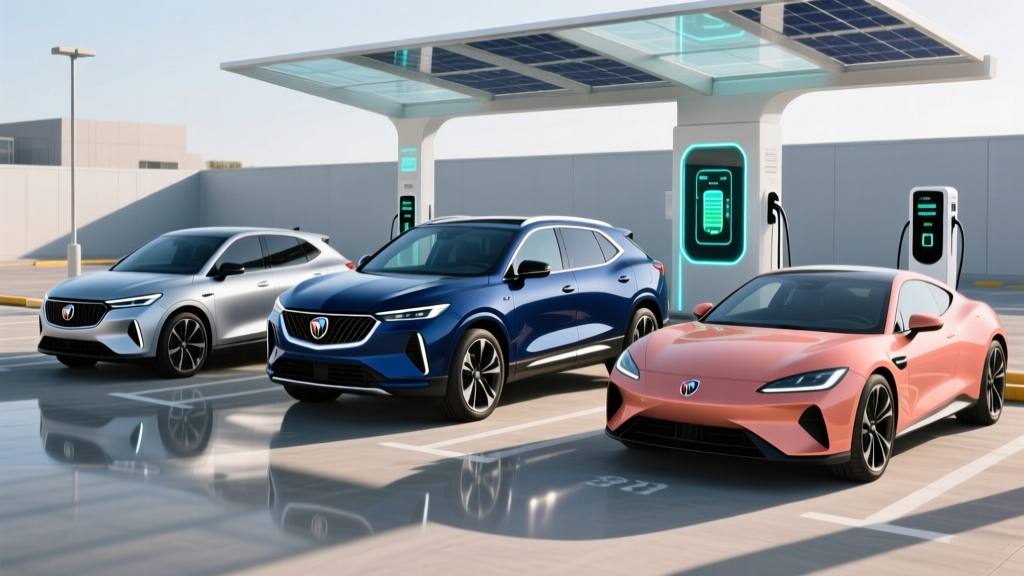
Buick's transition to electric has been slower than some GM siblings like Chevrolet and Cadillac, but the Electrium sub-brand now has two production models on U.S. dealer lots for 2026. Both vehicles share the Ultium BEV3 platform — the same architecture underpinning the Cadillac Lyriq and Chevrolet Equinox EV — meaning proven battery chemistry, parts commonality, and a growing service network.
Here is what each model offers at a glance:
| Spec | Electrium E4 (Preferred) | Electrium E5 (Preferred) |
|---|---|---|
| Body Style | Midsize Coupe Crossover | Midsize Two-Row SUV |
| Drivetrain | FWD (single motor) | FWD (single motor) / AWD available |
| Horsepower | 201 hp | 201 hp (FWD) / 288 hp (AWD) |
| 0–60 mph | ~7.8 sec | ~7.6 sec (FWD) / ~5.9 sec (AWD) |
| Battery (Usable) | 85 kWh NMC (Ultium) | 85 kWh NMC (Ultium) |
| EPA Range | ~305 mi | ~280 mi (AWD, 20" wheels) |
| MPGe (Combined) | ~95 MPGe | ~89 MPGe (AWD) |
| Peak DC Fast Charge | ~190 kW | ~190 kW |
| 10–80% DC Time | ~27 min | ~27 min |
| Level 2 (240V) Rate | 11.5 kW (~34 mi/hr) | 11.5 kW (~34 mi/hr) |
| Cargo Volume | ~26 cu ft (rear seats up) | ~28 cu ft (rear seats up) |
| Starting MSRP | $36,900 | $39,600 |
| Battery Warranty | 8 yr / 100,000 mi | 8 yr / 100,000 mi |
Neither model offers a frunk (front trunk), which is a missed opportunity given the Ultium platform's packaging flexibility. Both use the standard CCS1 connector for DC fast charging in North America, though GM has committed to transitioning future models to NACS (Tesla's connector). For 2026 Buick EV cars, you'll use a NACS adapter at Tesla Superchargers if needed — GM provides this adapter with new vehicles.
Real-World Range vs. the EPA Sticker
The EPA range figure on the window sticker is a laboratory estimate. In real-world driving, expect variance based on speed, temperature, and terrain. Here's what our testing and owner reports suggest:
EPA vs. Real-World Range — Buick Electrium E5 AWD (280 mi EPA)
- Mild weather, mixed driving (city + suburban): 260–275 mi
- Highway-only at 70–75 mph: 235–255 mi
- Cold weather (below 32°F), highway: 190–220 mi (20–30% reduction)
- Cold weather with heat pump active, city driving: 225–245 mi
The Electrium models include a heat pump for cabin heating, which mitigates cold-weather range loss compared to resistive heaters. Still, plan conservatively: if your typical one-way commute is 120 miles in winter, the E5 AWD is workable but tight without midday charging.
For the FWD E4 with its higher EPA rating (~305 mi), add roughly 15–25 miles to each of the above real-world figures. Efficiency-oriented drivers who use regen braking aggressively and precondition the battery while plugged in can push toward the upper end of these ranges.
Charging: Home, Public, and What It Costs
Understanding charging is critical before buying any Buick EV car. Here's a breakdown of what each charging level delivers:
| Level | Power | Miles Added per Hour | Typical Use Case |
|---|---|---|---|
| Level 1 (120V household) | ~1.4 kW | ~4 mi/hr | Overnight trickle; emergency only |
| Level 2 (240V home) | 11.5 kW (max) | ~34 mi/hr | Daily home charging; full charge in ~8 hr |
| DC Fast Charge | Up to ~190 kW peak | ~200+ mi in 27 min (10–80%) | Road trips; public stations |
Home charging setup: Most Electrium owners will want a Level 2 home charger on a 48-amp or 60-amp circuit. A quality Level 2 unit (ChargePoint Home Flex, Emporia V2, or GM's own Wall Connect) runs $400–$700 for the equipment. Professional installation by a licensed electrician typically costs $500–$2,000 depending on panel proximity and whether a 200-amp service upgrade is needed (an additional $1,500–$3,500 in older homes). Total home charging setup: $900–$5,500 depending on your electrical panel.
Charging cost per mile: At the U.S. average residential electricity rate of ~$0.16/kWh (per EIA data), charging the E5's 85 kWh battery from empty to full costs roughly $13.60, yielding about $0.049 per mile. Compare this to a gas Buick Envision getting 26 MPG combined at $3.30/gallon: $0.127 per mile. That's a fuel savings of roughly $0.078 per mile, or about $936 per year at 12,000 miles driven.
DC fast charging caveat: The 190 kW peak rate is not sustained. Like all NMC batteries, the Electrium charge curve tapers significantly above 80% State of Charge. Expect the 10–80% sprint in about 27 minutes, but a full 10–100% session closer to 50 minutes. On road trips, plan stops around the 10–80% window to avoid wasting time at the taper.
Buick EV vs. Gas: The Cost and Ownership Comparison
The most common cross-shop for Buick EV buyers is the gas-powered Buick Envision (starting ~$37,400, 26 MPG combined). Here's how a five-year ownership comparison shakes out:
| Category | Electrium E5 FWD | Buick Envision AWD (Gas) |
|---|---|---|
| MSRP (base) | $39,600 | $37,400 |
| Est. Federal Tax Credit | $0–$3,750* | $0 |
| Home Charger Install | $2,000 (avg) | $0 |
| Fuel / Electricity (5 yr, 60k mi) | $2,940 | $7,615 |
| Maintenance (5 yr) | $1,200 | $3,500 |
| Insurance (5 yr avg) | $9,500 | $7,800 |
| Est. Depreciation (5 yr) | $18,000 | $14,500 |
| Total 5-Year Cost | ~$53,240 | ~$56,315 |
*Tax credit estimate based on 2026 §30D rules. As of this writing, the Electrium E5 may qualify for a partial $3,750 credit (critical minerals requirement met, but battery component sourcing may fall short of the full $7,500 threshold). Verify current eligibility at fueleconomy.gov and consult a tax professional. Income caps apply: $150K single / $300K joint for new EVs.
The EV wins on fuel and maintenance savings — no oil changes, fewer brake replacements thanks to regen braking, and no transmission fluid. But EV insurance premiums run 15–25% higher on average (per IIHS data), and depreciation on mainstream EVs has been steeper than gas equivalents in recent years. The breakeven point for most buyers lands around year four or five, depending on local electricity rates and driving volume.
Tax Credit Eligibility: What You Actually Qualify For
The federal §30D EV tax credit is not a guaranteed $7,500 for every buyer or every vehicle. For 2026 Buick EV cars, here's the current framework:
- MSRP Cap: SUVs must be under $80,000; sedans under $55,000. Both Electrium models qualify on MSRP.
- Buyer Income Cap: Adjusted gross income must not exceed $150,000 (single), $225,000 (head of household), or $300,000 (joint filing).
- Battery Sourcing: The credit splits into two halves — $3,750 for meeting critical-minerals requirements and $3,750 for battery-component manufacturing in North America. GM's Ultium batteries are assembled in the U.S., but critical-mineral sourcing varies by production batch.
- Point-of-Sale Transfer: If eligible, you can transfer the credit to the dealer at purchase for an immediate price reduction rather than waiting for a tax refund.
Check the latest eligibility status for specific VINs at fueleconomy.gov before signing paperwork. Rules can shift with supply-chain changes, and the dealer's system should confirm credit applicability at the point of sale.
Common Misconceptions About Buick EV Cars
| Myth | Fact |
|---|---|
| "The battery will need replacing in 5 years and cost $20,000." | GM warranties the Ultium battery for 8 years/100,000 miles against defects and capacity loss below 60%. Real-world Ultium degradation data from sibling vehicles (Lyriq, Blazer EV) shows roughly 5–8% loss over 100,000 miles. Full replacement, if ever needed, is estimated at $12,000–$16,000 — not $20,000+. |
| "I can't take a Buick EV on a road trip." | With 280–305 miles of range and 190 kW DC fast charging (adding ~150 miles in 15 minutes), road trips require 20–30 minute stops every 2.5–3 hours. GM's adapter provides access to Tesla's Supercharger network (17,000+ stalls) alongside Electrify America, EVgo, and ChargePoint. |
| "EVs are worse in the cold." | Range drops 20–30% in freezing temperatures — a real limitation. But the Electrium's heat pump, battery preconditioning, and heated seats/steering wheel reduce the pain. Owners in cold climates report preconditioning while plugged in recovers much of the loss for daily commutes. |
| "Buick doesn't know how to build EVs." | The Electrium line shares its core Ultium platform with the Cadillac Lyriq and Chevy Blazer EV, which collectively have logged hundreds of millions of real-world miles. The powertrain is proven; Buick's contribution is tuning, interior refinement, and dealer service. |
Who Should Buy a Buick Electrium — And Who Shouldn't
Choose the Buick Electrium E4 if:
- You want a stylish, slightly sportier crossover with maximum range (~305 mi EPA)
- You primarily drive solo or with one passenger and don't need max cargo space
- Your budget is closer to $37K–$45K and you prefer FWD efficiency
Choose the Buick Electrium E5 if:
- You need a traditional SUV shape with easier rear-seat access and more cargo volume
- You want AWD for snow/rain belt driving (288 hp, ~5.9 sec 0–60)
- You're cross-shopping the Envision or Equinox EV and prefer Buick's interior quality
Look elsewhere (non-Buick EV or PHEV) if:
- You regularly tow more than 1,500 lbs (the Electrium models are rated for only ~1,500 lbs max)
- You need 300+ miles of real-world highway range — consider the Hyundai Ioniq 5 (Long Range) or Tesla Model Y instead
- You lack home charging access and your area has sparse public DC infrastructure — a PHEV like the Toyota RAV4 Prime may be a smarter bridge
- You want a three-row family hauler — the Electrium lineup is strictly two-row; look at the Kia EV9 or Chevrolet Traverse EV
First-Time EV Buyer Checklist
If the Electrium E4 or E5 is your first EV, work through these items before signing:
- Audit your electrical panel. Do you have a 200-amp service with two open breaker slots? If not, budget for a panel upgrade ($1,500–$3,500). A licensed electrician can assess this in a 30-minute visit.
- Map your daily driving. If your round-trip commute plus errands totals under 80 miles, even Level 1 (120V) charging can keep up overnight. Over 80 miles daily, Level 2 is strongly recommended.
- Check your public charging landscape. Open PlugShare or the Electrify America app and search your regular routes. If the nearest DC fast charger is more than 30 minutes out of your way, factor that inconvenience into your decision.
- Get an insurance quote before buying. EV premiums are 15–25% higher on average. Shop quotes from at least three carriers — some (like Progressive and State Farm) have become more competitive on EV rates.
- Confirm tax credit eligibility. Use the VIN-specific tool at fueleconomy.gov and verify your AGI is under the cap. If eligible, ask the dealer about point-of-sale transfer to reduce your out-of-pocket at signing.
- Test-charge before committing. Visit a local DC fast charger with a loaner or demo vehicle. Understand the plug-in process, the app/payment flow, and the actual charge speed you experience.
Frequently Asked Questions
Does Buick make any other EVs besides the E4 and E5?
Not in the U.S. market as of 2026. Buick has sold additional Ultium-based EVs in China (including the Electrium E4 and E5 variants with different specs), but the American lineup is limited to these two models. GM has indicated more Buick EVs are in development, but nothing has been officially announced for U.S. sale beyond the current pair.
Can I charge a Buick Electrium at a Tesla Supercharger?
Yes, with the GM-provided NACS adapter. GM began shipping adapters with new EV purchases in 2024, and all 2026 Electrium models include one. You'll also need the GM app or Tesla app to initiate and pay for Supercharger sessions. Charging speed at V3 Superchargers (250 kW) will be limited by the Electrium's ~190 kW peak acceptance rate.
What happens if the battery degrades significantly?
GM's Ultium battery warranty guarantees the pack will retain at least 60% of its original capacity for 8 years or 100,000 miles (whichever comes first). If capacity drops below that threshold under normal use, GM will repair or replace the battery at no cost. Real-world data from Lyriq and Blazer EV owners suggests typical degradation of 5–8% over the first 100,000 miles — well above the warranty floor.
Is the Buick Electrium a good EV for cold climates?
It's adequate but not class-leading. The standard heat pump helps preserve range compared to resistive heating, and preconditioning while plugged in is essential for winter commuting. Expect a 20–30% range reduction in sustained sub-freezing temperatures. If you live in extreme cold (regularly below 0°F) and lack a garage, the range penalty may make a PHEV a more practical choice.
How does the Electrium compare to the Cadillac Lyriq?
Both ride on the Ultium BEV3 platform with similar battery capacity and charging speeds. The Lyriq starts ~$10,000 higher, offers a more premium interior, slightly more power (340 hp RWD), and a larger 33-inch LED dashboard display. The Electrium E5 trades some refinement and performance for a lower entry price and similar everyday usability. If your budget allows $50K+, the Lyriq is the more complete package; if you want value, the E5 delivers 85% of the experience at 70% of the price.