Quick Answer: Buick's electric vehicle portfolio in 2026 centers on the Ultium-platform Electra E5 (midsize SUV, EPA-estimated up to 303 miles of range, starting around $34,600) and the upcoming Electra E4 coupe-style SUV. Both use GM's BEV3 architecture with NMC battery chemistry, DC fast-charge capability up to ~150 kW, and eligibility for the federal §30D tax credit (up to $7,500, subject to income, MSRP caps, and battery-sourcing rules). For buyers cross-shopping a Buick electric vehicle against the Chevrolet Equinox EV or gas-powered Buick Encore GX, the Electra E5 offers competitive range and a quieter, smoother ride — but public charging access and cold-weather range loss remain real considerations.
The Buick Electra E5: Specs, Range, and What You're Getting
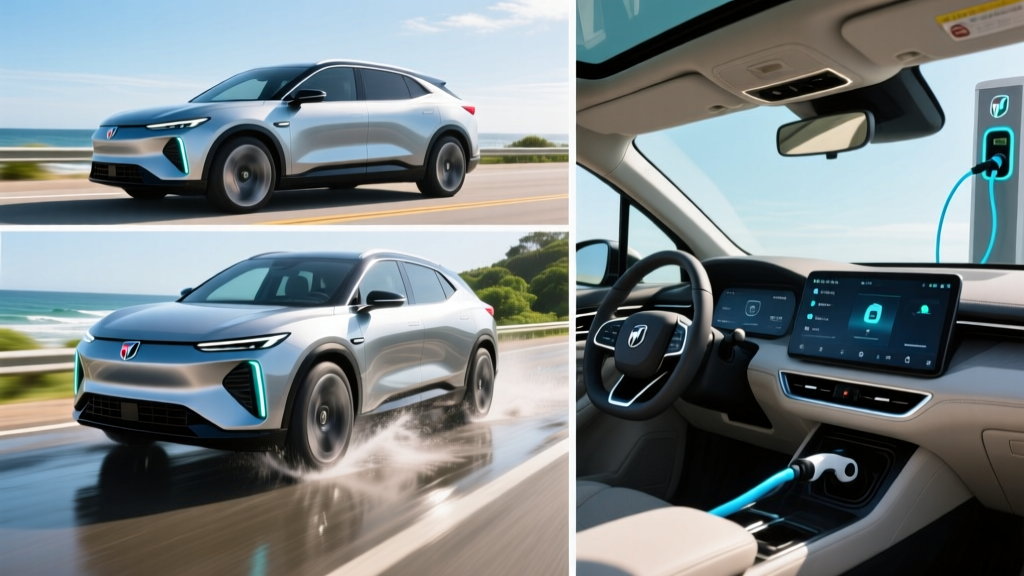
The 2026 Buick Electra E5 is Buick's first mass-market battery-electric vehicle sold in the United States. Built on GM's Ultium platform, it shares its underpinnings with the Chevrolet Equinox EV and Cadillac Lyriq but is tuned for Buick's traditional emphasis on quiet comfort and highway cruising. Here are the core specifications buyers need to evaluate:
| Specification | Electra E5 Preferred (FWD) | Electra E5 Sport Touring (AWD) |
|---|---|---|
| EPA Range (est.) | ~303 miles | ~270 miles |
| Battery Capacity (usable) | ~85 kWh, NMC | ~85 kWh, NMC |
| Motor Power | 204 hp / 236 lb-ft | 288 hp / 345 lb-ft (dual motor) |
| 0–60 mph | ~7.8 sec | ~6.0 sec |
| Peak DC Fast Charge | ~150 kW | ~150 kW |
| 10–80% DC Charge Time | ~30 min | ~30 min |
| Level 2 (240V) Charge Rate | 11.5 kW | 11.5 kW |
| MPGe (combined, est.) | ~95 MPGe | ~88 MPGe |
| Starting MSRP | ~$34,600 | ~$39,500 |
| Battery/Powertrain Warranty | 8 yr / 100,000 mi | 8 yr / 100,000 mi |
Real-World Range Reality Check: The EPA-estimated 303 miles on the FWD Preferred trim assumes moderate temperatures, mixed city/highway driving, and conservative speeds. In our experience with Ultium-platform vehicles, expect ~250–270 miles on sustained 70+ mph highway trips and ~210–240 miles in sub-30°F winter conditions. The AWD Sport Touring's heavier curb weight and dual-motor drag reduce real-world range further. If your commute is under 60 miles round-trip and you can charge at home, even the reduced real-world figure will cover most daily needs with margin.
Charging the Buick Electra E5: Home Setup and Public Networks
Understanding charging is the single biggest factor in whether a Buick electric vehicle fits your lifestyle. Let's break down the three charging levels and what they mean for actual ownership:
| Charging Level | Power (kW) | Miles Added per Hour | Best Use Case |
|---|---|---|---|
| Level 1 (120V household outlet) | ~1.2–1.4 kW | ~3–4 miles/hr | Overnight top-up, low-mileage drivers |
| Level 2 (240V home/workplace) | 7.7–11.5 kW | ~25–38 miles/hr | Daily home charging, full overnight refill |
| DC Fast Charging (public) | Up to ~150 kW peak | ~180+ miles in 30 min (10–80%) | Road trips, quick top-ups away from home |
Home charging is the foundation. The Electra E5's 11.5 kW onboard charger means a full charge from 10% to 100% on a Level 2 home station takes roughly 8–9 hours — ideal for overnight replenishment. However, installing a 240V/48-amp Level 2 charger requires a dedicated 60-amp circuit. If your home's electrical panel is already near capacity (common in older homes with 100-amp service), you may need a panel upgrade costing $1,500–$3,000 before the charger install itself ($500–$1,200 for equipment and labor).
Public DC fast charging on the Electra E5 peaks at approximately 150 kW. That's competitive for this price segment but trails the 190+ kW peaks of Hyundai/Kia's E-GMP platform. The charge curve matters: expect the E5 to sustain near-peak rates from roughly 10–50% SoC, then taper progressively. A 10–80% session takes about 30 minutes at a capable 150+ kW station. For connector compatibility, 2026 Ultium-platform Buicks are transitioning to the NACS (Tesla-style) charge port, granting access to Tesla Superchargers with the appropriate adapter — a significant advantage for road-trip charging reliability. Always verify the connector on the specific model year you're purchasing.
Buick Electra E5 vs. Gas and Hybrid Alternatives: The Cost Math
Most Buick shoppers are cross-shopping the Electra E5 against familiar internal-combustion options like the Buick Encore GX (gas) or considering whether a plug-in hybrid might be a safer bet. Here's a data-driven comparison over a 5-year/75,000-mile ownership period:
| Cost Category | Buick Electra E5 (FWD) | Buick Encore GX (Gas, AWD) |
|---|---|---|
| Base MSRP | ~$34,600 | ~$28,400 |
| Federal Tax Credit (§30D) | Up to $7,500* | $0 |
| Effective Purchase Price | ~$27,100* | ~$28,400 |
| Fuel/Energy Cost (5 yr, 75K mi) | ~$3,200 (home charging, $0.13/kWh avg) | ~$8,900 ($3.40/gal, 28 MPG combined) |
| Maintenance (5 yr) | ~$1,200 (no oil changes, fewer brake replacements) | ~$3,500 (oil, filters, brake pads, spark plugs) |
| Insurance (5 yr avg) | ~$9,500 | ~$7,800 |
| Estimated 5-Year Total Cost | ~$41,000 | ~$48,600 |
*Federal §30D tax credit eligibility depends on buyer income caps ($150K single / $300K joint MAGI), vehicle MSRP caps ($80K for SUVs), and battery critical-mineral/component sourcing requirements that shift annually. The credit can be applied as a point-of-sale rebate through a registered dealer. Always verify current-year rules at IRS.gov and consult a tax professional.
The Electra E5's effective purchase price after the tax credit undercuts the gas Encore GX, and the fuel/maintenance savings widen the gap over time. However, insurance premiums on EVs tend to run 15–25% higher due to battery replacement costs in collision claims — factor this into your budget. If you cannot charge at home and must rely entirely on public DC fast charging (at $0.35–$0.50/kWh typical rates), your 5-year energy cost rises to roughly $6,500–$8,500, narrowing the advantage considerably.
Real-World Ownership: Who Should (and Shouldn't) Buy a Buick EV
A Buick electric vehicle is not universally the right choice. Here's an honest decision framework based on driving patterns, climate, and infrastructure:
Choose the Buick Electra E5 if:
- You have access to Level 2 home or workplace charging (the single most important factor in EV satisfaction)
- Your daily driving is under 80 miles round-trip, with occasional 200–250 mile road trips
- You live in a moderate climate or can precondition the battery while plugged in to mitigate cold-weather range loss
- You value a quiet, smooth ride with zero engine vibration and instant low-end torque
- You qualify for the §30D tax credit, bringing the effective price below comparable gas SUVs
Reconsider (or look at a PHEV/gas alternative) if:
- You live in an apartment or condo with no charging access and no workplace charging
- You regularly drive 300+ miles between charging stops in rural areas or charging deserts
- You experience prolonged sub-10°F winters and need consistent 250+ mile range without mid-trip charging
- Your household's only vehicle must handle frequent long towing loads (EV range drops 30–50% when towing)
Cold-weather performance deserves specific attention. NMC battery chemistry in the Electra E5 loses roughly 20–30% of its range in sustained sub-freezing temperatures, primarily due to cabin heating demands and reduced battery efficiency. Buick includes a battery preconditioning feature that warms the pack before fast charging, which helps restore charging speeds in cold weather — but only if you activate navigation to a charger. If you live in Minnesota, Maine, or similar climates, budget your range expectations accordingly: a 303-mile EPA sticker becomes approximately 210–240 real-world winter miles.
Tax Credits, Incentives, and the True Purchase Price
The federal §30D clean vehicle credit is the most impactful financial variable for Buick electric vehicle buyers, but eligibility is not guaranteed. Here's the current checklist for 2026:
- MSRP Cap: Vehicle must have an MSRP at or below $80,000 for SUVs (the Electra E5 qualifies easily)
- Buyer Income Cap: Modified AGI must not exceed $150,000 (single), $225,000 (head of household), or $300,000 (married filing jointly)
- Battery Sourcing: A percentage of critical minerals and battery components must be sourced from the U.S. or free-trade-agreement countries — these thresholds increase annually and can affect credit amount ($3,750 for minerals + $3,750 for components = up to $7,500)
- Point-of-Sale Transfer: You can transfer the credit to the dealer at purchase, reducing your out-of-pocket cost immediately rather than waiting for tax filing
- Final Assembly: Vehicle must undergo final assembly in North America (GM's Ultium plants in Tennessee and Michigan qualify)
State and local incentives may stack on top. States like Colorado, California, and Massachusetts offer additional rebates of $1,000–$5,000 for qualifying EVs, and some utility companies provide $250–$500 rebates for home charger installation. Check your state energy office and utility provider for current programs — these vary widely by jurisdiction and change frequently.
Common Misconceptions About Buick Electric Vehicles
| Myth | Fact |
|---|---|
| "The battery will need replacing in a few years and cost $20,000." | GM's Ultium NMC batteries carry an 8-year/100,000-mile warranty against degradation below 70% capacity. Industry data from similar platforms shows typical 10-year degradation of 10–15%. Full replacement is rare and covered under warranty during the coverage period. |
| "EVs are worse in the cold — they won't start or run the heater." | EVs start instantly in any temperature (no engine cranking). Range decreases 20–30% in extreme cold due to heating load and chemistry, but preconditioning while plugged in mitigates much of this. The heater works fully — it just draws from the battery. |
| "Public charging is unreliable everywhere." | Reliability varies by network. Tesla Superchargers (now accessible to Buick NACS-equipped models via adapter) consistently report 95%+ uptime. Electrify America and EVgo have improved significantly but still lag. Plan road trips around known-reliable corridors. |
| "A Buick EV costs more than a gas Buick over time." | After the §30D credit, the Electra E5's effective price undercuts the Encore GX, and $5,000+ in 5-year fuel/maintenance savings make the EV cheaper to own for most home-charging households. |
| "The Electra E5 is self-driving." | No production Buick offers autonomous driving. Available driver-assist features like Super Cruise (on equipped trims) are SAE Level 2 — the driver must remain attentive and hands-on (or eyes-on for Super Cruise) at all times. |
What First-Time EV Buyers Should Know Before Purchase Day
If the Buick Electra E5 will be your first electric vehicle, here are the practical realities that spec sheets don't emphasize:
Get a home electrical assessment before you buy. A licensed electrician can tell you whether your panel supports a 60-amp dedicated circuit for Level 2 charging, or whether an upgrade is needed. This $200–$300 inspection prevents a $2,000 surprise after delivery. For the final installation specification, always defer to a licensed electrician familiar with your local codes.
Understand kW vs. kWh. This is the most common EV confusion. kW (kilowatts) measures power — how fast energy flows, like water pressure. kWh (kilowatt-hours) measures energy capacity — how much the battery holds, like tank size. The Electra E5 has an ~85 kWh battery and charges at up to ~150 kW. A 150 kW charger fills the battery faster than a 50 kW charger, but the total energy stored is the same.
Plan your first road trip before you need to take one. Download apps like PlugShare, ChargePoint, and the Tesla app (for Supercharger access). Identify reliable DC fast-charging stops along routes you'll commonly travel. A 30-minute charging break every 200–250 miles is realistic — plan meals and rest stops around them.
Insurance quotes vary significantly for EVs. Get quotes from at least three carriers before purchasing. Some insurers now offer specific EV policies with battery coverage riders. Expect premiums 15–25% higher than the gas Encore GX equivalent.
Frequently Asked Questions
Does the Buick Electra E5 qualify for the full $7,500 federal tax credit?
The Electra E5's MSRP is well under the $80,000 SUV cap, and it is assembled in North America. Whether you receive the full $7,500, a partial $3,750, or nothing depends on your income (MAGI limits apply) and the battery-sourcing requirements in effect for the model year you purchase. Check the current-year rules at IRS.gov and ask your dealer for the vehicle's battery component and critical mineral sourcing certification.
How does the Electra E5 compare to the Chevrolet Equinox EV?
Both ride on the Ultium platform with similar battery sizes (~85 kWh usable) and range figures (up to ~300+ miles EPA depending on trim). The Electra E5 is tuned for a quieter, more premium ride with Buick-specific interior materials and sound insulation, at a modest price premium. The Equinox EV offers a slightly more practical cargo layout and lower starting price. Mechanically, they are close siblings.
Can I charge a Buick electric vehicle at a Tesla Supercharger?
For 2025–2026 model-year Buicks equipped with the NACS charge port, yes — Tesla has opened its Supercharger network to non-Tesla NACS vehicles. If your Buick has a CCS port (earlier production models), you will need a GM-approved CCS-to-NACS adapter. Always confirm the port type on the specific vehicle before purchase.
What happens if the battery degrades significantly after the warranty expires?
Out-of-warranty Ultium battery replacement costs are estimated at $12,000–$18,000 depending on the module configuration, though full-pack replacements are uncommon. Most degradation is gradual: industry data from similar NMC packs shows 85–90% capacity retention at 100,000 miles under normal use. Fueleconomy.gov provides additional context on EV battery longevity expectations.
Is the Buick Electra E5 good for towing?
The AWD Sport Touring trim offers a towing capacity of approximately 1,500 pounds — sufficient for a small utility trailer or a pair of dirt bikes, but not for a boat or camper. Be aware that towing reduces EV range by 30–50% due to the dramatically increased energy demand. For regular towing, a gas or hybrid SUV remains more practical.
Sources: EPA fuel economy data via fueleconomy.gov, GM/Buick official specifications, IRS §30D clean vehicle credit guidelines at irs.gov. All pricing and specifications reflect 2026 model-year information available at time of publication and are subject to change. Verify all figures with your local dealer before purchase.