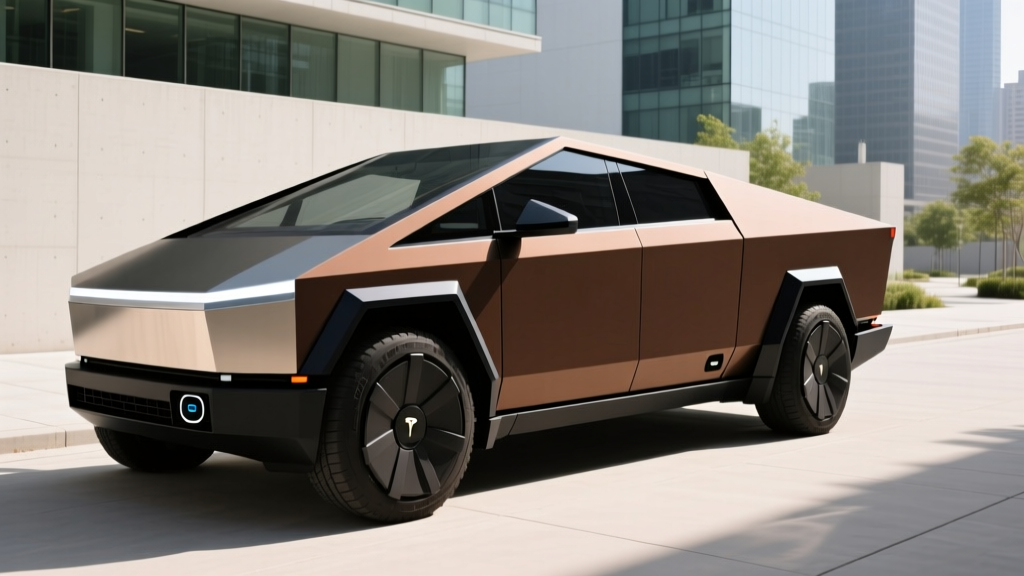
If you've been searching for a brown Cybertruck, you already know Tesla doesn't sell one from the factory. The stainless-steel exoskeleton ships in exactly one flavor: bare, uncoated 30X cold-rolled stainless. That's it. No Midnight Cherry Red, no Quicksilver, no earthy brown. So every brown Cybertruck you've seen on Instagram, at Cars & Coffee, or pulling a trailer through Moab is the result of an aftermarket wrap or ceramic coating — and that choice has real implications for range, warranty, charging behavior, and resale.
This guide is the owner's briefing we wish existed before we quoted our first Cybertruck wrap job: the actual 2026 AWD and Cyberbeast specs, how a brown PPF or vinyl wrap affects thermal load and supercharging, what the IRS §30D credit actually covers (and doesn't), and whether the truck earns its keep against the Rivian R1T, Ford F-150 Lightning, and Chevy Silverado EV.
2026 Tesla Cybertruck: The Numbers That Matter
Before we get to the brown finish, here's the hardware you're wrapping. For 2026, Tesla continues to offer three Cybertruck configurations. Dual Motor AWD remains the volume trim, Cyberbeast is the tri-motor halo, and the long-promised RWD model has finally begun limited deliveries as a fleet/commercial-oriented variant. The figures below reflect the EPA's official listings and Tesla's published spec sheet.
| Spec | AWD (Dual Motor) | Cyberbeast (Tri-Motor) | RWD (Single Motor) |
|---|---|---|---|
| EPA Range | 340 mi (est. w/ range extender) | 320 mi | ~250 mi (announced) |
| Battery (usable) | ~123 kWh, NMC | ~123 kWh, NMC | ~100 kWh, LFP (announced) |
| Peak DC Charge | 250 kW | 250 kW | ~170 kW (announced) |
| 10–80% DC Time | ~28 min | ~28 min | ~35 min |
| Level 2 Rate (11.5 kW) | ~37 mi/hr | ~37 mi/hr | ~30 mi/hr |
| 0–60 mph | 3.9 sec | 2.6 sec | ~6.5 sec |
| Horsepower | 600 hp | 845 hp | ~285 hp |
| Drivetrain | Dual-motor AWD | Tri-motor AWD | Single-motor RWD |
| Max Towing | 11,000 lb | 11,000 lb | ~7,500 lb |
| Base MSRP | $79,990 | $99,990 | $60,990 (announced) |
| Battery Warranty | 8 yr / 120,000 mi | 8 yr / 120,000 mi | 8 yr / 120,000 mi |
How Fast Does the Cybertruck Actually Charge?
Charging speed is where Cybertruck owners feel the most friction, because the 800-volt-class architecture Tesla engineered for peak power still tops out at 250 kW on V3 Superchargers — not the 350+ kW some rivals now hit. On a 250 kW stall, the AWD model peaks around 250 kW in the 10–30% state-of-charge window, then tapers to ~150 kW through the 50% mark and ~70 kW by 80%. That taper is why the 10–80% time is roughly 28 minutes rather than the "12 minutes to 50%" marketing headline.
| Level | Power | Miles Added Per Hour | Typical Use Case |
|---|---|---|---|
| Level 1 (120V / 12A) | 1.4 kW | ~4 mi/hr | Emergency / trickle |
| Level 2 (240V / 48A) | 11.5 kW | ~37 mi/hr | Overnight home charging |
| DC Fast (V3 Supercharger) | Up to 250 kW | Up to ~850 mi/hr (peak) | Road-trip charging |
| DC Fast (CCS w/ adapter) | Up to ~150 kW typical | Variable | EA / third-party networks |
Home charging on a 48-amp Level 2 circuit (60-amp breaker) replenishes about 37 miles of range per hour, meaning a full 10–100% session takes roughly 9–10 hours. If your panel is only 100 amps, expect an electrician to quote a $1,800–$4,000 service upgrade before installing a Wall Connector — a hidden cost most Cybertruck buyers underestimate.
The Brown Cybertruck: Wrap Options, Costs, and Thermal Trade-Offs
Tesla's stainless body isn't paintable in any conventional sense, so "brown Cybertruck" means one of three paths:
- Color-change vinyl wrap (3M 2080, Avery Dennison Supreme): $3,500–$6,000 installed, lasts 4–6 years, available in matte, satin, or gloss brown. Adds negligible weight.
- Paint Protection Film (PPF) with tinted top coat: $6,500–$9,500 installed, lasts 7–10 years, self-healing. Some installers offer a warm bronze PPF that reads as brown in direct sun.
- Ceramic tint coating over bare steel: $1,200–$2,200, doesn't change color dramatically but can warm the steel's tone. Does not hide scratches.
Here's the technical wrinkle most wrap shops won't volunteer: darker wraps, including chocolate and espresso browns, raise surface temperature by 10–15°F in direct sun versus bare stainless. Tesla's thermal management system handles this without issue in normal conditions, but in Arizona or Death Valley summer towing, you may see 1–3% additional range loss from increased cabin and pack cooling load. Lighter browns — think copper, tan, or "safari" bronze — are thermally neutral.
Warranty note: Tesla's body and corrosion warranty is not voided by a wrap, but any adhesive residue or film-related panel damage during removal is your problem, not theirs. Document pre-wrap panel condition with timestamped photos.
Federal Tax Credit: Does the Cybertruck Qualify Under §30D?
This is where the math gets specific. Under the current IRS §30D rules (always verify at irs.gov), the Cybertruck AWD and Cyberbeast face two hard hurdles:
- MSRP cap: Trucks and SUVs are capped at $80,000 MSRP. The AWD at $79,990 squeaks under. The Cyberbeast at $99,990 does not qualify — period.
- Buyer income cap: MAGI ≤ $300,000 (joint), $225,000 (head of household), $150,000 (single).
- Battery sourcing: Critical-mineral and battery-component percentages shift annually. Tesla's U.S. cell production (via Panasonic in Nevada/Kansas) currently satisfies the component threshold, but critical-mineral sourcing varies by build month — your dealer must confirm VIN eligibility at point of sale.
| Trim | Base MSRP | Est. Destination + Options | §30D Credit | Effective Price |
|---|---|---|---|---|
| RWD (announced) | $60,990 | $62,500 | Up to $7,500 | ~$55,000 |
| AWD | $79,990 | $81,500 | Up to $7,500 | ~$74,000 |
| Cyberbeast | $99,990 | $101,500 | $0 (over MSRP cap) | ~$101,500 |
The point-of-sale transfer option lets you hand the credit directly to Tesla at delivery and pay the reduced amount — no waiting until April. But if your VIN's battery sourcing doesn't clear the annual threshold, you owe the credit back. Get the eligibility report in writing before signing.
Efficiency, Cargo, and the Practical Numbers
The AWD Cybertruck posts an EPA-rated 67 MPGe combined, which translates to roughly 48–52 kWh per 100 miles in mixed driving — thirsty by EV standards, but competitive for a 6,800-lb stainless-steel trapezoid. Highway-only efficiency drops to ~58 kWh/100 mi; around town with regen cranked to High, owners report 44–46 kWh/100 mi.
Cargo volume is a mixed story. The 6-foot composite bed offers 67 cu ft with the tonneau closed, expanding to roughly 120 cu ft with the sail pillars opened (a process that requires tools and isn't quick). The frunk adds 7 cu ft — tight for a truck this size, because the steer-by-wire hardware and HVAC stack eat space. Rear legroom is 38.5 inches, adequate for adults but tighter than an F-150 Lightning's back seat.
Towing maxes at 11,000 lb on AWD and Cyberbeast, but real-world range while towing a 7,000-lb trailer drops to 120–150 miles — a hard truth every Cybertruck tower learns on their first mountain pass.
Tech, Driver Assists, and What SAE Level We're Actually Talking About
The Cybertruck runs Tesla's current infotainment stack on an 18.5-inch center display with a secondary 9.4-inch rear screen. The steer-by-wire system (no mechanical column) is standard and takes roughly 200 miles to internalize. Off-road, the adaptive air suspension delivers 17 inches of ground clearance in Extract Mode.
FSD (Supervised) is a $8,000 option or $99/month subscription in 2026. It handles highway interchanges, traffic lights, and neighborhood turns competently in good weather, but disengages without warning in construction zones, faded lane markings, and heavy rain. Budget for it as a convenience, not a capability.
Pros, Cons, and Who the Brown Cybertruck Is Actually For
Pros
- Stainless body resists dents and rock chips — ideal under a brown PPF for trail use
- 11,000-lb towing and 11,000-watt PowerShare (V2L/V2H) for job-site and overlanding use
- AWD qualifies for §30D credit at base MSRP (if sourcing and income clear)
- Steer-by-wire and four-wheel steering give absurdly tight 35-foot turning circle
- Supercharger network remains the most reliable DC fast-charging ecosystem in the U.S.
Cons
- Cyberbeast priced out of §30D eligibility entirely
- Real-world highway range well below EPA, especially towing or in cold
- Bed access limited by fixed sail pillars; no conventional open-bed option
- Insurance premiums run 25–40% higher than comparable F-150 Lightning trims
- Build-quality variance remains higher than legacy truck OEMs
Best fit: The brown-wrapped AWD Cybertruck suits owner-operators, overlanders, and design-forward buyers who want a truck that reads as a statement piece without sacrificing real utility — and who can charge at home. It is not the right choice for high-volume fleet buyers (insurance), for anyone whose daily drive exceeds 250 miles one-way (range taper), or for buyers banking on the §30D credit for the Cyberbeast (it doesn't qualify).
Competitor Check: Is It Worth Buying Over the R1T, Lightning, or Silverado EV?
Against the Rivian R1T Dual-Motor (~$75,000, 352 mi EPA, conventional open bed), the Cybertruck wins on towing and V2L capability but loses on serviceability, bed versatility, and perceived build quality. Against the F-150 Lightning Lariat (~$65,000, 320 mi EPA, Pro Power Onboard), the Lightning is the pragmatic work-truck answer; the Cybertruck is the statement answer. Against the Chevy Silverado EV 4WT, the Chevy offers a larger usable bed via the midgate and stronger fleet-telematics support, but trails on charging speed and driver-assist sophistication.
If the brown wrap is about aesthetics and individuality, no competitor offers an equivalent visual presence. If the purchase is purely utility-driven, the Lightning or R1T is the more rational tool.
Frequently Asked Questions
What is the real-world range of a brown-wrapped Cybertruck AWD?
With the range-extender pack, expect 260–280 miles at highway speeds in moderate temps. The wrap itself adds negligible range loss; driving style, tire choice, and temperature dominate. In winter, 200–220 miles is realistic.
How fast does the Cybertruck charge on DC fast and at home?
Peak 250 kW on a V3 Supercharger, 10–80% in roughly 28 minutes with preconditioning. Home Level 2 at 11.5 kW adds about 37 miles per hour, or a full charge in 9–10 hours.
How much does a Cybertruck cost after the federal tax credit?
The AWD at $79,990 MSRP qualifies for up to $7,500 under §30D if buyer income, battery sourcing, and VIN eligibility align — bringing effective price to roughly $74,000. Cyberbeast does not qualify (over the $80,000 truck MSRP cap).
Does a brown wrap affect the Cybertruck's warranty?
No, as long as the wrap is applied and removed professionally. Tesla's battery and drive-unit warranty (8 years / 120,000 miles) is unaffected. Body-warranty claims for wrap-related adhesive damage will be denied.
Can I tow 11,000 lb and still get real-world range?
You can tow 11,000 lb, but range drops to roughly 100–140 miles depending on trailer profile and terrain. Most Cybertruck owners towing campers report 120–150 miles with a 6,000–7,000-lb load.
Is FSD worth it on the Cybertruck?
At $8,000 or $99/month, FSD (Supervised) is a convenience upgrade, not autonomy. It's worthwhile for frequent highway commuters; skip it if you mostly drive in cities or bad weather, where it disengages frequently.
How much does a professional brown wrap cost on a Cybertruck?
Color-change vinyl runs $3,500–$6,000 installed; tinted PPF runs $6,500–$9,500. The Cybertruck's flat stainless panels are actually easier to wrap than curved painted bodies, which keeps labor costs toward the lower end of those ranges.
Sources: fueleconomy.gov (EPA range and MPGe), irs.gov §30D guidance, Tesla Cybertruck owner's manual and spec sheet. Pricing and credit eligibility reflect 2026 model-year data and are subject to change; confirm VIN eligibility with your tax professional before purchase.