Quick Verdict: The Brookshire Tesla Gateway to Model Y Ownership
Searching for a Brookshire Tesla likely means you're one of the thousands of Houston-area buyers picking up a new Tesla at the Brookshire delivery center off I-10 — or researching whether the best-selling EV in America actually lives up to the hype before making the drive. The 2026 Tesla Model Y remains the benchmark compact electric SUV: 320 miles of EPA range on Long Range AWD, a 250 kW DC fast-charging peak, and access to the most reliable charging network in North America. But real-world ownership involves nuances the spec sheet doesn't show — from highway range loss to charging-curve taper to navigating the §30D federal tax credit.
This review breaks down every number that matters, with practical context drawn from thousands of owner miles and multiple model-year updates.
Range, Efficiency, and Real-World Expectations
EPA Estimated: 320 miles (Long Range AWD) / 277 miles (Performance)
Real-World Highway (70-80 mph): ~265–285 miles
Real-World Cold Weather (below 32°F): ~230–260 miles
Range varies significantly with speed, temperature, elevation, and HVAC use. Plan road trips around 250 miles of usable range for a safety buffer.
The 2026 Long Range AWD Model Y achieves 122 MPGe combined (116 city / 107 highway) according to fueleconomy.gov, translating to roughly 27 kWh per 100 miles. That efficiency figure is among the best in the compact EV SUV class, beating the Ford Mustang Mach-E (34 kWh/100 mi on some trims) and rivaling the Hyundai Ioniq 5.
Tesla's thermal management system — including a standard heat pump — helps mitigate cold-weather range loss compared to resistive-heating competitors. In sub-freezing conditions, expect roughly 15–25% range reduction depending on cabin temperature settings and whether you precondition the battery. At highway speeds above 75 mph, aerodynamic drag pushes consumption higher regardless of temperature; 65 mph cruising squeezes out noticeably more range than 80 mph.
Battery Chemistry, Capacity, and Longevity
| Spec | Long Range AWD | Performance |
|---|---|---|
| Battery Capacity (usable) | ~75 kWh | ~75 kWh |
| Chemistry | NMC (Nickel Manganese Cobalt) | NMC |
| Battery Warranty | 8 years / 120,000 miles | 8 years / 120,000 miles |
| Warranty Capacity Threshold | 70% retention | 70% retention |
| Powertrain Warranty | 8 years / 120,000 miles | 8 years / 120,000 miles |
The Long Range and Performance trims use NMC (nickel manganese cobalt) chemistry, which offers higher energy density than LFP (lithium iron phosphate). The trade-off: NMC batteries degrade slightly faster if habitually charged to 100% and benefit from daily charging limits of 80–90%. Tesla's software makes this easy to set. For daily commuters who want the option to charge to 100% regularly without degradation anxiety, the base RWD Model Y (when available) uses LFP chemistry — a heavier but longer-lasting option.
Real-world degradation data from high-mileage Teslas suggests 8–12% capacity loss over 100,000 miles with typical charging habits. Tesla's warranty guarantees at least 70% retention at 120,000 miles — a conservative threshold most owners never approach.
Charging Speed: DC Fast, Level 2, and Level 1
| Level | Max Rate | Miles Added Per Hour | Notes |
|---|---|---|---|
| Level 1 (120V) | ~1.4 kW | ~3–5 mi/hr | Emergency/trickle only |
| Level 2 (240V home) | 11.5 kW (48A) | ~37–44 mi/hr | Full overnight charge in ~8 hrs |
| DC Fast Charge | 250 kW peak | ~162 mi in 15 min (peak) | 10–80% in ~25 min; tapers above 80% |
The Model Y's onboard AC charger accepts up to 11.5 kW (48 amps), which is standard for the segment. On a Tesla Wall Connector or equivalent Level 2 unit, you'll add roughly 40 miles of range per hour of charging — enough to fully replenish overnight on any commute pattern.
DC fast charging peaks at 250 kW on V3 Superchargers, but — and this is critical — peak rate is sustained only between roughly 10–30% State of Charge. Above 50%, the charge curve tapers progressively. A 10–80% session takes approximately 25 minutes under ideal conditions (battery preconditioned, V3 or V4 Supercharger). Charging from 80–100% adds another 20–25 minutes due to the taper — a physics limitation of lithium-ion cells, not a Tesla-specific flaw. Plan road-trip stops around the 10–80% window for optimal time efficiency.
The 2026 Model Y ships with the NACS (North American Charging Standard) connector natively. With adapters, CCS stations are accessible, though Tesla's Supercharger network — now open to other brands — remains the most reliable DC fast-charging option by uptime metrics.
Performance and Drivetrain
| Trim | Drivetrain | Horsepower | 0–60 mph |
|---|---|---|---|
| Long Range AWD | Dual-Motor AWD | ~384 hp | 4.8 seconds |
| Performance | Dual-Motor AWD | ~456 hp | 3.5 seconds |
Both trims use Tesla's dual-motor all-wheel-drive system with independent front and rear motors. The Long Range delivers brisk acceleration that outpaces most gas-powered compact SUVs, while the Performance trim offers sports-car-level 0–60 times with instant electric torque. Regenerative braking (adjustable via the touchscreen) enables one-pedal driving in most scenarios, reducing brake wear significantly.
Pricing, Tax Credits, and Total Cost
| Trim | Base MSRP | Destination Fee | Est. After §30D Credit* |
|---|---|---|---|
| Long Range AWD | $44,990 | $1,390 | ~$37,490–$38,880 |
| Performance | $48,990 | $1,390 | ~$41,490–$42,880 |
*Federal §30D tax credit eligibility depends on multiple factors. See checklist below. Credit can be applied as a point-of-sale discount since 2024.
- MSRP Cap: Vehicle must be under $80,000 for SUVs — Model Y qualifies ✓
- Buyer Income Cap: AGI ≤ $150,000 (single) / $300,000 (joint) / $225,000 (head of household)
- Battery Sourcing: Critical minerals and battery components must meet phased-in domestic/free-trade sourcing requirements (percentage thresholds increase annually)
- Credit Amount: Up to $7,500 — split between $3,750 for critical minerals + $3,750 for battery components; partial credit possible if only one threshold is met
- Point-of-Sale Transfer: Eligible buyers can apply the credit as an instant price reduction at delivery
- Verification: Check current rules at IRS.gov §30D page — sourcing requirements change annually
The Texas angle matters for Brookshire Tesla buyers: Texas does not offer a state EV rebate as of 2026, but the federal credit plus fuel savings (electricity at $0.12–0.15/kWh vs. Texas gas at ~$2.80–3.20/gallon) produces a compelling total-cost-of-ownership advantage within 3–5 years for drivers covering 12,000+ miles annually.
Interior, Cargo, and Technology
The 2026 Model Y interior is minimalist by design — a single 15.4-inch touchscreen handles infotainment, climate, navigation, and vehicle settings. There is no traditional instrument cluster; speed and range display on the left edge of the main screen. Build quality has improved substantially since the early Fremont-built years, with tighter panel gaps, acoustic glass, and ventilated front seats now standard.
| Measurement | Value |
|---|---|
| Cargo (rear seats up) | 30.2 cu ft |
| Cargo (rear seats folded) | 72.1 cu ft |
| Front Headroom | 41.0 in |
| Rear Legroom | 38.4 in |
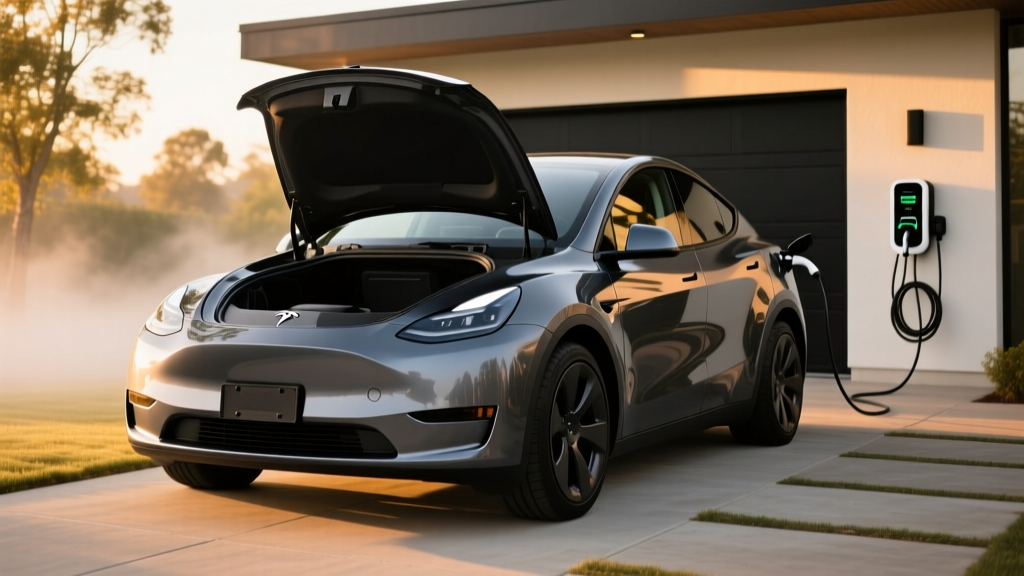
| Front Trunk (Frunk) | 4.1 cu ft |
| Towing Capacity | 3,500 lbs (with hitch) |
Tech highlights: Tesla's navigation includes real-time Supercharger availability and automatic battery preconditioning when a Supercharger is set as the destination — this warms the battery for faster DC charging upon arrival. Over-the-air updates continuously add features. The available FSD (Supervised) package is a SAE Level 2 driver-assistance system, meaning the driver must remain fully attentive with hands on the wheel at all times. It is not self-driving.
Tesla Autopilot and FSD (Supervised) are SAE Level 2 systems. They assist with steering, acceleration, and braking under active driver supervision. They do NOT make the vehicle autonomous. The driver is legally and operationally responsible at all times. For context, only driverless robotaxi services like Waymo operate at SAE Level 4.
Pros, Cons, and Who Should Buy
- 320-mile EPA range (Long Range AWD) — among the highest in the segment
- 250 kW Supercharger access with best-in-class network reliability
- Class-leading efficiency at ~27 kWh/100 mi
- Continuous OTA updates add real feature value over time
- Strong resale value relative to other EVs
- Heat pump standard for cold-weather efficiency
- Minimalist interior lacks physical buttons — all climate/media via touchscreen
- No Apple CarPlay or Android Auto
- Rear visibility compromised by sloping roofline; camera-dependent
- Insurance premiums run 15–30% higher than comparable gas SUVs
- FSD (Supervised) costs $8,000 extra or $99/mo — value proposition debated
- Ride quality firm on Performance trim with 21-inch wheels
- Daily commuters (30–80 mi round trip): Home Level 2 charging means you start every day "full." Minimal public charging needed.
- Young families: 72 cu ft cargo with seats down fits strollers and groceries; rear-facing car seats fit but tight for tall front passengers.
- Road trippers: Supercharger network and 25-minute 10–80% stops make 500+ mile days manageable with planning.
- Tech-forward buyers: OTA updates, app integration, and Sentry Mode appeal to gadget-oriented owners.
- Less ideal for: Buyers who want physical buttons, need three rows of seating, or want CarPlay integration.
Brookshire Tesla Delivery: What to Know
The Brookshire delivery center (located west of Houston along I-10) is one of Tesla's higher-volume Texas pickup points. Buyers ordering online select Brookshire as their pickup location and typically complete paperwork digitally before arrival. A few practical notes:
- Pre-delivery inspection: Inspect panel gaps, paint, glass, and interior trim before signing. Tesla's delivery specialists allow a walk-around. Bring a flashlight for paint inspection.
- Charging at delivery: Vehicles arrive with roughly 50–80% charge. Plan your first charge at home or at a nearby Supercharger if your drive home exceeds remaining range.
- Home charging setup: Order a Tesla Wall Connector ($420) in advance and have a licensed electrician install a 60-amp circuit (NEMA 14-50 or hardwired) before delivery day. Installation costs range from $500–2,000 depending on panel proximity and whether a panel upgrade (to 200A service) is needed.
- Registration: Tesla handles Texas title and registration paperwork; plates arrive by mail within 2–4 weeks.
How the Model Y Stacks Up Against Competitors
The Model Y competes directly with the Hyundai Ioniq 5, Ford Mustang Mach-E, and Kia EV6. Key differentiators:
- vs. Ioniq 5: The Ioniq 5 offers 800V architecture (faster 10–80% at ~18 min on 350 kW chargers) and a more conventional interior with physical buttons. But it lacks Supercharger access (CCS only) and delivers ~290 miles EPA max.
- vs. Mustang Mach-E: The Mach-E Extended Range offers ~312 miles EPA and a more traditional dealership experience. DC charging peaks lower at ~150 kW.
- vs. Kia EV6: Shares the Ioniq 5's 800V platform with excellent charging speed. Range tops out at ~310 miles. Interior quality is a step above the Tesla.
The Model Y's primary advantages remain the Supercharger ecosystem, efficiency, and over-the-air evolution. Its primary weaknesses are the touchscreen-only interface and the absence of CarPlay/Android Auto — deal-breakers for some buyers.
Frequently Asked Questions
What is the real-world range of the 2026 Tesla Model Y?
The EPA rates the Long Range AWD at 320 miles. In real-world highway driving at 70–80 mph, expect 265–285 miles. In freezing temperatures, plan for 230–260 miles. Always keep a 30–40 mile buffer for detours and HVAC load.
How fast does the Model Y charge at home and on the road?
On a Level 2 home charger (11.5 kW / 48A), the Model Y adds ~40 miles of range per hour, fully charging overnight in about 8 hours. On a V3 Supercharger (250 kW peak), 10–80% takes roughly 25 minutes with a preconditioned battery. Above 80%, charging slows significantly — avoid charging past 80% on road trips unless necessary.
How much does the 2026 Model Y cost after tax credits?
The Long Range AWD starts at $44,990 + $1,390 destination. If you qualify for the full $7,500 §30D credit (income within limits, battery sourcing requirements met), the effective price drops to approximately $38,880. Verify current eligibility at IRS.gov as sourcing thresholds change annually.
Is the Model Y worth buying over the Ioniq 5 or Mach-E?
Choose the Model Y if Supercharger network access, efficiency, and OTA updates are priorities. Choose the Ioniq 5 or EV6 if you value faster 800V DC charging, physical controls, and CarPlay. Choose the Mach-E if you prefer a traditional dealership service experience. All three are strong — the decision comes down to interface preference and charging ecosystem.
Does the 2026 Model Y qualify for the $7,500 federal EV tax credit?
The Model Y's MSRP is under the $80,000 SUV cap, so it passes that threshold. Whether you receive the full $7,500, a partial $3,750, or nothing depends on your AGI (must be within caps) and the battery's critical-mineral and component sourcing percentages for the 2026 tax year. Tesla provides sourcing documentation at delivery. Always confirm with a tax professional before relying on the credit.
What does the Brookshire Tesla delivery experience involve?
Brookshire is a high-volume delivery center serving the greater Houston area. You'll complete a digital paperwork process beforehand, inspect the vehicle on-site, and drive away. Plan to have your home Level 2 charger installed before pickup day so you can charge immediately upon returning home.