Why the 2017 Wrangler's Bolt Pattern Still Matters in 2026
If you're searching for the bolt pattern for the 2017 Jeep Wrangler, you likely have a wheel upgrade, spare rotation, or lift-kit project in mind — or you're weighing whether to keep your JK-generation Wrangler or trade into something electrified. Either way, getting the lug specs right is the starting point for any wheel decision.
The 2017 Jeep Wrangler (JK generation) uses a 5x127 bolt pattern (also written as 5x5.0 inches). This means five lug nuts arranged on a 127 mm (5.0-inch) diameter circle. The center bore is 71.5 mm, the lug nut thread size is 1/2"-20 UNF, and the factory wheel torque spec is approximately 100 lb-ft. These dimensions carried through the entire JK run (2007–2017), so wheels from a 2012 JK will fit a 2017 JK without adapters.
Bolt Pattern: 5x127 mm (5x5.0")
Center Bore: 71.5 mm
Thread Size: 1/2"-20 UNF
Torque Spec: ~100 lb-ft
Factory Wheel Sizes: 16" (Sport), 17" (Sahara), 18" (Rubicon Hard Rock)
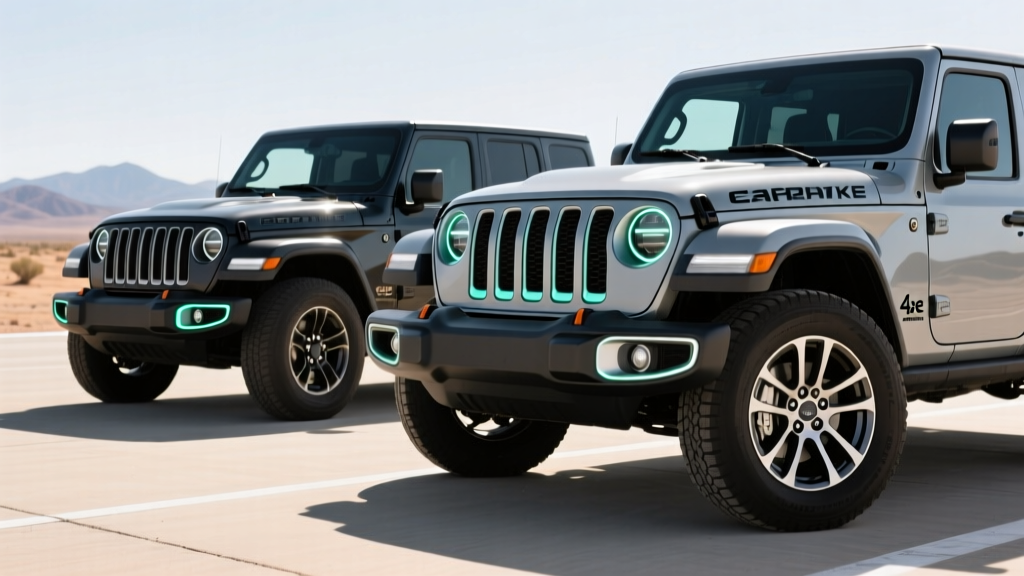
But here's where the conversation shifts. If you're investing in new wheels for a 2017 Wrangler, it's worth asking: does it make more sense to put that money toward a plug-in hybrid upgrade? The 2026 Jeep Wrangler 4xe delivers the same off-road DNA with an electrified powertrain, a different bolt pattern, and potential federal tax savings. Let's break down both paths.
2026 Jeep Wrangler 4xe: Full EV Profile & Specs
The Wrangler 4xe is Jeep's plug-in hybrid (PHEV) flagship — a body-on-frame off-roader with a turbocharged 2.0L inline-four paired with two electric motors and a 17.3 kWh battery pack. It's not a battery-electric vehicle (BEV), but it offers meaningful electric-only driving for daily commutes and a combined system output that outmuscles any gas-only Wrangler.
| Spec | Value |
|---|---|
| Powertrain | 2.0L Turbo I4 + dual electric motors (PHEV) |
| Combined Output | 375 hp / 470 lb-ft torque |
| 0-60 mph | ~6.0 seconds |
| Battery Capacity | 17.3 kWh (NMC lithium-ion) |
| EPA Electric-Only Range | 22 miles |
| EPA Combined (hybrid) | 49 MPGe / 20 MPG gas-only |
| Drivetrain | 4WD (Selec-Trac or Rock-Trac) |
| Max DC Charge Rate | ~7.4 kW (Level 2 AC max; no DC fast-charge) |
| Level 2 Charge Time (0-100%) | ~2.5 hours |
| Towing Capacity | 3,500 lbs |
| Bolt Pattern (2026 JL 4xe) | 5x127 mm (5x5.0") — same as JK |
| Battery Warranty | 8 years / 100,000 miles |
| Base MSRP (Willys 4xe) | $51,790 |
| As-Tested (Rubicon 4xe) | ~$64,500 |
Source: fueleconomy.gov, Stellantis North America.
Real-World Range: What 22 Electric Miles Actually Looks Like
Real-world expectation: Expect 17–20 miles of electric-only driving in mixed city/highway use. In cold weather (below 35°F), that figure drops to roughly 14–16 miles due to cabin heating demands and reduced battery efficiency. Highway-only driving at 70+ mph will yield closer to 15–17 electric miles before the gas engine engages.
Once the battery depletes, the 2.0L turbo takes over and delivers approximately 20 MPG combined as a conventional hybrid — respectable for a 5,000+ lb body-on-frame SUV, but not Prius territory.
The 4xe's electric range is best understood as a commute buffer, not a road-trip solution. If your round-trip commute is under 20 miles and you charge nightly at home, you may go weeks without burning gasoline. For longer drives, the 4xe operates as a standard hybrid with no range anxiety — the 17.2-gallon fuel tank provides 340+ total miles.
Charging Speed: Home Level 2 Is the Only Practical Option
Unlike battery-electric vehicles with DC fast-charging capability, the Wrangler 4xe charges exclusively via AC charging. There is no DC fast-charge port. This is a deliberate engineering choice — the 17.3 kWh battery is small enough that Level 2 charging refills it quickly.
| Level | Power (kW) | 0-100% Time | Practical Use |
|---|---|---|---|
| Level 1 (120V household) | ~1.4 kW | ~12 hours | Overnight trickle; emergency top-up |
| Level 2 (240V, 32A) | ~7.4 kW | ~2.5 hours | Primary home charging; daily use |
| DC Fast Charge | N/A | N/A | Not supported on 4xe |
A 240V Level 2 home charger (such as a ChargePoint Home Flex or Jeep-branded Wall Connector) is the practical daily solution. Installation typically costs $500–$1,500 depending on panel proximity and whether a 240V circuit already exists. A licensed electrician should evaluate your panel capacity — older homes may need a 200A service upgrade ($1,500–$3,000) before adding EV load.
Key distinction for new EV owners: kW (kilowatts) measures charging power — how fast energy flows. kWh (kilowatt-hours) measures battery energy capacity — how much the battery stores. The 4xe's 17.3 kWh battery charging at 7.4 kW takes roughly 2.3 hours from empty (17.3 ÷ 7.4 = 2.34 hrs, plus efficiency losses).
Pricing, Trims & Federal Tax Credit Eligibility
The 2026 Wrangler 4xe lineup spans multiple trims, each adding off-road capability or luxury features:
- Willys 4xe: $51,790 — entry off-road trim with 4WD, 32" tires
- Sahara 4xe: $55,590 — comfort-oriented, leather, larger infotainment
- Rubicon 4xe: $58,790 — Rock-Trac 4:1 transfer case, front/rear lockers, 33" tires
- High Altitude 4xe: ~$63,000 — premium luxury package
The Wrangler 4xe may qualify for a partial or full $3,750–$7,500 federal tax credit, but eligibility depends on several factors that change annually:
- MSRP Cap: SUVs must have an MSRP at or below $80,000 — all 4xe trims qualify.
- Buyer Income Cap: Modified AGI must not exceed $150,000 (single) / $300,000 (joint).
- Battery Sourcing: Critical minerals and battery components must meet escalating North American sourcing thresholds. For 2026, these requirements are stricter than in prior years, and some trims may qualify for only $3,750 (critical minerals half) rather than the full $7,500.
- Point-of-Sale Transfer: Buyers can transfer the credit to the dealer at purchase, reducing the out-of-pocket price directly — no need to wait until tax filing.
Bolt Pattern Comparison: 2017 JK vs. 2026 JL 4xe
Here's the good news for wheel shoppers: the bolt pattern hasn't changed between generations.
| Spec | 2017 Wrangler (JK) | 2026 Wrangler 4xe (JL) |
|---|---|---|
| Bolt Pattern | 5x127 mm (5x5.0") | 5x127 mm (5x5.0") |
| Center Bore | 71.5 mm | 71.5 mm |
| Thread Size | 1/2"-20 UNF | M14x1.5 (changed in JL) |
| Torque Spec | ~100 lb-ft | ~95 lb-ft (130 Nm) |
| Factory Wheel Range | 16"–18" | 17"–20" |
Critical note: While the bolt pattern and center bore are identical, the JL generation switched to M14x1.5 metric lug studs (from the JK's 1/2"-20 SAE). This means JK-era wheels will physically mount on a JL, but you must use JL-spec lug nuts. Never mix lug hardware between generations.
Who Should Buy the Wrangler 4xe — And Who Shouldn't
The Wrangler 4xe occupies a narrow but compelling niche. Here's a practical decision framework:
- Your daily commute is under 20 miles round-trip and you can charge at home
- You need genuine off-road capability (locking differentials, sway-bar disconnect, 10.8" ground clearance on Rubicon)
- You want to reduce fuel consumption without committing to a BEV in an apartment or area with sparse charging infrastructure
- You tow occasionally (3,500 lbs is sufficient for a small boat or utility trailer)
- You value removable doors/roof and the open-air experience no electric SUV currently offers
Look elsewhere if:
- Your commute exceeds 40 miles — the electric range won't cover it, and gas-only MPG drops to ~20
- You want DC fast-charging for road trips — the 4xe doesn't support it
- On-road ride quality and cabin quietness are priorities — the Wrangler's solid-axle architecture is inherently noisy and rough compared to unibody crossovers
- You're seeking maximum EV tax credit — some BEVs with full North American battery sourcing lock in the complete $7,500 more reliably
Pros & Cons at a Glance
- 375 hp / 470 lb-ft — quickest Wrangler ever sold
- 22-mile electric commute eliminates daily gas use
- Same 5x127 bolt pattern as JK — wheel options carry over
- True 4WD with low range (Rubicon Rock-Trac)
- Removable roof and doors — unique in the PHEV segment
- 8-year/100,000-mile battery warranty
- Point-of-sale tax credit reduces drive-off price
- No DC fast-charging — Level 2 only
- 20 MPG gas-only once battery depletes
- Base MSRP exceeds $51,000 before options
- Solid-axle ride quality is rough on pavement
- Cabin noise at highway speed (removable roof panels)
- Electric range drops significantly in cold weather
- Tax credit amount uncertain due to evolving sourcing rules
Frequently Asked Questions
What is the exact bolt pattern for the 2017 Jeep Wrangler?
The 2017 Jeep Wrangler (JK generation) has a 5x127 mm bolt pattern, also expressed as 5x5.0 inches. This means five lug holes on a 127 mm diameter circle. The center bore is 71.5 mm, and lug nuts are 1/2"-20 UNF thread.
Will 2017 JK Wrangler wheels fit a 2026 JL Wrangler 4xe?
Yes — the bolt pattern (5x127) and center bore (71.5 mm) are identical between JK and JL generations. However, the JL uses M14x1.5 metric lug studs instead of the JK's 1/2"-20 SAE studs, so you must use JL-compatible lug nuts. Always verify offset and clearance with larger brake calipers on the 4xe.
How much does the 2026 Wrangler 4xe cost after tax credits?
The base Willys 4xe starts at $51,790. If you qualify for the full $7,500 federal credit (subject to income, MSRP, and battery sourcing rules per IRS §30D), the effective price drops to approximately $44,290. However, 2026 sourcing requirements may limit some buyers to $3,750, making the effective price ~$48,040. State incentives may stack on top — check your local DMV or energy office.
What is the real-world electric range of the Wrangler 4xe?
The EPA rates the 4xe at 22 miles electric-only. In real-world mixed driving, expect 17–20 miles. Cold weather (below 35°F) reduces this to 14–16 miles. Sustained highway speeds above 70 mph will deplete the battery in roughly 15–17 miles. Once depleted, the gas engine delivers ~20 MPG combined.
Does the Wrangler 4xe support DC fast charging?
No. The Wrangler 4xe charges only via AC — Level 1 (120V) at ~1.4 kW or Level 2 (240V) at up to 7.4 kW. A full Level 2 charge takes approximately 2.5 hours. There is no DC fast-charge port. For PHEV owners who charge at home nightly, this is rarely a limitation.
Is the Wrangler 4xe worth buying over a used 2017 JK Wrangler?
It depends on budget and use case. A well-maintained 2017 JK Rubicon trades in the $22,000–$30,000 range — roughly half the 4xe's starting price. If you drive under 20 miles daily, can charge at home, and want modern safety tech (adaptive cruise, forward collision warning), the 4xe pays fuel dividends over time. If you primarily wheel off-road on weekends and garage the rig during the week, a used JK at half the price may be the smarter financial play.
Safety data: The 2026 Wrangler 4xe has not been fully crash-tested by IIHS as of publication. NHTSA rated the prior-year JL Wrangler 4 stars overall. The removable roof and door design inherently limits side-impact and rollover crash performance compared to fixed-roof SUVs.