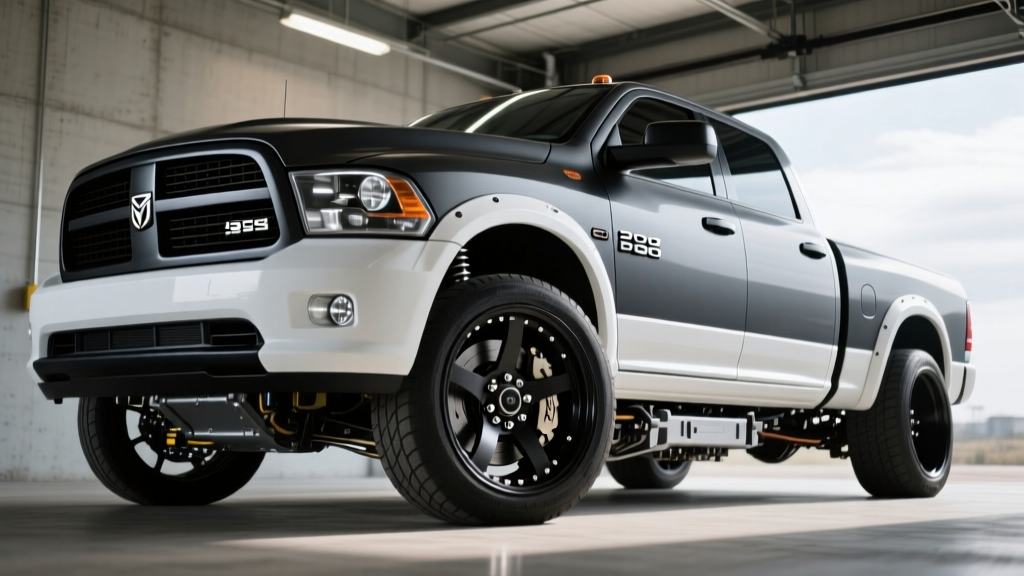
If you're researching the bolt pattern for a 2014 Dodge Ram 1500, you're likely planning a wheel upgrade, a brake conversion, or — increasingly — an electric-drivetrain swap into one of the most popular full-size truck platforms in North America. The 2014 Ram 1500 sits in the fourth generation (DS body, 2009–2018), and its wheel mounting specs are well-documented but easy to confuse with other Dodge/Chrysler platforms.
Below is the exact bolt pattern, lug specification, center bore diameter, and torque sequence — followed by practical guidance for anyone adapting these hubs for EV conversions or aftermarket wheel fitment.
2014 Dodge Ram 1500 Bolt Pattern: The Exact Numbers
The 2014 Dodge Ram 1500 uses a 5-lug, 139.7 mm (5.5-inch) bolt circle. This is commonly written as:
- 5×139.7 mm (metric)
- 5×5.5 in (imperial)
Both notations describe the same pattern: five lug holes arranged on a circle with a 139.7 mm (5.5 in) diameter measured center-to-center across opposing studs.
| Specification | Value |
|---|---|
| Bolt Pattern (PCD) | 5×139.7 mm (5×5.5 in) |
| Number of Lugs | 5 |
| Lug Thread Size | M14 × 1.5 |
| Center Bore | 77.8 mm |
| Lug Nut Torque (factory spec) | 130 lb-ft (176 Nm) |
| Lug Seat Type | Conical (60° taper) |
| Typical Offset Range (factory wheels) | +18 mm to +25 mm |
| Factory Wheel Sizes | 17", 18", 20" (depending on trim) |
Why This Bolt Pattern Matters for EV Conversions
The fourth-generation Ram 1500 has become a popular donor chassis for electric truck conversions. Its body-on-frame architecture, generous engine bay, and robust rear axle make it a practical platform for retrofitting battery-electric drivetrains — whether using a salvaged Tesla drive unit, a NetGain Hyper9 motor, or a Cascadia Motion stack.
When converting to electric drive, wheel fitment takes on added importance for three reasons:
- Weight distribution shifts. Battery packs mounted low in the frame can push curb weight well above the factory 5,000–5,800 lb range. Wheels and hubs must handle the increased static and dynamic load.
- Regenerative braking forces differ. High-torque regen (often 150–300 kW of deceleration energy recovery) places different cyclic loads on lug studs compared to friction-only braking.
- Hub-centric fitment is critical. The 77.8 mm center bore ensures the wheel is centered on the hub, not just by the lug studs. Using wheels with a larger bore without hub-centric rings introduces vibration that accelerates bearing wear — especially problematic when the drivetrain has been swapped and bearing loads are already non-standard.
Compatible Wheels and Cross-Reference Fitment
The 5×139.7 mm bolt pattern is shared across several Dodge/Chrysler vehicles and some older Ford and Toyota trucks. Here's a practical cross-reference:
| Vehicle | Years | Center Bore Match? |
|---|---|---|
| Dodge Ram 1500 (3rd & 4th gen) | 2002–2018 | Yes (77.8 mm) |
| Dodge Ram 2500/3500 (light-duty variants) | Select years | Varies — verify |
| Dodge Durango | 2004–2009 | Yes (77.8 mm) |
| Dodge Dakota | 2005–2011 | Yes (77.8 mm) |
| Ford F-150 (older platform) | Pre-2004 (some) | No (different bore) |
| Jeep Grand Cherokee (WK/WJ) | 1999–2010 | Yes (77.8 mm) |
Key rule: Even if the bolt pattern matches, the center bore must be 77.8 mm or larger. If the aftermarket wheel has a larger bore (common with universal-fit wheels), you must use hub-centric rings sized to 77.8 mm outer / wheel bore inner. Never rely on lug-centric mounting for a vehicle this heavy.
Measuring and Verifying the Bolt Pattern Yourself
If you're working with a stripped hub or an aftermarket axle adapter plate for an EV swap, here's how to verify the 5×139.7 mm pattern:
- Count the lugs. Five studs confirms a 5-lug pattern.
- Measure center-to-center. For a 5-lug pattern, measure from the center of one stud to the farthest point on the opposite stud (not center-to-center of adjacent studs). For 5×139.7, this measurement should read approximately 139.7 mm or 5.5 inches.
- Use a bolt-pattern gauge. A dedicated PCD gauge (available for under $15) eliminates measurement error. Digital calipers work but require care on a 5-lug circle.
- Check the center bore. Measure the hub pilot diameter with calipers — it should read 77.8 mm on a stock 2014 Ram 1500 hub.
Lug Nut Torque Sequence and Best Practices
Proper torque matters more on a heavy truck — and even more on an EV-converted truck where unsprung mass and regen forces change the load profile on each stud.
Factory torque specification: 130 lb-ft (176 Nm) for the M14×1.5 lug nuts.
Star-pattern sequence for 5-lug wheels:
- Start at the top stud (12 o'clock).
- Move to the bottom-left stud (roughly 7 o'clock).
- Move to the top-right stud (roughly 2 o'clock).
- Move to the bottom-right stud (roughly 5 o'clock).
- Finish at the top-left stud (roughly 10 o'clock).
Tighten in three progressive passes: first to ~40 lb-ft, then ~90 lb-ft, then the final 130 lb-ft. After the first 50 miles of driving on new or reinstalled wheels, re-torque all five lug nuts — studs can settle, especially on aluminum wheels.
Offset, Backspacing, and Brake Clearance for EV Builds
The factory 2014 Ram 1500 wheels typically carry an offset between +18 mm and +25 mm. When selecting aftermarket wheels — or wheels for an EV-converted Ram — consider:
- Brake clearance. If you've upgraded to larger rotors (common when adding the weight of a battery pack), you need wheels with enough inner spoke clearance. A 17" wheel may not clear a 14" rotor upgrade.
- Offset and scrub radius. Moving the wheel centerline outward (lower offset) increases scrub radius, which amplifies steering kickback — more noticeable with the instant torque of an electric drivetrain.
- Backspacing. For a 17×8" wheel with +20 mm offset, backspacing is approximately 5.3". Verify this against your caliper and suspension geometry before ordering.
- Load rating. The 2014 Ram 1500's gross axle weight rating (GAWR) can exceed 3,900 lb on the rear. Every wheel must carry a load rating that meets or exceeds half the GAWR per wheel. EV conversions that add 500–1,000 lb of battery mass demand wheels rated for the new, higher curb weight.
Frequently Asked Questions
Is the 2014 Ram 1500 bolt pattern the same as the 2014 Ram 2500?
No. The 2014 Ram 2500 and 3500 use an 8-lug pattern (8×165.1 mm / 8×6.5 in). Only the 1500 uses the 5×139.7 mm pattern. Never assume cross-compatibility between Ram weight classes.
Can I use Ford F-150 wheels on a 2014 Dodge Ram 1500?
Most modern F-150 wheels use a 6×135 mm bolt pattern, which is completely different from the Ram's 5×139.7 mm. Some older (pre-2004) F-150s used a 5-lug pattern, but the bolt circle and center bore differ. Direct fitment is not possible without adapters — and adapters on a full-size truck introduce safety and liability concerns, especially under the increased weight of an EV conversion.
What is the center bore of the 2014 Ram 1500?
77.8 mm. This is the hub pilot diameter. Any aftermarket wheel must either match this bore exactly or use hub-centric rings to fill the gap between the wheel's larger bore and the 77.8 mm hub.
Do I need to re-torque lug nuts after installing new wheels?
Yes. Re-torque all five lug nuts to 130 lb-ft after the first 50 miles of driving, then inspect every 5,000 miles or at each tire rotation. This is especially important on EV-converted trucks where drivetrain torque delivery and regen braking change the cyclic loading on each stud.
What size lug nuts does the 2014 Ram 1500 use?
M14 × 1.5 thread pitch with a 60° conical (tapered) seat. Use only conical-seat lug nuts — flat-seat or mag-seat nuts will not mate properly and can loosen under load.
Can I fit 35-inch tires on stock 2014 Ram 1500 wheels?
The stock 17" and 18" wheels can accommodate wider tires, but 35-inch tires typically require a lift kit and wheels with appropriate offset to prevent rubbing on the upper control arm and fender liner. Verify that the wheel's load rating supports the added unsprung mass, particularly if the truck has been converted to electric drive with additional battery weight.
Sources: Ram Trucks Owner's Manual (Stellantis), Tire Rack Wheel Fitment Guide.