2007 Honda Civic Bolt Pattern: The Exact Fitment Numbers
If you're replacing wheels, upgrading to lighter alloys, or exploring an EV conversion on an eighth-generation Civic, you need one number above all others: the bolt pattern. For the 2007 Honda Civic, the answer depends on which body style you have — and getting it wrong means wheels that simply won't mount.
Here's the quick answer, followed by the full fitment data every Civic owner should know.
2007 Honda Civic Si Coupe: 5×114.3 mm
2007 Honda Civic Hybrid: 5×114.3 mm
Thread Size: M12 × 1.5
Center Bore: 64.1 mm
Typical Offset Range: +35 to +45 mm (stock)
Every trim of the 2007 Civic — DX, LX, EX, EX-L, Si, and Hybrid — shares the same 5-lug, 114.3 mm bolt circle. This is a significant change from the 2005 and earlier Civic generations, which used a 4×100 mm pattern. Honda moved to the wider 5-lug layout for the 2006 redesign to improve handling stability and accommodate larger brake components.
Why the 5×114.3 Bolt Pattern Matters for Wheel Upgrades
The 5×114.3 mm (5×4.5") bolt pattern is one of the most common in the automotive world. It's shared across dozens of vehicles from Honda, Toyota, Nissan, Mazda, Ford, and Hyundai. That means the aftermarket wheel selection for a 2007 Civic is enormous — from lightweight Enkei RPF1s for track days to fuel-efficient low-rolling-resistance wheels for daily commuting.
However, bolt pattern is only the starting point. A wheel that bolts on isn't necessarily a wheel that fits correctly. Three additional dimensions determine whether a wheel will clear your brake calipers, sit flush in the fender, and maintain proper suspension geometry:
| Specification | Value | Notes |
|---|---|---|
| Bolt Pattern (PCD) | 5×114.3 mm | All trims: DX, LX, EX, Si, Hybrid |
| Center Bore | 64.1 mm | Hub-centric; use 64.1 mm rings if aftermarket wheel bore is larger |
| Thread Pitch | M12 × 1.5 | Lug nuts, not lug bolts |
| Stock Wheel Sizes | 15"–17" | DX/LX: 15"; EX: 16"; Si: 17" |
| Stock Offset (ET) | +35 to +45 mm | Varies by trim and wheel width |
| Stock Wheel Width | 6.0"–7.0" | Si models use wider 7.0" wheels |
| Lug Nut Torque | 80 lb-ft (108 Nm) | Per Honda service manual — always use a torque wrench |
Source: Honda Owner's Manual and aftermarket fitment databases.
Offset, Center Bore, and the Fitment Mistakes That Cost Money
The most common wheel-buying mistake among Civic owners is matching the bolt pattern but ignoring offset and center bore. Here's why each matters:
Offset (ET) — Where the Wheel Sits
Offset is the distance in millimeters from the wheel's mounting surface to its centerline. The 2007 Civic's stock offset ranges from +35 mm to +45 mm depending on wheel width. Go too low (e.g., +20 mm) and the wheel pushes outward, potentially rubbing the fender. Go too high (e.g., +55 mm) and the wheel tucks inward, risking contact with the strut or brake caliper.
For most 2007 Civic owners running aftermarket 17×7.5" wheels, an offset between +38 mm and +42 mm provides a flush, rub-free fit on stock suspension.
Center Bore — Hub-Centric vs. Lug-Centric
The Civic's hub diameter is 64.1 mm. OEM wheels are hub-centric — the center bore matches the hub exactly, so the hub carries the vehicle's weight. Many aftermarket wheels have a larger universal bore (e.g., 73.1 mm). Without hub-centric rings (typically $10–$20 per set) to fill that gap, the lug nuts alone bear the load, which can cause steering wheel vibration at highway speeds and accelerated stud wear.
Wheel Size Limits on Stock Suspension
On a stock 2007 Civic with no suspension modifications:
- 15"–17" wheels: Direct bolt-on with correct offset. This is the safe, proven range.
- 18" wheels: Possible with +35 to +42 offset and a 225/40R18 tire. Expect a firmer ride and increased risk of pothole damage to low-profile sidewalls.
- 19"+ wheels: Requires careful offset selection, possible fender rolling, and almost guarantees ride-quality degradation. Not recommended for daily driving.
2007 Civic Hybrid: Wheel Fitment and Efficiency Considerations
The 2007 Honda Civic Hybrid uses the same 5×114.3 bolt pattern and 64.1 mm center bore as its gasoline siblings, but there's an efficiency argument for being selective about replacement wheels.
The Civic Hybrid's EPA rating was 49 mpg city / 51 mpg highway (revised EPA methodology) on its original 15-inch low-rolling-resistance tires. Moving to heavier aftermarket alloy wheels increases unsprung mass, which directly impacts both fuel economy and regenerative braking efficiency. Testing by fueleconomy.gov and independent reviewers has shown that switching from lightweight 15" wheels to heavier 17" alloys can reduce real-world fuel economy by 1–3 mpg in mixed driving.
For Civic Hybrid owners prioritizing efficiency, stick with 15" or 16" wheels in lightweight forged or flow-formed constructions, paired with low-rolling-resistance tires such as the Michelin Energy Saver A/S or Continental EcoContact.
The 2007 Civic and EV Conversions: What Wheel Fitment Has to Do With It
The eighth-generation Civic (2006–2011) has become a popular platform for DIY electric vehicle conversions. Its relatively light curb weight (2,600–2,800 lbs depending on trim), compact dimensions, and plentiful aftermarket support make it a candidate for battery-electric swaps using salvaged drivetrains from Nissan Leafs, Tesla drive units, or purpose-built conversion kits.
When converting a 2007 Civic to electric, wheel and tire selection takes on added importance for two reasons:
1. Rolling Resistance Directly Impacts EV Range
In an EV conversion, every watt-hour counts. A tire with high rolling resistance can reduce range by 10–15% compared to a low-rolling-resistance alternative. Since most DIY conversions achieve 60–100 miles of range on a 20–30 kWh battery pack, that difference is meaningful. The 5×114.3 bolt pattern gives converters access to wheels designed for modern EVs like the Nissan Leaf and Hyundai Ioniq, which are optimized for low aerodynamic drag and low mass.
2. Increased Vehicle Weight Demands Proper Load Ratings
A typical EV conversion adds 300–600 lbs of battery mass compared to the original gasoline powertrain. This pushes the converted Civic's curb weight toward 3,100–3,400 lbs. Stock 15" Civic wheels are load-rated for the original weight; converters should verify that replacement wheels carry an adequate load rating (at minimum 1,100 lbs per wheel, or 4,400 lbs total) to handle the added battery weight safely.
Compatible Wheels: What Else Fits the 5×114.3 Pattern
Because 5×114.3 is one of the most widely adopted bolt patterns globally, 2007 Civic owners have access to OEM and aftermarket wheels from a broad range of vehicles. Here's a compatibility overview:
| Brand | Example Models | Center Bore Note |
|---|---|---|
| Honda | Accord (2003+), CR-V, Civic (2006+), Insight | 64.1 mm — direct fit |
| Acura | TL, TSX, ILX, RDX | 64.1 mm — direct fit |
| Toyota | Camry (2007+), RAV4, Prius (2010+) | 60.1 mm — requires 60.1→64.1 ring (NOT compatible without modification) |
| Nissan | Altima, Maxima, Leaf (2011–2017) | 66.1 mm — requires 66.1→64.1 ring |
| Mazda | Mazda3 (2014+), Mazda6, CX-5 | 67.1 mm — requires 67.1→64.1 ring |
| Hyundai/Kia | Sonata, Tucson, Forte, EV6 | 67.1 mm — requires ring |
Key rule: A wheel with a larger center bore than 64.1 mm can be adapted with hub-centric rings. A wheel with a smaller center bore (e.g., Toyota's 60.1 mm) will not physically fit over the Civic's hub without machining, which is generally not recommended.
How to Measure and Verify Your Civic's Bolt Pattern
If you want to confirm the bolt pattern on your specific 2007 Civic — particularly if the car has been modified or you're inspecting a used set of wheels — here's the process:
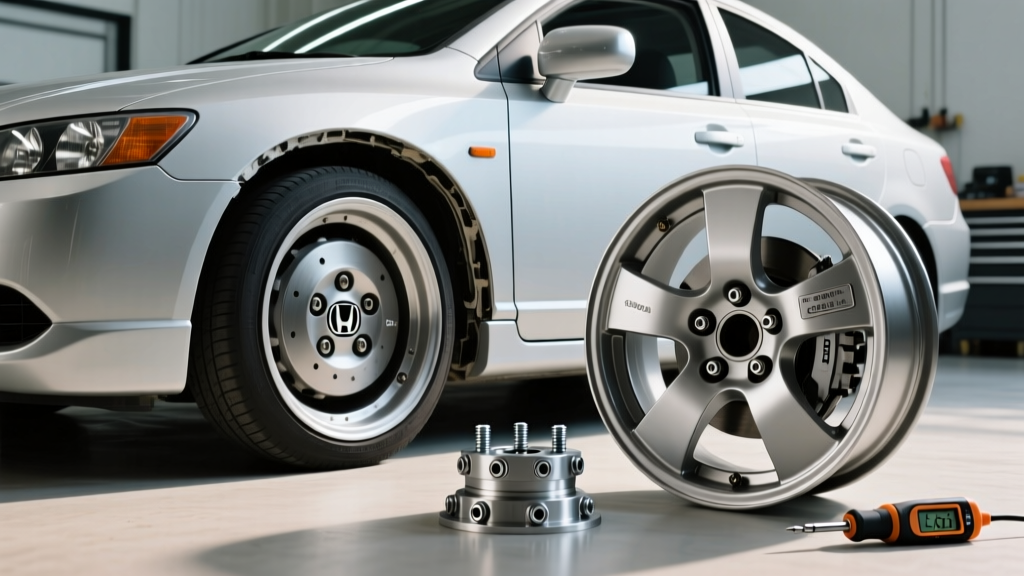
- Count the lugs. A 2007 Civic has 5 lug nuts per wheel.
- Measure the bolt circle. For a 5-lug pattern, measure from the center of one lug stud to the far edge of the lug stud directly across from it (skipping one stud). This should measure 114.3 mm (4.5 inches).
- Use a bolt pattern gauge. Available for under $15 at most auto parts stores, this tool eliminates measurement error.
- Check the center bore. Measure the hub diameter with calipers — it should read 64.1 mm.
Alternatively, pull the sticker inside the driver's door jamb. It lists the OEM tire and wheel size, which you can cross-reference against Honda's fitment specifications.
Frequently Asked Questions
Is the 2007 Honda Civic bolt pattern 4-lug or 5-lug?
All 2007 Honda Civic trims use a 5-lug pattern (5×114.3 mm). The 4-lug (4×100 mm) pattern was used on Civic models through the 2005 model year. If you're shopping for wheels and see "4×100" listed, those will not fit a 2007 Civic.
Can I put 5×112 wheels on my 2007 Civic?
No. While 5×112 (common on Audi, VW, and Mercedes-Benz) looks similar, the 3.3 mm difference in bolt circle diameter means the lug nuts will not align properly. Wobble bolts exist as a workaround, but they are not recommended for daily driving due to the risk of improper clamping force.
What is the lug nut torque spec for a 2007 Civic?
Honda specifies 80 lb-ft (108 Nm) for all 2007 Civic models. Always torque lug nuts in a star pattern and re-check after the first 50 miles of driving on newly installed wheels.
Will Tesla Model 3 wheels fit a 2007 Civic?
No. The Tesla Model 3 uses a 5×114.3 bolt pattern (which matches), but its center bore is 64.1 mm only on certain aftermarket options — OEM Tesla wheels have a 64.1 mm bore but use a different offset and are designed for a significantly heavier vehicle. Fitment is technically possible with the right offset selection, but load rating and offset compatibility should be verified before attempting this swap.
Does wheel weight affect my Civic Hybrid's fuel economy?
Yes. Heavier wheels increase rotational mass and unsprung weight, which reduces fuel economy and accelerates brake wear. For maximum efficiency, choose lightweight wheels (under 18 lbs per wheel for 15" sizes) and pair them with low-rolling-resistance tires.
I'm doing an EV swap on my 2007 Civic — do I need different wheels?
Possibly. If your conversion adds 400+ lbs of battery weight, verify that your stock wheels' load ratings are sufficient. Many converters opt for wheels from the Nissan Leaf or Hyundai Ioniq (both 5×114.3) because they're engineered for EV weight profiles and optimized for low rolling resistance.
For official fitment data, consult your Honda owner's manual or a trusted wheel fitment guide such as those published by Tire Rack. For EV conversion safety standards, reference resources from the National Highway Traffic Safety Administration.