Quick Answer: Is a Bollinger EV Right for You?
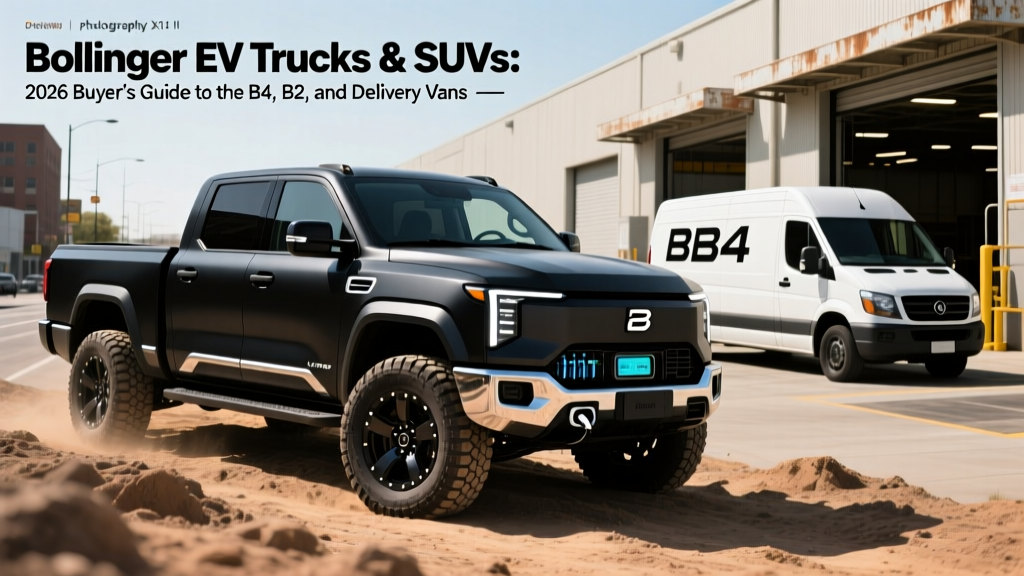
Bollinger Motors is a niche American EV maker focused on commercial delivery vans and rugged, utilitarian electric trucks and SUVs. As of early 2026, the company's primary production vehicle is the B4 Delivery Van (Class 3/4 electric commercial van), while the B2 electric truck and B4 SUV remain in pre-production with limited availability. Bollinger EVs prioritize payload, durability, and fleet utility over luxury or mass-market appeal. Expect base pricing in the $70,000–$125,000+ range depending on configuration, with EPA-estimated ranges in the 150–200 mile ballpark for commercial variants. If you're a fleet operator or commercial buyer seeking a purpose-built electric work vehicle, Bollinger deserves a look. If you're a consumer shopping for a daily-driver EV SUV or truck, established options like the Rivian R1T, Ford F-150 Lightning, or Tesla Model Y will serve you better today.
What Is Bollinger Motors and What EVs Do They Make?
Bollinger Motors, founded in 2014 and headquartered in Oak Park, Michigan, has carved out a specific niche in the EV landscape: commercial-grade electric vehicles built on a proprietary, modular chassis platform. Unlike Tesla, Ford, or Hyundai, Bollinger isn't chasing mass-market consumer sales. Their engineering philosophy centers on a skateboard-style chassis with hub motors, a flat load floor, and passthrough storage — features aimed squarely at fleet operators, last-mile delivery companies, and commercial upfitters.
Here's where Bollinger's lineup stands as of 2026:
| Model | Segment | Status (2026) | Target Buyer |
|---|---|---|---|
| B4 Delivery Van | Class 3/4 Commercial Van | Production / Limited Deliveries | Fleet operators, last-mile delivery |
| B2 Electric Truck | Class 3 Electric Pickup | Pre-Production / Reserved | Commercial fleets, utility buyers |
| B4 SUV (Consumer) | Full-Size Electric SUV | Announced / Not Yet in Production | Enthusiast / Off-Road Consumer |
Bollinger's approach differs fundamentally from mainstream EV makers. Their vehicles are designed to be upfitter-friendly — the chassis can be configured as a box van, flatbed, cab-chassis, or SUV body. This modularity is compelling for commercial applications but means consumer buyers face long wait times and limited service infrastructure.
Bollinger EV Specs: Range, Battery, Charging, and Performance
Because Bollinger's production vehicles are primarily commercial, specs vary significantly by configuration, wheelbase, and payload setup. Below are the best available figures based on Bollinger's published specifications and pre-production disclosures. Treat these as preliminary estimates for unreleased consumer models.
| Specification | B4 Delivery Van (Est.) | B2 Truck (Preliminary) | B4 SUV (Announced) |
|---|---|---|---|
| Battery Capacity | ~135–175 kWh (NMC) | ~135 kWh (NMC) | ~135 kWh (NMC) |
| EPA Range (Est.) | 150–200 mi | ~200 mi | ~200 mi |
| Peak DC Fast Charge | ~130 kW | ~130 kW | ~130 kW |
| 10–80% Charge Time | ~50–70 min | ~50–65 min | ~50–65 min |
| Level 2 Charging | ~11.5 kW (J1772) | ~11.5 kW | ~11.5 kW |
| Horsepower | ~500+ hp (dual motor) | ~520 hp | ~520 hp |
| 0–60 mph | N/A (commercial) | ~6.5 sec (est.) | ~6.5 sec (est.) |
| Payload Capacity | Up to ~5,000 lbs | ~5,000 lbs | TBD |
| Towing Capacity | Up to ~10,000 lbs | ~7,500 lbs | ~7,500 lbs |
| Base MSRP (Est.) | $70,000–$95,000+ | $125,000 (announced) | TBD (est. $100,000+) |
Real-World Range Expectations
Bollinger's commercial vans are heavy, boxy, and designed for stop-and-go urban delivery routes — not highway efficiency. Expect real-world range to fall 15–25% below EPA estimates when fully loaded, driving at highway speeds, or operating in cold weather (below 32°F). A B4 Delivery Van rated at 180 miles EPA might deliver 135–150 miles in winter with a full payload. For fleet route planning, always spec vehicles with a 20–30% range buffer above your daily mileage needs.
Charging Curve Reality
Bollinger's estimated peak charge rate of ~130 kW is modest compared to vehicles like the Hyundai Ioniq 5 (240 kW) or Tesla Cybertruck (250+ kW). At 130 kW, charging from 10–80% on a ~150 kWh pack takes roughly 50–70 minutes on a capable DC fast charger. However, charge rates taper significantly above 80% State of Charge — expect the final 20% to add another 40+ minutes. For fleet depot charging, overnight Level 2 charging at 11.5 kW will fully replenish the pack in roughly 12–15 hours, which aligns with typical fleet return-to-base schedules.
Bollinger EV vs. Gas and Competing Electric Work Vehicles
How does a Bollinger stack up against a gas-powered commercial van or competing electric options? Here's a data-driven comparison for fleet buyers evaluating their options:
| Metric | Bollinger B4 Van (EV) | Ford E-Transit (EV) | Mercedes Sprinter (Diesel) |
|---|---|---|---|
| Base Price | ~$70,000–$95,000 | ~$45,000–$55,000 | ~$48,000–$65,000 |
| EPA Range | ~150–200 mi | 126 mi (EPA) | ~400+ mi (diesel) |
| Payload | ~5,000 lbs | ~3,880 lbs | ~4,000–6,000 lbs |
| Fuel/Energy Cost per Mile | ~$0.10–$0.15 | ~$0.10–$0.15 | ~$0.25–$0.35 |
| Maintenance (Annual Est.) | ~$500–$800 | ~$500–$800 | ~$2,000–$3,500 |
| Charging/Fueling Time | 50–70 min (DC) / 12+ hr (L2) | 45 min (DC) / 8+ hr (L2) | ~10 min (diesel fill) |
| Federal Tax Credit | Up to $7,500 (§30D) or §45W commercial credit | Up to $7,500 (§30D) or §45W | None |
Key takeaway: The Ford E-Transit is the more accessible, lower-cost entry point for most fleet operators today, with established dealer service networks and a starting price nearly $25,000–$40,000 below Bollinger's estimated range. The E-Transit's 126-mile EPA range is limiting for longer routes, but for urban last-mile delivery averaging 75–100 miles/day, it's sufficient. Bollinger's advantage lies in higher payload capacity and a more modular chassis for custom upfitting — valuable for specific commercial applications where payload and configuration flexibility outweigh the premium price.
Bollinger vs. Rivian EDV and BrightDrop Zevo
The competitive landscape for electric commercial vans also includes the Rivian EDV (Electric Delivery Van, built primarily for Amazon but expanding to other fleets) and GM's BrightDrop Zevo 600. Rivian's EDV offers ~150 miles of range with a purpose-built delivery-focused interior, while the BrightDrop Zevo 600 targets ~250 miles of range at a higher price point. Bollinger's differentiator remains its hub-motor architecture and passthrough chassis, which allows configurations competitors can't easily match — but this engineering complexity may impact long-term serviceability and parts availability.
Total Cost of Ownership: Bollinger EV vs. Gas Commercial Vehicles
Commercial EV purchases are driven by total cost of ownership (TCO), not sticker price alone. Here's a 5-year / 100,000-mile TCO comparison for a typical fleet delivery van scenario:
| Cost Category | Bollinger B4 Van (EV) | Diesel Sprinter (ICE) |
|---|---|---|
| Purchase Price (Base) | $85,000 (est.) | $55,000 |
| Federal Tax Credit (§45W Commercial) | –$7,500 to –$40,000* | $0 |
| Fuel/Energy (100k miles) | $10,000–$15,000 | $25,000–$35,000 |
| Maintenance (5 years) | $2,500–$4,000 | $10,000–$17,500 |
| Insurance (5 years) | $12,000–$18,000 | $10,000–$15,000 |
| Estimated Resale Value (5yr) | $30,000–$40,000 | $20,000–$30,000 |
| Net 5-Year Cost | $32,000–$62,500 | $65,000–$97,500 |
*The IRS §45W Commercial Clean Vehicle Credit provides up to $7,500 for vehicles under 14,000 lbs GVWR and up to $40,000 for heavier commercial EVs. Eligibility depends on battery sourcing, vehicle weight, and business use. Consult a tax professional for your specific situation.
The math is clear: despite a higher upfront price, a Bollinger EV (or any electric commercial van) can save $20,000–$40,000+ over five years compared to a diesel equivalent, driven primarily by fuel and maintenance savings. Electric motors have far fewer moving parts than diesel engines — no oil changes, no DEF fluid, no transmission service, no exhaust aftertreatment systems. Brake wear is also dramatically reduced thanks to regenerative braking.
Charging Infrastructure Costs for Fleet Buyers
Fleet depot charging requires upfront infrastructure investment. Budget approximately:
- Level 2 chargers (11.5 kW): $2,000–$5,000 per unit installed (commercial-grade)
- DC fast chargers (50–150 kW): $30,000–$80,000+ per unit installed
- Electrical panel upgrades: $5,000–$25,000+ depending on facility capacity
- Utility demand charges: Varies widely; consult your local utility for commercial EV rate structures
Most fleet operators rely primarily on overnight Level 2 depot charging, reserving DC fast charging for mid-day top-ups or route emergencies. A licensed electrician should evaluate your facility's electrical capacity before committing to charger installations.
Real-World Ownership Considerations for Bollinger EV Buyers
Home Charging vs. Depot Charging
If you're an individual buyer (not a fleet), you'll need reliable Level 2 charging access. A Bollinger's ~135–175 kWh battery is massive — charging from empty on a standard 120V household outlet (Level 1, ~1.4 kW) would take over 100 hours. A 240V Level 2 home charger at 11.5 kW is essentially mandatory, adding roughly 25–35 miles of range per hour of charging. Expect $1,500–$4,000 for professional home Level 2 installation, including the charger unit, electrical work, and permits. If your home has a 100-amp electrical panel, a panel upgrade to 200 amps may add $2,000–$5,000+.
Cold-Weather Range Loss
Lithium-ion batteries lose efficiency in cold temperatures. Expect 15–30% range reduction at temperatures below 32°F, and up to 40% loss in extreme cold (below 0°F). Bollinger's vehicles use liquid-cooled/heated battery packs with thermal management, which mitigates but doesn't eliminate cold-weather losses. If you operate in northern climates, factor this into route planning and spec your vehicle with at least 25% more range than your daily needs require.
Service and Parts Availability
This is Bollinger's biggest risk factor for individual buyers. Unlike Ford, Rivian, or Tesla, Bollinger has no established nationwide service network. Commercial fleet buyers may negotiate direct service agreements or work with authorized upfitters, but consumer buyers could face long wait times for parts and limited repair options. Before purchasing, confirm service availability in your region and ask about mobile service, loaner vehicles, and warranty claim turnaround times.
Federal Tax Credit Eligibility
For the IRS §30D consumer credit, eligibility requires:
- Vehicle MSRP under $80,000 (vans/SUVs) — many Bollinger configurations will exceed this cap
- Buyer income below $150,000 (single) / $300,000 (joint)
- Battery components and critical minerals meeting US-sourcing thresholds
- Vehicle assembled in North America
Commercial buyers should instead look at the §45W Commercial Clean Vehicle Credit, which has different rules and potentially higher credit amounts for heavy-duty vehicles. Always verify current-year rules on IRS.gov and consult a tax professional before relying on credit eligibility in your purchase decision.
Common Bollinger EV Misconceptions — Fact vs. Myth
| Myth | Fact |
|---|---|
| "Bollinger EVs are available to buy at dealerships now." | Bollinger uses a direct-order and fleet-sales model. There is no traditional dealer network. Consumer availability is extremely limited as of 2026. |
| "The B2 truck is a Tesla Cybertruck competitor." | The B2 is a Class 3 commercial truck, not a consumer lifestyle pickup. It competes with work trucks, not the Cybertruck or R1T. |
| "Electric commercial vans can't handle heavy payloads." | Bollinger's hub-motor platform is designed for 5,000+ lb payloads. EVs deliver instant torque, which benefits heavy-load acceleration. |
| "The battery will need replacing in 5 years." | Modern NMC batteries are designed for 1,000–2,000+ charge cycles before significant degradation. At one cycle per day, that's 3–5+ years before hitting ~80% capacity — and most commercial vans charge less than once daily. Bollinger is expected to offer an 8-year/100,000-mile battery warranty (confirm final terms). |
| "You'll save money immediately." | Higher upfront cost means the payback period is typically 2–4 years for commercial use. Savings depend on mileage, electricity rates, and diesel prices in your area. |
Decision Framework: Should You Buy a Bollinger EV?
Choose Bollinger If:
- You're a fleet operator needing a customizable electric commercial van or cab-chassis with high payload capacity
- Your routes are predictable (under 150 miles/day) and you have depot charging infrastructure
- You need a modular platform for specialized upfitting (box van, flatbed, utility body)
- You want to reduce fleet emissions and meet corporate sustainability targets while lowering per-mile operating costs
- You can absorb a longer lead time and limited service infrastructure
Choose a Competitor If:
- You're a consumer buyer looking for a personal EV truck or SUV — consider the Rivian R1T, Ford F-150 Lightning, or Tesla Model Y
- You need immediate availability and a nationwide service network — Ford E-Transit or BrightDrop are in production now
- Your daily routes exceed 200 miles — current Bollinger range estimates won't suffice without mid-day charging
- You're budget-constrained — the Ford E-Transit starts ~$25,000–$40,000 lower than Bollinger's estimated pricing
- You need proven long-term reliability data — Bollinger is still early in its production lifecycle
What First-Time EV Buyers Should Know Before Ordering a Bollinger
If you're seriously considering a Bollinger EV — whether for commercial or personal use — here are the practical steps to take:
- Verify production status and delivery timeline. Bollinger has faced production delays. Confirm your expected delivery window in writing.
- Get a site assessment for charging. Hire a licensed electrician to evaluate your facility or home for Level 2 or DC fast-charger installation before ordering the vehicle.
- Model your real operating costs. Use your actual daily mileage, local electricity rates (check EIA state electricity data), and current diesel/gas prices to calculate your specific payback period.
- Confirm tax credit eligibility. Rules change annually. Check IRS.gov for current-year §30D or §45W requirements.
- Plan for cold-weather range loss. If you operate in freezing climates, spec 25–30% more range than your longest daily route requires.
- Ask about service and warranty. Get written details on battery warranty (capacity retention threshold, years, miles), powertrain warranty, and service options in your area.
Frequently Asked Questions
Can I buy a Bollinger EV as a regular consumer in 2026?
Practically speaking, it's very difficult. Bollinger prioritizes commercial and fleet sales. The B4 Delivery Van is their primary production vehicle. The B2 truck and B4 SUV have been announced but are not in widespread consumer production. If you're a consumer, place a reservation but also evaluate alternatives like the Rivian R1T or Ford F-150 Lightning that you can actually take delivery of today.
How much does it cost to charge a Bollinger EV?
Assuming a ~150 kWh battery and an average commercial electricity rate of $0.13/kWh, a full charge costs roughly $19.50. At 180 miles of range, that works out to approximately $0.11 per mile for electricity — compared to $0.28–$0.35/mile for a diesel commercial van at current fuel prices. Fleet operators with access to off-peak utility rates can reduce this further.
What connector does a Bollinger EV use?
Bollinger's vehicles are expected to use the CCS1 (Combined Charging System) connector for DC fast charging and a standard J1772 inlet for Level 1/Level 2 AC charging. As the industry shifts toward NACS (Tesla's connector standard), future Bollinger models may adopt NACS or offer an adapter — confirm with the manufacturer for your specific model year.
Is a Bollinger EV eligible for the $7,500 federal tax credit?
It depends. For the §30D consumer credit, the vehicle must have an MSRP below $80,000 (for vans, SUVs, and pickups), and the buyer must meet income caps. Many Bollinger configurations are likely to exceed the MSRP cap, making them ineligible for §30D. However, commercial buyers may qualify for the §45W Commercial Clean Vehicle Credit, which can provide up to $7,500 for vehicles under 14,000 lbs GVWR or up to $40,000 for heavier vehicles. Always verify on IRS.gov and consult a tax professional.
How long will the Bollinger battery last?
Bollinger uses NMC (nickel manganese cobalt) lithium-ion battery cells, which are industry-standard for energy density. Modern NMC packs are designed to retain approximately 70–80% of original capacity after 1,000–2,000 full charge cycles. For a commercial van charged once per workday (~260 days/year), that suggests 4–8 years before significant range degradation. Expect Bollinger to offer an 8-year/100,000-mile battery warranty, consistent with industry norms — but confirm exact terms before purchase.