The Quick Answer: Should You Buy a Bollinger Electric Vehicle?
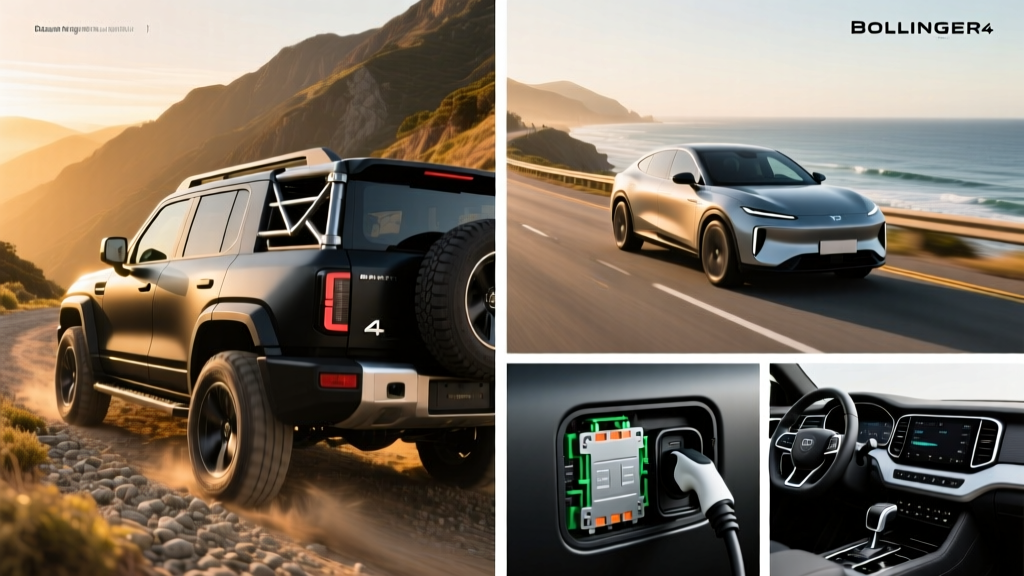
Bollinger Motors is an American EV startup targeting the commercial fleet and rugged-utility market with two core platforms: the B4 (a Class 3 electric cab-chassis truck) and the B5 (a larger Class 4/5 variant). As of early 2026, Bollinger has been taking reservations and building pre-production units, with volume production and customer deliveries targeted for late 2026. These are not consumer lifestyle trucks like the Rivian R1T or Ford F-150 Lightning — they are body-on-frame, work-focused electric platforms designed for upfitting (box trucks, dump bodies, utility beds). If you're a fleet operator or commercial buyer seeking a zero-emission work truck, Bollinger is worth tracking. If you're a retail buyer looking for a daily-driver EV, look elsewhere.
What Is Bollinger Motors and What Vehicles Do They Make?
Bollinger Motors, founded in 2014 and headquartered in Oak Park, Michigan, initially gained attention with concepts for the B1 (an electric SUV) and B2 (an electric pickup). However, the company pivoted hard toward the commercial electric chassis market — a sector with growing demand driven by emissions regulations, corporate sustainability mandates, and total-cost-of-ownership advantages for high-mileage fleet vehicles.
The current product lineup focuses on two platforms:
- B4 (Class 3): A cab-chassis electric truck rated for a gross vehicle weight rating (GVWR) of approximately 15,000 lbs. Designed for last-mile delivery, utility work, and light commercial applications.
- B5 (Class 4/5): A heavier-duty variant with a GVWR up to approximately 25,000 lbs, targeting box trucks, dump trucks, and heavier commercial upfits.
Both platforms share a common architecture: a body-on-frame design with a patented passthrough battery system that positions battery modules between the frame rails, lowering the center of gravity and allowing more flexible upfitting. Bollinger also integrates a disconnectable front axle and portal gear hubs — features borrowed from off-road engineering that give these trucks exceptional ground clearance and approach/departure angles.
Bollinger B4 and B5: Estimated Specs and Pricing
Because Bollinger is still ramping toward full production, final EPA-certified figures are not yet published. The following specs are based on Bollinger's announced engineering targets and pre-production disclosures. Treat these as preliminary estimates until EPA and SAE-certified data is released.
| Spec | B4 (Class 3) | B5 (Class 4/5) |
|---|---|---|
| GVWR | ~15,000 lbs | ~25,000 lbs |
| Battery Capacity (usable) | ~158 kWh (LFP) | ~200+ kWh (LFP) |
| Estimated Range | ~150 miles (varies by upfit/load) | ~150 miles (varies by upfit/load) |
| DC Fast Charge (peak) | ~150 kW (CCS) | ~150 kW (CCS) |
| 10–80% DC Charge Time | ~45–60 min (est.) | ~60–80 min (est.) |
| Motor Configuration | Dual motor AWD (disconnectable front axle) | Dual motor AWD (disconnectable front axle) |
| Horsepower | ~400 hp (combined, est.) | ~400+ hp (combined, est.) |
| Torque | ~500 lb-ft (at wheels, with portal hubs) | ~600+ lb-ft (at wheels, with portal hubs) |
| Ground Clearance | ~15+ inches (portal gear hubs) | ~15+ inches (portal gear hubs) |
| Estimated Base Price | $125,000–$150,000+ (before upfit) | $150,000–$185,000+ (before upfit) |
| Powertrain Warranty | TBD (commercial terms expected) | TBD (commercial terms expected) |
Note: Commercial EV pricing varies significantly based on battery configuration, upfit body, and fleet volume agreements. Contact Bollinger directly or an authorized dealer for binding quotes.
Real-World Range: What Fleet Operators Should Actually Expect
Bollinger's estimated ~150-mile range figure is a starting point, not a guarantee. Real-world range for a commercial electric truck depends heavily on factors that don't apply to passenger EVs:
- Payload weight: A fully loaded B4 hauling 5,000+ lbs of cargo will consume significantly more energy per mile than an empty chassis. Expect 20–35% range reduction at max payload.
- Upfit aerodynamics: A box-truck body creates far more drag than a flatbed. Box-body upfits can reduce range by 10–20% compared to bare-chassis testing.
- Stop-and-go routes: Regenerative braking recovers energy in urban delivery routes, which can actually improve efficiency vs. highway driving — the opposite of a passenger car.
- Cold weather: LFP (lithium iron phosphate) batteries handle cold somewhat better than NMC in terms of longevity, but cold-weather range loss of 15–30% is still expected at temperatures below 20°F, especially without preconditioning.
- Accessory loads: Hydraulic systems, lift gates, refrigeration units, and PTO (power take-off) equipment all draw from the traction battery, reducing driving range.
Charging Infrastructure: What Commercial Buyers Need to Plan For
Charging a Class 3–5 electric truck is fundamentally different from charging a Tesla Model Y at home. Here's the reality for fleet depot charging:
| Level | Power (kW) | Approx. Miles Added/Hour | Use Case |
|---|---|---|---|
| Level 2 (AC, J1772/CCS Combo) | 19.2 kW | ~25–40 miles/hr (truck-dependent) | Overnight depot charging (8–10 hrs for full charge) |
| DC Fast (CCS) | Up to ~150 kW peak | ~100–150 miles/hr (at peak) | Mid-day top-up; 10–80% in ~45–80 min |
Depot charging infrastructure is the single biggest hidden cost for commercial EV adoption. Here's a realistic cost breakdown for a small fleet installation:
| Item | Estimated Cost Range |
|---|---|
| 5× Level 2 commercial chargers (19.2 kW each) | $15,000–$35,000 |
| Electrical panel upgrade (480V 3-phase, if needed) | $20,000–$80,000 |
| Trenching, conduit, wiring (per run) | $10,000–$40,000 |
| Permits and utility interconnection | $5,000–$25,000 |
| DC fast charger (optional, 150 kW unit) | $60,000–$120,000 (unit + install) |
| Total (Level 2 only, 5 stalls) | $50,000–$180,000 |
Commercial buyers should investigate the IRS §30C Alternative Fuel Vehicle Refueling Property Credit, which covers up to 30% of charging equipment and installation costs (capped at $100,000 per item of property for commercial installations). State and utility incentives may also offset significant costs — check with your local utility and state energy office.
Bollinger vs. Gas/Diesel Work Trucks: Cost and Capability Comparison
The real purchase decision for a Bollinger isn't "Bollinger vs. Tesla" — it's "electric chassis vs. diesel/gas work truck." Here's how the economics compare for a typical Class 3 fleet vehicle running ~30,000 miles/year:
| Category | Bollinger B4 (EV, est.) | Diesel Class 3 Truck (est.) |
|---|---|---|
| Purchase Price (before incentives) | $135,000 | $65,000 |
| Federal/State Incentives | −$40,000 (IRC §45W commercial clean vehicle credit + state) | $0 |
| Net Purchase Cost | $95,000 | $65,000 |
| Fuel/Energy (5 yrs, 150k mi) | $18,750 (at $0.125/mi electricity) | $52,500 (at $0.35/mi diesel) |
| Maintenance (5 yrs) | $7,500 (no oil, fewer brakes via regen, no emissions systems) | $18,000 (DEF, oil, DPF, brakes, filters) |
| Depot Charging Install (amortized) | $10,000 | $0 |
| 5-Year Total Cost | $131,250 | $135,500 |
The takeaway: The Bollinger B4's higher upfront cost is substantially offset by fuel and maintenance savings. For fleets running predictable, return-to-base routes under 150 miles/day, the 5-year total cost of ownership can reach parity — or even favor the EV — especially when factoring in the IRC §45W Commercial Clean Vehicle Credit (up to $40,000 for qualifying vehicles over 14,000 lbs GVWR).
Note: The §45W credit has specific requirements including domestic use, qualified manufacturer, and minimum battery capacity. Consult a tax professional for fleet-specific eligibility.
Who Should (and Shouldn't) Consider a Bollinger Electric Vehicle
Decision Framework: Is Bollinger Right for Your Fleet?
Choose Bollinger if:
- You operate a fleet with predictable daily routes under 120 miles (accounting for payload and weather margins)
- Your vehicles return to a central depot nightly for charging
- You face municipal or corporate zero-emission mandates (e.g., California's Advanced Clean Trucks regulation or similar state adoption)
- You need a body-on-frame chassis for custom upfitting (box, dump, utility, flatbed)
- You want AWD capability with high ground clearance for construction sites or rough terrain
- You can absorb a higher upfront cost in exchange for lower operating costs and emissions compliance
Look elsewhere if:
- You need regional or long-haul range (200+ miles daily without depot return)
- You're a retail/consumer buyer looking for a lifestyle pickup (consider Rivian R1T, Ford F-150 Lightning, Chevrolet Silverado EV)
- You cannot install depot charging infrastructure
- You need immediate availability — Bollinger is still ramping production as of 2026
- Your routes regularly exceed the vehicle's real-world range in winter conditions
Common Misconceptions About Bollinger and Commercial EVs
| Myth | Fact |
|---|---|
| "Electric trucks can't handle heavy payloads." | The B4's 15,000-lb GVWR and body-on-frame design are engineered for commercial payloads. Range decreases under load, but capability is comparable to diesel equivalents for many applications. |
| "150 miles of range isn't enough for any real work." | Fleet data shows that a large percentage of Class 3–5 commercial vehicles travel under 100 miles daily on return-to-base routes. Range is sufficient for last-mile delivery, municipal services, and many utility applications. |
| "Electric trucks cost more forever." | Higher purchase price is offset by dramatically lower fuel and maintenance costs. TCO parity is achievable within 3–5 years depending on mileage and energy costs. |
| "LFP batteries won't last in a commercial truck." | LFP chemistry offers excellent cycle life (3,000+ cycles to 80% capacity is typical) and is well-suited to daily depot-charging patterns. This is a durability advantage for fleet use. |
| "Bollinger is already in full production and you can buy one today." | As of early 2026, Bollinger is in pre-production and reservation phases. Volume deliveries are targeted but not yet happening at scale. Confirm availability directly with the company. |
Battery Chemistry and Longevity: What Fleet Buyers Need to Know
Bollinger uses LFP (lithium iron phosphate) battery cells, which is a deliberate choice for commercial applications. Here's why this matters:
| Factor | LFP (Bollinger) | NMC (common in passenger EVs) |
|---|---|---|
| Cycle Life | 3,000–5,000+ cycles to 80% SoH | 1,000–2,000 cycles to 80% SoH |
| Thermal Stability | Excellent — less prone to thermal runaway | Good, but requires more active thermal management |
| Energy Density | Lower — heavier battery for same kWh | Higher — lighter, more compact |
| Cost per kWh | Lower (no cobalt or nickel) | Higher (cobalt/nickel supply chain) |
| Cold-Weather Performance | Acceptable, but slightly more range loss than NMC in extreme cold | Slightly better cold-weather energy delivery |
| 100% SoC Charging | Can charge to 100% regularly without significant degradation | Best kept at 80% daily for longevity |
For fleet operators who charge nightly to 100% and drive daily routes, LFP is the superior chemistry. The longer cycle life means the battery pack should outlast the vehicle's useful commercial life in most applications. Bollinger's passthrough battery design (modules between frame rails) may also simplify individual module replacement if a cell group degrades, potentially reducing long-term service costs.
Frequently Asked Questions
Can I buy a Bollinger electric vehicle as a consumer?
Not currently. Bollinger's B4 and B5 are commercial platforms sold primarily to fleet operators and commercial upfitters. There is no consumer retail version available, and Bollinger's earlier B1/B2 consumer concepts have been shelved. If you're a retail buyer wanting an electric truck, look at the Ford F-150 Lightning, Rivian R1T, or Chevrolet Silverado EV.
Does the Bollinger B4 qualify for the $7,500 federal EV tax credit?
No — the standard §30D Clean Vehicle Credit applies to light-duty vehicles under 14,000 lbs GVWR. The Bollinger B4 (15,000 lbs GVWR) and B5 (25,000 lbs) exceed this threshold. Instead, commercial buyers may qualify for the IRC §45W Commercial Clean Vehicle Credit, which provides up to $40,000 for qualifying heavy-duty commercial EVs. Consult a tax professional and review IRS guidance on §45W for eligibility details.
How long does it take to charge a Bollinger B4 overnight?
At a 19.2 kW Level 2 commercial charger, a fully depleted ~158 kWh battery would take roughly 8–10 hours to reach full charge. This aligns well with overnight depot charging for vehicles that return to base after a day route. DC fast charging at 150 kW can bring the battery from 10–80% in approximately 45–60 minutes for mid-day top-ups if needed.
What happens if a Bollinger battery needs replacement?
Bollinger's modular passthrough battery architecture is designed so individual battery modules can potentially be serviced or replaced without removing the entire pack. Exact replacement costs have not been published, but commercial LFP packs in this capacity range could cost $25,000–$50,000+ for a full replacement. However, LFP chemistry's long cycle life (3,000+ cycles) makes full-pack replacement unlikely within a typical commercial vehicle service life of 10–15 years.
Is Bollinger Motors a stable company? What about long-term support?
This is a legitimate concern with any EV startup. Bollinger has been operating since 2014 and has secured investment and partnership agreements, but it has not yet reached volume production or profitability. Fleet buyers should factor in the risk of startup viability when making purchasing decisions — consider ordering in smaller batches, negotiating service and parts agreements, and evaluating the company's financial health before committing to large fleet orders.
How does the Bollinger B4 compare to the Ford E-Transit or BrightDrop Zevo?
These are different vehicle categories. The Ford E-Transit and BrightDrop Zevo are purpose-built delivery vans (step-vans/cargo vans). The Bollinger B4 is a cab-chassis truck that can be upfitted with various bodies (flatbed, dump, box, utility). If you need a cargo van, the E-Transit or Zevo are more mature, available options. If you need a configurable truck chassis with AWD and off-road capability, Bollinger occupies a more specialized niche.