The Bottom Line on the Bollinger Electric Truck
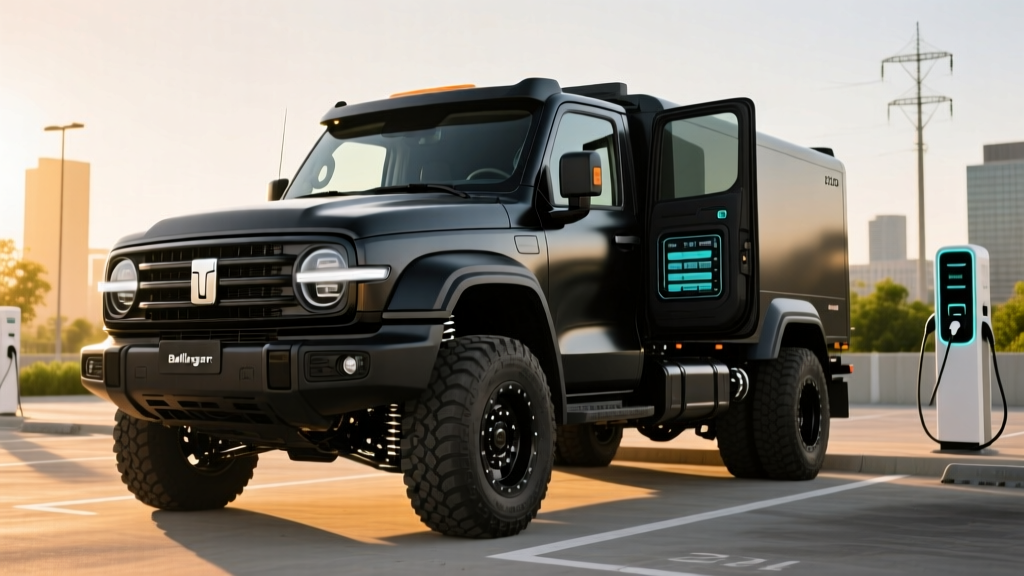
The Bollinger B4 electric delivery truck is a commercial Class 4 vehicle — not a consumer pickup. Bollinger Motors pivoted away from the B1/B2 off-road SUV and truck concepts in 2024, focusing instead on the B4 chassis cab for commercial fleet use. If you're a fleet manager evaluating electric delivery trucks, the B4 offers a targeted solution for last-mile and medium-duty routes. If you're a consumer looking for an electric pickup truck, Bollinger does not currently sell one, and you should look at the Rivian R1T, Ford F-150 Lightning, or Chevrolet Silverado EV instead.
What Is the Bollinger B4 Electric Truck?
Bollinger Motors, founded in 2014 and based in Oak Park, Michigan, spent years teasing the B1 SUV and B2 pickup — rugged, boxy electric vehicles aimed at the off-road enthusiast market. Neither reached production. In 2023-2024, the company announced a strategic pivot toward the B4: a Class 4 commercial electric chassis cab designed for upfitting into box trucks, dump trucks, utility bodies, and delivery vehicles.
The B4 targets the medium-duty commercial segment — think local delivery routes, municipal utility fleets, and tradesmen who need a work truck, not a lifestyle vehicle. Bollinger positions the B4 as a "skateboard" platform that upfitters and body builders can customize, similar to how commercial truck buyers spec chassis cabs from Ram, Ford, or Freightliner.
As of early 2026, Bollinger has announced preliminary specifications and begun limited production for select fleet customers, but the B4 is not widely available at dealerships. Buyers should treat current specs as preliminary and subject to change.
Bollinger B4 Specs: Range, Battery, and Charging
Here's what Bollinger has published about the B4 platform. Remember: these are manufacturer-announced figures for a commercial vehicle that may differ from final production specs.
| Spec | Value |
|---|---|
| Vehicle Class | Class 4 (GVWR 15,001–16,000 lbs) |
| Battery Capacity | ~150 kWh usable (announced, NMC chemistry) |
| EPA Range | ~150 miles (estimated, varies by upfit/load) |
| Motor / Drivetrain | Dual-motor AWD; ~400 hp combined |
| DC Fast Charging | Up to 150 kW peak (CCS1) |
| 10–80% DC Charge Time | ~50–60 minutes (estimated) |
| Level 2 AC Charging | ~19.2 kW |
| GVWR | Up to 16,000 lbs |
| Payload Capacity | Up to ~7,500 lbs (varies by upfit) |
| Towing Capacity | Not yet published |
| 0–60 mph | Not published (commercial vehicle) |
| Starting MSRP | ~$125,000+ (chassis cab, before upfit) |
| Warranty | Not yet finalized |
Real-World Range Reality
The ~150-mile estimated range is for a chassis cab with a moderate upfit at partial load. Expect significantly less range with a fully loaded box body, stop-and-go urban delivery routes, highway speeds above 55 mph, or cold-weather operation. Real-world range for a loaded B4 could drop to 100–120 miles in demanding conditions. This is typical for Class 4 electric trucks and adequate for defined local routes, but it rules out long-haul or rural applications.
Cost Breakdown: Bollinger B4 vs. Diesel/Gas Medium-Duty Trucks
The B4's ~$125,000+ chassis-cab price is steep compared to a comparable diesel Class 4 truck (typically $75,000–$95,000). But commercial EV economics depend heavily on total cost of ownership (TCO), not sticker price alone. Here's how the numbers stack up over a 5-year, 75,000-mile horizon for a typical urban delivery route:
| Cost Category | Bollinger B4 (Electric) | Diesel Class 4 |
|---|---|---|
| Purchase Price (chassis cab) | ~$125,000 | ~$85,000 |
| Federal Tax Credit (§45W Commercial) | Up to -$40,000 | $0 |
| Net After Incentive | ~$85,000 | ~$85,000 |
| Fuel/Energy (75,000 mi) | ~$9,400 ($0.125/mi) | ~$22,500 ($0.30/mi diesel) |
| Maintenance (5 yr) | ~$3,000 | ~$12,000 |
| DEF / Emissions Equipment | $0 | ~$2,500 |
| Insurance (5 yr est.) | ~$18,000 | ~$15,000 |
| Total 5-Year Cost | ~$115,400 | ~$137,000 |
Key takeaway: The B4 can reach cost parity or beat diesel on TCO within 5 years, primarily thanks to the §45W Commercial Clean Vehicle Credit (up to $40,000 for vehicles over 14,000 lbs GVWR) and dramatically lower fuel and maintenance costs. However, this assumes reliable depot charging and routes within the truck's range envelope.
Note: The §45W commercial credit is separate from the §30D consumer credit. It applies to businesses and tax-exempt organizations. Consult a tax professional for eligibility.
Who Should Consider the Bollinger B4?
The B4 is not a mass-market vehicle. It serves a narrow use case, and its viability depends on your operation fitting specific parameters.
Decision Framework: Is the B4 Right for Your Fleet?
- Choose the B4 if:
- You operate defined daily routes under 100–120 miles round-trip
- You have depot or yard space for Level 2 or DC fast charger installation
- Your fleet qualifies for the §45W commercial credit or state fleet incentives
- You need a Class 4 chassis cab for upfitting (box, dump, utility)
- You operate in a city or metro area with CARB/zero-emission fleet mandates
- You want to eliminate diesel fuel cost volatility from your operating budget
- Look elsewhere if:
- Your routes regularly exceed 150 miles without return-to-base charging
- You need a consumer electric pickup (see Rivian R1T, F-150 Lightning)
- You operate in extreme cold climates without heated depot storage
- You need immediate high-volume availability — B4 production is limited
- You require towing specs that haven't been published yet
- Your operation can't absorb the upfront cost before incentive reimbursement
Charging Infrastructure: The Hidden Cost Fleet Buyers Must Budget For
One of the most underestimated expenses in commercial EV adoption is charging infrastructure. The B4's ~150 kWh battery is large, and charging it matters enormously for fleet uptime.
| Item | Level 2 (19.2 kW) | DC Fast (60–150 kW) |
|---|---|---|
| Charging Equipment | $3,000–$7,000 | $25,000–$70,000 |
| Electrical Work & Conduit | $2,000–$8,000 | $15,000–$50,000 |
| Panel/Transformer Upgrade | $0–$15,000 | $10,000–$80,000 |
| Permits & Engineering | $1,000–$3,000 | $5,000–$15,000 |
| Total Per Stall | $6,000–$33,000 | $55,000–$215,000 |
For a fleet of five B4 trucks, you're likely looking at $30,000–$165,000 in depot charging infrastructure with Level 2 chargers — or significantly more with DC fast chargers. Level 2 at 19.2 kW will add roughly 30–40 miles of range per hour, meaning a full charge from empty takes 8–10 hours — fine for overnight depot charging, but inadequate for mid-day top-ups on multi-shift operations.
DC fast charging at 150 kW can take the B4 from 10–80% in roughly 50–60 minutes, enabling mid-day opportunity charging. But the infrastructure cost is substantial, and repeated DC fast charging accelerates battery degradation over time.
Critical: Contact your utility early. Many commercial EV charging installations require utility-side transformer upgrades with lead times of 6–18 months. Factor this into your procurement timeline.
Common Misconceptions About Bollinger Trucks
| Myth | Fact |
|---|---|
| "Bollinger makes an electric pickup truck I can buy." | The B1/B2 consumer concepts were canceled. Bollinger now makes the B4, a commercial Class 4 chassis cab — not a consumer vehicle. |
| "150 miles of range isn't enough for any real work." | For defined urban delivery routes (which average 60–90 miles/day per DOE data), 120–150 real-world miles is sufficient. Range needs depend entirely on route structure. |
| "Electric trucks are always cheaper to operate." | Not always. Electricity rates vary by region and time-of-use. Fleets paying peak commercial rates ($0.25+/kWh) in high-cost states may see less fuel savings. TCO depends on your specific utility rate, route mileage, and diesel price. |
| "I'll get the $7,500 EV tax credit." | The §30D consumer credit doesn't apply to Class 4 commercial vehicles. The relevant credit is §45W (Commercial Clean Vehicle Credit), which offers up to $40,000 for qualifying commercial EVs over 14,000 lbs GVWR. IRS rules apply; consult a tax professional. |
| "Cold weather will make the B4 useless." | Cold weather reduces EV range by 15–30%. A B4 rated at 150 miles might deliver 105–125 miles in freezing temperatures. This is manageable for short urban routes but requires honest route planning in northern climates. |
How the B4 Compares to Other Electric Commercial Trucks
The B4 occupies a specific niche in the growing commercial EV landscape. Here's how it stacks up against adjacent options:
| Spec | Bollinger B4 | Ford E-Transit (Cutaway) | BrightDrop Zevo 600 | Diesel Class 4 (Baseline) |
|---|---|---|---|---|
| Class | Class 4 | Class 2–3 | Class 3 | Class 4 |
| Est. Range | ~150 mi | ~126 mi | ~250 mi | ~400+ mi |
| Battery | ~150 kWh | 68 kWh | ~165 kWh | N/A (diesel tank) |
| DC Fast Charge | ~150 kW | ~115 kW | ~120 kW | N/A |
| Starting Price | ~$125,000 | ~$55,000 | ~$100,000+ | ~$85,000 |
| Availability | Limited/Pre-production | In production | Limited production | Widely available |
The Ford E-Transit cutaway is more established and affordable but sits in a lower weight class with less payload. GM's BrightDrop Zevo 600 offers more range but targets step-van delivery applications. The B4's differentiator is its Class 4 GVWR and chassis-cab flexibility — but its limited availability is a significant risk for fleet planners who need guaranteed delivery timelines.
First-Time Commercial EV Buyer: What You Need to Know
If your fleet has never operated electric trucks, the B4 represents more than a vehicle purchase — it's an operational transformation. Here's what first-time buyers consistently underestimate:
- Route analysis comes first. Before ordering any truck, GPS-log your current routes for 2–4 weeks. You need hard data on daily mileage, stop frequency, idle time, and payload weight to determine if an electric truck fits.
- Charging lead times are long. As noted above, utility coordination and electrical work can take 6–18 months. Start infrastructure planning before you order trucks.
- Driver training matters. Regenerative braking, one-pedal driving, and range-aware driving habits require training. Drivers who accelerate hard and idle excessively will erode your range margin.
- Maintenance shifts, not disappears. You eliminate oil changes, DEF, DPF filters, and transmission service. But you still need tire rotations, brake inspections (though regen reduces wear), coolant checks, and HVAC service. Budget for different maintenance, not zero maintenance.
- Battery warranty is your safety net. Commercial EV batteries typically carry warranties of 8 years/100,000 miles with a capacity retention threshold (usually 70%). Confirm Bollinger's final warranty terms before purchasing — this is your protection against premature degradation.
- Insurance may cost more. Commercial EV insurance premiums tend to run 10–25% higher than equivalent diesel trucks, reflecting higher repair costs and limited collision-repair networks. Get quotes before finalizing your TCO model.
Frequently Asked Questions
Can I buy a Bollinger electric truck as a consumer?
No. Bollinger canceled its consumer vehicles (B1 SUV, B2 pickup) and now focuses exclusively on the B4 commercial chassis cab. If you want a consumer electric truck, look at the Rivian R1T, Ford F-150 Lightning, Chevrolet Silverado EV, or Tesla Cybertruck.
What tax credit applies to the Bollinger B4?
The §45W Commercial Clean Vehicle Credit applies — not the §30D consumer credit. For vehicles over 14,000 lbs GVWR, the credit can be up to $40,000 (30% of the cost difference between the EV and a comparable ICE vehicle, or the incremental cost). Eligibility depends on your tax situation; consult a tax professional.
How long does it take to charge the Bollinger B4?
On a Level 2 charger at 19.2 kW, a full charge from near-empty takes approximately 8–10 hours — suitable for overnight depot charging. On a 150 kW DC fast charger, expect roughly 50–60 minutes for a 10–80% charge. Actual times depend on battery temperature, state of charge, and charger availability.
Is Bollinger Motors still in business?
As of early 2026, Bollinger Motors continues operations and is pursuing limited production of the B4. The company has faced the same challenges as many EV startups — funding, supply chain, and production scaling. Fleet buyers should assess Bollinger's financial stability and production commitments carefully before placing large orders. Diversifying your fleet order across established and emerging OEMs can mitigate risk.
What upfits are compatible with the B4?
The B4 is designed as a chassis cab, meaning third-party upfitters can mount box bodies, dump beds, utility service bodies, flatbeds, and other commercial bodies. Specific upfit compatibility depends on the body builder and Bollinger's published chassis dimensions and PTO (power take-off) provisions. Contact Bollinger directly or consult their upfitter partner network for approved configurations.
How does cold weather affect the B4's range?
Like all electric vehicles, the B4 will experience range reduction in cold weather — typically 15–30% in freezing temperatures. A truck rated at ~150 miles might deliver 105–125 miles at 20°F. Battery preconditioning (if equipped) and heated depot storage can mitigate this loss. Fleets in northern climates should plan routes conservatively and consider cold-weather range reduction in their procurement models.