Quick Answer: Is the Bobcat All Electric Skid Steer Worth It?
The Bobcat T7X all-electric compact track loader (the closest product in Bobcat's lineup to an "all electric skid steer") carries an estimated base price of $75,000–$90,000 depending on configuration, powered by a 62 kWh lithium-ion battery pack (LFP chemistry). It delivers roughly equivalent performance to a diesel T770 in breakout force and lift capacity, with 4–6 hours of continuous heavy-cycle runtime per charge. Level 2 (240V) charging takes approximately 8–10 hours from empty; DC fast charging to 80% takes roughly 1.5–2 hours at peak rates near 30 kW. For contractors working in noise-restricted zones, indoor demolition, or emissions-regulated job sites, the T7X can pay for its premium through fuel savings and expanded bid eligibility. For high-utilization outdoor earthmoving with no charging infrastructure, a diesel machine still wins on runtime flexibility.
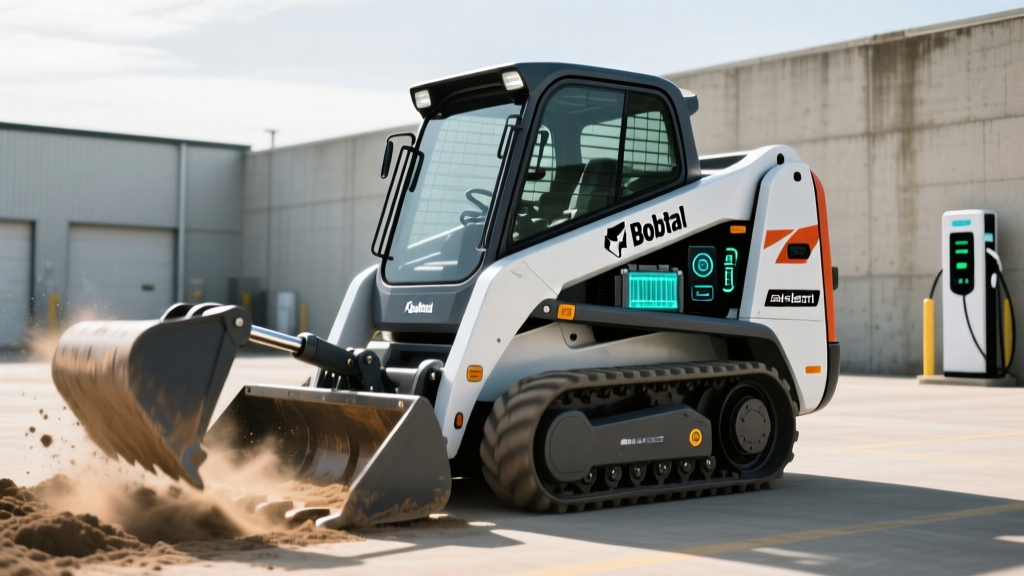
When buyers search for a "Bobcat all electric skid steer," they're typically referring to the Bobcat T7X, an all-electric compact track loader that Bobcat has been developing and demonstrating since its CES debut. While Bobcat's traditional skid-steer lineup (S76, S66, etc.) remains diesel-powered, the T7X represents the company's flagship zero-emission machine and the primary electric option in the compact equipment segment for 2026. Here's what you need to know before committing capital.
Battery, Powertrain, and Performance Specs
The T7X replaces the conventional diesel engine, hydraulic pumps, and associated plumbing with an electric drivetrain built around three core components:
- Battery pack: 62 kWh usable capacity, lithium iron phosphate (LFP) chemistry — chosen for thermal stability, long cycle life (3,000+ cycles to 80% State of Health), and reduced fire risk compared to NMC cells.
- Drive motors: Dual electric drive motors powering the tracks independently, enabling zero-radius turns and instant torque delivery with no turbo lag or RPM buildup.
- Electric actuators: The lift arm, tilt, and auxiliary circuits use electric linear actuators rather than hydraulic cylinders, eliminating hydraulic fluid entirely — approximately 50+ gallons of fluid removed from the machine.
| Specification | Value |
|---|---|
| Battery Capacity | 62 kWh (LFP chemistry) |
| Rated Operating Capacity | ~3,000 lbs (comparable to T770 diesel) |
| Tipping Load | ~8,600 lbs |
| Drive System | Dual electric track motors |
| Hydraulic System | None — fully electric actuators |
| Estimated Runtime (heavy cycle) | 4–6 hours |
| Level 2 Charge Time (240V, ~7 kW) | ~8–10 hours (0–100%) |
| DC Fast Charge (peak ~30 kW) | ~1.5–2 hours (10–80%) |
| Operating Weight | ~10,000 lbs |
| Estimated Base Price | $75,000–$90,000 |
Important context on runtime: The 4–6 hour figure applies to mixed heavy-cycle work (digging, grading, lifting). Light-duty tasks like site cleanup or material transport can stretch runtime to 7–8 hours. In cold weather (below 32°F / 0°C), expect a 15–25% reduction in usable runtime due to battery internal resistance and cabin/operator comfort loads — similar to how EV passenger cars lose range in winter.
Total Cost of Ownership: Electric vs. Diesel Skid Steer
The upfront price premium for the T7X over a comparable diesel compact track loader (e.g., Bobcat T770 at roughly $55,000–$65,000) is substantial — approximately $15,000–$30,000 more. The question is whether operational savings close that gap over a 5-year ownership horizon.
| Cost Category | T7X Electric | Diesel CTL (T770-class) |
|---|---|---|
| Purchase Price | $82,000 (est. mid-config) | $60,000 |
| Fuel / Energy (5 years) | $4,500 ($0.12/kWh avg, ~60 kWh/day) | $22,500 ($4.00/gal diesel, ~4 gal/hr) |
| Maintenance (5 years) | $2,500 (grease, filters, wear items) | $12,000 (oil, filters, hydraulics, DEF, coolant) |
| Hydraulic Fluid Replacement | $0 (no hydraulics) | $3,000 (50+ gal over 5 years) |
| Downtime Cost (est.) | $1,500 | $5,000 |
| Estimated Resale (Year 5) | -$30,000 | -$25,000 |
| Total 5-Year Net Cost | $60,500 | $77,500 |
The electric machine shows a projected $17,000 net savings over 5 years in this scenario, driven primarily by fuel and maintenance elimination. The breakeven point typically arrives around Year 3 at 1,500 hours/year utilization. Below 800 hours/year, the diesel machine's lower purchase price may never be offset.
What's not in this table: The T7X qualifies for expanded bid opportunities on municipal, school, hospital, and indoor demolition projects where zero-emission equipment is now mandated. Several 2026 municipal RFPs in California, New York, and Washington state include emissions-equipment scoring bonuses worth 5–10% of bid evaluation — a competitive advantage with no dollar equivalent in the TCO spreadsheet.
Charging Infrastructure: What You Actually Need on Site
This is where most first-time electric equipment buyers underestimate complexity. Unlike a passenger EV that charges at home overnight, a skid steer lives on a job site or at a yard — and those locations may lack adequate electrical service.
Level 2 Charging (240V, ~7 kW)
This is the primary charging method. A standard NEMA 14-50 outlet or hardwired EVSE delivers roughly 7 kW, adding about 20–25 kWh in 3 hours — enough for a half-shift of moderate work. For a full overnight charge (62 kWh), plan on 8–10 hours. Most equipment yards can accommodate this with a dedicated 50-amp circuit.
DC Fast Charging (~30 kW peak)
Bobcat has indicated DC fast-charge capability for the T7X, allowing a 10–80% charge in approximately 1.5–2 hours. This requires a dedicated DC charger (est. $15,000–$25,000 installed for a 30 kW unit) or access to commercial charging infrastructure. Note: sustained charge rate tapers above 80% State of Charge to protect the LFP cells — don't plan on the peak 30 kW rate holding for the full session.
Site Electrical Reality Check
Before ordering a T7X, have a licensed electrician assess your yard or primary job site. Key questions:
- Do you have 240V/50A service available at the parking location?
- Will you need a panel upgrade? Older commercial buildings with 100A or 200A panels may not have spare capacity. A panel upgrade adds $2,000–$5,000.
- For job-site charging: does the GC provide temporary power, and at what amperage? A standard construction temp pole often provides 200A at 240V — enough for one Level 2 charger with room to spare.
- For remote sites with no grid power: a diesel generator can charge the T7X via a portable Level 2 unit, but this defeats the emissions benefit and adds fuel cost back in.
Real-World Ownership: Who Should (and Shouldn't) Buy
Not every contractor is a good candidate for an electric compact track loader in 2026. Here's a practical framework:
Decision Framework: Is the T7X Right for Your Operation?
Choose the Bobcat T7X (electric) if:
- You regularly bid on indoor demolition, warehouse, hospital, school, or municipal projects with emissions requirements
- Your work is primarily within a 50-mile radius of a yard with 240V charging
- You work in noise-restricted zones (residential neighborhoods, hospitals, schools with hour limitations) — the T7X operates at significantly lower dB levels than diesel
- Your daily utilization averages 4–6 hours of heavy cycle work (fits within one charge)
- You want to eliminate hydraulic fluid handling, disposal costs, and leak-related site contamination
- Operating cost per hour matters more than lowest purchase price
Stick with a diesel CTL if:
- You work remote sites with no grid power access for days at a time
- Your daily utilization exceeds 8 hours of continuous heavy digging/grading
- You frequently relocate between distant job sites and can't plan charging stops
- You operate in extreme cold (below 10°F / -12°C) for extended periods without heated storage
- Your budget is strictly capped below $65,000 for a track loader
Common Misconceptions About Electric Skid Steers
| Myth | Fact |
|---|---|
| "Electric machines don't have enough power for real digging" | Electric motors deliver peak torque at zero RPM. The T7X matches the T770-class rated operating capacity (~3,000 lbs) and breakout force. Instant torque actually improves responsiveness in cycle loading. |
| "The battery won't last and replacement costs a fortune" | LFP chemistry is rated for 3,000+ full cycles to 80% SoH. At one full cycle per day, that's 8+ years before meaningful degradation. Bobcat offers a battery warranty (confirm terms with your dealer for 2026 coverage details). |
| "You need a massive charging station" | A standard 240V/50A outlet (same as a large welder or commercial dryer) handles overnight charging. No special utility service required for most yards. |
| "It's completely silent — that's a safety problem on site" | The T7X includes a configurable travel alarm and backup beeper. It's quieter than diesel but not silent — electric motors and track drives still produce audible mechanical noise. |
| "Electric equipment doesn't qualify for any tax incentives" | Commercial clean vehicle credits (IRC §45W) and various state-level equipment electrification incentives may apply. Consult a tax professional — the federal credit for commercial equipment differs from the §30D consumer passenger-vehicle credit. |
Maintenance Savings: Where the Money Actually Goes
The most underappreciated advantage of the T7X isn't fuel — it's the near-total elimination of scheduled maintenance intervals that plague diesel equipment:
- No engine oil changes: A diesel CTL requires oil changes every 250–500 hours. At $150–$250 per service, that's $1,500–$2,500 over 5 years at 1,500 hrs/year.
- No hydraulic fluid: 50+ gallons of hydraulic fluid, replaced every 2,000 hours or so, plus filter changes. At $15–$25/gallon for quality hydraulic fluid, plus disposal fees, this adds up.
- No DEF (diesel exhaust fluid): Tier 4 Final diesels consume DEF at roughly 2–3% of fuel volume. Eliminated entirely.
- No air filters, fuel filters, or coolant flushes: The electric powertrain has none of these consumables.
- No DPF (diesel particulate filter) regeneration or replacement: DPF replacement on a compact diesel can cost $3,000–$5,000 — a catastrophic unplanned expense eliminated on the T7X.
What maintenance remains: track tensioning and replacement, grease points on pivot pins, battery thermal management system checks, actuator inspection, and standard wear items (bucket teeth, cutting edges). Budget roughly $500/year for these items.
Financing, Incentives, and the Bottom Line
For commercial buyers, the financial picture extends beyond the purchase price:
- Federal Commercial Clean Vehicle Credit (IRC §45W): Up to $7,500 for vehicles under 14,000 lbs GVWR, or up to $40,000 for heavier qualified commercial clean vehicles. The T7X's eligibility and classification depend on its GVWR and IRS guidance — consult IRS.gov guidance on §45W and a tax professional before relying on a specific credit amount.
- State and utility incentives: Several states (notably California's CARB programs, New York's NYSERDA, and various utility make-ready programs) offer grants or rebates for zero-emission construction equipment. These vary by jurisdiction and application cycle — check with your state air quality board and local utility.
- Section 179 and bonus depreciation: The T7X qualifies as depreciable business equipment. Current bonus depreciation rules allow significant first-year write-offs — another area for your CPA.
- Dealer financing: Bobcat Financial Services typically offers lease and loan programs. The higher upfront cost may be partially offset by favorable money factors on electric equipment as manufacturers incentivize adoption.
Frequently Asked Questions
How long does the Bobcat T7X battery last before it needs replacement?
Bobcat uses LFP (lithium iron phosphate) cells rated for approximately 3,000+ full charge cycles to 80% capacity retention. At one full cycle per working day (250 days/year), that translates to roughly 12 years before the battery drops below 80% of original capacity — and the machine remains usable beyond that point with reduced runtime. Confirm specific warranty terms (typically 5 years or a set hour limit) with your local Bobcat dealer for 2026 models.
Can I charge the T7X from a standard household outlet?
Technically, a 120V Level 1 connection would trickle-charge the 62 kWh battery, but at roughly 1.4 kW, a full charge would take 40+ hours — completely impractical for commercial use. You need a 240V/50A circuit (Level 2) minimum for viable overnight charging.
Does the T7X work in cold weather?
Yes, but with reduced runtime. Expect 15–25% less operating time in temperatures below freezing due to battery chemistry limitations and any operator cabin heating load. The LFP pack includes thermal management, but extreme cold (below 0°F / -18°C) will further impact performance. Storing the machine in a heated or semi-heated bay overnight helps preserve next-morning readiness.
What happens if the battery runs out mid-job?
The T7X provides progressive low-battery warnings and will eventually limit functions to protect the cells. Unlike a diesel that can be refueled in 3 minutes from a jerry can, a depleted T7X needs at minimum 1–2 hours on a DC fast charger to resume meaningful work. Plan your charging windows like you'd plan fuel stops — at lunch breaks, shift changes, or between tasks.
Is the Bobcat T7X currently available to order?
Bobcat has been producing and delivering T7X units to select customers and dealers since the early demonstration phase. Availability and lead times vary by region and dealer allocation. Contact your local Bobcat dealer for current 2026 order status, pricing, and delivery timelines. Specs and pricing in this guide reflect the most current available information but may change — always confirm with an authorized dealer.
Does the T7X have a front-mounted attachment interface like a traditional skid steer?
Yes. The T7X uses Bobcat's standard compact track loader attachment interface, compatible with the broad Bobcat attachment ecosystem — buckets, augers, breakers, grapples, and more. The auxiliary circuit is electric rather than hydraulic, so confirm attachment compatibility for high-flow hydraulic tools; Bobcat offers electric-compatible attachment options.
Sources: Bobcat Company official specifications and press materials; IRS Commercial Clean Vehicle Credit (IRC §45W) guidance. Pricing and availability are estimates based on available industry data and may vary by dealer, region, and configuration. Always confirm current specs with an authorized Bobcat dealer.