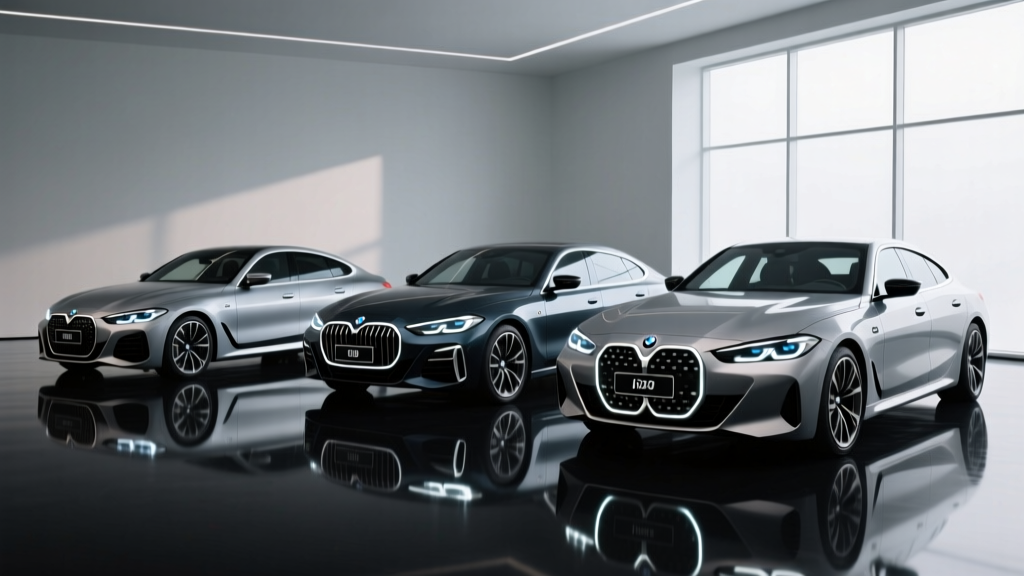
Quick Answer: BMW's 2026 electric sedan lineup spans three models: the i4 (compact, EPA 307 mi, ~$52,200), the i5 (mid-size, EPA 295 mi, ~$70,900), and the flagship i7 (full-size luxury, EPA 318 mi, ~$105,700). All three use BMW's 5th-gen eDrive powertrain on shared CLAR architecture with NMC battery chemistry. The i4 offers the best efficiency at up to 109 MPGe, while the i7 delivers the longest range and most power. None currently qualify for the full federal §30D tax credit due to battery-sourcing rules — buyers should plan around state incentives and point-of-sale lease loopholes instead.
BMW's Electric Sedan Lineup at a Glance
If you're researching a BMW sedan electric option in 2026, you have three distinct choices, each targeting a different buyer profile and budget. BMW took a pragmatic approach: rather than building dedicated EV platforms, they integrated electric powertrains into existing 4 Series, 5 Series, and 7 Series architectures. This means familiar proportions, premium interiors, and proven driving dynamics — but with some packaging compromises (transmission tunnel remnants, slightly reduced cargo space versus purpose-built EVs).
All three sedans use NMC (nickel-manganese-cobalt) battery chemistry, which delivers higher energy density than LFP but requires more careful thermal management and typically shows slightly more degradation over a decade. BMW provides an 8-year/100,000-mile battery warranty with a 70% capacity retention threshold, which is industry-standard but not class-leading.
| Spec | 2026 BMW i4 eDrive40 | 2026 BMW i5 eDrive40 | 2026 BMW i7 eDrive50 |
|---|---|---|---|
| EPA Range | 307 mi | 295 mi | 318 mi |
| Battery (usable) | 81.5 kWh (NMC) | 81.2 kWh (NMC) | 101.7 kWh (NMC) |
| Horsepower | 335 hp | 335 hp | 449 hp |
| 0–60 mph | 5.5 sec | 5.7 sec | 4.5 sec |
| Peak DC Fast Charge | 205 kW | 205 kW | 195 kW |
| 10–80% DC Charge | ~31 min | ~30 min | ~34 min |
| Level 2 Rate (11 kW) | ~8.5 hrs | ~8 hrs | ~9.5 hrs |
| MPGe (combined) | 109 MPGe | 97 MPGe | 82 MPGe |
| Base MSRP | $52,200 | $70,900 | $105,700 |
| Battery Warranty | 8 yr / 100,000 mi | 8 yr / 100,000 mi | 8 yr / 100,000 mi |
Source: fueleconomy.gov and BMW USA press specifications. Real-world highway range at 75 mph typically drops 12–18% below EPA. In sub-freezing temperatures, expect an additional 20–30% range reduction.
Real-World Range: What the EPA Sticker Doesn't Tell You
The EPA numbers above represent a standardized test cycle that blends city and highway driving. In practice, your experience with a BMW sedan electric model will depend heavily on three factors: speed, temperature, and terrain.
Highway driving: At a sustained 75 mph on flat interstate, the i4 eDrive40 delivers roughly 255–270 miles before needing a charge. The i5 falls to around 240–255 miles, and the heavier i7 manages approximately 260–275 miles. BMW's aerodynamic tuning helps, but the i7's larger frontal area and 5,500+ lb curb weight work against efficiency at speed.
Cold weather: All three models come with a standard heat pump, which mitigates cabin-heating energy draw compared to resistive heaters. Still, NMC chemistry loses efficiency in cold temperatures. In 20°F conditions, expect 20–30% range reduction. A 307-mile i4 could realistically deliver 215–245 miles in a cold Midwestern winter. Preconditioning the battery while plugged in (using the BMW app's departure timer) recovers some of this loss and is critical for DC fast-charging speed in cold weather.
Real-World Range Expectations (i4 eDrive40 shown):
- EPA sticker: 307 mi
- Mild weather, mixed driving: ~280–300 mi
- Highway 75 mph, mild: ~255–270 mi
- Highway 75 mph, 20°F: ~200–225 mi
- City with regen, mild: ~310–320 mi
Charging Speed and the Curve Reality
BMW's 5th-gen eDrive supports DC fast charging at up to 205 kW (i4/i5) and 195 kW (i7). These are peak rates — the number the marketing materials highlight. But EV charging follows a curve, not a flat line.
Here's what actually happens at a 350 kW Electrify America or Tesla Supercharger station (using BMW's NACS adapter, now standard for 2026 models):
- 10–30% SoC: You'll see peak rates near 200 kW, adding roughly 3–3.5 miles per minute.
- 30–60% SoC: Rate tapers to ~150–170 kW.
- 60–80% SoC: Further taper to ~90–120 kW.
- 80–100% SoC: Drops below 50 kW — charging above 80% on DC is slow and unnecessary for road trips.
The 10–80% times of 30–34 minutes are realistic for a preconditioned battery at a capable station. Without preconditioning (or in cold weather), add 10–15 minutes as the battery management system limits current to protect the cells.
For daily driving, Level 2 home charging at 11 kW (48A on a 60A circuit) is the practical standard. An i5 with an 81.2 kWh battery charges fully overnight in about 8 hours. A properly installed Level 2 home setup (BMW's Wallbox or a third-party unit like ChargePoint or Emporia) costs $1,200–$2,500 including electrician labor, assuming your panel has capacity. If a 200A panel upgrade is needed, add $1,500–$3,000.
Cost of Ownership: BMW Sedan Electric vs. Gas Equivalent
Let's compare the i5 eDrive40 against its closest gas sibling, the 530i (2.0L turbo, 255 hp, EPA 30 MPG combined). This is where the economics of going electric become clear — and where they don't.
| Cost Factor (5-Year/75,000 mi) | BMW i5 eDrive40 | BMW 530i (Gas) |
|---|---|---|
| Base MSRP | $70,900 | $58,900 |
| Federal Tax Credit (§30D) | $0–$3,750* | $0 |
| Estimated Fuel/Energy Cost | $4,500** | $9,375*** |
| Maintenance (scheduled) | $1,800 | $3,500 |
| Insurance (avg) | $12,500 | $10,000 |
| 5-Year Depreciation (est.) | $31,900 | $23,560 |
| Est. 5-Year Total Cost | ~$57,800 | ~$58,215 |
*As of 2026, BMW's battery sourcing does not fully meet §30D critical-mineral and component requirements. Some buyers may qualify for partial credits or state incentives. Check IRS.gov §30D for current rules. **Based on $0.14/kWh national average and 3.1 mi/kWh. ***Based on $3.75/gal premium and 30 MPG combined.
The takeaway: over five years, the i5 and 530i land in a similar total-cost ballpark, but the money flows differently. The i5 costs more upfront and depreciates harder (luxury EVs are still finding their resale floor), but saves roughly $4,800 in fuel and $1,700 in maintenance. Insurance runs 15–25% higher on the EV due to repair-cost data and parts pricing. Your actual savings depend heavily on local electricity rates, whether you have home charging, and how long you hold the vehicle.
Tax Credits and Incentive Reality for BMW EVs
This is where many BMW sedan electric shoppers encounter disappointment. The federal §30D clean vehicle credit offers up to $7,500, but eligibility hinges on three interlocking requirements:
- MSRP cap: Sedans must be under $55,000. Only the base i4 eDrive40 clears this threshold; the i5 and i7 are ineligible on price alone.
- Buyer income cap: AGI must be ≤$150,000 (single), ≤$225,000 (head of household), or ≤$300,000 (joint).
- Battery sourcing: Critical minerals and battery components must meet escalating North American/free-trade-partner percentages. BMW's current supply chain does not fully comply, meaning even the i4 may qualify for only $3,750 or $0 depending on the specific battery batch and model year.
Leasing is a workaround: the commercial clean vehicle credit (§45W) applies to lessors, and many BMW dealerships pass the $7,500 benefit through as a lease credit regardless of sourcing or buyer income. If you're flexible on ownership vs. leasing, this can save thousands. State incentives vary widely — California's CVRP, Colorado's innovative motor vehicle credit, and various utility rebates can stack on top. Always verify current rules with your tax professional and your state's energy office.
Common Misconceptions About BMW's Electric Sedans
| Myth | Fact |
|---|---|
| "BMW EVs are just compliance cars." | BMW invested over $5B in its 5th-gen eDrive system. The i4, i5, and i7 are fully developed products with bespoke electric motors, not conversions. The i4 has been one of BMW's best-selling models globally since 2022. |
| "The battery will need replacing in 5 years." | NMC degradation in BMW's thermal-managed packs typically runs 8–12% over 8 years based on fleet data. You'll still have ~88–92% of original capacity. The 8yr/100,000mi warranty covers drops below 70%. |
| "I can charge on any public station easily." | 2026 BMW models now ship with NACS ports, granting native access to Tesla's Supercharger network (20,000+ stalls). For CCS-only Electrify America stations, an adapter is included. CHAdeMO networks are largely irrelevant for BMW owners. |
| "The i7 has more range so it's more efficient." | The i7 achieves 318 mi EPA thanks to its 101.7 kWh battery, not efficiency. At 82 MPGe combined, it consumes significantly more energy per mile than the i4 (109 MPGe). Bigger battery ≠ more efficient. |
| "Driving assists make it self-driving." | BMW's Highway Assistant (part of Driving Assistance Professional) is an SAE Level 2 system. You must keep hands near the wheel and eyes on the road. It is not autonomous. |
SAE Automation Level Reminder: BMW's Highway Assistant and Active Cruise Control with Stop & Go are Level 2 driver-assist systems. The vehicle handles steering and speed on mapped highways, but the driver remains fully responsible. Eyes-off capability (Level 3) is available only in the 7 Series/i7 in select markets under very specific conditions (below 40 mph, divided highways) and is not broadly available in the US as of 2026.
Decision Framework: Which BMW Electric Sedan Fits You?
Choose the BMW i4 if:
- Your budget is $50,000–$65,000 (well-equipped)
- You want the best efficiency (109 MPGe) in the lineup
- You primarily commute and take occasional road trips under 250 miles
- You value driving dynamics and compact proportions over rear-seat space
- You want the best chance at partial federal tax-credit eligibility
Choose the BMW i5 if:
- You need a true mid-size sedan with comfortable rear seating for adults
- Your budget is $70,000–$85,000
- You want a daily driver that balances range (295 mi EPA), performance, and tech
- You're replacing a 5 Series or similar executive sedan
- You value BMW's latest iDrive 8.5 with QuickSelect and curved display
Choose the BMW i7 if:
- You want flagship luxury with S-class/Taycan-level refinement
- Budget is $105,000+ and you're cross-shopping the Mercedes EQS or Porsche Taycan
- You need the longest range (318 mi EPA) and strongest acceleration (449 hp, 4.5 sec)
- Rear-seat comfort and technology (available 31" Theater Screen) are priorities
- You accept that operating costs and insurance will be the highest in the lineup
First-Time EV Buyer Checklist for BMW Sedans
If this is your first electric vehicle, here's what to nail down before signing:
- Home charging access: Can you install a Level 2 charger (240V, 48A/60A circuit)? This is the single biggest factor in EV satisfaction. If you're in an apartment or condo without charging, public-only charging gets expensive ($0.35–$0.55/kWh at DC stations) and time-consuming.
- Electrical panel capacity: A 200A panel typically supports a 48A EV circuit. Older homes with 100A or 150A service may need a panel upgrade ($1,500–$3,000) or a load-management device like Emporia's Smart Panel.
- Typical daily mileage: If you drive under 60 miles/day, any of these BMWs will cover multiple days between charges. If you regularly exceed 200 miles in a day, the i7's larger battery offers more buffer.
- Climate: Cold-weather buyers (upper Midwest, Northeast) should prioritize preconditioning habits and accept that winter range will be 20–30% lower. The heat pump in all three models helps, but physics still applies.
- Road-trip patterns: BMW's navigation includes route-based preconditioning for DC charging. Plan stops around the NACS/Supercharger network, which now offers the most reliable public charging in the US. Expect 25–35 minute stops every 200–240 miles on the highway.
- Lease vs. buy: Given current tax-credit limitations for BMW, leasing often yields a lower effective monthly cost through the pass-through commercial credit.
Frequently Asked Questions
Do BMW electric sedans qualify for the $7,500 federal tax credit?
Most do not qualify for the full amount. The i5 and i7 exceed the §30D MSRP cap for sedans ($55,000). The base i4 eDrive40 falls under the cap but may not meet all battery-sourcing requirements for the full $7,500. Some buyers may receive a partial $3,750 credit. Leasing bypasses these restrictions via the §45W commercial credit. Always check IRS.gov and consult a tax professional for your specific situation.
How does BMW's electric sedan range compare to Tesla or Hyundai?
The i4 (307 mi EPA) is competitive with the Tesla Model 3 Long Range (341 mi) and Hyundai Ioniq 6 (361 mi). BMW prioritizes driving refinement and build quality over maximum range-per-dollar. The i7's 318 mi trails the Tesla Model S (402 mi) but matches or exceeds most luxury competitors like the Mercedes EQS (305 mi).
Can I use Tesla Superchargers with a BMW electric sedan?
Yes. Starting with 2025 model-year vehicles, BMW ships with a native NACS charge port, providing direct access to Tesla's Supercharger network without an adapter. For older models (2022–2024 i4), BMW offers an official CCS-to-NACS adapter.
What's the maintenance schedule on a BMW i4, i5, or i7?
BMW recommends annual cabin air filter replacement, brake fluid checks every two years, and tire rotation every 7,500–10,000 miles. There are no oil changes, spark plugs, or transmission fluid services. Regenerative braking significantly reduces brake pad wear — many owners report original pads at 60,000+ miles. Expect annual maintenance costs of $300–$500, roughly half of a gas BMW sedan.
How long will the BMW EV battery last before needing replacement?
Based on fleet data from BMW's global EV fleet (over 500,000 vehicles on the 5th-gen eDrive platform), NMC batteries in these models typically retain 88–92% of original capacity after 8 years / 100,000 miles. Full battery replacement, if ever needed outside warranty, runs $15,000–$22,000 depending on the model. However, most EV batteries outlast the vehicle's economic life without requiring replacement.