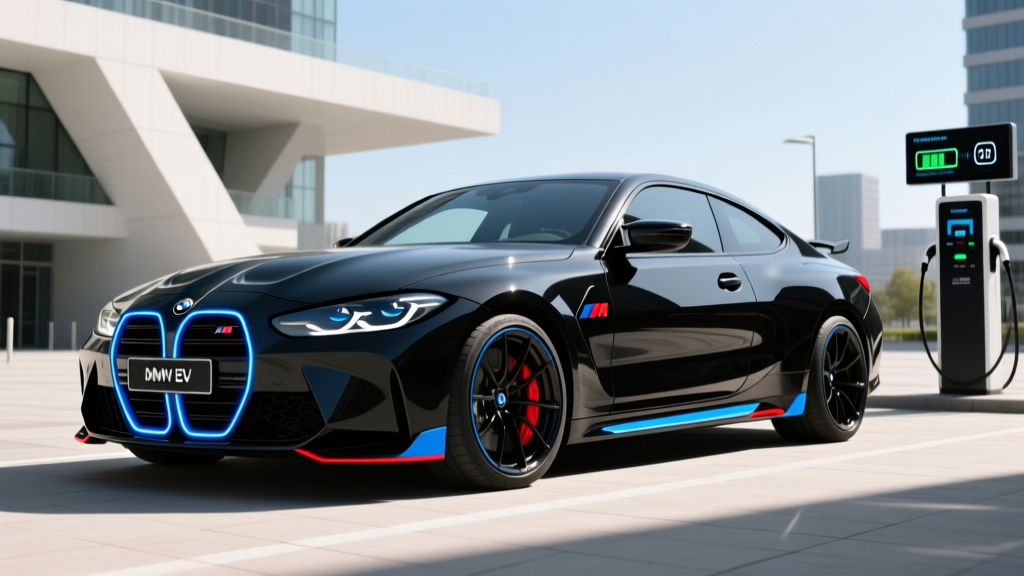
Quick Answer: Is There a BMW M3 EV You Can Buy Right Now?
No. As of mid-2026, BMW has not yet put an electric M3 into production. What exists is the BMW Vision Neue Klasse concept (debuted 2023), the i5 M60 as BMW's current top electric performance sedan, and strong official signals that a next-generation M3 on the Neue Klasse platform will arrive as a battery-electric vehicle — likely for the 2028 or 2029 model year. Everything below about the "BMW M3 EV" reflects announced platform specs, BMW executive statements, and informed projections. Final production specs, pricing, and EPA certification are not yet available.
What the BMW M3 EV Actually Is (and Isn't)
The current BMW M3 (G80) is a twin-turbo 3.0-liter inline-six performance sedan producing up to 523 hp in Competition xDrive form, with EPA fuel economy around 19 mpg combined. It is not electrified. BMW has confirmed that the next M3 will ride on the Neue Klasse architecture — a dedicated EV platform debuting with mainstream models in 2025–2026 — and will be fully electric.
BMW M boss Frank van Meel has publicly stated that the next M3 will use a quad-motor all-wheel-drive layout (one motor per wheel) with torque vectoring, and will sit on an 800-volt electrical architecture. BMW has also confirmed the Neue Klasse platform will use cylindrical battery cells (similar in form factor to Tesla's 4680 cells) with roughly 20% higher energy density than today's BMW prismatic cells, and up to 30% faster charging.
What we do not yet have: an official model name (BMW may drop the "M3" badge or modify it), a confirmed on-sale date, EPA range figures, or MSRP. Treat every number below as a projection anchored to confirmed platform data.
Projected Specs: BMW M3 EV vs. Current Gas M3 vs. i5 M60
The table below compares what we know about the current gas M3 Competition, BMW's current electric performance flagship (i5 M60), and a reasoned projection for the next-gen electric M3 based on Neue Klasse platform disclosures and BMW M statements.
| Attribute | 2026 M3 Competition xDrive (G80) | 2026 i5 M60 xDrive | Next-Gen M3 EV (Projected, ~2028-29) |
|---|---|---|---|
| Powertrain | 3.0L twin-turbo I6, 8-speed auto | Dual-motor AWD | Quad-motor AWD (one per wheel) |
| Horsepower | 523 hp | 593 hp | ~700–800+ hp (estimated) |
| 0–60 mph | 3.4 sec (mfg) | 3.7 sec (mfg) | ~2.5–3.0 sec (est.) |
| Battery / Fuel | 15.6-gal tank, premium required | 84.3 kWh usable, NMC | ~100 kWh usable, cylindrical NMC (est.) |
| EPA Range / Tank Range | ~340 mi (tank) | 295 mi (EPA) | ~320–380 mi (est. EPA) |
| Architecture | CLAR (ICE) | CLAR (EV adaptation) | Neue Klasse (dedicated EV, 800V) |
| Max DC Fast Charge | N/A | 205 kW peak | ~300–350 kW peak (est., 800V) |
| 10–80% DC Charge Time | N/A | ~30 min | ~18–22 min (est.) |
| Base MSRP | ~$85,300 | $85,100 | ~$95,000–$115,000 (est.) |
| Federal §30D Tax Credit | Not eligible | Not eligible (MSRP cap for sedans is $55,000) | Unlikely eligible (MSRP cap) |
Sources: BMW Group PressClub, fueleconomy.gov for i5 M60 and M3 data.
Neue Klasse Platform: What's Confirmed vs. Speculated
BMW has disclosed several hard facts about Neue Klasse that anchor any M3 EV projection:
- Round cylindrical cells in a 46mm diameter format (two lengths planned). BMW claims ~20% energy-density improvement and ~30% faster charging vs. current Gen5 eDrive prismatic cells.
- 800-volt architecture across the platform, enabling higher peak DC charge rates — realistically 300+ kW for performance variants, comparable to Porsche Taycan and Hyundai Ioniq 5 N.
- Gen6 eDrive motors with reduced rare-earth content and higher power density.
- Structural battery pack contributing to chassis stiffness — critical for an M car's handling target.
- "Heart of Joy" central compute unit consolidating driving dynamics, powertrain, and chassis control into one processor — enabling the kind of per-wheel torque-vectoring a quad-motor M3 demands.
What remains unconfirmed: exact battery capacity for the M variant, whether BMW will offer a lower-output "M340e-equivalent" electric M3 alongside a full M3, thermal management specifics for sustained track use, and final curb weight. Expect the electric M3 to weigh 4,800–5,100 lbs — roughly 1,000 lbs heavier than the gas M3 — which BMW will need to mask with torque vectoring and a low center of gravity.
Charging Reality: What 800V Actually Means for an M3 EV Owner
An 800-volt architecture is the single most ownership-relevant spec for a future M3 EV. Here's what it translates to in practice:
| Charging Level | Power (kW) | Typical Scenario | Miles Added per Hour |
|---|---|---|---|
| Level 1 (120V household) | ~1.4 kW | Emergency trickle | ~4–5 mi/hr |
| Level 2 (240V home, 48A) | ~11.5 kW | Overnight home charging | ~35–40 mi/hr (full charge in ~9 hr) |
| DC Fast (350 kW station) | ~300–350 kW peak | Road-trip fast charge | 10–80% in ~18–22 min (est.) |
| DC Fast (150 kW station) | ~150 kW sustained | Common public charger | 10–80% in ~35–40 min |
Critical nuance: Peak charge rate (kW) is not sustained charge rate. Even on a 350 kW Electrify America or Tesla Supercharger V4 stall, the M3 EV will likely hold peak rate only between roughly 10–40% State of Charge, then taper. The "10–80% in ~20 min" projection assumes battery preconditioning is active and ambient temps are moderate. In cold weather (below 40°F), expect 10–80% times to stretch by 30–50% unless preconditioning warms the pack en route to the charger.
Real-World Range: Why the EPA Sticker Won't Tell the Whole Story
Projected EPA Range: ~320–380 miles (based on ~100 kWh usable battery and 2.5–3.0 mi/kWh efficiency typical of performance AWD sedans).
Real-World Expectations:
- Highway (70–80 mph, moderate temps): ~260–310 miles. Aerodynamic drag dominates at speed; performance tires add rolling resistance.
- Cold weather (below 32°F, highway): ~200–250 miles. Battery internal resistance increases, cabin heating draws 3–5 kW continuously, and regenerative braking is limited until the pack warms.
- Track day: Effectively 80–120 miles of hard driving before needing a charge. Sustained high-power output and aggressive braking/acceleration cycles drain a battery far faster than any EPA cycle.
This is the honest math for any high-performance EV. The Porsche Taycan Turbo GT (EPA 269–292 mi depending on trim) and Tesla Model S Plaid (EPA 359 mi but closer to 280 mi at highway speed) show the same pattern. BMW's cylindrical-cell chemistry may improve energy density, but physics doesn't negotiate.
Cost of Ownership: Electric M3 vs. Gas M3 — The Real Numbers
Even at projected pricing, the ownership economics diverge sharply from the gas M3. Below is a 5-year / 60,000-mile comparison using the current gas M3 Competition xDrive and a projected M3 EV at ~$105,000 MSRP.
| Cost Category | Gas M3 Competition xDrive (~$85,300) | M3 EV (Projected, ~$105,000) |
|---|---|---|
| Purchase Price (MSRP) | $85,300 | $105,000 (est.) |
| Federal Tax Credit (§30D) | $0 | $0 (exceeds $55K sedan MSRP cap) |
| Fuel / Electricity (60K mi) | ~$12,600 (19 mpg combined, $4.00/gal premium) | ~$3,600 (home L2 at $0.15/kWh, 2.8 mi/kWh) |
| Maintenance (5 yr) | ~$4,500 (oil, brakes, spark plugs, fluids) | ~$1,500 (cabin filter, wipers, brake fluid, tire rotation) |
| Tires (performance, 2 sets) | ~$3,200 | ~$3,600 (EV torque wears tires faster) |
| Insurance (avg 5 yr) | ~$16,000 | ~$18,500 (EV performance premium) |
| Estimated Depreciation (5 yr) | ~$38,000 | ~$50,000 (higher starting price, EV depreciation curve) |
| Total 5-Year Cost (est.) | ~$159,600 | ~$182,200 |
| Cost per Mile | ~$2.66 | ~$3.04 |
Key takeaways:
- The M3 EV will almost certainly cost more to own over 5 years, primarily due to higher purchase price and steeper depreciation on a six-figure EV.
- Fuel savings are substantial (~$9,000 over 5 years) but don't close the gap.
- Maintenance savings are real — no oil changes, far less brake wear thanks to regenerative braking — but tires cost more on a heavy, high-torque EV.
- This is a passion purchase, not an economics play. The same is true of the gas M3.
Fuel cost assumptions based on fueleconomy.gov electricity and gasoline cost calculators. Insurance estimates reflect industry averages for performance vehicles; actual quotes vary by driver, state, and carrier. Depreciation is projected using current EV luxury-sedan trends.
Myths vs. Facts: Common Misconceptions About the BMW M3 EV
| Myth | Fact |
|---|---|
| "The electric M3 is available now." | It is not. The current M3 (G80) is gas-only. The next-gen electric M3 is expected for the 2028–2029 model year at the earliest. |
| "It will qualify for the $7,500 federal tax credit." | Almost certainly not. IRS §30D caps the credit for sedans at $55,000 MSRP. The M3 EV will far exceed that. See IRS §30D rules. |
| "An electric M3 won't feel like a real M car." | Quad-motor torque vectoring can simulate (and in some axes exceed) the dynamic capability of a mechanical limited-slip differential. The question is weight and steering feel — valid concerns BMW will need to address. |
| "800V means it charges at 800 kW." | No. Voltage (V) and power (kW) are different. 800V architecture enables higher charge power with lower current, but actual peak charge rate depends on battery chemistry and thermal management. Expect ~300–350 kW peak, not 800 kW. |
| "I can track it all day like a gas M3." | Thermal management for sustained track use is the hardest engineering challenge for any performance EV. Expect meaningful power derating after 2–3 hot laps until battery and motor cooling systems mature. |
Decision Framework: Should You Wait for the M3 EV or Buy Now?
Buy the current gas M3 Competition now if:
- You want an M3 in your garage within 30 days, not in 2–3 years.
- Track days are a priority — the S58 inline-six is a proven, thermally robust engine with a massive aftermarket.
- You love the sound, shift character, and analog feedback of a turbocharged six.
- You live in an area with limited DC fast-charging infrastructure.
Buy the i5 M60 now as an electric BMW performance sedan if:
- You want a fast, quiet, daily-drivable electric BMW today and don't need M3-level aggression.
- Your commute is under 200 miles and you have Level 2 home charging.
- You're comfortable with 295 miles of EPA range and ~593 hp.
Wait for the electric M3 (Neue Klasse) if:
- You're 2+ years out from your next purchase anyway.
- You want the cutting-edge of BMW M's electric performance engineering and can accept early-adopter risk (first-year model bugs, uncertain depreciation).
- You have reliable home Level 2 charging and access to 150+ kW DC fast chargers for road trips.
- Instant torque, sub-3-second 0–60, and per-wheel torque vectoring excite you more than exhaust note.
What First-Time EV Buyers Should Know Before Committing to a Performance EV
If the M3 EV is your entry point into electric ownership, understand these realities before putting down a deposit:
- Home charging is nearly mandatory. Public DC fast charging at 150–350 kW stations costs $0.35–$0.55/kWh in many markets — sometimes more than gasoline per mile. The economic advantage of EVs depends heavily on home Level 2 charging at residential electricity rates ($0.10–$0.20/kWh in most US states). Budget $800–$2,500 for a quality Level 2 home charger installation (equipment + licensed electrician + permit), and potentially $2,000–$5,000 more if your home needs an electrical panel upgrade to 200A service.
- Cold weather is real range loss. If you live in the upper Midwest or Northeast, plan for 30–40% range reduction in sustained sub-freezing temperatures. A garage-kept car fares better than one parked outside.
- Tire costs are higher. EVs are heavy (the i5 M60 is 5,390 lbs) and deliver instant torque. Expect performance tire life of 15,000–25,000 miles — shorter than on a comparable gas car.
- Insurance premiums run 15–25% higher for performance EVs vs. their gas equivalents, driven by higher repair costs and total-loss thresholds.
- The §30D tax credit has strict rules. Even if a future M3 EV somehow fell under the $55,000 sedan MSRP cap (it won't), you'd still need to meet buyer income limits ($150K single / $300K joint AGI), battery critical-mineral sourcing requirements, and North American final assembly. Always verify current-year rules at IRS.gov and consult a tax professional.
Frequently Asked Questions
When will the BMW M3 EV be available to buy?
BMW has not announced a firm on-sale date. Based on the Neue Klasse rollout timeline (mainstream sedans/SUVs starting 2025–2026, M variants following), the earliest realistic availability is the 2028 or 2029 model year, meaning late 2027 at the earliest for first deliveries.
Will the electric M3 have a manual transmission or simulated gears?
BMW has not confirmed. The i5 and iX use single-speed reductions. Hyundai's Ioniq 5 N simulates 8-speed shifts with software-defined torque interruptions — BMW M may implement something similar to preserve engagement, but this is speculation.
Will BMW keep selling a gas M3 alongside the electric one?
BMW CEO Oliver Zipse has indicated the company will maintain flexible powertrains as long as demand exists. However, EU CO2 fleet-average regulations tighten significantly after 2027, making a high-output gas M3 increasingly difficult to sell in Europe. A US-only gas M3 continuation is possible but unconfirmed.
How does the projected M3 EV compare to the Tesla Model S Plaid or Porsche Taycan Turbo GT?
The Model S Plaid (1,020 hp, 0–60 in 1.99 sec, EPA 359 mi, ~$90K) will likely be quicker in a straight line but is a larger, heavier sedan without M-car chassis tuning. The Taycan Turbo GT (1,019 hp w/Launch Control, 0–60 in 2.1 sec, EPA 269–292 mi, ~$230K) is the current benchmark for EV track capability. The M3 EV will target the Taycan's handling dynamics at a significantly lower price point, with competitive but not record-breaking straight-line performance.
Can I reserve a BMW M3 EV now?
No. BMW has not opened reservations for any Neue Klasse M variant. Be wary of third-party sites claiming to accept deposits. Official reservations will open through BMW USA only when the production model is announced.