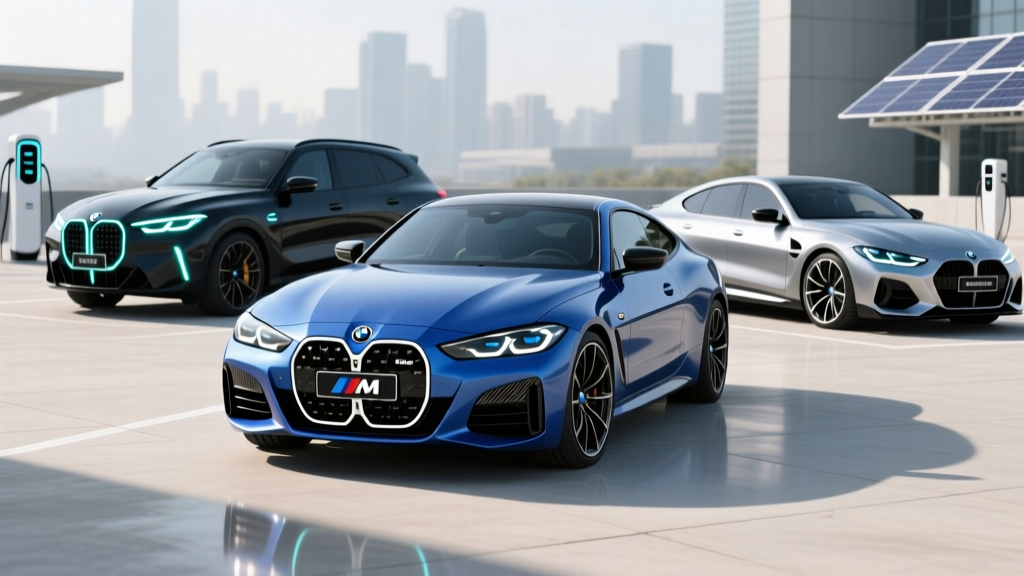
Quick Answer: BMW's M electric performance lineup for 2026 spans three core models: the i4 M50 (536 hp, EPA 227–270 mi, from ~$69,700), the iX M60 SUV (610 hp, EPA 288 mi, from ~$111,500), and the flagship i7 M70 sedan (650 hp, EPA 295 mi, from ~$169,700). These deliver M-car acceleration (0-60 in 3.3–3.7 seconds) with daily-usable range and DC fast charging up to 195–205 kW. Unlike traditional M cars, they eliminate fuel costs (~$1,800–$2,400/year saved vs. an M3 or X5 M) but carry higher insurance premiums, heavier curb weights, and steeper upfront prices. They're best for buyers who want M-badge performance with daily EV practicality and have reliable home Level 2 charging access.
BMW M Electric: What the Badge Actually Means
BMW M GmbH has historically meant high-revving inline-sixes and V8s, track-tuned suspensions, and rear-biased dynamics. The electric M models — badged as "M Performance" rather than full-blooded M cars — reinterpret that formula around electric torque, dual-motor all-wheel drive, and adaptive dampers tuned for the extra mass of a 100+ kWh battery pack.
The distinction matters. A traditional BMW M3 Competition ($76,900, 503 hp, twin-turbo I-6) weighs 3,830 lbs. The i4 M50 weighs 4,891 lbs — over 1,000 lbs heavier. That mass affects cornering feel, tire wear, and braking distances, even though the i4 M50's instant electric torque delivers a quicker 0-60 time (3.7 seconds vs. the M3's 3.8 seconds).
For 2026, BMW is also preparing its next-generation Neue Klasse M performance EVs on an 800-volt architecture, with the first M3 electric successor expected to arrive as a 2027 model. Until then, the current i4 M50, iX M60, and i7 M70 represent the production BMW M electric lineup you can actually buy.
Spec Comparison: BMW M Electric Models Side by Side
| Spec | i4 M50 | iX M60 | i7 M70 |
|---|---|---|---|
| Powertrain | Dual-motor AWD | Dual-motor AWD | Dual-motor AWD |
| Horsepower | 536 hp | 610 hp | 650 hp |
| Torque | 586 lb-ft | 811 lb-ft | 749 lb-ft |
| 0–60 mph | 3.7 sec | 3.6 sec | 3.5 sec |
| Battery (usable) | 81.5 kWh, NMC | 105.2 kWh, NMC | 101.7 kWh, NMC |
| EPA Range | 227–270 mi | 288 mi | 295 mi |
| Efficiency | 86 MPGe combined | 85 MPGe combined | 82 MPGe combined |
| Max DC Charge Rate | 205 kW | 195 kW | 195 kW |
| 10–80% DC Charge | ~31 min | ~35 min | ~34 min |
| Level 2 (240V) Rate | 11 kW | 11 kW | 11 kW |
| Curb Weight | 4,891 lbs | 5,840 lbs | 6,100 lbs |
| Starting MSRP | $69,700 | $111,500 | $169,700 |
| Federal Tax Credit (§30D) | Up to $7,500* | Up to $7,500* | Not eligible (over MSRP cap) |
| Battery Warranty | 8 yr / 100,000 mi | 8 yr / 100,000 mi | 8 yr / 100,000 mi |
*§30D credit eligibility depends on buyer income caps, battery critical-mineral sourcing requirements, and MSRP limits ($55,000 sedans / $80,000 SUVs). The i4 M50 sedan MSRP exceeds the $55K sedan cap at most trims; consult IRS §30D guidelines and a tax professional for your specific situation. The iX M60 qualifies under the $80K SUV cap only at base pricing before options push it higher.
Real-World Range Reality Check: EPA estimates assume a mix of city and highway driving at moderate temperatures. In real-world highway testing at 70–75 mph, expect the i4 M50 to deliver roughly 200–230 miles on a full charge, the iX M60 around 250–265 miles, and the i7 M70 approximately 255–275 miles. In cold weather (below 32°F), reduce those figures by 15–25% due to cabin heating demands and reduced battery efficiency. BMW's heat pump (standard on all three) mitigates some of this loss but doesn't eliminate it.
EV vs. Gas M Cars: Performance and Cost Compared
The most common question from M enthusiasts: how do these electric M models compare to their gasoline counterparts in both performance and wallet impact? Let's run the numbers on two direct comparisons.
| Metric | i4 M50 (EV) | M3 Competition (Gas) |
|---|---|---|
| Horsepower | 536 hp | 503 hp |
| 0–60 mph | 3.7 sec | 3.8 sec |
| Top Speed | 140 mph (limited) | 180 mph (w/ M Driver's Pkg) |
| Curb Weight | 4,891 lbs | 3,830 lbs |
| EPA Efficiency | 86 MPGe (39 kWh/100mi) | 19 MPG combined |
| Annual Fuel/Energy Cost | ~$800–$1,100 | ~$2,600–$3,200 |
| Starting MSRP | $69,700 | $76,900 |
| Estimated Annual Insurance | $2,800–$3,400 | $2,200–$2,800 |
| Annual Maintenance | ~$300–$500 | ~$900–$1,500 |
Key takeaways from this comparison:
- Acceleration parity, different character: The i4 M50's instant torque gives it a slight 0-60 advantage, but the M3's lighter weight and rear-drive bias deliver a more engaging cornering experience that most driving enthusiasts prefer on back roads.
- Fuel savings are substantial: At 12,000 miles/year and $0.14/kWh home charging, the i4 M50 costs roughly $660/year in electricity. The M3 at 19 MPG and $3.80/gallon premium costs about $2,400/year. That's a ~$1,740 annual savings with the EV.
- Insurance runs higher for the EV: EV insurance premiums run 15–25% higher on average due to specialized repair requirements and battery replacement costs. Budget an extra $500–$800/year.
- Maintenance favors the EV heavily: No oil changes, no spark plugs, no transmission fluid. Regenerative braking extends pad life significantly. Expect 60–70% lower maintenance costs.
| 5-Year Cost Category | i4 M50 | M3 Competition |
|---|---|---|
| Purchase Price (base) | $69,700 | $76,900 |
| Federal Tax Credit | –$0 to $7,500* | $0 |
| Fuel/Energy (5 yrs) | $3,300–$5,500 | $13,000–$16,000 |
| Maintenance (5 yrs) | $1,500–$2,500 | $4,500–$7,500 |
| Insurance (5 yrs) | $14,000–$17,000 | $11,000–$14,000 |
| Estimated 5-Yr Total | $81,000–$95,200 | $105,400–$114,400 |
*Tax credit availability varies. Even without the credit, the i4 M50 saves $10,000–$20,000 over 5 years in operating costs. Source: fueleconomy.gov for efficiency data.
Charging the BMW M Electric Fleet: Home and Road
All three BMW M electric models use the CCS1 (Combined Charging System) connector for DC fast charging and the J1772 connector for Level 2 AC charging. BMW has confirmed that future Neue Klasse models will adopt the NACS (Tesla-style) connector, but the current lineup remains CCS1.
| Charging Level | Power | Approx. Miles Added/Hour | Use Case |
|---|---|---|---|
| Level 1 (120V) | 1.4 kW | 3–5 mi/hr | Emergency / overnight trickle only |
| Level 2 (240V, 48A) | 11 kW | 28–35 mi/hr | Home daily charging (8–10 hr for full) |
| DC Fast Charge | Up to 205 kW (i4) | ~180 mi in 10 min (peak) | Road trips, 10–80% in ~31 min |
Charging curve reality: The advertised peak of 205 kW (i4 M50) or 195 kW (iX/i7) is sustained only between roughly 10–30% state of charge. Above 50%, the rate tapers to 100–120 kW; above 80%, it drops further to 50 kW or less. This is why manufacturers quote 10–80% times rather than 0–100%. On a road trip, plan stops around the 10–80% window for maximum charging speed.
Preconditioning matters: All three models support battery preconditioning when you navigate to a DC fast charger via the built-in navigation. This warms the battery to optimal temperature, enabling peak charge rates. Without preconditioning — especially in cold weather — your initial charge rate may be limited to 50–80 kW until the battery warms up, adding 10–15 minutes to your stop.
Home charging setup: With 11 kW onboard chargers, all three models can fully recharge overnight on a 48-amp Level 2 home station (requires a 60-amp circuit). Installation costs for a home Level 2 charger typically range from $800 (simple outlet near panel) to $3,500+ (panel upgrade required for older homes). The iX M60's 105 kWh battery needs about 9.5 hours from empty on Level 2; the i4 M50's 81.5 kWh battery needs about 7.5 hours.
Real-World Ownership: What First-Time EV Buyers Must Know
Buying a BMW M electric vehicle is not the same as buying a gas M car. Here are the practical realities that spec sheets don't highlight:
Home Charging Access Is Non-Negotiable
Public DC fast charging at Electrify America or EVgo costs $0.35–$0.55/kWh in most metro areas. At those rates, fueling an i4 M50 costs $1,400–$2,200/year — erasing much of the savings over gas. Home charging at $0.12–$0.16/kWh is where the economics work. If you live in an apartment without charging access, a BMW M electric vehicle will cost you more to operate than expected and add inconvenience to your routine.
Cold Weather Cuts Range Harder Than You'd Think
BMW's NMC batteries lose efficiency below freezing. In sustained sub-32°F driving, expect 15–25% range reduction even with the standard heat pump. An i4 M50 rated at 270 miles EPA (with 19-inch wheels) may deliver only 200–220 miles in January in Chicago or Boston. If your commute is 80+ miles round-trip in a cold climate, the iX M60's larger battery provides a more comfortable buffer.
Tire Wear Accelerates on Heavy EVs
At 4,891–6,100 lbs with instant torque, BMW M electric models wear through tires faster than their gas counterparts. Expect to replace tires every 20,000–30,000 miles rather than the 35,000–45,000 miles typical for lighter gas cars. Budget $1,200–$2,000 for a set of performance tires every 2–3 years.
Regenerative Braking Changes Your Driving
BMW's adaptive regen system (with selectable levels and an "Auto" mode that uses radar to adjust deceleration) enables near-one-pedal driving in most situations. Expect a 1–2 week adjustment period. The benefit: brake pads last 80,000–100,000+ miles since the motors handle most deceleration.
Myths vs. Facts About BMW M Electric Performance
| Myth | Fact |
|---|---|
| "Electric M cars aren't real M cars" | They're officially "M Performance" models — a tier below full M, similar to how Mercedes-AMG positions its 43/53 vs 63 models. They deliver genuine performance but with a different character. |
| "The battery will need replacing in 5 years" | BMW warranties the battery for 8 years/100,000 miles against degradation below 70% capacity. Industry data shows NMC batteries typically retain 85–90% capacity after 100,000 miles with normal use. |
| "DC fast charging destroys the battery" | Occasional DC fast charging has minimal impact. BMW's thermal management system actively cools the battery during fast charging. Daily Level 2 home charging with occasional road-trip DC fast charging is the recommended pattern. |
| "They handle like gas M cars" | The extra 1,000–2,000 lbs of battery mass is physically unavoidable. These cars grip well and are fast, but they don't change direction with the agility of a 3,830-lb M3. They're grand-touring fast, not track-weapon sharp. |
| "You'll get the full $7,500 tax credit" | Federal §30D credit depends on buyer AGI limits, vehicle MSRP caps ($55K sedans / $80K SUVs), and battery mineral sourcing. Most BMW M electric models exceed base MSRP caps — verify current eligibility on IRS.gov before counting on it. |
Decision Framework: Which BMW M Electric (or Gas) Is Right for You?
Choose the i4 M50 if:
- You want M-badge acceleration in a daily-driver sedan under $75K
- Your commute is under 100 miles round-trip
- You have home Level 2 charging
- You prioritize instant torque and low running costs over track-day dynamics
Choose the iX M60 if:
- You need SUV cargo space and all-weather capability
- You want the longest range in the M electric lineup (288 mi EPA)
- Family hauling is a priority alongside performance
- Budget allows $110K+ for an electric performance SUV
Choose the i7 M70 if:
- You're cross-shopping a Mercedes-AMG EQS or Porsche Taycan Turbo
- Luxury and rear-seat comfort matter as much as performance
- Tax credit eligibility is irrelevant at this price point
- You want 650 hp in a whisper-quiet executive sedan
Stick with a gas M3/M4/M5 if:
- Track driving is a regular activity (weight matters on brakes and tires)
- You lack reliable home charging access
- You value engine sound, rev character, and lightweight handling feel
- You frequently drive in rural areas with sparse DC charging infrastructure
Looking Ahead: Neue Klasse M and the 800V Future
BMW's next-generation Neue Klasse platform, debuting in production form for 2026–2027, promises an 800-volt architecture enabling DC fast charging at 300+ kW, next-gen cylindrical battery cells with ~20% higher energy density, and a dedicated electric M3 successor. BMW M CEO Franciscus van Meel has confirmed that a full electric M3 is in development, targeting the performance envelope of the current M3 CSL but with all-electric propulsion.
Until those models arrive, the current i4 M50, iX M60, and i7 M70 are the production BMW M electric vehicles available today — and they represent a compelling, if imperfect, bridge between BMW's M heritage and its electric future. For data on safety ratings, check IIHS and NHTSA for the latest crash-test results on each model.
Frequently Asked Questions
Does BMW make a full M electric car, or only M Performance models?
As of 2026, BMW offers "M Performance" electric models (i4 M50, iX M60, i7 M70). A full electric M3 successor based on the Neue Klasse platform is in development and expected as a 2027–2028 model. The M Performance badge sits between standard BMW models and full M cars, similar to how M Sport packages and M50i/M60i models are positioned in the gas lineup.
What is the real-world range of the BMW i4 M50?
The i4 M50 carries an EPA rating of 227–270 miles depending on wheel size (20-inch wheels reduce range vs. 19-inch). In real-world highway driving at 70–75 mph, expect 200–230 miles. In cold weather below freezing, that drops to approximately 170–195 miles. Preconditioning and using the heat pump efficiently can recover some of that loss.
How much does it cost to charge a BMW iX M60 at home?
The iX M60 has a usable battery of approximately 105.2 kWh. At the US average electricity rate of ~$0.16/kWh, a full charge costs about $16.80. For an average driver covering 12,000 miles/year at 39 kWh/100mi, annual home charging costs approximately $740–$900, compared to $2,400–$3,000 for a comparable gas SUV on premium fuel.
Can I use Tesla Superchargers with a BMW M electric vehicle?
Not directly. Current BMW M electric models use the CCS1 connector, while Tesla Superchargers use NACS. BMW has not yet released a NACS adapter for current models, though third-party CCS-to-NACS adapters are beginning to enter the market. Future Neue Klasse BMWs will ship with native NACS ports. For now, Electrify America, EVgo, and ChargePoint provide the primary DC fast charging network for BMW EVs.
Do BMW M electric models qualify for the $7,500 federal tax credit?
It depends. The §30D credit has an MSRP cap of $55,000 for sedans and $80,000 for SUVs. The i4 M50 starts at ~$69,700 (over the sedan cap), and the iX M60 starts at ~$111,500 (over the SUV cap). The i7 M70 at $169,700 is well over any cap. Additionally, buyer income limits ($150K single / $300K joint) and battery mineral sourcing requirements apply. Always verify current rules on IRS.gov and consult a tax professional.
How does BMW's battery warranty work?
BMW covers the high-voltage battery for 8 years or 100,000 miles (whichever comes first) against defects and capacity loss below 70% of original capacity. If the battery degrades beyond that threshold within the warranty period, BMW will repair or replace it. Based on industry NMC battery data, most BMW EV batteries retain 85–92% capacity at 100,000 miles under normal use patterns.