Quick Verdict: The BMW iX in Alpine White
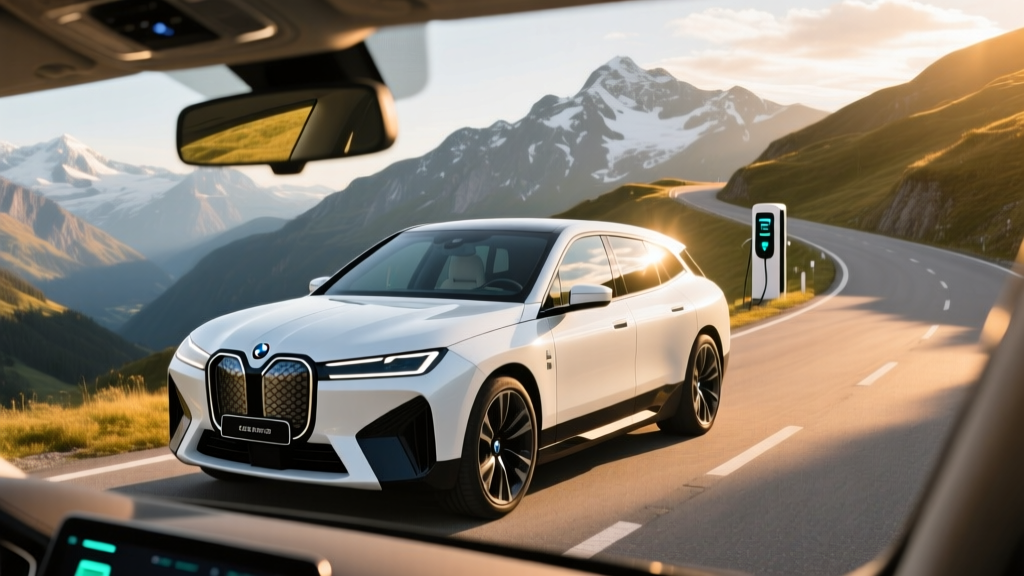
The BMW iX remains one of the most refined luxury electric SUVs on the market, and in Alpine White (BMW paint code 300), it presents a clean, architectural aesthetic that photographs well and hides minor road grime better than the brand's darker metallics. Underneath that polarizing kidney grille lies a serious EV platform: dual-motor all-wheel drive, a 105.2 kWh (usable) battery pack, and DC fast-charging that peaks at 200 kW. For 2026, BMW has streamlined the iX lineup into the xDrive50 and the performance-oriented M60, with the xDrive50 delivering an EPA-estimated 324 miles of range — enough for confident road-tripping when paired with the car's excellent thermal management system.
This review covers the xDrive50 in detail, with M60 comparisons where specs diverge. We'll break down real-world range expectations, the charging curve you'll actually see at a public DC fast charger, total pricing after potential tax incentives, and whether the iX earns its premium over rivals like the Mercedes EQE SUV, Audi Q8 e-tron, and Tesla Model X.
Range and Efficiency: EPA Sticker vs. Real World
Real-World Expectation: ~260–290 miles highway at 70–75 mph; ~220–250 miles in sub-30°F winter conditions
Efficiency: 86 MPGe combined / 39 kWh per 100 miles
The xDrive50's 324-mile EPA rating is achieved with the standard 20-inch Aero wheels. Opting for the available 21- or 22-inch wheels reduces that figure by roughly 10–15 miles due to increased rolling resistance and weight. According to fueleconomy.gov, the xDrive50 posts 86 MPGe combined, which translates to 39 kWh consumed per 100 miles of driving — competitive for a 5,600-pound luxury SUV.
In real-world highway testing at sustained 70–75 mph speeds, expect roughly 260–290 miles before needing to charge, depending on terrain, wind, and temperature. The iX's heat pump (standard on all 2026 models) mitigates cold-weather range loss compared to EVs without active thermal management, but any lithium-ion pack will lose 15–25% range in sustained sub-freezing temperatures. City and suburban driving with regenerative braking engaged recovers more energy, often returning 300+ miles in mild conditions.
The M60 variant sacrifices range for power: its EPA estimate drops to approximately 288 miles (20-inch wheels) due to a sportier tune, stickier tires, and more aggressive power delivery.
Battery, Charging Speed, and the Real Charge Curve
| Spec | xDrive50 | M60 |
|---|---|---|
| Battery Capacity (Usable) | 105.2 kWh | 105.2 kWh |
| Battery Chemistry | NMC (Nickel Manganese Cobalt) | NMC |
| Max DC Fast Charge Rate | 200 kW | 200 kW |
| 10–80% DC Fast Charge Time | ~31 minutes | ~31 minutes |
| Level 2 AC Charge Rate | 11 kW (onboard charger) | 11 kW |
| Level 2 Miles per Hour | ~25–28 mi/hr | ~23–25 mi/hr |
| Level 1 (120V) Miles per Hour | ~3–4 mi/hr | ~3–4 mi/hr |
| Charge Port / Connector | CCS1 (J1772 combo) | CCS1 |
The iX uses an NMC (nickel manganese cobalt) lithium-ion battery with 105.2 kWh of usable capacity. BMW quotes a 200 kW peak DC fast-charging rate, and in practice the iX sustains strong charging speeds through the 10–60% state of charge window before tapering. Expect roughly 15–18 minutes to go from 10% to 60%, with the full 10–80% session taking approximately 31 minutes at a functioning 200+ kW charger (Electrify America, EVgo, or compatible Ionity stations in Europe).
Here's where real-world ownership matters: peak kW is not sustained kW. Above 80% SoC, charging slows dramatically — often below 50 kW — to protect battery longevity. Plan your road trips to charge from 10–80% and skip; charging to 100% at a DC fast station adds 30+ minutes for relatively few extra miles. Preconditioning the battery via the iDrive navigation system (set your charger as the destination) warms the pack for optimal charge acceptance, which is especially important in cold weather.
At home, the iX's 11 kW onboard charger means a full Level 2 session (from 10% to 100%) takes roughly 10–11 hours on a 48-amp hardwired station, or about 12–13 hours on a 40-amp NEMA 14-50 outlet. Overnight charging easily replenishes daily driving.
Performance: 0–60, Horsepower, and Drivetrain
| Spec | xDrive50 | M60 |
|---|---|---|
| Drivetrain | Dual-Motor AWD | Dual-Motor AWD |
| Horsepower | 516 hp | 610 hp |
| Torque | 564 lb-ft | 811 lb-ft |
| 0–60 mph | 4.4 seconds | 3.6 seconds |
| Top Speed | 124 mph (electronically limited) | 155 mph |
| Towing Capacity | 3,500 lbs | 3,500 lbs |
The xDrive50's 516 horsepower and 4.4-second 0–60 time make it genuinely quick for a family SUV. BMW's fifth-generation eDrive technology places one motor on each axle, providing precise torque vectoring and confident all-weather traction. The M60's 610 hp drops the sprint to 3.6 seconds — sports-car territory in a vehicle with over 100 cubic feet of passenger volume.
Regenerative braking offers adjustable levels via steering-wheel paddles, and the adaptive mode uses navigation and sensor data to modulate regen automatically — approaching a slower car ahead increases regen; open road ahead lets the iX coast freely. It's one of the most intuitive one-pedal-like implementations without forcing full one-pedal driving.
Pricing, Trims, and Federal Tax Credit Eligibility
| Trim | Base MSRP | As-Tested (Typical) | §30D Credit Eligible? |
|---|---|---|---|
| xDrive50 | $87,250 | $92,000–$98,000 | No (exceeds MSRP cap) |
| M60 | $111,500 | $118,000–$125,000 | No (exceeds MSRP cap) |
Here's the hard truth for tax-credit seekers: the BMW iX does not qualify for the $7,500 federal EV tax credit under IRS §30D rules. The reason is straightforward — the §30D credit caps eligible SUVs at an $80,000 MSRP, and the iX xDrive50 starts at $87,250. No trim, even with zero options, falls under the cap. This is a dealbreaker for buyers counting on the credit to offset the purchase price.
- ✅ Vehicle must be a new qualified plug-in EV
- ❌ SUV MSRP must be ≤ $80,000 (iX starts at $87,250 — fails)
- ❌ Buyer AGI: ≤ $150K single / $300K joint (must also meet)
- ❌ Battery critical minerals & component sourcing requirements (iX battery sourced outside qualifying FTA partners for some components)
- ✅ Point-of-sale transfer available for eligible vehicles (not applicable here)
Some buyers may offset costs through state-level incentives (check your local DMV or energy office), employer EV benefits, or utility company rebates for home charger installation. BMW Financial Services also periodically offers lease cash or loyalty credits that can reduce effective cost — but these are manufacturer incentives, not federal tax credits.
Interior, Cargo, and Passenger Space
The iX's cabin is where BMW's investment shows most clearly. The interior uses a mix of sustainable materials — recycled microfiber, FSC-certified wood, and olive-leaf-tanned leather — creating a minimalist-luxury atmosphere that differs from traditional BMW interiors. The curved display houses a 14.9-inch touchscreen and 12.3-inch instrument cluster running iDrive 8.5 (updated for 2026 with improved voice recognition and wireless Apple CarPlay/Android Auto).
| Measurement | Specification |
|---|---|
| Passenger Volume | 111.0 cu ft |
| Cargo (Behind 2nd Row) | 35.5 cu ft |
| Cargo (2nd Row Folded) | 77.9 cu ft |
| Front Legroom | 40.2 inches |
| Rear Legroom | 38.9 inches |
| Front Headroom | 40.5 inches (panoramic roof) |
| Seating Capacity | 5 passengers |
Rear-seat comfort is a genuine strength — the flat floor (no transmission tunnel) and 38.9 inches of legroom make the iX a credible family hauler. The panoramic electrochromic roof (optional Sky Lounge) dims electronically and eliminates the need for a physical shade, though some buyers prefer the guaranteed darkness of a traditional cover.
The 35.5 cu ft of cargo space behind the second row is adequate for weekly groceries and luggage for a family of four, though it trails the Tesla Model X (behind the second row) and the Mercedes EQS SUV. There is no front trunk (frunk) — BMW uses that space for HVAC and power electronics.
Technology and Driver Assistance
The iX comes standard with BMW's Driving Assistant Professional, which includes adaptive cruise control with stop-and-go, lane-keeping assist, automatic lane-change assist (when turn signal is activated), and evasive steering assist. This is an SAE Level 2 system — the driver must remain attentive, keep hands available, and monitor the road at all times. It is not autonomous driving.
The iX's Driving Assistant Professional provides combined steering, acceleration, and braking assistance. The driver is always responsible. BMW's Highway Assistant allows hands-off driving at speeds up to 85 mph on divided highways, but requires eyes-on monitoring via the driver-facing camera.
The Highway Assistant (standard on 2026 models) is one of the better Level 2 implementations available — it handles lane centering and speed management smoothly on interstate drives. However, it does not navigate on-ramps, exits, or traffic lights without driver input, distinguishing it from Tesla's FSD (Supervised) in capability scope, though many reviewers consider BMW's system more predictable and less prone to phantom braking.
The iDrive 8.5 infotainment system supports over-the-air updates, a natural-language voice assistant ("Hey BMW"), and a head-up display with augmented-reality navigation overlays. Available features include a Bowers & Wilkins 4D surround sound system (36 speakers), heated and ventilated front and rear seats, and the IconicSounds Electric suite (soundscapes composed by Hans Zimmer for acceleration and regeneration).
Warranty and Long-Term Ownership
| Coverage | Term |
|---|---|
| Limited Vehicle Warranty | 4 years / 50,000 miles |
| Powertrain Warranty | 4 years / 50,000 miles |
| High-Voltage Battery Warranty | 8 years / 100,000 miles |
| Battery Capacity Retention Threshold | 70% of original capacity |
| Corrosion Perforation | 12 years / unlimited miles |
| Roadside Assistance | 4 years / unlimited miles |
BMW guarantees the high-voltage battery will retain at least 70% of its original capacity over 8 years or 100,000 miles, whichever comes first. This is industry-standard and matches the federal minimum requirement. NMC chemistry in the iX has shown moderate degradation in early ownership data — most owners report 3–5% capacity loss in the first two years, leveling off afterward. BMW's battery management system maintains a generous buffer (roughly 6–8 kWh above and below the usable window) to protect long-term health.
Maintenance costs are lower than ICE BMW counterparts — no oil changes, fewer brake replacements (regen handles most deceleration), and cabin air filter swaps are the primary service items. BMW includes 3 years / 36,000 miles of complimentary scheduled maintenance.
Pros, Cons, and Who Should Buy the BMW iX
- 324-mile EPA range is road-trip capable
- 200 kW DC fast charging with strong sustained curve
- Refined ride quality and cabin quietness
- Genuine 516 hp / 4.4-sec 0–60 performance
- Premium sustainable interior materials
- Excellent Level 2 driver-assist (Highway Assistant)
- Heat pump standard for cold-weather efficiency
- 3,500-lb towing capacity
- Does NOT qualify for $7,500 federal tax credit (MSRP cap)
- Polarizing exterior design (large kidney grille)
- No front trunk (frunk)
- Cargo space trails some competitors
- iDrive touchpad/rotary controller learning curve
- CCS1 port (no native NACS; adapter required for Tesla Superchargers)
- High starting price with limited incentive offsets
Look elsewhere if: You need the $7,500 federal credit to justify the purchase, prioritize maximum cargo space (consider the Mercedes EQS SUV or Rivian R1S), or want access to the Tesla Supercharger network without an adapter (consider vehicles with native NACS ports).
Frequently Asked Questions
What is the real-world range of the BMW iX xDrive50?
The EPA rates the xDrive50 at 324 miles (20-inch wheels). In real-world highway driving at 70–75 mph, expect 260–290 miles. In sustained sub-30°F winter conditions, plan for 220–250 miles. The standard heat pump helps mitigate cold-weather losses compared to EVs without active battery thermal management.
How fast does the BMW iX charge at home and on the road?
At a DC fast charger rated 200 kW or higher, the iX charges from 10% to 80% in approximately 31 minutes, with peak speeds sustained through the 10–60% window. At home on a Level 2 station (11 kW / 48 amps), a full charge takes roughly 10–11 hours — easily done overnight. On a standard 120V outlet (Level 1), expect about 3–4 miles of range per hour.
Does the BMW iX qualify for the federal EV tax credit?
No. The iX xDrive50 starts at $87,250, which exceeds the IRS §30D MSRP cap of $80,000 for SUVs. The M60 at $111,500 is also ineligible. Additionally, the iX's battery sourcing does not fully meet the critical-minerals and battery-component requirements. Check IRS.gov for current rules, and consult a tax professional for your specific situation.
Is the BMW iX worth buying over the Mercedes EQE SUV or Audi Q8 e-tron?
The iX leads on range (324 vs. ~305 miles for the EQE SUV and ~285 for the Q8 e-tron) and charging speed. The EQE SUV offers a more traditional luxury aesthetic and slightly lower starting price. The Q8 e-tron provides strong value but trails on efficiency. If you prioritize range, modern tech, and driving dynamics, the iX is the strongest pick. If cabin tradition and dealer incentives matter more, cross-shop the EQE SUV.
Can the BMW iX charge at Tesla Superchargers?
Not natively. The iX uses a CCS1 (J1772 combo) charge port. BMW offers an approved CCS-to-NACS adapter that enables access to Tesla's Supercharger network, but charging speeds will be limited by the adapter and the Supercharger's CCS protocol handshake. Expect peak rates of roughly 150 kW through an adapter rather than the iX's native 200 kW capability.
What color is Alpine White and does it cost extra?
Alpine White (paint code 300) is BMW's standard non-metallic white and is included at no additional charge on the iX. It's a solid (non-metallic) finish that is easier to touch up and hides light scratches well. BMW also offers Mineral White Metallic (code A96) as an upgrade for $650, which adds metallic flake for more depth under direct sunlight.