If you've been searching for a luxury electric SUV and your research keeps circling back to the BMW Tesla debate, you're not alone. The BMW iX and Tesla Model X represent two fundamentally different philosophies of what a premium electric vehicle should be. One leans into traditional luxury craftsmanship and ride refinement; the other pushes tech-forward minimalism and raw performance. But beyond marketing, which one actually delivers when you factor in real-world range, charging infrastructure, ownership costs, and current federal tax credit rules?
We've driven both, charged both on public DC networks and at home, and dug into the EPA data so you don't have to guess. Here's the full breakdown.
Quick Verdict: Two Paths to Premium EV Ownership
The BMW iX xDrive50 is the comfort-first luxury cruiser — quieter, more plushly finished, and tuned for long-distance highway serenity. The Tesla Model X Long Range is the tech-and-performance play — faster, more spacious, and backed by the most reliable DC fast-charging network in North America.
Neither is universally "better." Your choice depends on whether you prioritize cabin refinement and ride quality (BMW) or maximum cargo space, acceleration, and Supercharger access (Tesla). Let's get into the numbers.
Side-by-Side Spec Comparison
| Specification | 2026 BMW iX xDrive50 | 2026 Tesla Model X Long Range |
|---|---|---|
| EPA Range | 324 miles | 335 miles |
| Battery (usable) | 105.2 kWh (NMC) | 100 kWh (NMC, estimated) |
| Drivetrain | Dual-motor AWD | Dual-motor AWD |
| Horsepower | 516 hp | 670 hp |
| 0–60 mph | 4.4 seconds | 3.8 seconds |
| Max DC Fast Charge | 195 kW (peak) | 250 kW (peak) |
| 10–80% DC Charge Time | ~34 minutes | ~27 minutes |
| Level 2 Home Charging | 11 kW (~30 mi/hr) | 11.5 kW (~33 mi/hr) |
| MPGe (combined) | 86 MPGe | 102 MPGe |
| kWh/100 mi | 39 kWh | 33 kWh |
| Cargo (rear seats up) | 35.5 cu ft | 40.2 cu ft |
| Cargo (rear seats folded) | 77.9 cu ft | 83.1 cu ft |
| Rear Legroom | 38.9 in | 40.9 in |
| Base MSRP | $87,250 | $79,990 |
| Battery Warranty | 8 yr / 100,000 mi | 8 yr / 150,000 mi |
Real-World Range: What the EPA Sticker Doesn't Tell You
EPA vs. Reality — Tesla Model X LR: 335 miles EPA. Expect ~290–310 miles highway in mild weather. Cold weather drops this to roughly 250–275 miles. Tesla's thermal management system is among the best in the industry, and the Model X's efficiency (33 kWh/100 mi) is impressive for its size.
Both SUVs use NMC (nickel manganese cobalt) battery chemistry, which offers higher energy density than LFP but is more sensitive to sustained 100% state-of-charge storage. For daily driving, charge to 80–90% and save 100% for road-trip days. According to fueleconomy.gov, the Model X's combined efficiency edge translates to roughly $150–$200 less per year in electricity costs at 12,000 miles driven.
Charging Speed and Infrastructure: Where Tesla Still Leads
| Charging Level | BMW iX xDrive50 | Tesla Model X LR |
|---|---|---|
| Level 1 (120V / 12A) | ~1.4 kW — ~4 mi/hr | ~1.4 kW — ~4 mi/hr |
| Level 2 (240V / 48A) | 11 kW — ~30 mi/hr | 11.5 kW — ~33 mi/hr |
| DC Fast Charge (peak) | 195 kW | 250 kW |
| DC 10–80% Time | ~34 min | ~27 min |
| DC 10–80% Miles Added | ~195 miles | ~235 miles |
| Connector | CCS1 (NACS adapter available) | NACS (native Supercharger) |
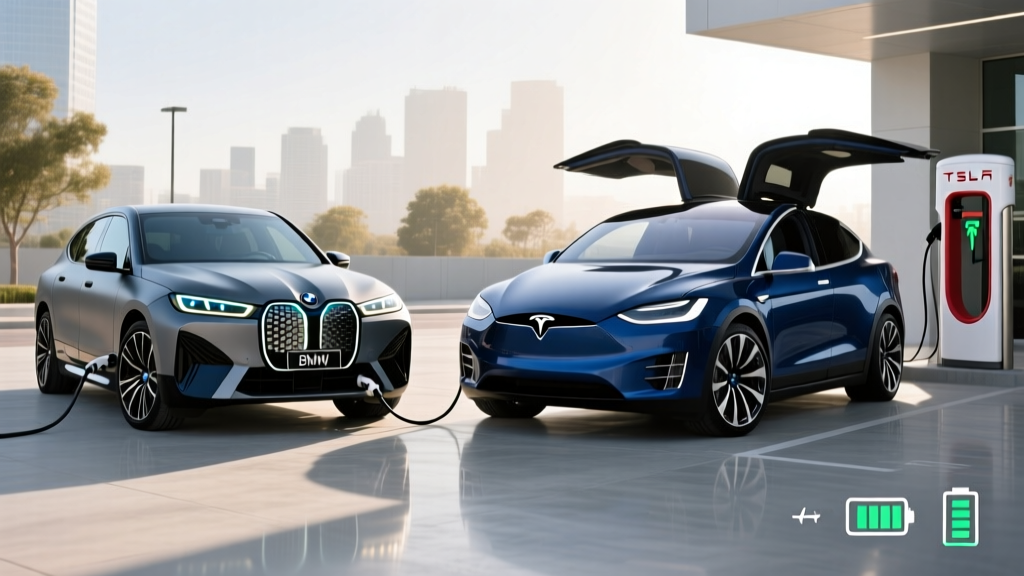
The Model X charges roughly 7 minutes faster from 10–80% on DC, and it accesses Tesla's Supercharger network natively — still the most reliable and dense fast-charging network in North America, with stalls consistently delivering their rated power.
The iX uses CCS1, meaning it relies on Electrify America, EVgo, and ChargePoint networks. BMW does offer a NACS adapter (included on 2026 models) enabling Supercharger access, but peak speeds are limited by the iX's 195 kW onboard ceiling. On a road trip, that 7-minute gap per stop adds up: on a 600-mile drive requiring two DC stops, the Model X saves roughly 15–20 minutes total.
Charging curve reality: Neither vehicle sustains peak kW for the full session. The iX holds ~180–195 kW from roughly 10–35% SoC, then tapers to ~120 kW by 60%, and drops sharply above 80%. The Model X sustains ~230–250 kW from 10–30%, tapers more gradually, and still pulls ~100 kW at 70%. This is why 10–80% time matters more than peak kW claims.
Performance, Ride, and Daily Drivability
The Model X wins on paper and on the stoplight: 670 hp and a 3.8-second 0–60 mph time make it genuinely quick for a 5,100-lb SUV. The Plaid variant (1,020 hp, 2.5 seconds) exists in a different performance stratum entirely, though at $94,990 it competes with sports cars, not family haulers.
The iX xDrive50's 516 hp and 4.4-second 0–60 are more than adequate, and BMW's tuning prioritizes something Tesla still doesn't quite nail: ride comfort. The iX's adaptive air suspension soaks up broken pavement with a suppleness that the Model X's firmer setup can't match. Road noise isolation is noticeably better in the BMW, and the cabin materials — open-pore wood, microfiber headliner, available massaging seats — feel a class above Tesla's minimalist interior.
For ADAS, both vehicles offer Level 2 driver-assistance — meaning you must remain engaged with hands on or near the wheel. BMW's Driving Assistant Professional includes highway lane-centering and lane-change assist. Tesla's Autopilot (standard) and Full Self-Driving Supervised ($8,000 option) offer more aggressive automation features but still require active driver supervision. Neither system is self-driving.
Pricing, Trims, and Federal Tax Credit Eligibility
| Detail | BMW iX xDrive50 | Tesla Model X LR |
|---|---|---|
| Base MSRP | $87,250 | $79,990 |
| As-Tested (typical options) | $95,000–$102,000 | $85,000–$92,000 |
| MSRP Cap (§30D SUV limit) | $80,000 | $80,000 |
| Federal Tax Credit (§30D) | Not eligible (exceeds MSRP cap) | Not eligible (exceeds MSRP cap) |
| State/Local Incentives | Varies by state | Varies by state |
Here's a critical reality check: neither vehicle qualifies for the $7,500 federal EV tax credit under IRS §30D rules. The Model X base price of $79,990 sits just under the $80,000 MSRP cap for SUVs, but typical configurations with destination charges and common options push it over. The iX at $87,250 base is well above the threshold. Additionally, buyer income caps apply ($300,000 joint / $150,000 single for new vehicles), and battery critical-mineral and component sourcing requirements must be met. Always verify current eligibility at irs.gov before purchasing.
Some buyers may qualify for state-level rebates (California's CVRP, Colorado's state credit, etc.), but these vary by jurisdiction and are subject to funding availability. Consult your state's energy office for current programs.
Cargo, Passenger Space, and Practicality
The Model X is the more practical family hauler. With 40.2 cu ft of cargo space behind the second row and 83.1 cu ft with seats folded, it out-hauls the iX (35.5 / 77.9 cu ft) by a meaningful margin. The Model X also offers an optional third row (seating up to 7), though the rearmost seats are best suited for children. The iX is strictly a five-seater.
The Model X's front trunk (frunk) adds roughly 6.5 cu ft of additional storage. The iX does not have a frunk — BMW uses that space for HVAC and electronics.
For rear-seat passengers, the Model X offers 40.9 inches of legroom vs. 38.9 in the iX. Both offer generous headroom, but the Tesla's panoramic glass roof creates an airier feel. The iX counters with more traditional luxury: available heated and ventilated rear seats, four-zone climate control, and superior sound insulation.
Pros, Cons, and Who Should Buy Which
BMW iX xDrive50 — Pros
- Superior ride comfort and cabin quietness
- Premium materials and build quality
- Excellent highway cruiser with composed handling
- Curved display with iDrive 8.5 is intuitive
- Standard adaptive air suspension
BMW iX xDrive50 — Cons
- No federal tax credit eligibility
- Slower DC charging vs. Model X
- Less cargo space, no third row option
- CCS reliance (NACS adapter needed for Superchargers)
- Polarizing exterior design
Tesla Model X Long Range — Pros
- Native Supercharger network access
- Best-in-class DC charging speed
- More cargo room + optional third row
- Quick acceleration even in base LR trim
- Over-the-air updates continuously add features
Tesla Model X Long Range — Cons
- Firm ride quality, more road noise
- Interior materials don't match the price
- Falcon-wing doors can be slow and finicky in tight spaces
- FSD ($8,000) still requires full driver attention
- No federal tax credit in most configurations
Choose the Tesla Model X if: You take regular road trips and value Supercharger reliability. You need maximum cargo space or an optional third row. You want the fastest DC charging available in this segment and don't mind a firmer ride.
Frequently Asked Questions
What is the real-world range of the BMW iX and Tesla Model X?
The BMW iX xDrive50 achieves roughly 275–295 miles on highway trips in mild weather, dropping to 230–260 miles in freezing cold. The Tesla Model X Long Range delivers approximately 290–310 highway miles in mild conditions and 250–275 in cold weather. Both figures assume 70–75 mph speeds with climate control active.
How fast does each SUV charge at home and on the road?
On a 240V Level 2 home charger, the iX adds about 30 miles of range per hour (11 kW) and the Model X about 33 miles per hour (11.5 kW). A full overnight charge (8 hours) restores roughly 240 miles for the BMW and 264 miles for the Tesla. On DC fast chargers, the iX peaks at 195 kW (10–80% in ~34 min) while the Model X peaks at 250 kW (10–80% in ~27 min).
Does either vehicle qualify for the federal EV tax credit?
In most configurations, no. The IRS §30D credit has an $80,000 MSRP cap for SUVs. The iX starts at $87,250 and is ineligible. The Model X starts at $79,990 but destination fees and common options typically push it over the cap. Additionally, buyer income limits and battery sourcing requirements apply. Always check irs.gov for current-year rules before committing to a purchase.
Is the BMW iX or Tesla Model X worth buying over competitors?
Compared to the Mercedes EQS SUV (305 mi EPA, $104,400 base) and the Rivian R1S (352 mi EPA, $79,900 base), both the iX and Model X occupy a competitive middle ground. The iX wins on interior luxury; the Model X wins on charging infrastructure and efficiency. The Rivian R1S offers better off-road capability and a more competitive price, but with a less refined on-road ride. The Mercedes is more opulent but less efficient and pricier.
What are the biggest ownership costs to budget for?
Insurance for both vehicles runs 20–35% higher than comparable gas SUVs, per industry data. Expect $2,400–$3,800 annually depending on your profile. Tire wear is accelerated on both due to weight and instant torque — budget for replacement every 25,000–35,000 miles. Neither vehicle requires oil changes, transmission fluid, or spark plugs, partially offsetting the higher insurance and tire costs.
Which has the better battery warranty?
Tesla covers the Model X battery for 8 years or 150,000 miles (whichever comes first) with a minimum 70% capacity retention guarantee. BMW covers the iX battery for 8 years or 100,000 miles with a similar 70% retention threshold. Tesla's 50,000-mile advantage in coverage is meaningful for high-mileage drivers.