Quick Verdict: Is the BMW iX Worth Leasing in 2026?
The 2026 BMW iX occupies a narrow but compelling slice of the luxury EV market: it delivers genuine 300+ mile range, ultra-fast DC charging, and a tech-forward cabin — without the polarizing looks or software quirks that plague some rivals. For shoppers hunting BMW iX lease deals, the math often favors leasing over buying, especially given luxury EV depreciation and evolving federal tax credit rules. But before you sign, you need the exact numbers on range, charging, and whether this SUV actually qualifies for the §30D credit.
Real-World Range Check
EPA Estimated: 307 miles (xDrive50) / 324 miles (xDrive45) / 296 miles (M60)
Expect in Reality: ~250-270 miles on sustained highway driving at 70+ mph. In cold weather (below 30°F), plan for 20-25% range loss, dropping effective range to ~220-240 miles. City driving with regen braking gets you closest to the EPA sticker.
Range, Battery & Efficiency
The 2026 iX lineup uses BMW's fifth-generation eDrive architecture with NMC (nickel manganese cobalt) lithium-ion battery packs. The xDrive50 and xDrive45 trims share a 105.2 kWh usable battery (111.5 kWh gross), while the performance-oriented M60 uses the same pack tuned for higher discharge rates.
| Trim | Battery (usable) | Chemistry | EPA Range | Efficiency |
|---|---|---|---|---|
| xDrive45 | 105.2 kWh | NMC | 324 mi | 86 MPGe (39 kWh/100mi) |
| xDrive50 | 105.2 kWh | NMC | 307 mi | 86 MPGe (39 kWh/100mi) |
| M60 | 105.2 kWh | NMC | 296 mi | 78 MPGe (43 kWh/100mi) |
NMC chemistry offers higher energy density than LFP (lithium iron phosphate), which is why BMW can pack over 100 kWh into a midsize SUV footprint. The trade-off: NMC degrades slightly faster over time and prefers not to sit at 100% state of charge for extended periods. BMW's thermal management system and 8-year/100,000-mile battery warranty (covering degradation below 70% capacity) mitigate long-term concerns. For full context on NMC vs LFP longevity, see our battery chemistry guide.
Real-world efficiency varies with driving style. The iX xDrive50 averages 2.5-2.7 miles per kWh in mixed driving, which is respectable for a 5,600-pound luxury SUV but trails the more aerodynamic Tesla Model X (2.8-3.0 mi/kWh). If you prioritize efficiency over luxury, the Hyundai Ioniq 5 or Kia EV6 deliver 3.5+ mi/kWh — though they lack the iX's premium materials and ride quality.
Charging Speed: DC Fast & Home Level 2
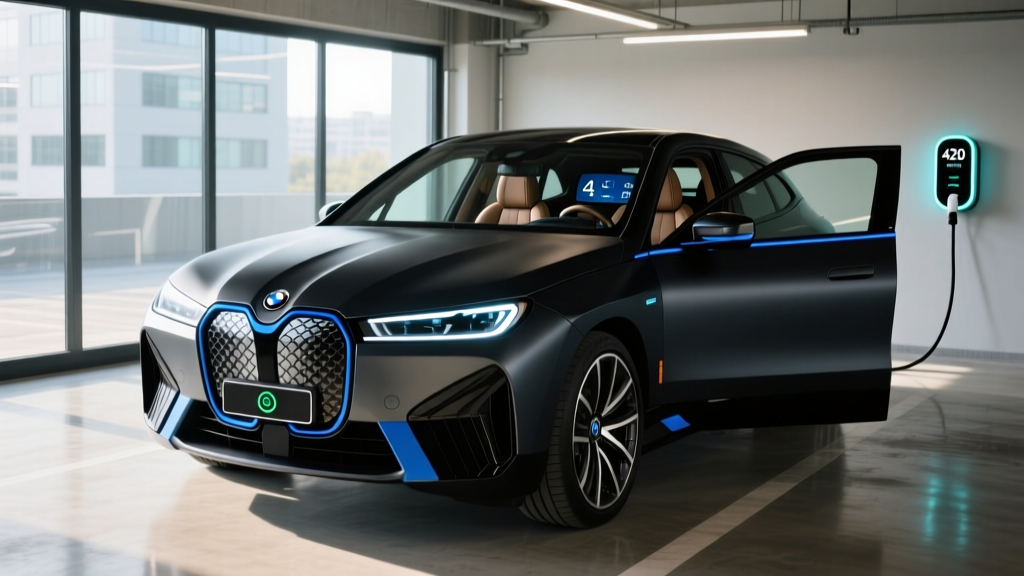
Charging is where the iX shines. BMW equips every 2026 iX with a 195 kW peak DC fast-charging capability on CCS1 connectors (or NACS via adapter for Tesla Supercharger access). On a 350 kW Electrify America or Ionity station, the iX can add 90 miles of range in 10 minutes and charge from 10-80% in approximately 34 minutes.
| Charging Level | Power | Time / Rate | Notes |
|---|---|---|---|
| Level 1 (120V) | 1.4 kW | ~3-4 mi/hr | Emergency/trickle only |
| Level 2 (240V, 48A) | 11.5 kW | ~28-30 mi/hr | Home/workplace ideal |
| DC Fast (CCS1/NACS) | 195 kW peak | 10-80% in ~34 min | Tapers above 80% SoC |
The charge curve is relatively flat through 50% state of charge, then tapers progressively. You'll see sustained 170-190 kW from 10-40%, dropping to ~120 kW by 60%, and ~80 kW by 80%. This is typical for NMC packs with aggressive thermal management — BMW prioritizes battery longevity over peak speed at high SoC. For road trips, plan to charge to 80% and move on; the last 20% takes nearly as long as the first 70%.
At home, the iX's 11.5 kW onboard charger is among the fastest in its class. A 240V/48A Level 2 wallbox (like the ChargePoint Home Flex or Emporia V2) adds ~30 miles per hour, meaning a full overnight charge from 20% to 100% takes roughly 8-9 hours. If your electrical panel supports a 60A circuit (required for 48A continuous draw), you'll wake up to a full battery every morning. Installation costs vary widely — expect $800-$2,500 depending on panel upgrades and conduit runs. For detailed home charging setup, check our Level 2 installation cost guide.
Performance & Drivetrain
Every 2026 iX uses a dual-motor all-wheel-drive layout, but power output varies significantly by trim:
- xDrive45: 335 hp, 465 lb-ft torque, 0-60 mph in 5.7 seconds
- xDrive50: 516 hp, 564 lb-ft torque, 0-60 mph in 4.4 seconds
- M60: 610 hp, 811 lb-ft torque, 0-60 mph in 3.6 seconds
The xDrive50 strikes the best balance for most buyers. Its 4.4-second 0-60 time is genuinely quick (faster than a Porsche Cayenne S), and the instant torque delivery makes highway merging effortless. The M60's 3.6-second sprint is supercar territory, but you'll pay a $10,000+ premium and sacrifice 10-15 miles of range for the privilege.
Ride quality is a standout. The iX uses an adaptive air suspension that soaks up imperfections while keeping body roll controlled in corners. It's not as sporty as a Tesla Model X or Porsche Taycan Cross Turismo, but it's more comfortable on long highway cruises. The regenerative braking system offers three levels (low, medium, high) plus an adaptive mode that uses radar and navigation data to modulate regen based on traffic and upcoming turns. One-pedal driving is possible but not as aggressive as Tesla or Nissan Leaf — BMW's philosophy is to let the car coast when possible for efficiency.
Pricing, Lease Deals & Tax Credit Eligibility
The 2026 BMW iX starts at $75,150 (including destination) for the xDrive45, climbing to $85,150 for the xDrive50 and $111,500 for the M60. These are base MSRPs — adding options like the Executive Package ($3,500), Driving Assistance Professional ($2,100), or premium leather ($2,500) can push an xDrive50 past $95,000.
| Trim | Base MSRP | Federal Tax Credit | Effective Price (if eligible) |
|---|---|---|---|
| xDrive45 | $75,150 | Up to $7,500 | $67,650 |
| xDrive50 | $85,150 | Up to $7,500 | $77,650 |
| M60 | $111,500 | $0 (MSRP cap) | $111,500 |
Federal Tax Credit (§30D) Caveats: The iX xDrive45 and xDrive50 may qualify for up to $7,500 under the federal EV tax credit, but eligibility depends on three factors:
- MSRP Cap: SUVs must be under $80,000. The xDrive45 and base xDrive50 qualify; the M60 ($111,500) does not.
- Income Limits: Modified adjusted gross income (MAGI) must be ≤$300,000 (married filing jointly), ≤$225,000 (head of household), or ≤$150,000 (single). Exceed these, and you're ineligible regardless of vehicle specs.
- Battery Sourcing: At least 40% of critical minerals and 50% of battery components must be sourced from the US or free-trade-agreement countries (2026 thresholds). BMW's supply chain has historically met these requirements, but verify with your dealer using the VIN-specific IRS lookup tool at fueleconomy.gov.
Starting in 2024, the credit can be transferred to the dealer at point of sale as an instant discount (rather than waiting for tax filing). If you're leasing, the credit technically goes to the lessor (BMW Financial Services), but many dealers pass it through as a capitalized cost reduction — confirm this in writing before signing.
Lease Deal Reality: BMW Financial Services typically offers 36-month leases with $5,000-$7,500 down, resulting in monthly payments of $900-$1,200 for an xDrive50 (depending on credit tier and mileage allowance). Compare this to buying: a $85,000 purchase with $7,500 down at 6.5% APR over 72 months yields ~$1,250/month. Leasing often wins on monthly cash flow, but you'll face mileage penalties (typically $0.25-$0.30/mile over 10,000-15,000 miles/year) and won't build equity. If you drive 12,000+ miles annually and plan to keep the car 5+ years, buying may be cheaper long-term.
Interior, Cargo & Tech
The iX cabin is a masterclass in luxury materials and minimalist design. BMW's curved display setup combines a 12.3-inch instrument cluster and 14.9-inch infotainment touchscreen running iDrive 8.5. The system is responsive and feature-rich (wireless Apple CarPlay/Android Auto, over-the-air updates, customizable ambient lighting), but the menu structure can be convoluted — expect a learning curve.
Passenger space is generous for a midsize SUV:
- Front legroom: 40.2 inches
- Rear legroom: 37.5 inches
- Cargo (behind rear seats): 35.5 cu ft
- Cargo (rear seats folded): 77.9 cu ft
That cargo volume trails the Tesla Model X (81.5 cu ft max) and even the Hyundai Ioniq 5 (59.3 cu ft), but the iX's load floor is flat and the rear seats fold 40/20/40 for flexibility. There's no frunk (front trunk) — BMW uses that space for power electronics and HVAC components.
Standout tech features include:
- Driving Assistance Professional: Adaptive cruise with stop-and-go, lane centering, and automatic lane change (SAE Level 2 — driver must remain engaged)
- Parking Assistant Plus: Surround-view cameras, remote parking via smartphone app
- Harman Kardon surround sound: 18 speakers, 655 watts (optional Bowers & Wilkins system adds 30 speakers, 1,615 watts)
- Sky Lounge panoramic roof: Electrochromic glass that dims at the touch of a button
ADAS Limitations
BMW's Driving Assistance Professional is a Level 2 driver-assist system, not autonomous driving. You must keep your hands on the wheel (or be ready to resume control) and eyes on the road at all times. The system handles highway cruising well but disengages in construction zones, poor weather, or unclear lane markings. For true Level 4 robotaxi service, see our Waymo vs Cruise comparison.
Warranty & Ownership Costs
BMW covers the 2026 iX with:
- Limited warranty: 4 years / 50,000 miles
- Powertrain warranty: 4 years / 50,000 miles (includes motors, reduction gear)
- Battery warranty: 8 years / 100,000 miles (covers degradation below 70% capacity)
- Corrosion warranty: 12 years / unlimited miles
- Complimentary maintenance: 3 years / 36,000 miles (oil changes don't apply, but covers brake fluid, cabin filters, wiper blades)
The 8-year battery warranty is industry-standard (matches Tesla, Ford, Hyundai), but the 4-year/50,000-mile bumper-to-bumper coverage is shorter than Hyundai's 5-year/60,000-mile or Genesis's 5-year/60,000-mile. If you plan to keep the iX beyond 50,000 miles, consider an extended warranty — luxury EV repairs (air suspension, infotainment screens) can be expensive out of pocket.
Insurance costs are higher than gas-powered BMW X5s. Expect annual premiums of $2,800-$3,500 depending on your location, driving record, and coverage limits. Get quotes before committing — some insurers (like Geico and Progressive) offer EV discounts, while others charge a luxury surcharge.
Pros & Cons
Pros
- Genuine 300+ mile range with efficient highway cruising
- Ultra-fast 195 kW DC charging (34 min 10-80%)
- Luxurious, quiet cabin with premium materials
- Adaptive air suspension delivers excellent ride quality
- Generous rear legroom for a midsize SUV
- Strong federal tax credit eligibility (xDrive45/xDrive50)
Cons
- High starting price ($75k+), options push it past $90k
- Cargo space trails Tesla Model X and Hyundai Ioniq 5
- iDrive infotainment has a steep learning curve
- No frunk (front trunk) for extra storage
- 4-year/50k-mile warranty is shorter than rivals
- Insurance premiums 20-30% higher than gas X5
Who Should Lease the BMW iX?
The 2026 iX is ideal for:
- Luxury commuters: If you drive 20-40 miles daily and can charge at home, the iX delivers silent, effortless acceleration with zero tailpipe emissions.
- Families needing space: Rear legroom fits rear-facing car seats, and 35.5 cu ft of cargo handles strollers and groceries.
- Road trippers: 300+ mile range and 195 kW charging make 300-400 mile days feasible with one 30-minute stop.
It's less suited for:
- Towing: The iX is rated for 3,500 pounds (braked trailer), which is adequate for small boat trailers but not campers or horse trailers. If you need 5,000+ lb towing, look at the Rivian R1S or Tesla Model X.
- Budget-conscious buyers: Even with the $7,500 credit, the iX starts at $67k+. The Hyundai Ioniq 5, Kia EV6, or Ford Mustang Mach-E offer 250-300 mile range for $40k-$55k.
- Off-roaders: Despite AWD, the iX has 8.0 inches of ground clearance and no low-range gearing. It's a pavement SUV, not a trail rig.
FAQ: BMW iX Lease & Ownership Questions
What is the real-world range of the BMW iX?
The EPA rates the xDrive50 at 307 miles, but expect 250-270 miles on sustained highway driving at 70+ mph. In cold weather (below 30°F), plan for 20-25% range loss, dropping effective range to 220-240 miles. City driving with regenerative braking gets you closest to the EPA sticker.
How fast does the BMW iX charge?
On a 350 kW DC fast charger, the iX peaks at 195 kW and charges from 10-80% in approximately 34 minutes. At home on a 240V/48A Level 2 wallbox, it adds ~30 miles per hour (11.5 kW), so a full overnight charge takes 8-9 hours.
Does the BMW iX qualify for the federal EV tax credit?
The xDrive45 and xDrive50 may qualify for up to $7,500 under IRS §30D, provided your income is under the caps ($300k married filing jointly, $150k single) and the vehicle's battery meets critical mineral sourcing requirements. The M60 ($111,500 MSRP) exceeds the $80,000 SUV cap and is ineligible. Verify eligibility at fueleconomy.gov using the VIN.
Is leasing the BMW iX better than buying?
Leasing often results in lower monthly payments ($900-$1,200 vs $1,250+ for a purchase) and lets you upgrade every 3 years. However, you'll face mileage penalties (typically $0.25-$0.30/mile over 10k-15k miles/year) and won't build equity. If you drive 12,000+ miles annually and plan to keep the car 5+ years, buying may be cheaper long-term.
How does the BMW iX compare to the Tesla Model X?
The Model X offers more cargo space (81.5 cu ft vs 77.9 cu ft), faster 0-60 times (3.8 sec Plaid vs 4.4 sec iX xDrive50), and access to the Tesla Supercharger network (though BMW now includes a NACS adapter). The iX wins on ride quality, cabin quietness, and interior material quality. Both qualify for the $7,500 federal tax credit (subject to income and sourcing rules).
What's the biggest drawback of the BMW iX?
The high starting price ($75,150) and expensive options are the main barriers. A well-equipped xDrive50 easily tops $90,000. Secondary complaints include the convoluted iDrive infotainment system, lack of a frunk, and cargo volume that trails rivals like the Tesla Model X and Hyundai Ioniq 5.
For more luxury EV comparisons and real-world range testing, browse our EV reviews archive.