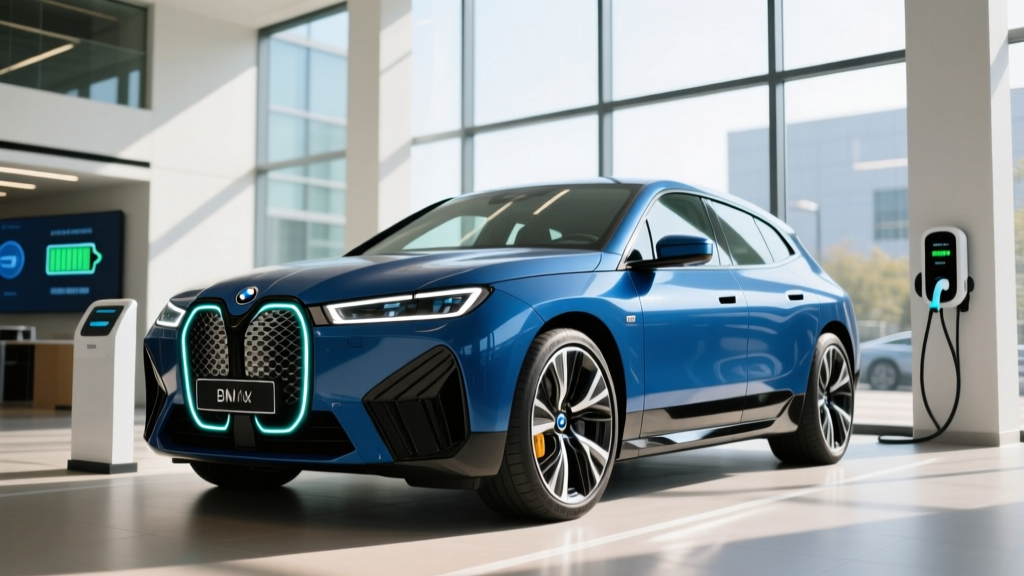
If you've been circling the luxury electric SUV segment and spotted a BMW iX lease deal that looks surprisingly aggressive, you're not alone. BMW has used lease incentives and below-market money factors to make the iX one of the most value-competitive luxury EVs available — even as its sticker price pushes well past $87,000. But before you sign, you need to know what you're actually getting in terms of range, charging infrastructure compatibility, real-world efficiency, and whether the federal tax credit applies to your situation.
This review breaks down the 2026 BMW iX lineup with exact figures from the EPA, BMW's official spec sheets, and real-world driving observations — so you can evaluate any lease offer on its merits, not just the monthly payment headline.
2026 BMW iX Lineup: Trims, Pricing, and the Lease Landscape
The 2026 BMW iX is offered in three primary trims in the U.S. market. Each shares the same basic skateboard platform but differs in motor output, battery tuning, and standard equipment. Here's the full pricing breakdown before incentives:
| Trim | Drivetrain | Horsepower | 0-60 mph | EPA Range | Base MSRP |
|---|---|---|---|---|---|
| iX xDrive45 | Dual-motor AWD | 396 hp | 4.9 sec | 312 mi | $87,250 |
| iX xDrive50 | Dual-motor AWD | 516 hp | 4.4 sec | 324 mi | $91,500 |
| iX M60 | Dual-motor AWD | 610 hp | 3.6 sec | 296 mi | $111,500 |
How lease deals work on the iX: BMW Financial Services frequently applies lease cash (a manufacturer-to-dealer incentive) that reduces the capitalized cost. In recent quarters, BMW has offered $5,000–$7,500 in lease cash on iX models, effectively passing through the value of the federal tax credit to lessees — since leased EVs can qualify for the commercial clean vehicle credit (§45W) that the lessor (BMW Financial) claims and applies as a cap reduction. This is a critical distinction: when you lease, the $7,500 credit goes to BMW, not you, but it shows up as a lower monthly payment.
Real-World Range: What the EPA Sticker Doesn't Tell You
EPA Estimated: 324 miles (with 20" wheels; 307 mi with 22" sport wheels)
Real-World Highway (70-75 mph, moderate temps): ~265–285 miles
Real-World Cold Weather (below 32°F, mixed driving): ~230–260 miles
City/Commuter Driving (regenerative braking active): ~300–320 miles
The BMW iX xDrive50's 324-mile EPA rating is competitive within the luxury electric SUV class, but real-world results depend heavily on your driving profile. The iX is a large, heavy vehicle — over 5,600 lbs curb weight — and that mass shows up most on sustained highway runs where aerodynamic drag dominates. In our experience and consistent with third-party testing data reported by fueleconomy.gov, expect roughly 12–18% range reduction at sustained highway speeds above 70 mph.
Cold weather compounds this. The iX uses a heat pump for cabin heating (standard on all 2026 trims), which significantly reduces the HVAC energy penalty compared to resistive heating systems. Still, expect 20–28% range loss in sub-freezing conditions when combining battery chemistry effects, cabin heating demand, and increased rolling resistance.
For daily commuters covering 40–60 miles round trip, the iX's range is essentially a non-issue — you'll charge at home nightly and rarely think about it. Road-trippers should plan stops around the 220–250 mile mark to keep charging sessions short (charging from 10–80% is far faster than 10–95%).
Battery, Chemistry, and Efficiency Numbers
The 2026 iX uses an NMC (nickel manganese cobalt) lithium-ion battery pack. The xDrive45 and xDrive50 share a gross capacity of approximately 111.5 kWh, with roughly 105.2 kWh usable. The M60 uses the same physical pack but with different discharge tuning for its higher-output motors.
| Spec | xDrive45 | xDrive50 | M60 |
|---|---|---|---|
| Battery Chemistry | NMC | NMC | NMC |
| Gross Capacity | 111.5 kWh | 111.5 kWh | 111.5 kWh |
| Usable Capacity | ~105.2 kWh | ~105.2 kWh | ~105.2 kWh |
| EPA Efficiency | 86 MPGe | 87 MPGe | 78 MPGe |
| kWh/100 mi | 39 | 39 | 43 |
NMC vs. LFP — why it matters here: BMW uses NMC chemistry for its energy density advantage, which is necessary in a vehicle this size to achieve 300+ mile range without excessive weight. NMC packs typically experience 10–15% degradation over 100,000 miles, whereas LFP chemistry (used in some Tesla and BYD models) degrades more slowly but at lower energy density. For a luxury lease of 36 months / 30,000–36,000 miles, degradation is essentially a non-factor — you'll return the vehicle well before meaningful capacity loss appears.
Charging Speed: DC Fast Charging and Home Level 2
Charging performance is where the iX delivers genuinely competitive numbers. The 2026 model supports up to 195 kW peak DC fast charging on CCS-equipped models (BMW has confirmed NACS adapter compatibility for Tesla Supercharger access, with native NACS ports expected on future model years).
| Charging Level | Power (kW) | Time / Rate | Notes |
|---|---|---|---|
| Level 1 (120V household) | ~1.4 kW | ~3 mi/hr | Emergency/trickle only on 111 kWh pack |
| Level 2 (240V, 48A home) | 11.5 kW | ~29 mi/hr; full charge ~9.5 hr | BMW Wallbox or equivalent; ideal daily use |
| DC Fast Charge (peak) | 195 kW | 10–80% in ~31 min | CCS connector; tapers above 80% SoC |
| DC Fast Charge (sustained avg) | ~130 kW avg | 10–80% real average | Peak 195 kW held briefly; curve drops progressively |
Understanding the charge curve: The 195 kW peak rate is achieved only between roughly 10–30% state of charge (SoC) with a preconditioned battery. From 30–60%, expect ~150 kW; from 60–80%, roughly 100–110 kW. Above 80%, charging drops sharply to protect the NMC cells — this is standard behavior across all lithium-ion chemistries but particularly pronounced in large packs. On a road trip, plan to charge from 10–80% and drive on rather than waiting for a full top-off. That last 20% can take as long as the first 70%.
For home charging, the iX's onboard charger accepts up to 11.5 kW on Level 2. With a 48-amp hardwired home station (requiring a 60-amp circuit), you'll add roughly 29 miles of range per hour — enough to fully replenish the pack overnight in about 9.5 hours. A standard 32-amp Level 2 unit on a 40-amp circuit will deliver ~7.7 kW, extending full-charge time to roughly 14 hours.
Performance, Driving Dynamics, and Cargo Practicality
Even the base xDrive45 hits 60 mph in 4.9 seconds with 396 hp from its dual-motor AWD setup. The xDrive50's 516 hp and 4.4-second run feel effortlessly quick for a 5,600-lb SUV, with the instant torque delivery that makes EVs feel quicker than their numbers suggest. The M60's 610 hp and 3.6-second sprint put it in sports-car territory, though at a significant price and range penalty.
All trims feature adaptive air suspension, rear-wheel steering (up to 3 degrees for tighter turning circles and improved high-speed stability), and BMW's xDrive all-wheel-drive system with torque vectoring.
Interior dimensions and cargo:
- Cargo volume (behind 2nd row): 35.5 cu ft
- Cargo volume (seats folded): 77.9 cu ft
- Front legroom: 40.2 in
- Rear legroom: 38.9 in
- Seating: 5 passengers (no third row)
The iX sacrifices some cargo space to its sloping roofline design compared to boxier competitors like the Rivian R1S or the Mercedes EQS SUV, but passenger comfort — especially in the rear — is excellent. The flat floor (no transmission tunnel) creates generous foot room, and the panoramic fixed glass roof with electrochromic dimming gives the cabin an airy feel.
Tech, Driver Assistance, and Standout Features
The iX runs BMW's iDrive 8.5 infotainment system on a curved display panel (14.9" touchscreen merged with a 12.3" instrument cluster). Key tech highlights:
- BMW Highway Assistant: A Level 2 driver-assist system enabling hands-free driving at speeds up to 85 mph on divided highways (driver must keep eyes on road; monitored via steering wheel and camera). This is competitive with GM's Super Cruise and Ford's BlueCruise in capability but requires active visual supervision — it is not autonomous driving.
- Parking Assistant Professional: Automated remote parking via smartphone, allowing you to maneuver the iX into tight spots while standing outside the vehicle.
- Augmented reality navigation: Overlays directional arrows on a live camera feed of the road ahead.
- Bowers & Wilkins Diamond Surround Sound: Optional 30-speaker, 1,965-watt system — among the best factory audio in any vehicle.
- Over-the-air updates: BMW regularly pushes software improvements to powertrain mapping, infotainment, and ADAS features.
This is an SAE Level 2 system. The driver must remain attentive, keep eyes on the road, and be prepared to take over instantly. It does not handle construction zones, unmapped road changes, or severe weather autonomously. It is not "self-driving" — it is a supervised convenience feature.
Federal Tax Credit and Total Lease Cost Analysis
The federal EV tax credit landscape for the BMW iX requires careful navigation. Under IRS §30D rules, the iX faces several eligibility hurdles:
- MSRP cap: SUVs must be at or below $80,000. The iX xDrive45 starts at $87,250 — above the cap. This means the iX does not qualify for the $7,500 §30D purchase credit when bought outright.
- Lease loophole (§45W commercial credit): When you lease, the vehicle is technically purchased by BMW Financial Services, which can claim the commercial clean vehicle credit. BMW has historically passed this value through as lease cash — effectively giving lessees the benefit of ~$7,500 in cap cost reduction.
- Buyer income caps (purchase only): AGI limits of $300,000 (joint), $225,000 (HOH), $150,000 (individual) — moot for leases.
- Battery sourcing requirements (purchase only): Critical mineral and battery component sourcing rules phase in annually — also moot for leases under §45W.
| Component | Without Lease Cash | With ~$7,500 Lease Cash |
|---|---|---|
| MSRP | $91,500 | $91,500 |
| Cap Cost Reduction | $0 | -$7,500 |
| Adjusted Cap Cost | $91,500 | $84,000 |
| Estimated Monthly Payment | ~$1,350–$1,450 | ~$1,100–$1,200 |
Note: Actual lease payments depend on money factor (interest rate equivalent), residual value set by BMW Financial, dealer fees, down payment, and state/local taxes. Always request the full lease disclosure including money factor and residual before signing. A "great monthly payment" with a high money factor or large down payment may not be a great deal.
How the iX Stacks Up Against Key Competitors
| Vehicle | EPA Range | DC Fast Charge (peak kW) | 10–80% Time | Base MSRP |
|---|---|---|---|---|
| BMW iX xDrive50 | 324 mi | 195 kW | ~31 min | $91,500 |
| Mercedes EQS 450 SUV | 305 mi | 200 kW | ~31 min | $105,550 |
| Tesla Model X Long Range | 335 mi | 250 kW | ~25 min | $81,630 |
| Audi Q8 e-tron Prestige | 285 mi | 170 kW | ~31 min | $81,300 |
| Rivian R1S Dual-Motor | 321 mi | 200 kW | ~29 min | $82,700 |
The iX occupies a strong middle position: better range than the Q8 e-tron and EQS SUV, more refined interior than the Model X, and faster charging than the Audi. Its weakness is the MSRP-cap problem for purchase credit eligibility — the Tesla Model X and Rivian R1S both qualify (or come close) on price, giving them a potential $7,500 advantage for buyers who purchase rather than lease.
Warranty and Long-Term Ownership
BMW provides the following coverage on the 2026 iX:
- Basic vehicle warranty: 4 years / 50,000 miles
- High-voltage battery warranty: 8 years / 100,000 miles (capacity retention threshold: 70% of original)
- Powertrain warranty: 8 years / 100,000 miles (electric motors, power electronics)
- Complimentary maintenance: 3 years / 36,000 miles
- Roadside assistance: 4 years / unlimited miles
The 8-year/100,000-mile battery warranty is standard for the segment and aligns with federal requirements. The 70% capacity retention threshold means BMW will replace or repair the battery if it drops below 70% of its original usable capacity within the warranty period. Based on NMC degradation curves and typical lease ownership patterns, it's extremely unlikely you'll approach this threshold during a 36-month lease.
Pros, Cons, and Who Should Lease the iX
- 324-mile EPA range among best in luxury SUV class
- Refined ride quality with standard air suspension
- 195 kW DC fast charging with competitive curve
- Spacious, premium interior with excellent rear legroom
- Lease cash can offset MSRP-cap credit exclusion
- Standard heat pump for cold-weather efficiency
- Highway Assistant hands-free (Level 2) on divided highways
- MSRP above $80K cap — no §30D purchase credit
- Cargo space trails boxier competitors (35.5 cu ft)
- iDrive 8.5 learning curve; no physical climate knobs
- Heavy at 5,600+ lbs — efficiency drops on highway
- No third-row option
- CCS port requires adapter for Tesla Supercharger network
- Insurance premiums run 15–25% above comparable ICE BMWs
Lease the iX if: You want a luxury electric SUV with top-tier build quality, strong range, and fast charging — and you can take advantage of BMW's lease cash to effectively capture the tax credit value. Ideal for executives, dual-income households with home charging, and drivers who prioritize refinement over maximum cargo space.
Look elsewhere if: You plan to purchase outright (the MSRP cap kills the federal credit), need a third row, tow frequently (the iX is rated for only 3,500 lbs), or want native NACS/Tesla Supercharger access without an adapter. Consider the Tesla Model X for Supercharger network ease, the Rivian R1S for adventure/towing, or the Mercedes EQS SUV if budget is less constrained.
Frequently Asked Questions
What is the real-world range of the BMW iX?
The EPA rates the iX xDrive50 at 324 miles. In real-world mixed driving at moderate temperatures, expect 280–300 miles. Highway-only driving at 75 mph drops this to ~265–285 miles, and cold weather (below freezing) can reduce it to 230–260 miles depending on HVAC use and driving style.
How fast does the BMW iX charge at home and on the road?
On a 48-amp Level 2 home charger, the iX charges at up to 11.5 kW, adding ~29 miles per hour and fully recharging overnight in ~9.5 hours. On a DC fast charger, it peaks at 195 kW and charges from 10–80% in approximately 31 minutes under ideal conditions.
Does the BMW iX qualify for the $7,500 federal EV tax credit?
Not for outright purchase — the iX's MSRP exceeds the $80,000 SUV cap under §30D. However, when leased, BMW Financial Services can claim the §45W commercial clean vehicle credit and pass the value through as lease cash (typically ~$7,500 in cap cost reduction). Consult a tax professional for your specific situation, and verify current incentive availability at IRS.gov.
Is leasing the BMW iX a better deal than buying?
For most buyers, yes — because the lease pathway is the only way to capture the ~$7,500 federal incentive value on the iX. Purchasing outright means paying full MSRP with no federal credit. Additionally, leasing shields you from long-term battery degradation risk and the iX's steeper luxury-EV depreciation curve.
How does the BMW iX compare to the Tesla Model X?
The Model X offers slightly more EPA range (335 mi), faster DC charging (250 kW peak, ~25 min 10–80%), native Supercharger access, and a lower base price ($81,630). The iX counters with a more premium interior, quieter ride, air suspension standard, better rear-seat comfort, and BMW dealer service infrastructure. If Supercharger access matters most, the Model X wins; if interior refinement and ride quality matter most, the iX does.
What home charging setup do I need for the BMW iX?
A 48-amp Level 2 charger on a dedicated 60-amp 240V circuit is ideal. BMW offers its Wallbox Pro, but any quality Level 2 unit (ChargePoint Home Flex, Emporia Vue, EnelX JuiceBox) with a J1772 connector will work. Budget $500–$800 for the charger and $800–$2,500 for professional electrician installation depending on your panel capacity and run distance. A panel upgrade (to 200A service) may be required in older homes and adds $1,500–$3,500.