The BMW iX Meets the Mile High City
Denver's combination of high altitude, extreme temperature swings, and a growing but uneven public charging network makes it one of the more demanding environments for any electric vehicle. The BMW iX — the brand's flagship electric SUV — is engineered with a heat pump, sophisticated thermal management, and all-wheel drive that theoretically make it well-suited for the Front Range. But spec sheets don't tell you what happens when you're driving I-70 westbound in January with the cabin heater blasting and a 6,000-foot elevation gain ahead.
We've spent extended time with the 2026 BMW iX across Denver's seasons to answer the questions that matter to local buyers: what range actually looks like in Colorado conditions, how fast it charges on the state's DC fast-charging corridors, whether it qualifies for federal tax credits, and how it stacks up against rivals like the Audi Q8 e-tron, Mercedes EQE SUV, and Tesla Model X.
Range, Battery, and Efficiency — What Denver Drivers Actually See
The 2026 BMW iX xDrive50 comes equipped with a 111.5 kWh gross battery pack (approximately 105.2 kWh usable) using NMC (nickel manganese cobalt) chemistry. BMW's thermal management system is among the most capable in the segment, actively heating or cooling cells to maintain optimal operating temperature — critical for Colorado's -10°F winter nights and 95°F summer afternoons.
| Spec | Value |
|---|---|
| EPA Estimated Range | 324 miles |
| Battery (gross / usable) | 111.5 kWh / ~105.2 kWh |
| Battery Chemistry | NMC (Nickel Manganese Cobalt) |
| Drivetrain | Dual-motor AWD (xDrive) |
| Horsepower | 516 hp |
| 0–60 mph | 4.4 seconds |
| EPA Efficiency | 86 MPGe combined (39 kWh/100 mi) |
| Cargo Volume (rear seats up / folded) | 35.5 / 77.9 cu ft |
| Rear Legroom | 38.9 in |
| Curb Weight | 5,610 lbs |
| Towing Capacity | 3,500 lbs |
EPA estimates are measured under controlled conditions. In Denver, expect the following from the iX xDrive50:
- Summer city/highway mix (70–80°F): ~290–310 miles — close to EPA, aided by regenerative braking in stop-and-go traffic on I-25.
- Highway cruising at 75 mph (summer): ~260–280 miles — the iX's tall, aerodynamic profile loses efficiency above 70 mph.
- Winter city/highway mix (20–35°F): ~230–260 miles — the heat pump mitigates cabin-heating energy draw, but cold battery chemistry still reduces usable capacity by 15–20%.
- Mountain pass driving (I-70 west to Vail, winter): ~180–210 miles effective range — steep grades at speed consume energy aggressively, though regen on descents recovers some.
Denver's altitude (5,280 ft) has a negligible direct effect on EV efficiency — electric motors don't suffer the oxygen-starved power loss that gas engines experience at elevation. The real range killers are cold temperatures, high-speed mountain driving, and cabin heating.
Charging Speed: DC Fast Charging and Home Level 2 in Denver
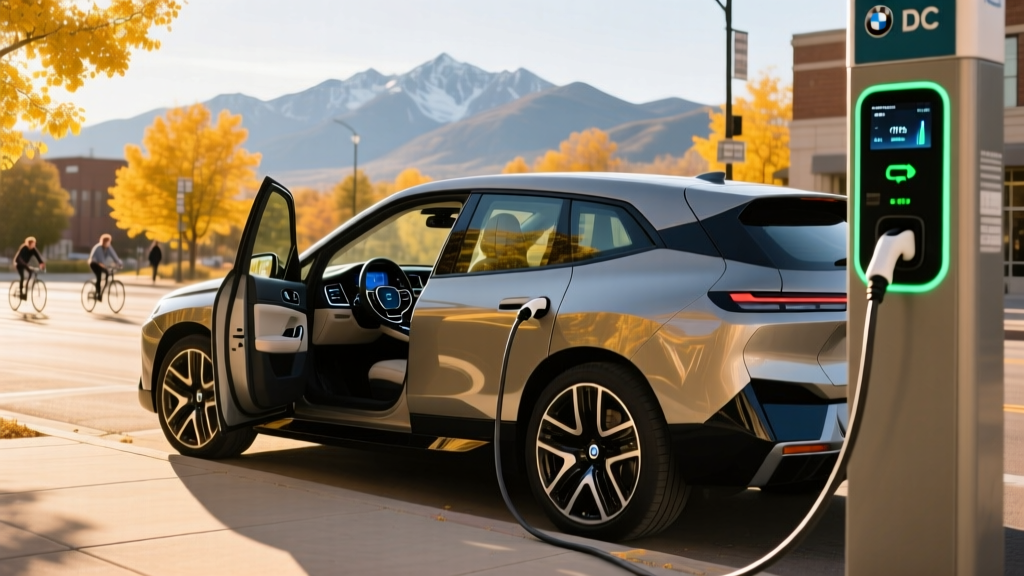
The iX supports up to 200 kW peak DC fast charging via its CCS1 connector (BMW has confirmed NACS adoption for future model years, but the 2026 iX retains CCS). On a capable charger, BMW rates the 10–80% charge time at approximately 34 minutes. However, real-world charging sessions on Electrify America and EVgo stations along the I-25 and I-70 corridors tell a more nuanced story.
| Charging Level | Power (kW) | Speed | Typical Use Case |
|---|---|---|---|
| Level 1 (120V household) | ~1.4 kW | ~4 mi/hr | Emergency top-up only |
| Level 2 (240V, 48A home) | 11.5 kW | ~30 mi/hr | Overnight home charging (~10 hrs empty to full) |
| DC Fast Charge (peak) | 200 kW | 10–80% in ~34 min | Road-trip stops; peak rate sustained only to ~30% SoC |
| DC Fast Charge (average 10–80%) | ~125 kW avg | ~190 mi in 34 min | Real-world sustained average accounts for taper above 50% |
The charging curve matters. Like all EVs, the iX does not sustain its 200 kW peak rate throughout the session. Peak power is available roughly between 10% and 30% state of charge. From 50% onward, the rate tapers significantly — by 80%, you're typically seeing 50–70 kW. BMW's preconditioning system will warm the battery when a DC fast-charger is set as your navigation destination, which is essential in Denver's cold months to achieve anything close to advertised speeds.
Denver public charging context: The city's DC fast-charging infrastructure is concentrated along I-25 (Electrify America stations at Castle Rock, Monument, and north through Fort Collins). The I-70 mountain corridor has improved, with chargers at Silverthorne and Georgetown, but gaps remain between Denver and Grand Junction. Plan accordingly — the iX's range is adequate for most Front Range driving, but mountain road trips require route planning.
Home Level 2 installation: The iX's onboard charger accepts up to 11.5 kW (48 amps) on a 240V circuit. Most Denver homeowners will need a 60-amp dedicated circuit installed by a licensed electrician. Expect $800–$2,500 for installation depending on panel proximity and whether your home's electrical panel needs an upgrade (many older Denver homes have 100-amp panels that require a $2,000–$4,000 upgrade to 200 amps). Xcel Energy, the primary utility in metro Denver, has occasionally offered EV-ready rebates — check their current programs.
Performance and Driving Dynamics at Altitude
The iX xDrive50's dual-motor all-wheel-drive system produces 516 horsepower and 564 lb-ft of torque, launching the 5,610-pound SUV to 60 mph in 4.4 seconds. For those wanting more, the iX M60 variant bumps output to 610 hp with a 3.6-second 0–60 time, though at a significant price premium and a range reduction to an EPA-estimated 296 miles.
Electric motors are immune to the altitude-related power loss that plagues internal combustion engines. A turbocharged gas SUV might lose 3–4% of its rated power per 1,000 feet of elevation; the iX delivers identical acceleration in Denver as it does at sea level. This is a genuine advantage for Front Range drivers who regularly climb to 8,000+ feet on weekend trips.
The adaptive air suspension (standard on the xDrive50) provides a compliant ride on Denver's occasionally rough pavement and handles well on the twisty sections of Highway 93 to Boulder. The steering is precise but light — this is a grand touring SUV, not a sports car. Body roll is well-controlled for its height, and the low center of gravity (battery pack under the floor) keeps it planted on highway sweepers.
Pricing, Trims, and Federal Tax Credit Eligibility
The 2026 BMW iX lineup is structured as follows:
| Trim | Base MSRP | As-Tested (typical options) | §30D Federal Credit Eligibility |
|---|---|---|---|
| iX xDrive50 | $87,250 | $94,000–$102,000 | See below — MSRP cap and sourcing rules apply |
| iX M60 | $111,500 | $118,000–$128,000 | Exceeds MSRP cap — ineligible |
Federal tax credit reality check: Under IRS §30D rules, the BMW iX xDrive50 faces significant hurdles for the full $7,500 credit. The vehicle must meet battery component and critical minerals sourcing requirements that shift annually. Additionally, buyer income caps apply ($150,000 single / $300,000 joint filer modified AGI), and the MSRP must not exceed $80,000 for SUVs. The xDrive50's $87,250 base MSRP exceeds this cap, making it ineligible for the new-vehicle §30D credit at its base price.
The point-of-sale transfer option (allowing the credit to be applied as a down-payment reduction at the dealer) is available for qualifying vehicles, but since the iX exceeds the MSRP cap, this doesn't change the outcome. Always verify current eligibility on IRS.gov's clean vehicle credit page, as battery sourcing requirements and manufacturer compliance updates occur periodically. Consult a tax professional before making a purchase decision based on credit eligibility.
Colorado state incentive: Colorado offers its own EV tax credit (currently $5,000 for vehicles with an MSRP under $80,000, with different rules for higher-priced vehicles). The iX's pricing may affect eligibility here as well — check the Colorado Legislature's current statutes or consult a local tax advisor for the most current rules.
Interior, Technology, and Daily Livability
The iX cabin is where BMW justifies its premium pricing. The minimalist dashboard centers on BMW's Curved Display — a 14.9-inch infotainment touchscreen merged with a 12.3-inch digital instrument cluster running BMW iDrive 8.5. The system is responsive, supports wireless Apple CarPlay and Android Auto, and includes a competent voice assistant.
Standout tech features:
- BMW Digital Key Plus: Uses ultra-wideband to unlock and start the vehicle from your phone without removing it from your pocket.
- Driving Assistant Professional: Includes adaptive cruise with stop-and-go, lane-keeping assist, and automated lane changes on highways. This is an SAE Level 2 system — the driver must remain attentive and keep hands on or near the wheel at all times.
- Parking Assistant Plus: Surround-view cameras and automated parking work well in tight Denver garage spaces.
- Heat pump (standard): Heats the cabin efficiently without drawing heavily from the traction battery — essential for Denver winters.
- Harman Kardon or optional Bowers & Wilkins audio: The B&W Diamond surround system (optional, ~$3,400) is one of the best in any vehicle at this price point.
Cargo and passenger space: With 35.5 cubic feet behind the second row and 77.9 cubic feet with seats folded, the iX offers competitive cargo volume for the luxury midsize SUV segment. Rear legroom is generous at 38.9 inches. There is no front trunk (frunk) — the space is occupied by HVAC and power electronics.
Notable drawbacks:
- The iX's styling remains polarizing — the oversized kidney grille and angular rear design don't appeal to all buyers.
- No frunk means less secure, separated storage for charging cables or groceries.
- The iDrive 8.5 system has moved many climate and vehicle controls into touchscreen menus, which some drivers find distracting.
- Rear visibility is compromised by the thick C-pillars and small rear window — the surround-view camera compensates but isn't a substitute for direct sightlines.
- Run-flat tires (standard) provide a firmer ride and are costly to replace — budget $300–$450 per tire.
- Strong real-world range for a luxury AWD SUV
- Excellent thermal management and heat pump for cold climates
- Quiet, refined cabin with premium materials
- Power delivery unaffected by high altitude
- Competitive DC fast-charging speed (200 kW peak)
- Generous cargo and rear passenger space
- Base MSRP exceeds $80K federal tax credit cap
- Polarizing exterior design
- No front trunk (frunk)
- CCS connector limits Tesla Supercharger access (without adapter)
- High starting price vs. competitors like the Hyundai Ioniq 5 or Kia EV9
- Run-flat tires add replacement cost
Warranty and Long-Term Ownership
BMW covers the iX with the following warranty terms:
- Limited vehicle warranty: 4 years / 50,000 miles
- Battery and high-voltage components: 8 years / 100,000 miles (capacity retention guaranteed above 70% of original capacity during the warranty period)
- Complimentary maintenance: 3 years / 36,000 miles (covers brake fluid, cabin filters, and scheduled inspections)
- Roadside assistance: 4 years / unlimited miles
The 70% capacity retention threshold over 8 years is standard for the luxury EV segment. Based on available data from BMW's earlier EVs (i4, iX3), NMC packs with active thermal management typically degrade 8–12% over the first 100,000 miles under normal use. Denver's cold climate may actually benefit long-term battery health compared to hot-climate states like Arizona, as extreme heat is more damaging to lithium-ion cells than cold.
For a deeper understanding of how NMC chemistry ages versus LFP alternatives used in some competitors, see our battery technology guide referencing DOE data on fueleconomy.gov.
How the iX Compares to Key Rivals in Denver
Denver buyers cross-shopping the iX typically consider these alternatives:
| Vehicle | EPA Range | Peak DC Charge | 0–60 mph | Base MSRP | §30D Eligible? |
|---|---|---|---|---|---|
| BMW iX xDrive50 | 324 mi | 200 kW | 4.4s | $87,250 | No (MSRP cap) |
| Audi Q8 e-tron | 285 mi | 170 kW | 5.5s | $74,400 | Partial (sourcing dependent) |
| Mercedes EQE 350 4MATIC SUV | 279 mi | 170 kW | 6.4s | $77,900 | Partial (sourcing dependent) |
| Tesla Model X Long Range | 335 mi | 250 kW | 3.8s | $79,990 | Yes (if under cap + sourcing) |
| Rivian R1S Dual-Motor | 352 mi | 200 kW | 5.0s | $79,900 | Partial (sourcing dependent) |
The iX's position: It leads the German luxury trio (BMW, Audi, Mercedes) in range and charging speed. The Tesla Model X edges it in performance and Supercharger network access, but can't match the iX's cabin quality or ride refinement. The Rivian R1S is the strongest competitor for Denver buyers who plan to use their EV for serious mountain and backcountry driving — it offers more ground clearance and a more robust adventure-oriented platform.
Who Should Buy the BMW iX in Denver?
- You want a luxury daily driver for Front Range commuting with excellent cabin comfort and tech.
- Your typical daily driving is under 100 miles and you can charge at home overnight.
- You value ride quality and quiet over sporty handling dynamics.
- You want a heat pump and strong thermal management for Colorado winters.
- Budget is not your primary constraint and the tax credit ineligibility doesn't change your math.
- You regularly tow heavy loads (the 3,500-lb capacity is modest; the Rivian R1S tows 7,700 lbs).
- You need Supercharger network access for frequent road trips without CCS adapter hassles.
- You want to maximize federal tax credit savings — several competitors qualify.
- Off-pavement capability matters (ground clearance is limited at 7.9 inches).
- Third-row seating is a priority (the iX is strictly a two-row, five-passenger SUV).
Frequently Asked Questions
What is the real-world range of the BMW iX in Denver?
The EPA rates the iX xDrive50 at 324 miles. In Denver's climate, expect approximately 290–310 miles in summer mixed driving, 260–280 miles on the highway, and 230–260 miles in winter conditions. Mountain pass driving on I-70 can reduce effective range to 180–210 miles due to steep grades and high speeds.
How fast does the BMW iX charge at home and on the road?
On a Level 2 home charger (240V, 48A), the iX adds approximately 30 miles of range per hour, charging from empty to full in about 10 hours. On a DC fast charger, it peaks at 200 kW and charges from 10–80% in approximately 34 minutes, though the sustained average rate is closer to 125 kW due to taper above 50% state of charge.
Does the BMW iX qualify for the federal EV tax credit?
The iX xDrive50's base MSRP of $87,250 exceeds the $80,000 SUV cap set by IRS §30D, making it ineligible for the $7,500 new clean vehicle credit regardless of battery sourcing. The M60 variant is even more expensive. Always verify current rules at IRS.gov and consult a tax professional.
Is the BMW iX good in Colorado snow and ice?
Yes. The xDrive dual-motor AWD system provides confident traction, and the standard heat pump efficiently manages cabin heating without excessive range drain. Pair it with dedicated winter tires (the run-flat all-seasons are adequate but not exceptional on ice) and the iX is one of the more capable luxury EVs in snow.
Can I charge a BMW iX at Tesla Superchargers?
The 2026 iX uses a CCS1 connector. Tesla has begun opening some Supercharger stations to non-Tesla EVs via the Tesla app, and CCS-to-NACS adapters are available. However, access remains limited compared to Tesla vehicles, and charge speeds may be restricted by adapter compatibility.
How does altitude affect the BMW iX's performance?
Unlike gas engines, electric motors do not lose power at high altitude. The iX delivers its full 516 horsepower whether you're in downtown Denver at 5,280 feet or at the Eisenhower Tunnel at 11,158 feet. This is a meaningful advantage over turbocharged ICE vehicles that lose roughly 3–4% power per 1,000 feet of elevation.
What does it cost to charge the iX at home in Denver?
Xcel Energy's residential electricity rate in metro Denver averages approximately $0.14–$0.16 per kWh (as of 2025–2026). Charging the iX's 105.2 kWh usable battery from 10% to 90% (roughly 84 kWh) costs about $12–$14 at home. That's roughly $0.04–$0.05 per mile — significantly less than a comparable gas SUV at current Colorado fuel prices.