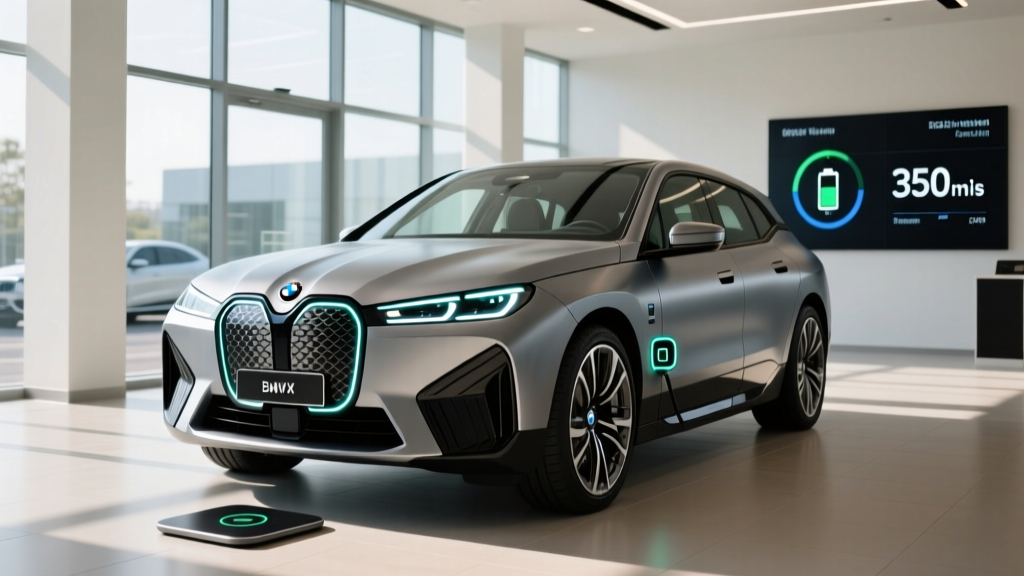
If you're searching for a BMW iX dealer near you, you're likely drawn to BMW's flagship electric SUV for its blend of luxury, technology, and long-range capability. But before you step onto the lot, you need hard numbers — not brochure gloss. This guide breaks down the 2026 BMW iX lineup with the exact range, charging, pricing, and ownership data you need to negotiate with confidence.
The 2026 BMW iX carries over the core architecture introduced in 2022 but with updated pricing, refined software (iDrive 8.5), and continued availability in xDrive50 and M60 trims. It remains one of the most accomplished luxury electric SUVs on the market — but it also sits at a price point where the federal tax credit picture is complicated. Here's everything you need to know.
2026 BMW iX: Key Specs at a Glance
| Spec | iX xDrive50 | iX M60 |
|---|---|---|
| EPA Range | 324 miles | 296 miles |
| Battery (usable) | 105.2 kWh (NMC) | 105.2 kWh (NMC) |
| Max DC Fast Charge | 200 kW | 200 kW |
| 10–80% DC Charge Time | ~34 minutes | ~34 minutes |
| Level 2 Home Charging | 11 kW (~31 mi/hr) | 11 kW (~31 mi/hr) |
| 0–60 mph | 4.4 seconds | 3.6 seconds |
| Horsepower | 516 hp | 610 hp |
| Drivetrain | Dual-motor AWD | Dual-motor AWD |
| MPGe (combined) | 86 MPGe | 78 MPGe |
| kWh/100 mi | 39 kWh | 43 kWh |
| Base MSRP | $87,250 | $111,500 |
| Battery Warranty | 8 yr / 100,000 mi | 8 yr / 100,000 mi |
Sources: EPA fueleconomy.gov, BMW Group PressClub.
Real-World Range: What to Actually Expect
EPA estimated range: 324 miles (xDrive50) / 296 miles (M60)
Real-world highway (70–80 mph, mild weather): Expect ~270–290 miles in the xDrive50 and ~245–265 miles in the M60. The iX is a heavy, aerodynamically challenged SUV at highway speeds, and efficiency drops noticeably above 70 mph.
Cold-weather impact (below 32°F): Plan for a 20–30% range reduction, bringing the xDrive50 down to roughly 225–260 miles. The iX uses a heat pump (standard), which mitigates cabin-heating losses, but battery chemistry still suffers in deep cold. Preconditioning the battery while plugged in is essential to preserve range and charging speed.
City/mixed driving: Closer to EPA or slightly above, thanks to regenerative braking recapturing energy in stop-and-go traffic. Some owners report 330+ miles in mild-weather city loops.
The iX's 105.2 kWh usable battery pack uses NMC (nickel-manganese-cobalt) chemistry, which offers high energy density but is more temperature-sensitive than LFP (lithium iron phosphate). BMW's thermal management system is robust — liquid-cooled with active heating — but physics is physics. If your commute involves sustained 80 mph highway driving in a Minnesota winter, budget for real-world range well below the sticker number.
Charging Speed: DC Fast Charging and Home Setup
Charging speed is where luxury EV buyers often have unrealistic expectations. Here's what the 2026 iX actually delivers:
| Charging Level | Power | Speed (approx.) | Notes |
|---|---|---|---|
| Level 1 (120V outlet) | ~1.4 kW | ~4 miles/hour | Emergency/trickle only; full charge in ~75 hours |
| Level 2 (240V home) | 11 kW (48A) | ~31 miles/hour | Full charge in ~10 hours; ideal overnight |
| DC Fast Charge | Peak 200 kW | 10–80% in ~34 min | Sustains ~150 kW to 50%, tapers significantly above 80% |
Charging curve reality: The 200 kW peak rate only holds briefly at low state of charge (roughly 10–25% SoC). From 25–50%, expect ~150 kW. From 50–80%, the rate drops to 80–100 kW. This means the advertised 34-minute 10–80% time is achievable at a properly rated 200+ kW station (like Electrify America or Tesla Supercharger with NACS adapter), but you'll spend noticeably longer if you routinely charge past 80%.
Home charging setup: The iX accepts up to 11 kW on Level 2, which requires a 48-amp hardwired wallbox on a 60-amp circuit. BMW includes a Flexible Fast Charger with the vehicle (up to 9.6 kW on a NEMA 14-50 outlet). For the full 11 kW, you'll need a dedicated BMW Wallbox or a third-party unit like the ChargePoint Home Flex or Emporia Vue. Expect a home installation cost of $800–$2,500 depending on your electrical panel capacity and run length — more if you need a panel upgrade from 100A to 200A service.
Pricing, Trims, and the Federal Tax Credit Question
The 2026 BMW iX starts at $87,250 for the xDrive50 and climbs to $111,500 for the M60. With popular options — the Dynamic Handling Package, Executive Package (massaging seats, soft-close doors), and 22-inch wheels — an xDrive50 can easily land between $95,000 and $105,000 before destination.
| Trim | Base MSRP | As-Tested Typical | §30D Federal Credit |
|---|---|---|---|
| iX xDrive50 | $87,250 | $95,000–$105,000 | Not eligible (above $80,000 SUV cap) |
| iX M60 | $111,500 | $118,000–$130,000 | Not eligible (above $80,000 SUV cap) |
Under current IRS rules, new electric SUVs must have an MSRP at or below $80,000 to qualify for the up-to-$7,500 federal tax credit. Both iX trims exceed this cap. Additionally, buyers must meet income thresholds ($150,000 single / $300,000 joint AGI) and the vehicle must meet critical-mineral and battery-component sourcing requirements.
The iX does not qualify at any trim level. If the federal credit is a deal-breaker, consider pre-owned iX models (eligible for the up-to-$4,000 used EV credit under §25E if priced at or below $25,000 — though finding an iX at that price is unlikely) or look at alternatives below the MSRP cap.
Always verify current rules at IRS.gov before purchasing.
Interior Space, Tech, and What It's Like to Live With
The iX is a midsize luxury SUV, roughly comparable to a BMW X5 in footprint but with a dedicated EV platform that frees up interior volume.
Cargo space: 35.5 cubic feet behind the second row, expanding to 77.9 cubic feet with the rear seats folded. There is no front trunk (frunk) — the space under the hood houses power electronics and the HVAC system.
Passenger room: Front legroom is 40.2 inches; rear legroom is 38.5 inches. The flat floor (no transmission tunnel) makes the rear middle seat genuinely usable for adults. Headroom is generous thanks to the tall roofline.
Infotainment: BMW iDrive 8.5 runs on a curved display panel — a 14.9-inch touchscreen merged with a 12.3-inch instrument cluster. Wireless Apple CarPlay and Android Auto are standard. The system supports over-the-air updates, and navigation includes EV-aware route planning with automatic charging stop integration.
Driver assistance: The iX comes with Active Driving Assistant Professional, which includes adaptive cruise control with stop-and-go, lane centering, and automatic emergency braking. This is an SAE Level 2 system — the driver must remain attentive with hands on or near the wheel at all times. BMW's Highway Assistant (available in the Driving Assistance Professional Package) allows hands-off driving at speeds up to 85 mph on divided highways, but requires eyes-on supervision confirmed by a driver-monitoring camera. It is not autonomous driving.
Standout feature: The iX's cabin materials and noise isolation are among the best in the EV segment. The available Shy Tech interior (fabric-wrapped surfaces with hidden capacitive controls) and Bowers & Wilkins Diamond Surround Sound create a genuinely premium environment that rivals Mercedes and outpaces Tesla on perceived quality.
Pros and Cons: The Honest Assessment
- Class-leading ride comfort and cabin quietness
- 324-mile EPA range (xDrive50) is competitive with rivals
- 200 kW DC fast charging is quick for a 105+ kWh pack
- Spacious, premium interior with genuine five-seat usability
- Standard heat pump for cold-weather efficiency
- Strong real-world regenerative braking with adaptive modes
- 8-year/100,000-mile battery warranty
- Does NOT qualify for the $7,500 federal tax credit (MSRP above cap)
- No front trunk (frunk) — lost cargo opportunity
- Polarizing exterior design (large kidney grille, angular rear)
- Heavy at ~5,600 lbs — affects tire wear and handling agility
- Real-world highway range drops to ~270 mi at sustained speed
- Pricey options packages push total cost past $100K quickly
- CCS1 connector standard; NACS adapter required for Tesla Superchargers
BMW iX vs. Key Competitors: Is It Worth Buying?
The iX competes in the luxury midsize electric SUV segment. Here's how it stacks up against the most common cross-shops you'll encounter at a BMW iX dealer:
- vs. Mercedes EQE SUV: The EQE SUV (EPA ~279 mi, ~$78K starting) offers a slightly softer ride but less range and slower DC charging (170 kW peak). The iX wins on range and charging speed; the EQE SUV wins on price and available tax credit eligibility on lower trims.
- vs. Tesla Model X: The Model X (EPA ~335 mi, ~$80K starting) offers more range, access to the Supercharger network natively (NACS), and a frunk. But the iX is significantly quieter, better built, and more comfortable. Build quality and cabin materials are not close.
- vs. Audi Q8 e-tron: The Q8 e-tron (EPA ~285 mi, ~$75K starting) charges faster (peak 170 kW but with a flatter curve) and is eligible for the tax credit on base trims. The iX has more range and a more distinctive interior, but the Audi is the smarter financial play if the credit matters.
- vs. Rivian R1S: The R1S (EPA ~352 mi dual-motor, ~$80K starting) offers three-row seating, genuine off-road capability, and a frunk. The iX is more refined on-road; the R1S is more versatile. Different buyers, different priorities.
Choose the iX if: You prioritize ride comfort, cabin quality, and quietness above all else. You have reliable home Level 2 charging. You drive a midsize SUV today (X5, GLE, Q7 class) and want the electric equivalent without compromise on luxury.
Look elsewhere if: The $7,500 federal tax credit is important to your purchase math. You need three rows. You frequently tow (the iX is rated for only 3,500 lbs). You rely heavily on the Tesla Supercharger network and don't want to deal with a CCS-to-NACS adapter.
Warranty and Long-Term Ownership
BMW backs the iX with its standard new-vehicle warranty of 4 years/50,000 miles, plus an 8-year/100,000-mile battery warranty that covers the high-voltage pack if capacity drops below 70% of its original state of health. The 70% retention threshold is standard for the industry (matching Tesla, Hyundai, and most others), though some competitors like Rivian use a more generous 60% threshold that triggers replacement sooner.
NMC chemistry in the iX's pack has proven durable in early real-world data, with most owners reporting less than 5% degradation after 30,000 miles. However, long-term data beyond 100,000 miles is still limited given the vehicle's 2022 launch. BMW's 8-year warranty provides a reasonable safety net, but replacement cost for the full pack out of warranty is estimated at $18,000–$25,000 based on current parts pricing — a figure worth considering if you plan to own the vehicle past the warranty period.
Maintenance costs are low compared to ICE equivalents: no oil changes, no transmission fluid, and brake pads last significantly longer thanks to regenerative braking. BMW includes 3 years/36,000 miles of complimentary scheduled maintenance.
Frequently Asked Questions
What is the real-world range of the BMW iX?
The EPA rates the xDrive50 at 324 miles and the M60 at 296 miles. In real-world highway driving at 70–80 mph in mild weather, expect roughly 270–290 miles (xDrive50) or 245–265 miles (M60). In cold weather below freezing, plan for 225–260 miles due to battery chemistry limitations and increased cabin heating demands, even with the standard heat pump.
How fast does the BMW iX charge at home and on the road?
At home on a 240V Level 2 charger (48 amps), the iX charges at up to 11 kW, adding roughly 31 miles of range per hour — a full charge takes about 10 hours overnight. On DC fast chargers, it peaks at 200 kW and can go from 10% to 80% in approximately 34 minutes, though the charge rate tapers significantly above 50% state of charge.
Does the BMW iX qualify for the federal EV tax credit?
No. Under current IRS §30D rules, new electric SUVs must have an MSRP at or below $80,000 to qualify. The iX xDrive50 starts at $87,250 and the M60 at $111,500, so neither trim is eligible for the up-to-$7,500 credit regardless of buyer income or battery sourcing. Verify current rules at IRS.gov.
Is the BMW iX worth buying over the Tesla Model X or Mercedes EQE SUV?
The iX wins on cabin quality, ride comfort, and noise isolation. The Tesla Model X offers more range, a frunk, and native Supercharger access at a lower starting price. The Mercedes EQE SUV is slightly cheaper and may qualify for the tax credit on base trims, but offers less range. If luxury feel and quietness are your top priorities, the iX is the strongest choice in the segment.
What are the biggest drawbacks of the BMW iX?
The most significant drawbacks are the lack of federal tax credit eligibility (adding $7,500 to effective cost vs. competitors), the absence of a front trunk, the polarizing exterior styling, and the vehicle's 5,600-pound weight, which accelerates tire wear. Options packages also push the transaction price well past $100,000 quickly.
What connector does the BMW iX use for charging?
The 2026 iX uses the CCS1 connector for DC fast charging and J1772 for Level 2 AC charging. BMW offers a NACS adapter for accessing Tesla Supercharger stations, which significantly expands the available fast-charging network. Confirm adapter availability and compatibility with your dealer at purchase.
Editorial note: Pricing, tax credit rules, and specifications reflect 2026 model-year data available at time of publication. Federal and state incentives change frequently. Always confirm eligibility with a tax professional and verify specs with your local BMW iX dealer before purchase. Safety ratings and additional data available at NHTSA.gov and IIHS.org.